Refinancing in Community Property States: Mortgage Guidelines
Refinancing in a community property state can be tricky, especially if only one spouse wants to get the new mortgage. In community property states, the spouse not applying for the loan is not automatically a borrower. However, community property laws affect which debts matter, whose credit is checked, how debt-to-income is figured, and which spouse must sign mortgage or title papers.
If you live in a community property state, check your marital status, finances, property details, and loan type before deciding to leave your spouse off the mortgage application.
The biggest differences appear in FHA, VA, USDA, and conventional refinance loans. Because of community property laws, lenders may have to count some of the non-borrowing spouse’s debts. Conventional loans might treat this differently, but state property rights, ownership, shared debts, and signing rules still apply.
What States Are Community Property States
As of August 2026, the nine standard community property states of the IRS are Arizona, California, Idaho, Louisiana, Nevada, New Mexico, Texas, Washington, and Wisconsin. Some places have special community-property rules.
If you have a unique ownership setup or a marital property agreement, do not just rely on the standard state list. Instead, have your situation reviewed by an expert.
Community property laws usually define how property, income, and certain debts acquired during the marriage are classified. The main point is that in a community property state, your spouse’s debts can still affect your mortgage approval, even if they don’t sign the new loan.
Community Property Rules Are Not the Same in Every State
In community property states, not all assets or debts are treated the same. State law decides if a debt is community debt, separate debt, or tied to the property of one or both spouses. The IRS knows there are important differences in how community-property areas handle debts and property. Mortgage lenders must interpret loan program requirements alongside applicable state law.
Why Community Property Laws Are Important for a Mortgage Refinance
Refinancing replaces your old mortgage with a new one. Even if you already own your home, the new loan must still meet all the lender’s requirements. Marital status becomes especially important when one spouse is left off the refinance application.For example, one spouse might have good credit, steady income, and little debt, while the other has big car loans, credit card debt, student loans, or court judgments. Depending on the loan type and state law, some of these debts could still affect your application.
A non-borrowing spouse is not automatically a co-borrower. Many people are confused by this rule. A non-borrowing spouse is not financially obligated on the mortgage note.
It is incorrect to assume that marriage or residence in a community property state automatically makes a spouse a borrower. In a Community Property state, HUD’s current guidance on FHA lending confirms that the borrower’s spouse need not be a borrower or co-signer, though both the mortgage and the property would still have to comply with legal requirements. This rule is confirmed by the HUD’s FHA FAQ, which was most recently updated in July of 2026.
Spouse Debt and Spouse Credit Score Are Two Separate Issues
Borrowers often ask, “If my spouse isn’t on the mortgage, why does the lender check their credit?” Lenders check to find any debts that might count as community property, even if your spouse is not a borrower. Your spouse’s credit score might not be used to qualify, but their debts could still be counted. This is more so for FHA/USDA financing and lending.
Can You Get a Refinance Without Your Spouse in a Community Property State?
In many situations, yes, you can. In many situations, the answer is yes. A married person can refinance if they meet the required credit, income, asset, property, and underwriting rules.
Learn 2026 refinancing community property states guidelines for FHA, VA, USDA, and conventional loans, including spouse debt, DTI, divorce, and cash-out rules.
However, financial and legal issues about the spouse remain, even if the spouse is left off the loan application. This includes whether the spouse has an interest in the property, whether state community property laws require inclusion of the spouse’s debts, and whether the spouse must sign the mortgage, deed of trust, or other security papers.
Does the Non-Borrowing Spouse Have to Sign the Mortgage?
Possibly, but not every document. It is a common misconception that the non-borrowing spouse must always sign the note or the Closing Disclosure.
Many people wrongly think the non-borrowing spouse must always sign the note or Closing Disclosure; this is not true. must sign the security document.
A spouse or domestic partner may need to sign the security document if state law requires the spouse or domestic partner to waive property rights in the marriage or domestic partnership. Signing a security document to accept or give up a property right is not the same as signing the mortgage note and being personally responsible for the mortgage.
Does a Non-Borrowing Spouse’s Debt Count When You Refinance?
That answer varies by the mortgage program and state law. A main issue with refinancing in community property states is that a spouse’s monthly debts can push the borrower’s debt-to-income ratio too high. Let’s say one spouse applies for the loan alone. But the other spouse has a large car payment and a lot of credit card debt.
Some government loans may require counting the spouse’s debts, even if their income isn’t used to qualify. All these factors can tip the scales in determining whether your refinance is approved.
They can affect whether the debt must be considered and whether a legitimate reason exists to exclude it in accordance with the relevant guidelines and state laws. This is why it is a good idea to talk to a mortgage expert rather than relying solely on online DTI calculators.
FHA Refinance Community Property States
FHA refinancing deserves particular attention, as HUD sets specific rules regarding non-borrowing spouses in community property states. A spouse does not automatically become an FHA borrower or co-borrower. However, FHA rules could require the lender to find the non-borrowing spouse’s debts as a community obligation. (HUD Answers)
FHA Guidelines on Non-Borrowing Spouse’s Debt
If a spouse’s debt is relevant as a community obligation under State law, the lender must include it when qualifying the borrower for FHA financing. This is especially important if you want to qualify on your own, but your spouse has a lot of monthly debt. FHA has specific guidance on the obligations of a non-borrowing spouse. For example, HUD says that in a community property state, collections belonging to a non-borrowing spouse can be included in the collection account analysis.
Does FHA Consider the Non-Borrowing Spouse’s Credit Score?
Looking at the credit history of the non-borrowing spouse for the purpose of identifying community property debts does not in itself make that spouse an FHA borrower. The lender has to distinguish between using the credit score for borrowing and reviewing credit history to fulfill the community property debt requirement. This difference is important, especially if you have good credit, but your spouse’s credit history is not as strong.
Property Rules
An FHA cash-out refinance has additional requirements for accessing home equity. Ownership and occupancy of the home, payment history, loan-to-value ratio, and spouse’s property rights can all be significant. Do not assume that leaving your spouse off the loan application means they will not be involved in the rest of the process.
Married Borrowers
An FHA Streamline Refinance is less complex than a fully underwritten FHA cash-out or standard FHA refinance. Eligible borrowers may benefit from reduced underwriting, though requirements such as title, ownership, borrower eligibility, and state laws are still assessed. To provide an accurate assessment, it is important to identify the specific FHA refinance product being considered, not just whether the current mortgage is FHA.
VA Refinance Guidelines in Community Property States
Veterans and eligible borrowers may have two options for a VA refinance. These options are the VA cash-out refinance and the VA Interest Rate Reduction Refinance Loan. VA describes a cash-out refinance as an opportunity for eligible borrowers to refinance and access home equity. An IRRRL is a VA-to-VA refinance that serves a primary purpose of refinancing to a lower rate or to offer a refinance benefit.
VA Cash-Out Refinance With a Non-Borrowing Spouse
A VA cash-out refinance entails a consideration of the pertinent VA underwriting standards. When the Veteran is married, and community property laws are in effect, the lender must consider the relevant obligations, the spouse’s interests in the marital community, the property and occupancy, and the issues of title. To avoid delays, tell your loan officer your marital status early in the process instead of waiting until title or underwriting.
VA IRRRL in a Community Property State
A VA IRRRL cannot be used as a regular cash-out refinance. For the most part, it will be used only to refinance a VA-guaranteed loan. VA also permits borrowers to receive a sample showing how the refinance will affect them, along with recoupment information. Even though IRRRLs and cash-out refinances are both under the VA, the IRRRL Underwriting Guidelines will have more flexibility than a cash-out refinance.
USDA Refinance Guidelines in Community Property States
USDA has the most up-to-date agency language regarding non-purchasing spouses living in community property states. The current USDA HB-1-3555 instructs lenders to treat community property laws as they would any other lending laws if either the loan applicant or the property is in a community property state. USDA states that the non-purchasing spouse’s credit history is not a basis for a loan denial. Nonetheless, the lender must obtain the non-purchasing spouse’s credit report outside GUS and include the spouse’s debts in GUS as required by state law. This difference can determine whether your loan is approved.
USDA Non-Borrowing Spouse Debt Calculates DTI
As for USDA, debts of non-purchasing spouses must be included in GUS if state law requires their inclusion. According to the current Chapter 10 guidance, USDA instructs lenders to keep the documentation of the spouse’s debt (when state law allows to omit the debt) if that spouse’s debt is subject to GUS. Therefore, a loan may be secured by USDA for only one spouse, while the other spouse’s debts may be included in the family’s debt burden calculation.
USDA Implements Recognizing Property Community Jurisdictions
Current Chapter 10 for USDA underwriting includes Arizona, California, Guam, Idaho, Louisiana, Nevada, New Mexico, Puerto Rico, Texas, Washington, and Wisconsin, and also advises lenders that this list is non-exhaustive and that jurisdictional rules may apply differently. In this case, mortgage program guidelines and the standard nine-state list are not interchangeable.
Conventional Refinance Guidelines in Community Property States
Conventional refinancing may offer advantages when one spouse has significant debt, as conventional underwriting differs from the FHA, VA, and USDA non-borrowing-spouse guidelines.
It Would Not Be Accurate to State That:
- “Conventional loans disregard the other spouse.”
- This is not accurate.
- The lender is still obligated to recognize the actual borrower and non-joint debts, jointly held debts, property ownership, mortgage and title obligations, and other state-law considerations.
- Current Fannie Mae guidelines require lenders to obtain a complete picture of a borrower’s regular obligations and provide specific rules on when certain obligations may be allowed to be omitted.
Why Conventional Refinancing May Be Favorable When a Spouse Carries Significant Debt
If the borrowing spouse has considerable qualifying income and has low debt, and the non-borrowing spouse has high personal debt, it may be the case that a conventional refinance may result in a more favorable DTI calculation when compared to financing through FHA, VA, or USDA, based on the structure of the debts and agency guidelines. This does not mean conventional, but that doesn’t mean conventional loans are always the best fit. mortgage insurance, credit score, equity, occupancy, loan amount, reserves, and property type. Also assess cash-out requirements and overall qualification.
Requirements for Non-Borrowing Spouse on Conventional Refinances
A non-borrowing spouse may still need to sign the security document if the law requires it. Fannie Mae points out the difference between ownership (or legal possession) and who actually pays the note.
Start Refinancing In Community Property States
Apply Online And Get recommendations From Loan ExpertsRate-and-Term Versus Cash-Out Refinancing in Community Property States
Why your reWhy your reason for refinancing is important.r looking to improve the rate or terms of a mortgage. The purpose of the refinance is important. Enter a different range of requirements than a borrower looking to extract equity from the home. Fannie Mae, for instance, has different requirements for limited cash-out and cash-out refinance transactions. Their cash-out refinancing guidance includes seasoning and ownership requirements in addition to the typical borrower requirements.
Cash-Out Refinancing Requires More Scrutiny
Cash-out refinancing may involve additional considerations, such as home ownership duration, subordinate liens, intended use of equity, and state-specific requirements. Community property rights may also affect your refinance if you want the new loan in your name only.
Texas Cash-Out Refinancing Has Unique Considerations
Texas requires separate consideration because its home equity laws affect cash-out refinancing independently of standard agency guidelines.
Fannie Mae warns lenders that a transaction may be classified as cash-out or limited cash-out under their guidelines, while Texas statutes may classify the transaction differently.
It is the lender’s responsibility to determine if the transaction would fall under Texas Constitution Section 50(a)(6). If you own a home in Texas, make sure your refinance is reviewed under Texas-specific rules, not just general community property guidelines.
Refinancing During or After Divorce in a Community Property State
Divorce is one of the most common scenarios where community property and mortgage refinancing intersect. Sometimes, one spouse wants to keep the house, buy out the other’s share, or update the mortgage after a property settlement. A divorce decree does not change a spouse’s mortgage obligation or remove them as a borrower. If both spouses signed the promissory note, the lender’s rights will remain until the mortgage is settled, refinanced, repaid, or modified.
Can You Refinance Before a Divorce Is Final?
The old advice that you “can’t refinance until the divorce is final” is often too simplistic. To determine if a refinance can close during a pending divorce, the ownership structure, mortgage program and type, title, agreements between the spouses, court orders, applicable state laws, the lender(s), and the intended use of the property must be considered. The mortgage professional must work with the spouse seeking the refinance, the title company, and, if applicable, the spouse’s divorce attorney.
Refinancing to Buy Out an Ex-Spouse’s Equity
A divorce buyout need not be viewed as an ordinary cash-out refinance. Fannie Mae permits a refinance when several conditions are satisfied, in which the purchase of another owner’s interest (in this case, an equity buyout of the spouse) is treated as a limited cash-out refinance. Keep in mind that the property must generally have been jointly owned for at least 12 months prior to the disbursement of the new loan, the parties must have a written agreement describing the transfer and use of the proceeds, and the borrower seeking sole ownership must have sufficient income to qualify for the mortgage. It is important to set up the loan correctly during a divorce.
Effects of Non-Borrowing Spouse Debt on DTI
Let’s assume a hypothetical situation. Take, for example, a borrower with a monthly gross income of $9,000. The borrower also has monthly personal obligations equal to $1,200. The borrower also proposes a new monthly housing expense of $2,700. Once again, the total debt this borrower would be liable for, for the purposes of this example, is $3,900. Now, let’s assume that the Non-Borrowing Spouse has debts equal to $1,000 per month.
These debts must be included for the purpose of the applicable mortgage program and Community Property. Now, the total debts that would be incurred for qualifying purposes would equal $4,900.
This is a significant enough difference to change an Automated Underwriting System (AU) decision. Extra debt could cause the system to deny your loan or push you over the DTI limit. The loan should be properly structured before underwriting.y State? The required documentation depends on the specific mortgage program and the borrower’s individual situation. There are no requirements that every refinance applicant provide the same two years of tax returns.
Documentation Required for a Mortgage in Community Property States
A lender might request standard documentation to verify income, assets, credit, insurance, mortgage, property, and marital status. Additional documentation may also be required to cover the non-borrowing spouse’s credit, a marriage/separation agreement, a divorce decree, a property settlement agreement, title(s), certain indebtedness, or a confirmation of the exclusion of an obligation. Self-employed individuals, wage employees, retirees, Veterans, individuals on disability, and users of alternative-documentation mortgage programs may have different documentation needs.
Refinancing Community Property States
If you’re considering refinancing your home and live in a community property state, you may have questions about how the process works. Refinancing a mortgage in these states has unique guidelines that affect married couples and their finances.
If you aim to reduce your rate, modify your terms, or withdraw cash, it’s crucial to recognize how community property laws influence the procedure. This guide will break it all down in simple, borrower-friendly terms.
A community property state operates under regulations that consider most assets and debts obtained during a marriage as jointly owned by both partners. This suggests that assets, income, and even debts are viewed as jointly owned by both partners, regardless of who produced or obtained them. At present, the following states qualify as community property states:
Why Does Refinancing Work Differently in Community Property States?
When you refinance in a community property state, your spouse’s financial situation matters—even if they’re not on the mortgage. Lenders consider your combined marital debt to calculate your debt-to-income (DTI) ratio. This rule applies to government-backed loans like FHA, VA, and USDA mortgages but doesn’t apply to conventional loans. Let’s dive into what this means for your refinancing options.
Refinancing Guidelines for Community Property States
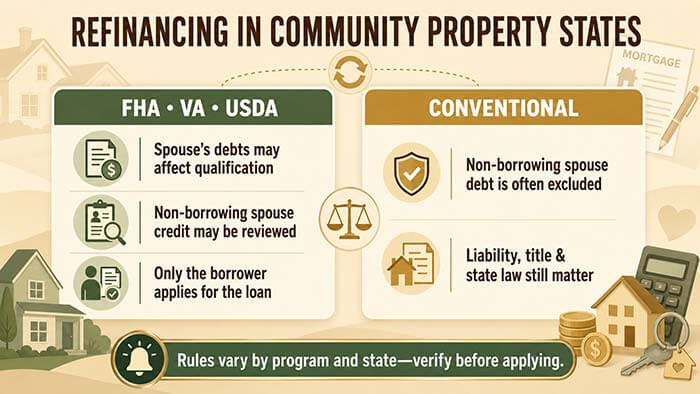
Government-Backed Loans (FHA, VA, USDA)
When using a government-backed loan to refinance in a community property state, lenders will consider:
- Both spouses’ debts, even if only one spouse is applying for the mortgage.
- Both credit reports state that the loan can proceed in one spouse’s name if they meet the income and credit requirements.
For Example:
- If you’re refinancing with an FHA loan, the lender will pull your credit and your spouse’s credit to calculate your DTI ratio.
- However, only the applying spouse’s credit score will affect the loan terms.
- VA loans work similarly, but they require the borrowing spouse to be eligible for VA benefits.
Key Tip: If your spouse has significant debt or a low credit score, refinancing with a government loan in a community property state could complicate matters.
Conventional Loans
If you’re refinancing with a conventional loan, only the applying spouse’s credit and debt are considered.
This Can Be a Major Advantage in Community Property States if Your Spouse Has Poor Credit or High Debt. However, Keep in Mind:
- Even with a conventional loan, both spouses must sign certain documents, such as the closing disclosure and title paperwork.
Key Tip: If you’re refinancing after a divorce, ensure the divorce is finalized before starting the process. In community property states, you typically can’t remove a spouse from the mortgage or title until the divorce is legally completed.
What Happens If You’re Divorced or Divorcing?
Refinancing after a divorce is common, especially when one spouse wants to keep the home. Here’s how it works:
- Finalize the Divorce: In community property states, you cannot refinance or remove a spouse from the mortgage until the divorce is finalized.
- Buy Out Your Spouse: If one spouse wants to keep the home, they may need to refinance to pay the other spouse their share of the equity.
- Sign Off on Title: Both spouses must sign the necessary title documents, even if one is no longer on the mortgage.
Key Tip: Work closely with your lender and attorney to navigate refinancing during or after a divorce.
What is the Best Refinance Program When Your Spouse Carries High Debt?
The answer depends on individual circumstances. If your spouse has a lot of debt, a conventional refinance might work better for you. FHA could be the answer if your credit score is lower. VA loans often offer great terms for those who qualify, and USDA loans are a good fit for rural homeowners. Choosing which option is best depends on the borrower’s qualifications, such as credit score, income, debt-to-income (DTI) ratio, equity, existing mortgage, the property, the refinance objective, state law, spousal obligations, and the results of either automated or manual underwriting. There is no single rule for choosing the right mortgage.
How to Start the Refinancing Process
Getting started is simple when you know what to expect. Here’s what you’ll need to gather:
- Current Mortgage Statement: This helps your lender see the terms of your existing loan.
- Pay Stubs (Last 30 Days): Proof of current income is essential.
- Tax Returns (Last Two Years): These verify your income history.
- W-2s or 1099s: Depending on your employment type, you’ll need these documents.
- Driver’s License: To verify your identity.
- Homeowners Insurance Policy: Proof of coverage is required.
Take the Next Step Today
Refinancing in a community property state doesn’t have to be complicated. By understanding how community property laws affect your loan and working with the right lender, you can confidently achieve your financial goals. Contact us today to learn more and get started on your refinancing journey!
How Gustan Cho Associates Can Assist Community Property State Refinancing
Community property state mortgage files rarely stem from borrower ineligibility. Difficulties with community property state mortgage files rarely stem from borrower ineligibility. More often, challenges arise from selecting the wrong loan program, failing to analyze spousal debt before underwriting, or identifying title and marital property issues too late.
Refinance scenarios can be assessed prior to loan structuring. This ensures that borrowers know how various loan programs, including FHA, VA, USDA, and conventional loans, as well as other option programs, might address their specific needs.
This is particularly important for borrowers with high debt-to-income ratios, a non-borrowing spouse with significant debt, divorce or mortgage buyouts, prior credit issues, or previous loan denials. If one lender says no, it does not mean that every loan program will. While we offer multiple solutions, loan approval cannot be guaranteed, as each program has its own requirements. With access to government loans, conventional mortgages, and non-QM options, we’ll work to find the best solution for your unique situation. Call us at (800) 900-8569 or gcho@gustancho.com. Our team is available 7 days a week to answer your questions and get you started.
Frequently Asked Questions About Refinancing in Community Property States
Can I Refinance My Mortgage Without My Spouse in a Community Property State?
According to the law, yes. Your spouse is not required to be a co-borrower on the new mortgage. But your spouse may be required to sign the new mortgage, or may have their interests, debts, or rights addressed in it, depending on the lending program and applicable law. FHA states that a spouse from a community property state is not required to be a borrower or co-signer.
Does My Spouse’s Debt Count If I Refinance in My Name Only?
It may. State community property rules will govern how FHA, USDA, VA, and other conventional lending programs will treat the non-borrowing spouse’s debts. USDA has stated that the non-purchasing spouse’s debts must be accounted for, per state law.
Will a Lender Pull My Spouse’s Credit If My Spouse is Not on the Mortgage?
In certain lending programs and community property scenarios, the spouse may need to provide their credit information so the lender can assess all of the spouse’s debts. In applicable community property situations, USDA will require the lender to obtain the non-purchasing spouse’s credit report outside GUS.
Can My Spouse’s Low Credit Score Cause My FHA Refinance to Be Denied?
No. A non-borrowing spouse’s score cannot be treated as the same as the borrower’s qualifying score. However, the spouse’s debts, collection accounts, judgments, and other obligations may be considered in an FHA refinance, as well as the community property provision.
Does My Spouse Have to Sign the Refinance If They Are Not on the Loan?
It can depend on a few things, such as who owns the property and the laws in your state. A spouse that is not borrowing could sign the mortgage or the deed to the trust to either acknowledge or waive their property rights, though they would not sign the promissory note. If you follow Fannie Mae regulations, they also state that, if applicable state laws exist, a spouse must sign the security instrument.
Can I Remove My Spouse from the Mortgage By Refinancing?
Yes, refinancing can be used to take the mortgage that both spouses are responsible for and turn it into an individual mortgage, as long as one spouse qualifies. The spouse who remains would need to qualify for the new mortgage. Issues relating to property ownership and title would also need to be resolved.
Is a Divorce Buyout Automatically a Cash-Out Refinance?
No. At this time, Fannie Mae has said that refinancing to buy out a spouse to whom you are now divorced, or to settle a similar property division, can be considered a limited cash-out refinancing if other requirements are met.
Is an FHA or a Conventional Loan Better When My Spouse Has High Debt?
Neither would be considered better. FHA financing may assist borrowers with other credit issues or who have trouble qualifying, while Conventional lending may allow for better outcomes when the non-borrowing spouse has a high debt level. The lender should consider both options and run the complete scenario under both options.
How Do Community Property Laws Affect Refinancing?
When refinancing in community property states, lenders may consider both spouses’ debts, even if only one spouse is applying for the mortgage. This rule mostly applies to government-backed loans like FHA, VA, and USDA.
Can I Refinance Without My Spouse in Community Property States?
Yes, you can refinance in only one spouse’s name, but with government loans, the other spouse’s debts are still factored into the debt-to-income (DTI) ratio. Both spouses must also sign certain documents during the process.
What Types of Loans are Better for Refinancing in Community Property States?
A conventional loan may be better if your spouse has a low credit score or high debt because it only considers the applying spouse’s credit and debt, unlike government-backed loans.
Do I Need My Spouse’s Permission to Refinance?
Yes, in community property states, both spouses must sign off on certain documents, like the title and closing disclosure, even if only one spouse is on the loan.
How Do Community Property Laws Affect Refinancing After a Divorce?
You can only refinance or remove a spouse from the mortgage once the divorce is finalized. Afterward, refinancing is common to buy out the other spouse’s share of equity.
Can I Remove My Spouse from the Mortgage in Community Property States?
Yes, but only after the divorce is finalized. Refinancing is typically required to remove a spouse from the mortgage and title.
What Documents do I Need to Start the Refinancing Process?
You’ll need documents such as your current mortgage statement, the last 30 days of pay stubs, tax returns for the past two years, W-2s or 1099s, a driver’s license, and proof of homeowners insurance.
What are the Most Common Reasons to Refinance?
Borrowers refinance to lower interest rates, shorten loan terms, take cash out, switch from FHA to conventional loans, or remove a borrower due to divorce or other circumstances.
Why is Refinancing in Community Property States More Complex?
Community property laws consider both spouses’ debts and assets, making the process more detailed. This is especially true for government-backed loans, where both spouses’ financial situations impact approval.
This Guide About “Refinancing Community Property States Mortgage Guidelines” Was Updated on August 10, 2026.