How do you avoid mistakes when refinancing?
To avoid mistakes when refinancing, compare the proposed loan to your existing mortgage rather than chasing the lowest advertised rate. Review the new interest rate, APR, closing costs, loan term, monthly payment, mortgage insurance, and total interest. Calculate how long it will take to recover the refinancing costs and consider how long you expect to keep the home. A refinance should support a clear financial goal and improve your overall position—not simply lower one part of your payment.
What Does Refinancing a Mortgage Actually Change?
Refinancing replaces your current mortgage with a new loan. It does not simply change the interest rate. The new mortgage may affect your loan balance, repayment term, monthly payment, mortgage insurance, home equity, and total borrowing cost. Understanding each change can help you avoid mistakes when refinancing.
Your Mortgage Balance
Your new loan balance may be different from the amount you currently owe. It could increase if you:
- Take cash out of your home
- Finance the allowable closing costs into the loan
- Pay off a second mortgage or other debt
- Add certain prepaid expenses or escrow funds when permitted
A higher loan balance may reduce your equity and increase the total interest paid over time.
Your Interest Rate
A lower rate may reduce your monthly principal and interest payment, but the advertised rate does not tell the whole story. Compare the interest rate, APR, discount points, lender credits, and closing costs. A very low rate may require substantial upfront fees.
Your Loan Term
You may replace your remaining mortgage term with a new 15-, 20-, or 30-year loan. Starting another 30-year term can lower the payment, but it may extend the repayment period and increase the total interest over time. A shorter term may save on interest but result in a higher monthly payment.
Your Monthly Payment
Your new payment may change due to the rate, balance, term, mortgage insurance, property taxes, and homeowners’ insurance. Compare both the principal-and-interest payment and the estimated total monthly payment. A lower monthly payment does not automatically mean the refinance will save money overall.
Your Mortgage Insurance
Refinancing may add, remove, or change mortgage insurance. A homeowner with enough equity can refinance from an FHA loan to a conventional loan, potentially eliminating private mortgage insurance. However, eligibility depends on factors such as the appraised value, loan-to-value ratio, credit profile, and current program requirements.
Your Equity Position
A rate-and-term refinance may have a limited effect on equity, while a cash-out refinance converts part of the homeowner’s equity into a larger mortgage balance. A lower-than-expected appraisal may also increase the loan-to-value ratio, change pricing, reduce available cash, or affect approval.
Your Closing Costs
Refinancing typically involves lender charges, title fees, appraisal costs, recording fees, prepaid interest, and other expenses. A “no-closing-cost” refinance is generally not free. The lender may cover some costs through a higher interest rate, or eligible costs may be added to the loan balance. Before moving forward, compare the proposed loan side by side with your current mortgage. The best refinance is not necessarily the one with the lowest rate or payment. It is the one that supports your financial goal after accounting for costs, equity, repayment time, and long-term interest.
12 Mistakes to Avoid When Refinancing
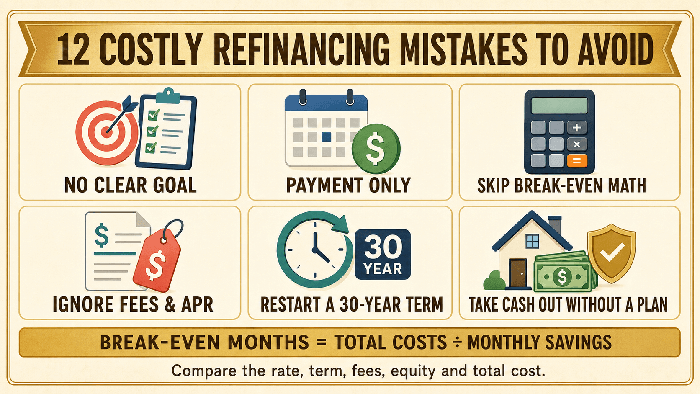
Refinancing can lower your payment, change your loan terms, or provide access to home equity. However, a lower advertised rate does not guarantee meaningful savings. To avoid mistakes when refinancing, compare the proposed loan to your existing mortgage, calculate the short- and long-term costs, and ensure the new loan supports a clear financial goal.
Mistake 1: Refinancing Without a Clear Financial Goal
Before requesting loan offers, decide what you want the refinance to accomplish. Common goals include:
- Lowering the monthly mortgage payment
- Shortening the repayment term
- Removing or reducing mortgage insurance
- Transitioning from an adjustable-rate mortgage to a fixed-rate mortgage.
- Switching from one mortgage program to another
- Removing a borrower from the mortgage
- Accessing equity through a cash-out refinance
Each goal requires a different comparison. For example, refinancing into a shorter term may increase the monthly payment while reducing total interest. A cash-out refinance may provide needed funds, but it also increases the amount secured by the home.
Mistake 2: Looking Only at the New Monthly Payment
A reduced monthly payment might appear attractive, but it doesn’t necessarily mean the new loan is cheaper. Suppose you have 20 years remaining on your current mortgage and refinance the balance into a new 30-year loan. The longer term could lower your payment, even if the improvement in the interest rate is modest. However, you may make payments for an additional 10 years, resulting in more total interest. Compare the new payment, total borrowing cost, payoff date, and interest over the period you expect to keep the loan.
Mistake 3: Failing to Calculate the Break-Even Point
The break-even point indicates the time required for the monthly savings to offset the refinancing expenses. Break-even months = total refinance costs ÷ monthly savings
Example
Assume a homeowner would pay $4,800 in refinancing costs and save $200 per month: $4,800 ÷ $200 = 24 months The homeowner would need to keep the new mortgage for approximately two years to recover the refinancing costs through monthly savings. If the homeowner expects to sell, move, or refinance again before then, the transaction may not produce the expected benefit. This is a simplified example for educational purposes. A complete analysis may also consider changes in the loan balance, mortgage insurance, term, tax consequences, and total interest.
Mistake 4: Comparing Interest Rates Without Comparing Fees
Two lenders may advertise the same interest rate while charging very different fees. Likewise, the offer with the lowest rate may require the most money at closing. Compare each Loan Estimate for:
- Interest rate
- Annual percentage rate, or APR
- Discount points
- Origination charges
- Lender credits
- Third-party closing costs
- Estimated cash to close
- Rate-lock period
- Total monthly payment
Discount points generally allow a borrower to pay more upfront for a lower rate. Lender credits commonly reduce upfront costs in exchange for a higher rate. Ask for options with and without points or lender credits so you can compare costs over the time you expect to keep the mortgage. The CFPB explains how points and lender credits affect upfront and long-term costs.
Mistake 5: Believing a “No-Closing-Cost” Refinance Is Free
A no-closing-cost refinance generally does not eliminate the cost of obtaining the loan. Instead, the costs may be covered by:
- A lender credit tied to a higher interest rate
- Financing eligible costs into the new loan balance
- A combination of lender credits and financed costs
A higher rate can increase the monthly payment and interest expense. Adding costs to the loan increases the amount owed and reduces equity. Compare the no-closing-cost option with one that requires upfront costs but offers a lower rate.
Mistake 6: Extending the Loan Term Without Comparing Total Interest
Compare the remaining term of your current mortgage with the full term of the proposed loan. Replacing a mortgage with 18 years remaining with a new 30-year mortgage could extend the repayment schedule. Ask the lender to provide alternatives that more closely match the remaining term, such as a 15-, 20-, or 25-year loan when available. A shorter term often produces a higher payment, but it may reduce total interest and help rebuild equity faster.
Mistake 7: Taking Cash Out Without a Repayment Plan
A cash-out refinance converts part of your home equity into a larger mortgage balance. Using the funds to pay off credit cards can lower monthly payments, but it turns unsecured debt into secured debt against your home. If the spending that caused the credit-card balances continues, you could end up with a larger mortgage and new revolving debt. Before closing, identify how the funds will be used, how the new payment fits your budget, and how you will prevent the paid-off balances from returning.
Mistake 8: Applying Before Reviewing Credit and Equity
Review your credit reports, current mortgage balance, and estimated property value before applying. Do not rely on promises that one action will increase your credit score by a specific number of points. Score changes depend on the scoring model and the complete credit profile. Refinance eligibility and pricing may be affected by:
- Credit history and credit scores
- Property value
- Loan-to-value ratio
- Available equity
- Owner-occupied, second-home, or investment-property status
- Rate-and-term or cash-out loan purpose
- Debt-to-income ratio
- Mortgage program and lender requirements
Correct genuine credit-report errors, but avoid making major financial changes without first discussing how they could affect underwriting.
Mistake 9: Assuming the Appraisal Will Support the Expected Value
Online estimates and recent neighborhood sales can provide a starting point, but they do not guarantee the appraised value. The appraiser evaluates the property and analyzes appropriate comparable sales. A lower-than-expected appraisal can:
- Increase the loan-to-value ratio
- Reduce the available cash-out proceeds
- Change the interest rate or loan pricing
- Add or affect mortgage insurance
- Require the borrower to bring more money to closing
- Make the proposed loan ineligible
Use a conservative estimate when projecting refinance results. Also, ask what happens to any appraisal or application fees if the value does not support the transaction.
Mistake 10: Choosing an ARM Without Reviewing the Adjustment Risk
An adjustable-rate mortgage, or ARM, may offer an initial rate lower than that of a fixed-rate loan. However, the payment can change after the initial fixed period. Before choosing an ARM, review:
- The length of the initial fixed-rate period
- How often can the rate be adjusted
- The index used to calculate adjustments
- The lender’s margin
- Initial, periodic, and lifetime adjustment caps
- The highest possible rate
- The worst-case monthly payment
Do not assume you will be able to sell or refinance before the first adjustment. Your plans, property value, income, credit, and market rates could change. The CFPB recommends examining an ARM’s worst-case scenario when comparing offers.
Mistake 11: Comparing Offers Issued on Different Days
Mortgage rates can change daily—and sometimes during the same day. One lender’s offer may appear better simply because it was issued under different market conditions. Whenever possible, request Loan Estimates for the same:
- Loan type and purpose
- Loan amount and term
- Property value and occupancy
- Rate-lock period
- Discount-point structure
- Day and approximate time
Also, check whether each quoted rate is locked. An unlocked rate may change before closing. Comparing similar Loan Estimates issued under similar conditions provides a more meaningful side-by-side review.
Mistake 12: Refinancing Too Soon or Too Often
Repeatedly refinancing can create new closing costs and continually restart the amortization schedule. During the early years of many mortgages, a larger share of each payment goes toward interest. Repeatedly beginning a new long-term loan can slow principal reduction. Some loan programs and transaction types may also have payment history, seasoning, or net tangible benefit requirements. These rules are not identical across every program. Before refinancing again, review:
- Costs paid on the previous refinance
- Time since the current loan closed
- Program-specific eligibility requirements
- New break-even period
- Expected time in the home
- Change in the payoff date
- Total interest under both loans
Refinancing should improve your overall financial position or achieve an important goal. It should not be based solely on an advertised rate or a small reduction in the monthly payment.
How to Compare Two Refinance Loan Estimates
To avoid mistakes when refinancing, compare two Loan Estimates side by side rather than choosing a lender based solely on the advertised interest rate. Before reviewing the numbers, confirm that both estimates use the same loan amount, loan type, repayment term, property value, occupancy, discount points, and rate-lock period. Rates can change daily, so request both estimates on the same day whenever possible.
Compare the Interest Rate and Monthly Payments
Begin with Page 1 of each Loan Estimate. Review:
- Interest rate
- Monthly principal and interest
- Mortgage insurance, if applicable
- Estimated taxes, insurance, and assessments
- Estimated total monthly payment
A lower principal-and-interest payment does not always mean the loan is less expensive. The lender may have extended the repayment term, added costs to the balance, or charged discount points for the lower rate. Compare the proposed payoff date with the remaining term of your existing mortgage. Property taxes and homeowners’ insurance are generally not controlled by the lender. If these estimates differ considerably, ask why. Do not assume the lender showing the lowest estimated taxes or insurance offers the better mortgage.
Refinancing Your Mortgage? Avoid the Costly Mistakes First
A refinance can save money—but only if the numbers make sense. Get a clear review of your rate, closing costs, break-even point, loan term, and long-term savings before you commit.
Compare Upfront Lender Costs
Compare the charges that can vary among lenders. Pay close attention to:
- Section A: Origination Charges
- Section B: Services You Cannot Shop For
- Section D: Total Loan Costs
- Section J: Lender Credits
Origination charges may include underwriting, processing, application, rate lock, and other fees. One lender may divide these charges into several line items, while another may combine them. Compare the total rather than the number of fees. Also, determine whether either offer includes discount points. Points require more money upfront in exchange for a lower interest rate. Lender credits work in the opposite direction: they reduce closing costs but may come with a higher rate. Ask each lender to show comparable options with the same points or lender-credit structure.
Review the Estimated Cash to Close
Estimated cash to close is the amount the borrower may need to provide at closing. However, it should not be confused with the total cost of the loan. For a refinance, this amount can be affected by:
- Whether closing costs are paid up front or added to the loan
- The payoff amount on the current mortgage
- Prepaid interest
- New escrow deposits
- An expected refund from the existing escrow account
- Cash received in a cash-out refinance
- Lender credits
An offer requiring less cash at closing is not automatically less expensive. The lender may have added costs to the new mortgage balance or provided a credit in exchange for a higher rate. Ask each lender to explain how the cash-to-close figure was calculated.
Calculate the Five-Year Borrowing Cost
Page 3 contains a Comparisons section with an “In 5 years” calculation. The first number estimates the total amount paid during the first five years, including principal. The second shows how much principal would be paid off during that period. Use this formula: Five-year borrowing cost = total paid in five years − principal paid in five years
Example
Suppose Loan A shows:
- Total paid in five years: $126,000
- Principal paid in five years: $28,000
$126,000 − $28,000 = $98,000 five-year borrowing cost Loan B shows:
- Total paid in five years: $122,000
- Principal paid in five years: $25,000
$122,000 − $25,000 = $97,000 five-year borrowing cost Although Loan A pays down more principal, Loan B has the lower estimated five-year cost in this example. The borrower must decide whether faster equity growth, lower upfront costs, a different term, or another feature makes one offer more suitable. The CFPB recommends using this calculation because it combines interest and fees over a meaningful comparison period. For an adjustable-rate mortgage, however, the five-year figure assumes the rate remains unchanged. Actual costs could be higher if the rate adjusts upward.
Ask Each Lender to Explain the Differences
After completing the comparison, ask both lenders:
- Is the interest rate locked, and when does the lock expire?
- Are discount points included?
- How much are the total origination charges?
- Why do the lender credits differ?
- Were any costs added to the new loan balance?
- How does the new term compare with my remaining term?
- What would I pay over the period I expect to keep the loan?
- Can you offer the same loan without points or lender credits?
The best refinance offer is not always the one with the lowest rate, payment, or cash-to-close. It is the loan that provides the best combination of upfront costs, monthly affordability, equity retention, repayment time, and borrowing cost for the homeowner’s specific goal. The CFPB Loan Estimate Explainer and CFPB loan-comparison guidance provide additional help reviewing these figures.
Rate-and-Term Versus Cash-Out Refinancing Mistakes
Rate-and-term and cash-out refinances serve different purposes. Understanding the difference can help homeowners avoid mistakes when refinancing and select a loan that supports their financial goals.
Common Rate-and-Term Refinancing Mistakes
A rate-and-term refinance generally replaces the existing mortgage without providing substantial cash back to the borrower. The goal may be to lower the interest rate, reduce the monthly payment, shorten the repayment period, eliminate mortgage insurance, or change the loan program. Common mistakes include:
- Focusing on the lower payment without noticing that the loan term has restarted
- Paying discount points without calculating the break-even period
- Extending a mortgage with 15 or 20 years remaining into a new 30-year loan
- Refinancing to remove mortgage insurance without confirming that the savings justify the closing costs
- Switching loan types without comparing mortgage insurance, fees, and long-term interest rates
- Assuming a “no-closing-cost” refinance is free
A rate-and-term refinance should be compared with the existing mortgage based on the new balance, closing costs, remaining term, monthly savings, payoff date, and total interest—not the interest rate alone.
Common Cash-Out Refinancing Mistakes
A cash-out refinance replaces the current mortgage with a larger loan and allows the homeowner to receive part of the difference in cash. It may be used for home improvements, debt consolidation, education, business expenses, or other financial needs. The risks can be greater because the transaction reduces available equity and increases the debt secured by the home. Common mistakes when refinancing include:
- Borrowing more than necessary simply because the equity is available
- Using home equity to eliminate credit card debt without changing the spending habits that created the balances
- Converting unsecured debt into mortgage debt secured by the home
- Ignoring the higher rate or pricing adjustments that may apply to cash-out transactions
- Failing to account for the larger payment and loan balance
- Leaving too little equity for emergencies, a future sale, or declining property values
- Using cash-out proceeds without a specific repayment or investment plan
Paying off high-interest debt through a cash-out refinance may lower combined monthly payments, but it can also spread short-term debt over a much longer period. The borrower could pay more total interest and place the home at risk if the new mortgage payment becomes unaffordable.
Compare the Loan With Its Intended Purpose
For a rate-and-term refinance, ask whether the savings justify the costs and whether the new term improves the homeowner’s overall position. For a cash-out refinance, also ask whether the purpose of the funds is worth reducing equity and increasing the mortgage balance. Before proceeding with either option, compare:
- Current and proposed loan balances
- Existing and new repayment terms
- Interest rate and APR
- Closing costs and discount points
- Monthly and lifetime interest costs
- Break-even period
- Equity remaining after closing
- Expected time in the home
- Reason for refinancing
A rate-and-term refinance is usually evaluated primarily for savings or improved loan terms. A cash-out refinance must also be evaluated as a new borrowing decision. Neither option should be chosen solely because it reduces a single payment or makes cash available.
When Refinancing May Not Make Sense
Refinancing can be helpful, but a lower advertised rate does not always produce real savings. To avoid mistakes when refinancing, compare the proposed loan with your current mortgage, future plans, available equity, and cash reserves before moving forward.
The Break-Even Period Is Too Long
Calculate how many months of savings it will take to recover the refinancing costs: Break-even period = total refinancing costs ÷ monthly savings If you expect to sell the home, move, or refinance again before reaching the break-even point, the refinance may cost more than it saves.
The New Loan Increases Your Lifetime Costs
A new 30-year mortgage can lower your monthly payment by extending the time you have to repay the loan. However, restarting the loan term could increase total interest and delay the payoff date. This may make sense if it accomplishes an important goal, such as making the payment affordable or replacing a risky adjustable-rate mortgage. Otherwise, the short-term payment reduction may not justify the long-term cost.
Your Existing Interest Rate Is Significantly Lower
If your current mortgage has a much lower rate than today’s available rates, replacing the entire loan may be expensive. This is especially important when considering cash-out refinancing. Depending on the homeowner’s goals and qualifications, a home equity loan or a home equity line of credit might permit the original mortgage to stay active. Compare rates, payments, fees, repayment terms, and total costs before choosing an option.
Refinancing Would Drain Your Emergency Savings
Paying closing costs upfront can help avoid increasing the loan balance, but it should not leave you without adequate cash reserves. Home repairs, medical bills, income interruptions, and other emergencies can arise after closing. If refinancing would use most of your available savings, consider whether lender credits, a different loan structure, or waiting would better protect your finances. Remember that lender credits may come with a higher interest rate.
The Appraisal Produces an Unfavorable LTV
The loan-to-value ratio, or LTV, compares the mortgage amount with the property’s appraised value. A lower-than-expected appraisal can produce a higher LTV than anticipated. That higher LTV could:
- Reduce the amount available through a cash-out refinance
- Change the interest rate or loan pricing
- Add or increase mortgage insurance
- Require more money at closing
- Make the proposed refinance ineligible
Review the revised Loan Estimate carefully, rather than accepting less favorable terms simply because the appraisal has already been completed.
Cash-Out Proceeds Do Not Have a Disciplined Purpose
A cash-out refinance reduces equity and increases the debt secured by the home. Using the proceeds without a clear plan can turn short-term spending into mortgage debt that may take decades to repay. Before taking cash out, decide exactly how much is needed, how the funds will be used, and whether the financial benefit justifies the added balance, interest, and risk. If the proceeds will pay off credit cards, the plan should also address the spending patterns that created those balances. Refinancing may not make sense when its costs, risks, or extended repayment period outweigh its benefits. The right decision depends on more than the new rate or monthly payment. It should improve the homeowner’s overall financial position or accomplish a meaningful goal.
Refinance Comparison Example
The following illustration is hypothetical and is provided for educational purposes only. It is not a loan offer or a promise of savings. Actual rates, payments, fees, property values, and qualification requirements will vary. Assume a homeowner has a $280,000 mortgage balance, a 7.25% fixed interest rate, and 22 years remaining. The current monthly principal-and-interest payment is approximately $2,125. The homeowner receives two refinance options:
- A new 30-year fixed mortgage at 6.25%
- A new 20-year fixed mortgage at 6.00%
- Estimated closing costs of $6,000, paid upfront
Taxes, homeowners’ insurance, mortgage insurance, and HOA dues are excluded to keep the comparison focused on principal and interest.
Option 1: Restart With a New 30-Year Mortgage
The new 30-year loan would reduce the principal-and-interest payment to approximately $1,724 per month. That produces estimated monthly savings of: $2,125 − $1,724 = $401 The estimated break-even period would be: $6,000 ÷ $401 = approximately 15 months If the homeowner keeps the new mortgage for more than 15 months, the accumulated savings on payments would begin to exceed the upfront closing costs. However, reaching the break-even point does not automatically mean this is the best long-term option. Over the first five years:
- Existing mortgage interest: approximately $96,276
- New 30-year mortgage interest: approximately $84,785
- Estimated interest reduction: approximately $11,491
- Closing costs: $6,000
After subtracting closing costs, the homeowner’s estimated five-year interest-and-cost advantage would be about $5,491. The tradeoff is slower principal reduction. After five years, the homeowner would owe approximately $261,344 on the new loan, compared with about $248,782 if the existing mortgage remained in place. If both loans were kept until payoff, the remaining interest would be approximately:
- Existing 22-year mortgage: $280,974
- New 30-year mortgage: $340,643, plus closing costs
Restarting with a 30-year term lowers the payment but extends the repayment period by 8 years. This could result in substantially more lifetime interest despite the lower rate.
Option 2: Shorten the Loan to 20 Years
The 20-year refinance would have an estimated principal and interest payment of $2,006 per month. That is approximately $119 less than the current payment. The estimated break-even period would be: $6,000 ÷ $119 = approximately 51 months The homeowner would need to keep the new loan for a little more than four years to recover the closing costs through savings from monthly payments alone. Over the first five years:
- Existing mortgage interest: approximately $96,276
- New 20-year mortgage interest: approximately $78,079
- Estimated interest reduction: approximately $18,197
- Closing costs: $6,000
After accounting for closing costs, the estimated five-year interest-and-cost advantage would be about $12,197. The homeowner would also reduce the principal faster. After five years, the estimated balance would be $237,719, or about $11,063 less than the projected balance on the existing mortgage. If held until payoff, the new 20-year loan would generate approximately $201,442 in interest, plus closing costs. It would also pay off the mortgage two years sooner than the existing loan.
What This Comparison Shows
To avoid mistakes when refinancing, homeowners should compare more than the new rate and payment. In this hypothetical example, restarting with a 30-year loan provides the greatest monthly relief and quickest break-even point. The 20-year option provides smaller monthly savings, faster equity growth, and lower projected interest. The better choice depends on the homeowner’s income, budget, expected time at the property, financial goals, and ability to manage payments. A complete comparison should also consider mortgage insurance, taxes, insurance, whether costs are paid upfront or financed, and any differences in loan features.
Checklist Before Applying for a Refinance
Before applying, use this checklist to organize your information, compare potential costs, and determine whether a new mortgage aligns with your financial goals.
- Review your latest mortgage statement. Confirm the current balance, interest rate, monthly payment, remaining loan term, escrow amount, and any prepayment penalty.
- Check your credit reports. Review your reports for inaccurate balances, unfamiliar accounts, late payments, or other errors. Do not assume that one credit action will raise your score by a specific amount.
- Estimate your property value. Review recent comparable sales and online estimates as a starting point. Remember that the lender’s appraisal or approved valuation may be different.
- Calculate your estimated equity and LTV. Compare the proposed loan amount with the estimated property value. A higher loan-to-value ratio may affect pricing, mortgage insurance, cash-out proceeds, or eligibility.
- Decide how long you expect to keep the home and mortgage. If you plan to sell, move, or refinance again soon, you may not keep the new loan long enough to recover its closing costs.
- Identify one clear refinancing goal. Decide whether you want to lower the payment, shorten the term, remove mortgage insurance, change loan types, remove a borrower, or access equity.
- Calculate the break-even period. Divide the total refinancing costs by the estimated monthly savings. Compare the result with your expected holding period.
- Request written Loan Estimates. Compare offers with the same loan amount, term, loan type, points, and rate-lock period—preferably on the same day.
- Review more than the interest rate. Compare the APR, principal-and-interest payment, mortgage insurance, total monthly payment, lender charges, discount points, lender credits, cash to close, and five-year borrowing cost.
- Compare the new term with the remaining term. Make sure a lower payment is not simply the result of restarting the mortgage with a longer repayment period.
- Protect your cash reserves. Account for closing costs, moving expenses, repairs, income interruptions, and other emergencies. Avoid draining your savings merely to complete the refinance.
- Review the final numbers before committing. If the appraisal, rate, costs, cash-to-close, or loan amount changes, recalculate the expected benefit.
A refinance should improve your overall financial position or accomplish an important goal. Completing this checklist can help you avoid mistakes when refinancing caused by focusing only on an advertised rate or a lower monthly payment.
Final Thoughts: Avoid Refinancing Mistakes With a Clear Plan
A refinance should support a clear financial goal—not simply replace your mortgage because a lower rate or payment sounds appealing. Before deciding, compare your current loan with the proposed refinance, including the balance, term, closing costs, monthly payment, break-even period, equity, and projected interest. This complete review can help you avoid mistakes when refinancing and determine whether refinancing may improve your overall financial position. You do not need to apply immediately to explore your options. Gustan Cho Associates can help you complete a refinance readiness assessment and cost comparison based on your existing mortgage and financial goals. This no-pressure review can show where you stand, what the potential tradeoffs may be, and whether moving forward—or waiting—makes more sense for you.
Frequently Asked Questions About Mistakes When Refinancing
Does Refinancing a Mortgage Hurt Your Credit Score?
Refinancing can cause a temporary change in your credit score because the lender may complete a hard credit inquiry and report a new mortgage account. The specific impact varies based on your complete credit profile. The CFPB states that multiple mortgage inquiries made within a 45-day shopping window are generally treated as one inquiry, although scoring models may use windows ranging from 14 to 45 days.
Do You Really Skip a Mortgage Payment When Refinancing?
No. You may have a month in which no regular payment is due, but the interest is not forgiven. Your closing figures generally account for interest owed on the old mortgage and prepaid interest on the new loan. The later first-payment date changes when you pay, not whether interest is charged.
Can You Refinance with Your Current Mortgage Lender?
Yes. Your current lender may offer a refinance, but staying with the same company does not guarantee the lowest rate or cost. Request comparable Loan Estimates from other lenders and review the rates, points, credits, fees, and loan terms before deciding. The CFPB encourages borrowers to request and compare multiple Loan Estimates.
How Long Does it Take to Refinance a Mortgage?
A mortgage refinance commonly takes approximately 30 to 45 days, but the timeline can vary. Appraisal issues, title problems, missing documents, underwriting questions, rate-lock deadlines, and high lender volume may cause delays. Responding quickly to document requests can help keep the process moving.
What Documents are Commonly Needed for Refinancing?
Depending on the borrower and loan program, a lender may request recent pay stubs, W-2 forms, tax returns, bank or investment statements, homeowners’ insurance information, identification, and a current mortgage statement. Self-employed borrowers or homeowners with nontraditional income may need additional records. Streamline programs may require less documentation, but “streamline” does not mean every borrower qualifies without review.
Can You Cancel a Mortgage Refinance After Signing?
Most refinances secured by a borrower’s principal residence provide a three-business-day right of rescission. This allows the borrower to cancel after signing, subject to federal rules and certain exceptions. Saturdays generally count as business days, while Sundays and federal holidays do not. Follow the cancellation instructions in your closing documents because a phone call alone may not be sufficient.
Are Mortgage Refinance Points Tax-Deductible?
Refinance points are generally not fully deductible in the year they are paid. The IRS typically requires homeowners who qualify for the deduction to deduct the points gradually over the loan’s repayment term. Other refinancing expenses are not automatically deductible. Tax treatment depends on how the property and loan proceeds are used, so consult a qualified tax professional.
Can You Refinance if You have a HELOC or Second Mortgage?
Possibly. The HELOC or second-mortgage lender may need to approve a subordination agreement that allows the new mortgage to remain in first-lien position. If the lienholder refuses, you may need to pay off the HELOC or second mortgage. The balances may also affect your combined loan-to-value ratio and refinance eligibility. The CFPB explains how a HELOC can affect refinancing.
This article about “Mistakes When Refinancing: 12 Costly Traps to Avoid” was updated on July 28th, 2026.
Taking Cash Out? Make Sure It Helps—Not Hurts
Cash-out refinancing can help with debt or home improvements, but it can also increase your balance and reset your loan term. Get a smart cash-out strategy first.