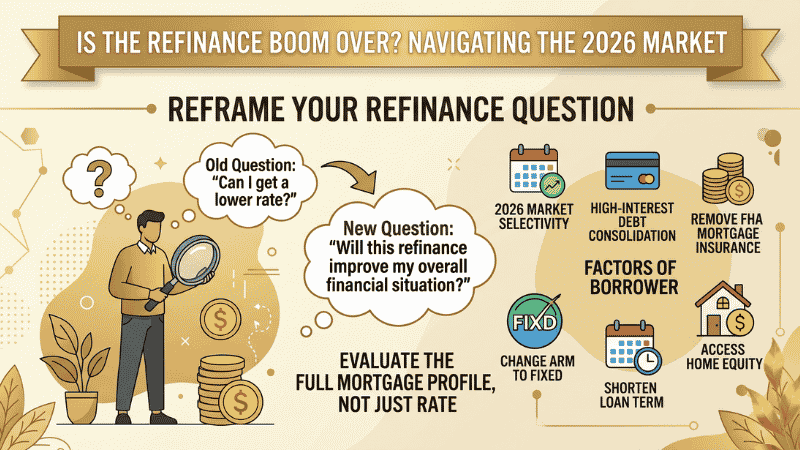
The refinance boom is not completely over, but it is no longer the easy refinance market homeowners saw when mortgage rates were near record lows. In 2026, refinancing is more selective. Many homeowners who locked in low mortgage rates during the past few years may not benefit from replacing their current loan. However, refinancing can still make sense when it solves a real financial problem. Today, homeowners are asking a different question. Instead of only asking, “Can I get a lower rate?” they should ask, “Will this refinance improve my overall financial situation?”
A refinance may still help if it lowers your monthly payment, removes FHA mortgage insurance, consolidates high-interest debt, changes an adjustable-rate mortgage to a fixed-rate loan, shortens the loan term, or allows you to access home equity for a clear purpose.
Higher mortgage rates do not automatically mean refinancing is a bad idea. The right answer depends on your current interest rate, loan balance, home value, credit score, income, debt-to-income ratio, closing costs, and how long you plan to keep the home. A homeowner with a high current rate, strong equity, or expensive monthly debt may still benefit from refinancing even when rates are higher than the record-low years. The key is to compare your current mortgage against the new loan terms. Look at the new payment, closing costs, break-even point, loan term, mortgage insurance, cash-out amount, and long-term savings. Refinancing should not be based on guessing where rates will go next. It should be based on whether the new loan helps you reach a clear financial goal. At Gustan Cho Associates, homeowners can explore various refinance options during the current refinance boom, considering their complete mortgage profile rather than focusing solely on the interest rate. The most suitable refinance option hinges on factors such as the borrower’s credit, income, equity, property type, loan program, payment history, and whether the lender adheres to agency guidelines or imposes additional lender overlays.
What The 2026 Refinance Market Looks Like
In 2026, the refinance market is more selective than it was during the record-low mortgage rate years. The refinance boom is not over yet, but homeowners are no longer refinancing solely because rates are historically low. Today, a refinance needs to solve a specific financial problem. Mortgage rates are still much higher than they were during the peak refinance boom. Freddie Mac reported that the average rate for a 30-year fixed mortgage is 6.51%, while the average rate for a 15-year fixed mortgage is 5.85% as of May 21, 2026. That means many homeowners who already have low mortgage rates may not benefit from replacing their current loan with a higher-rate mortgage. This is one reason many homeowners are “rate locked.” They may want to move, refinance, or access equity, but their current mortgage rate is too low to give up unless the new loan creates a clear benefit. For these homeowners, refinancing may only make sense if it removes mortgage insurance, consolidates high-interest debt, funds necessary home improvements, changes an adjustable-rate mortgage to a fixed-rate loan, or solves a major life event such as divorce.
Refinance activity can still increase quickly when rates dip. Fannie Mae reported that refinance application dollar volume was up 43.8% year over year for the week ending May 15, 2026, even though activity dropped from the prior week. That shows homeowners are still watching rates closely and acting when the numbers make sense.
Cash-out refinances, FHA streamline refinances, VA IRRRLs, USDA streamline refinances, debt consolidation refinances, and rate-and-term refinances can still create activity in 2026. ICE reported that refinances accounted for nearly 40% of fourth-quarter lending, the highest quarterly share since early 2022. The better question is not only, “Is the refinance boom over?” The better question is, “Does refinancing improve my financial position right now?” For some homeowners, the answer will be no. For others, a refinance may still lower total monthly debt, remove mortgage insurance, stabilize payments, or provide access to home equity for a clear and necessary purpose.
Why Mortgage Rates Move Up And Down
Mortgage rates go up and down based on a bunch of factors, like how the economy is doing, inflation, what’s happening in the bond markets, how much investors are interested, and the risk associated with different borrowers. This volatility is especially noticeable during a refinance boom, as rates can change rapidly, often even before the Federal Reserve makes any official adjustments to its benchmark rate. Inflation is one of the biggest drivers of mortgage rates. When inflation goes up, mortgage rates usually go up too because investors want a better return for lending money for a long time. When inflation cools, mortgage rates may improve, depending on the overall economy and investor confidence. The 10-year Treasury yield also affects mortgage rates. Mortgage rates do not move exactly in step with the Federal Reserve rate, but they often follow long-term bond market trends. When Treasury yields rise, mortgage rates often move higher. When yields fall, mortgage rates may improve. Your personal loan profile also matters. A borrower’s credit score, loan-to-value ratio, property type, occupancy, debt-to-income ratio, loan program, and cash-out amount can all affect the final rate. This is why two homeowners can apply on the same day and receive different refinance offers. Homeowners should focus on comparing their existing mortgage to a viable refinance option rather than trying to pinpoint the ideal moment to refinance, especially amid a refinance boom. Key considerations include the new payment amount, closing costs, break-even point, loan term, mortgage insurance, cash-out amount, and the overall long-term financial benefits.
Refinancing Jumbo, Condo, And Non-Traditional Properties
Refinancing a jumbo loan, condo, condotel, second home, investment property, or other non-traditional property can require more documentation than a standard refinance. Lenders usually review the borrower’s credit score, loan-to-value ratio, debt-to-income ratio, income, reserves, occupancy, property type, and overall loan risk. Jumbo refinances often have stricter requirements because the loan amount exceeds the standard conforming loan limit. Borrowers may need stronger credit, more reserves, lower debt ratios, and more equity than they would need for a smaller conventional refinance.
Condo and condotel refinances can also involve extra review. The lender may need to confirm whether the project meets loan program rules, whether the property is used as a primary home, second home, vacation property, or investment property, and whether the building has any issues that could affect approval.
Non-traditional property refinances may also have different pricing and underwriting standards. A rate-and-term refinance may be reviewed differently from a cash-out refinance. A main home usually gets treated differently than a vacation place or a rental. Conventional, FHA, VA, USDA, jumbo, and non-QM lenders may also have different rules. The most effective way to prepare for the refinance boom is to ensure you have comprehensive documentation ready before submitting your application. Having a solid credit profile, a stable income, sufficient reserves, clear information about the property, and a realistic loan-to-value ratio can significantly enhance your chances of approval. For borrowers in this situation, the lowest advertised interest rate isn’t always the top priority. Instead, the more pertinent questions are whether the refinance can be approved and whether the new loan is financially beneficial.
What Happened To HARP And High-LTV Refinance Programs?
HARP is no longer available. The Home Affordable Refinance Program helped many underwater homeowners refinance after the housing crisis, but the program ended in 2018. After HARP ended, Fannie Mae introduced the High LTV Refinance Option for certain homeowners with little equity. Freddie Mac also created the Enhanced Relief Refinance program. These programs were created to help people who were up to date on their mortgage but couldn’t get a regular refinance because their loan amount was too high compared to what their home was worth. However, these high-LTV refinance programs are currently paused or no longer available for most new refinance applications. That means homeowners with little equity may need to consider other refinance options depending on their current loan type. FHA borrowers may qualify for an FHA streamline refinance. VA borrowers may qualify for a VA IRRRL. USDA borrowers may have USDA streamline refinance options. Conventional borrowers may need enough equity for a standard refinance, wait until the property gains more value, or explore non-QM refinance options if they do not meet traditional lending guidelines. The best option depends on the homeowner’s current mortgage, property value, credit profile, payment history, loan program, and refinance goal.
What Homeowners Should Do Before Starting A Refinance
 Before you start refinancing, take a close look at your current mortgage and your overall finances. Check your interest rate, mortgage balance, home value, credit score, monthly debts, and income.
Next, think about why you want to refinance. A rate-and-term refinance can lower your payment, extend your loan term, or convert your loan from a variable-rate to a fixed-rate loan. A cash-out refinance lets you use the value you have built in your home to pay off debt, improve your home, or meet other money goals.
You should also find your break-even point. This lets you see how many months it’ll take for your savings to cover the refinancing costs. If you currently pay mortgage insurance, see if refinancing could help you stop paying it. The best refinance choice considers your entire mortgage situation, not just the interest rate. Compare loan options with a lender who understands the rules and does not add extra conditions.
How To Calculate Your Refinance Break-Even Point
Your refinance break-even point is the time it takes for the money you save each month to cover the costs of refinancing. This is one of the most important numbers homeowners should review before replacing their current mortgage. For example, if refinancing saves you $250 per month and your closing costs are $5,000, your break-even point is 20 months. That means it would take about 20 months of savings to recover the cost of the refinance. If you plan to keep the home longer than the break-even point, refinancing may make sense. If you plan to sell, move, or refinance again before reaching that point, the refinance may not be worth the cost. Homeowners should also look beyond the monthly payment. Refinancing can reset the loan term, increase the total amount owed if closing costs are rolled into the loan, or increase total interest paid over time. A lower payment is helpful, but the full loan picture matters. Before refinancing, compare the new payment, closing costs, break-even point, loan term, mortgage insurance, cash-out amount, and long-term savings. This gives homeowners a clearer answer than looking at the interest rate alone.
Higher Rates Do Not End Every Refinance
A refinance is not always about lowering the rate. Homeowners may refinance to access equity, pay off high-interest debt, or restructure their mortgageWhen Refinancing Can Still Make Sense In A Higher-Rate Market
Refinancing can still make sense in a higher-rate market when the new loan solves a real financial need. A lower interest rate is helpful, but it is not the only reason homeowners refinance.
A refinance may be worth considering if the homeowner currently has a much higher mortgage rate, can remove FHA mortgage insurance, or can qualify for better loan terms after improving credit.
It may also help borrowers consolidate high-interest credit card debt, access cash for home improvements, or move from an adjustable-rate mortgage into a fixed-rate loan. Some homeowners refinance because of life changes. For example, a refinance may be needed to remove an ex-spouse or co-borrower from the mortgage after divorce. Others may refinance to shorten the loan term and pay off the home faster. The key is to compare the current mortgage against the new loan. Homeowners should review the payment, closing costs, break-even point, loan term, equity position, and long-term financial goal before deciding.
When Refinancing May Not Be Worth It
Refinancing is not always the best choice. If the new mortgage rate is higher and there is no strong financial reason to change your current loan, it might not be worth it. Homeowners should watch out for high closing costs that could outweigh any monthly savings. If you plan to sell your home soon, you might not save enough each month to cover refinancing costs. Refinancing can reset your loan term. While this might lower your monthly payment, it could mean paying more interest over time. Be careful with cash-out refinancing. Using your home equity to pay off credit cards might help for now, but it can be risky if you do not address the spending habits that caused the debt. Refinancing might not be a good idea if the new payment is unaffordable, it takes too long to break even, or it does not improve your overall financial situation.
Refinance Options By Mortgage Program
Homeowners may have different refinance options depending on their current loan type, equity, credit score, income, property type, and refinance goal. Some borrowers want to lower their monthly payment. Some people want to ditch mortgage insurance, pull out some cash, shorten their loan term, change from a variable-rate mortgage to a fixed-rate mortgage, or refinance after getting their credit score up.
FHA Streamline Refinance
An FHA streamline refinance may help homeowners who already have an FHA loan. This option usually requires less documentation than a full refinance and may not require a new appraisal. FHA borrowers often use this program to lower their payments or improve their loan terms.
VA IRRRL Refinance
A VA Interest Rate Reduction Refinance Loan, also called a VA IRRRL, may help eligible veterans, active-duty service members, and qualifying surviving spouses who already have a VA loan. This program is often used to lower the rate, reduce the payment, or move from an adjustable-rate VA loan to a fixed-rate VA loan.
USDA Streamline Refinance
USDA borrowers may qualify for a USDA streamline refinance if they currently have a USDA loan and meet program requirements. This option may help eligible rural homeowners lower their payments with a simpler refinance process.
Conventional Refinance
A conventional refinance may help homeowners lower their rate, adjust the loan term, remove private mortgage insurance, or move from an FHA loan into a conventional loan if they have enough equity. Conventional refinances usually depend on credit score, loan-to-value ratio, debt-to-income ratio, income, and property type.
Cash-Out Refinance
A cash-out refinance allows homeowners to replace their current mortgage with a larger new loan and receive part of their home equity as cash. Homeowners may use a cash-out refinance to consolidate debt, finance home improvements, cover major expenses, or achieve other financial goals. However, borrowers should compare the new rate, payment, closing costs, and long-term debt before using home equity.
Jumbo Refinance
A jumbo refinance may be available when the loan amount exceeds conforming loan limits. Jumbo lenders often require stronger credit, more reserves, lower debt-to-income ratios, and more equity than standard conventional loans.
Non-QM Refinance
A non-QM refinance may help borrowers who do not fit traditional lending guidelines. Self-employed borrowers may use bank statement loans to document income. Real estate investors may qualify for DSCR loans based on rental income. Non-QM refinance options can help borrowers with unique income, credit, or property situations, but rates and terms may differ from standard loans. The right refinance program depends on the homeowner’s full mortgage profile. Credit score, income, equity, loan type, occupancy, property type, reserves, debt-to-income ratio, and lender overlays can all affect approval. This is why homeowners should compare refinance options based on the full loan picture, not just the advertised interest rate.
Final Thoughts: Is The Refinance Boom Over?
The refinance boom is not completely over, but it has changed. Homeowners are no longer refinancing simply because mortgage rates are at record lows. In 2026, refinancing needs to have a clear purpose.
For some homeowners, refinancing may not make sense if their current mortgage rate is much lower than today’s available rates. Replacing a low-rate loan with a higher-rate loan can increase the monthly payment and total interest cost unless there is another strong financial benefit.
For others, refinancing can still be a smart move. A refinance may help lower the payment, remove mortgage insurance, consolidate high-interest debt, transition from an adjustable-rate mortgage to a fixed-rate mortgage, shorten the loan term, access home equity, or remove a co-borrower after a major life change. The best refinance decision should be based on the full mortgage picture, not just the interest rate. Homeowners should compare the current loan to the new loan by reviewing monthly payments, closing costs, break-even point, loan term, mortgage insurance, cash-out amount, total debt, and long-term savings. So, is the refinance boom over? The old rate-driven refinance boom is mostly over. But refinance opportunities still exist for homeowners who have a real financial reason to restructure their mortgage. The key is knowing when refinancing improves your situation and when keeping your current loan is the better choice.
FAQs About Whether The Refinance Boom Is Over
Will Mortgage Refinance Rates Go Down in 2026?
Mortgage interest rates can rise or fall depending on inflation, the bond market, economic reports, and investor demand. Some homeowners wait for lower rates, but waiting can be risky because rates can change quickly. The better move is to compare your current mortgage to a real refinance quote and see if the numbers work now.
How Much Lower Should My Rate Be Before I Refinance?
There is no one-size-fits-all rule. Some homeowners may need the new rate to be at least 1% lower to make refinancing worth it, while others may benefit from a smaller drop if the loan also removes mortgage insurance, lowers debt, or improves the loan term. The decision should be based on monthly savings, closing costs, and how long you plan to keep the home.
Can I Refinance Without Starting My Loan Over?
Yes, some homeowners refinance into a shorter term, such as a 15-, 20-, or 25-year loan, instead of starting over with a new 30-year mortgage. This can help avoid stretching the loan too far, but the monthly payment may be higher. The right term depends on income, budget, equity, and long-term goals.
Is It Better To Refinance Or Get A Home Equity Loan?
A refinance replaces your current mortgage with a new loan. A home equity loan or HELOC usually keeps your current first mortgage in place and adds a second loan. If your current mortgage rate is very low, a home equity loan or HELOC may be worth comparing before refinancing the entire balance.
Can I Refinance If My Home Value Drops?
It depends on your loan type, equity, and refinance program. FHA, VA, and USDA borrowers may have more flexible streamline refinance options. Conventional borrowers usually need enough equity for a standard refinance unless another eligible program is available. A lender will review the current loan balance, property value, payment history, and loan program.
Will There Be Another Refinance Boom?
Another refinance boom could occur if mortgage rates fall enough to create a clear savings opportunity for millions of homeowners. However, the next refinance wave may not look like the record-low rate years. Many future refinances may come from homeowners using equity, removing mortgage insurance, consolidating debt, or restructuring loans, rather than just chasing a lower rate.
This article about “Is the Refinance Boom Finally Over in 2026?” was updated on May 26th, 2026.
Related> Refinance Mortgage Lending Guidelines Related> Refinance FAQ