NON-QM Loans For Self-Employed Borrowers: Qualification Guide
This article will cover qualifying for non-QM loans for self-employed borrowers’ home purchases with no income tax returns. In 2026, over thirty million people were self-employed in the United States. That is about 10% percent of the workforce.
Discover the process and documents, including bank statements, 1099s, and other income, required to qualify for NON-QM loans for self-employed borrowers.
Lenders must follow strict and specific guidelines for self-employed borrowers on traditional mortgage loans with traditional income calculations. The biggest hurdle self-employed borrowers face is usually the debt-to-income ratio. This is due to the ability of self-employed borrowers to write off expenses on their income tax returns. In the following paragraphs, we will cover non-Loans for self-employed borrowers.
What Are NON-QM Loans For Self-Employed Borrowers
NON-QM loans for self-employed borrowers are designed for individuals whose income does not meet standard home loan documentation requirements. These loans assist business owners, freelancers, independent contractors, and consultants, especially when tax returns do not reflect their full income due to business expense write-offs.
This approach can be helpful at tax time. While this approach benefits borrowers at tax time, it can create challenges during mortgage applications since lenders focus on net income from tax returns.
NON-QM loans offer a practical alternative, or “no ability to repay”. Mortgage lenders are still required to make a reasonable evaluation and good-faith determination that a borrower can repay the loan, per the federal ability-to-repay rules. Qualified Mortgages offer some legal protections under those rules, while NON-QM loans are just some loans that do not meet the Qualified Mortgage criteria.
Understanding NON-QM Loans
NON-QM loans are distinct because lenders can use various methods to document income and assess repayment ability. These may include bank statements, 1099s, profit and loss statements, or assets, rather than relying solely on tax returns.is not to lower standards, but to help borrowers with real financial strength who do not fit the usual mortgage rules. This approach benefits self-employed borrowers who may not qualify for standard agency loans, as NON-QM loans use a more realistic analysis of income and business cash flow.
Reasons Why Self-Employed Borrowers Find Difficulty with Traditional Mortgage Guidelines
Tax Write-Offs Can Decrease Qualifying Income
A primary reason self-employed borrowers seek NON-QM loans is that standard mortgage underwriting often does not reflect how self-employed income works. Strong gross revenue and healthy business deposits may still result in lower reported income due to tax deductions. This creates a significant gap, as borrowers may appear to earn less on paper than they actually do.
It Can Be More Difficult to Average Irregular Income
Income for self-employed individuals often fluctuates monthly or yearly. Some businesses are seasonal or show growth, while others have stable finances but uneven cash flow. Traditional mortgage underwriting is typically inflexible for variable-income borrowers. The guidelines established by various agencies for analyzing self-employed income are complex and require substantial documentation. To illustrate, Fannie Mae requires lenders to provide a history of income for self-employed borrowers over the previous 2 years, and the self-employed income documentation requirements are specifically outlined in Freddie Mac’s guidelines.
Business Ownership May Increase Time to Close
Borrowers who own a corporation, partnership, S-corp, or LLC must often provide business tax returns, K-1s, balance sheets, and year-to-date financial statements. This process is more complex than for W-2 wage earners, even for financially strong borrowers.
How do Mortgage Underwriters Calculate Self-Employed Income?

With the launch of non-QM loans for self-employed borrowers with no income tax returns, bank statement deposits over the past 12 months can be used to qualify for a mortgage.
Self-employed wage earners can utilize unreimbursed business expenses to offset their gross income. Therefore, the adjusted gross income is low, or in many instances, negative, which disqualifies them to meet the income requirements on traditional mortgages. Non-QM loans for self-employed borrowers are for primary homes, second homes, and investment properties. Gustan Cho Associates has dozens of unique non-QM mortgage loan options for self-employed homebuyers.
Self-Employed and Looking for a Mortgage? NON-QM Loans Are Here to Help!
Reach out today to see how we can help you secure financing for your home.What Are Non-QM Loans For Self-Employed Borrowers
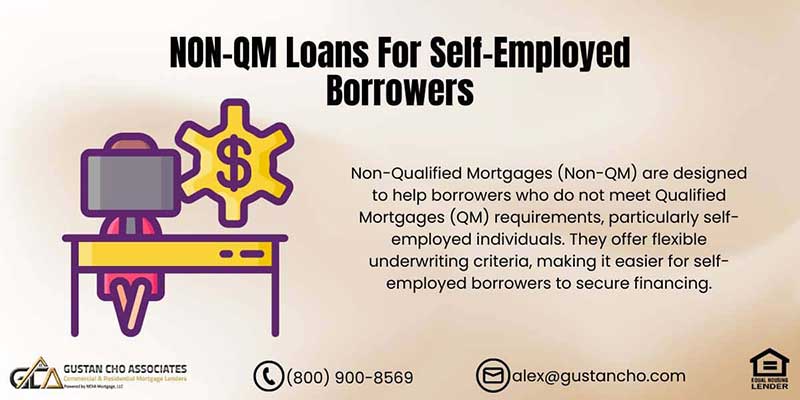
Non-Qualified Mortgages (Non-QM) are designed to help borrowers who do not meet Qualified Mortgages (QM) requirements, particularly self-employed individuals. Non-QM loans offer more flexible underwriting criteria, making it easier for self-employed borrowers to secure financing. Here’s an overview of Non-QM loans for self-employed borrowers, including their benefits, requirements, and considerations:
Key Features of Non-QM Loans for Self-Employed Borrowers
Flexible Income Verification: Bank Statement Loans: Instead of traditional income documentation like tax returns, self-employed borrowers can use 12 to 24 months of personal or business bank statements to demonstrate their income. Profit and Loss Statements: Some lenders may accept profit and loss statements prepared by a certified public accountant (CPA) to verify income. Non-QM loans typically have more lenient credit score requirements than conventional loans. Borrowers with credit scores as low as 580 can sometimes qualify.
Benefits for Self-Employed Borrowers
Easier Qualification: No Tax Returns Needed: Non-QM loans do not require tax returns, which can benefit self-employed borrowers with significant business expenses that reduce their taxable income. Diverse Options: Non-QM loans offer various term options, including fixed and adjustable-rate mortgages, to suit different financial situations and preferences. Higher Loan Amounts: Larger Loans: Non-QM loans can cater to borrowers needing larger loan amounts, often exceeding the conforming loan limits set by Fannie Mae and Freddie Mac.
Considerations and Potential Drawbacks of Non-QM Loans For Self-Employed Borrowers
Higher Interest Rates: Risk Premium: Due to the increased risk associated with less stringent qualification criteria, non-QM loans often have higher interest rates than conventional loans. Larger Down Payments: Down Payment Requirements: Non-QM loans may require a larger down payment, often 20% or more, depending on the lender and the borrower’s overall financial profile. Limited Lender Availability: Specialized Lenders: Not all lenders offer non-QM loans. Borrowers may need to seek out specialized lenders who cater to this market.
Common Types of NON-QM Loans For Self-Employed Borrowers
Bank Statement Loans For Self-Employed Home Buyers
Among the NON-QM loan options available to self-employed individuals, the bank statement loan is a popular choice. Instead of tax returns, lenders review 12 to 24 months of personal or business bank statements to estimate income. write-offs in their tax returns. It’s also great for business owners because tax returns often omit crucial details about monthly cash flow. Some lenders require only business bank statements, while others accept personal statements or a combination, depending on how business income is structured.
Loans With Profit and Loss Statements
Non-QM lenders may accept a current year profit and loss statement instead of, or in addition to, bank statements or other business documents. This benefits borrowers whose current income exceeds what is shown in older tax returns. Borrowers with growing businesses, recent revenue increases, or improved cash flow may benefit from these programs.
1099 Loans For Independent Contractors
Independent contractors, gig workers, and commission-based borrowers may benefit from 1099 loan programs. Lenders may use 1099 income, sometimes adjusted for expenses, instead of requiring full tax returns.
Other NON-QM programs may accept a mixture of alternative documentation when a borrower’s profile is strong but cannot be quantified through a single measurement.
This may benefit real estate agents, truck drivers, consultants, and rideshare drivers. This approach is suitable for real estate agents, truck drivers, consultants, rideshare drivers, salespeople, and others who earn income through 1099 forms rather than W-2s. Individuals may have substantial liquid assets, as well as retirement and other investments. In these situations, an asset depletion approach may help support qualification.
Who Should Think About NON-QM Loans
NON-QM loans may be beneficial for self-employed borrowers, such as:
Business Owners Who Have Significant Tax Deductions
If your business is making a profit but your taxable income appears lower because of business write-offs, a NON-QM loan may be a better indicator of your capacity to repay.
Freelancers and Independent Contractors
Freelancers often have high income but inconsistent documentation by traditional standards. NON-QM programs may offer a more suitable solution.
Borrowers With A Complicated Income Situation
If your income comes from multiple businesses, 1099 work, contracts, or fluctuating deposits, conventional underwriting may be challenging. NON-QM loans can accommodate complex but legitimate income situations. M lender may be able to consider more recent business performance rather than just older tax returns, which would be beneficial for you.
How to Qualify for a Non-QM Loan For Self-Employed Borrowers
Gather Documentation: Bank Statements: Prepare 12 to 24 months of personal or business bank statements to verify your income. Profit and Loss Statements: If applicable, have a CPA prepare profit and loss statements to present to lenders. A mortgage broker can help identify non-QM lenders and guide you through the application process, ensuring you meet all requirement. Credit Management: While Non-QM loans are more flexible, improving your credit score can help secure better terms and lower interest rates.
How Are Debt-To-Income Ratios Calculated on Non-QM Loans For Self-Employed Borrowers

Non-QM lenders may accept higher debt-to-income (DTI) ratios than conventional lenders, recognizing the variable nature of self-employment income.
The deductions can kill your income on paper. The two-year average can be tough to maintain in many cases. Most small businesses take at least three years to generate any profit. All it takes is one not-so-good year, and you could be out of luck.
Requirements For Self-Employed Borrowers Seeking NON-QM Loans
Though NON-QM loan requirements vary by lender and program, most assess the same core risk factors. Considerations for NON-QM Loans.
Credit is important for NON-QM loans, though the criteria may be less stringent than those of traditional programs. Higher credit scores can lead to better pricing, lower down payments, and easier approval.
Although lenders may require more scrutiny, higher reserves, and larger down payments, some borrowers with lower credit scores can still qualify.
Down Payment Requirements on NON-QM Mortgages
Down payment requirements vary based on credit profile, occupancy type, loan amount, and documentation type. As a general rule of thumb, the better the overall file, the more competitive the condition.
Generally, stronger borrower profiles receive more competitive loan terms. NON-QM loans allow debt-to-income rules are more flexible.
Instead of using a single strict formula, some lenders look at the whole financial picture, including reserves, down payment, credit, and the strength of the income documentation. unlimited risk appetite. A lender must be able to demonstrate that a borrower can realistically afford to assume the risk of the payment.
Documents Needed for NON-QM Loans
Required documentation varies by program, but self-employed borrowers typically need to provide the following:
Bank Statements
This may include 12 or 24 months of personal or business bank statements.
Business Documentation
A lender may request a business license, a letter from a CPA, proof of ownership, or any other documents it may require. A lender may request a business license, a CPA letter, proof of ownership, or other documents to verify the business is active and operating. o-date picture of the business’s income.
1099 Forms or Other Income Records
Freelancers and contract workers should include 1099 forms in their application file.
Asset Statements
If reserves or asset depletion are part of the qualification, lenders may review bank, retirement, or investment account statements.
How Lenders Look at Business Income on NON-QM Loans
Lenders offering NON-QM loans to self-employed individuals typically review deposit patterns, business stability, industry, time in business, expense ratio, credit history, and reserves.
They want consistency. Issues SULenders seek consistency. Large unexplained deposits, overdrafts, declining revenue, or missing documents can be cause for concern.
Clean records, stable deposits, and clear business history improve approval chances. Well-organized, complete files are more likely to be approved than messy or incomplete ones.
Case Scenario on How Underwriters Calculate Self-Employed Income
Until recently, with the introduction of NON-QM loans for self-employed borrowers, self-employed borrowers had difficulty qualifying for mortgages. Below is an example case scenario on how mortgage underwriters calculate self-employment income on traditional government and conventional loans. The underwriters will have to use the lower of the two years for borrowers with declining income.
See Below:
Example 1– income in 2016 – $72,000
- Income in 2017 – $60,000
- $60,000 / 12 months = $5,000 monthly income
Example 2– income in 2016 = $60,000
- Income in 2017 = $72,000
Since the income is increasing, a two-year average will be used.
- $60,000 + $72,000 = $132,000
- $132,000 / 24 months = $5500 monthly income
How Does NON-QM Loans For Self-Employed Borrowers Work
The good news is that NON-QM loans for self-employed borrowers are available for these borrowers. Borrowers can use a one-year average! The only catch is borrowers must use the most recent year’s tax return.
These NON-QM loans do not allow for extensions to file taxes. For 2026, borrowers’ IRS returns must be filed before April 15. Filing for the extension is very common.
But will not work for obtaining a mortgage in this case. For self-employed borrowers trying to obtain a mortgage, this program can increase their buying power. The borrower’s business must be in existence for two full years. This will be verified by a business license or with the Secretary of State. A complete 4506-T form will be needed to verify your tax returns with the IRS.
Self-Employed and Ready to Buy a Home? Let’s Talk NON-QM Loans!
Contact us now to find out how we can help you secure the financing you deserve.What Do You Need To Qualify For Non-QM Loans For Self-Employed Borrowers
Owner Occupied and Second Homes:
- 620 – 659 credit score requires a 15% down payment.
- 660 credit score or higher requires 10% down payment.
- 3 months reserves (minimum) (One Month Reserves is one month of PITI).
- 6 months reserves for 2nd homes.
- Seller concessions are allowed at 6%.
Investment Properties:
- 640 credit score or higher requires a 20% down payment.
- 680 credit score or higher requires a 15% down payment.
- Six months of reserves for investment properties.
- 2% seller concessions for investment properties.
How To Qualify For One-Year Tax Returns Non-QM Loans For Self-Employed Borrowers
The process to obtain this loan is very similar to any other mortgage loan. Borrowers will contact a mortgage loan officer at Gustan Cho Associates and provide the following:
- Last 60 Days Bank Statements – to source down payment.
- Last Two Years’ Tax Returns (the only most recent year for income).
- Driver’s License.
- Home Owner’s Insurance Quote.
Next, borrowers will complete an application online, and your pre-approval process will start. Many questions will pop up while doing due diligence and completing research looking for a mortgage. Please contact the NON-QM expert, Gustan Cho at (800) 900-8569 to review your specific scenario. Free one-on-one consultations are available seven days a week!
Advantages of NON-QM Loans For Self-Employed Borrowers
A Better Fit For The Actual Self-Employment Income
The main benefit is that these loans let self-employed borrowers present their actual financial situation, aligning more closely with lender review processes.
More Options for Documenting Financial Info
NON-QM lenders may use bank statements, 1099s, profit and loss statements, and asset statements in addition to tax returns.
A Possibility for Home Ownership That Might Otherwise Be Lost
Some qualified borrowers are declined because their income does not meet agency formulas. For these individuals, NON-QM loans can provide a path to homeownership. Rower Profile: There is a Solution Borrowers with unconventional income who follow a structured process can access more flexible loan options.
The Downsides to NON-QM Mortgages That Borrowers Must Accept
While NON-QM loans are helpful, borrowers should be aware of potential downsides.
Higher Interest Rates
Due to flexible documentation and non-traditional risk factors, these loans often have higher interest rates than conventional loans. Files may be required to put more skin in the game.
Getting a NON-QM Loan
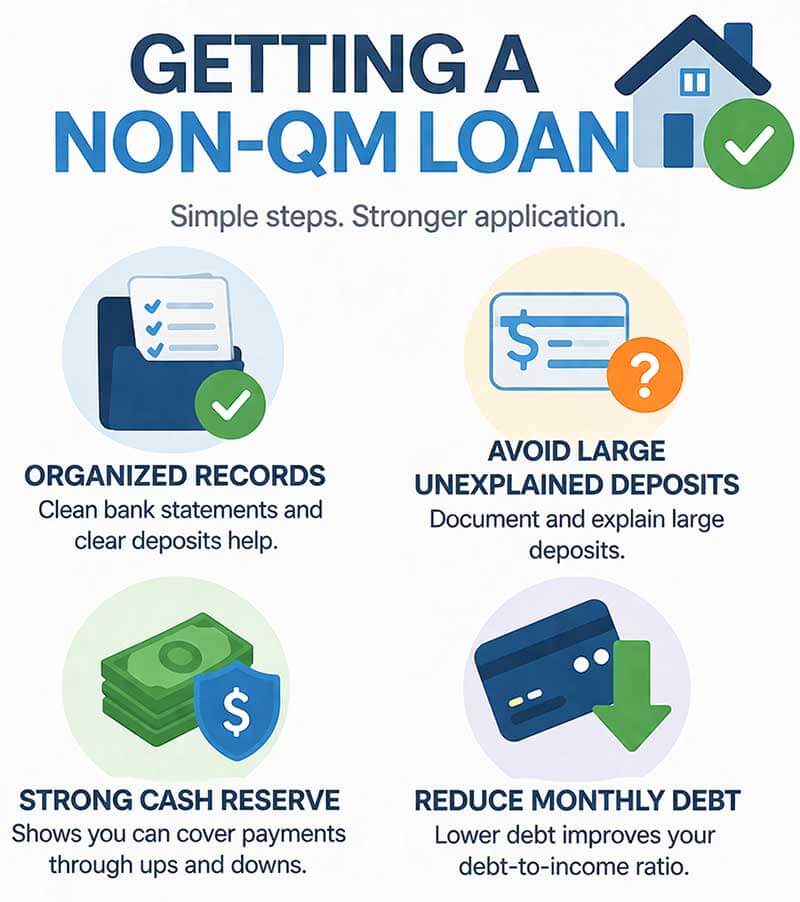 Maintaining organized records, clear deposit patterns, and clean bank statements can significantly aid the underwriting process.
Avoid Large Unexplained Deposits
Documenting transactions and providing explanations for large deposits can expedite the process and increase transparency with your lender.
Create a Strong Cash Reserve
Maintaining cash reserves strengthens your application and demonstrates your ability to make payments even if business income fluctuates.
Reduce Other Monthly Debt
Reducing monthly debt can improve your debt-to-income ratio and support your mortgage application.
Choose Lenders with Experience with Self-Employed Mortgages
Self-employed mortgage files are more complex than those for W-2 employees. Work with a lender experienced in alternative documentation to ensure proper loan structuring from the start.
Self-Employed Borrowers
If tax returns show stable income and agency criteria are met, conventional loans may be the best option and typically offer the most favorable rates. If business tax returns show significant write-offs, ownership is complex, or documentation is not agency-compliant, NON-QM loans are likely more suitable for self-employed borrowers.
Self-Employed Borrowers and Mortgage Guidelines
It’s not a matter of one option beach loan type addresses different needs rather than one being universally better. A NON-QM loan may be appropriate if you are self-employed with high income not fully reflected on tax returns, have inconsistent income, recent business growth, or need documentation that better aligns with cash flow. For some, a NON-QM loan serves as a bridge to homeownership. Later, if tax returns and profiles align with agency guidelines, refinancing to a conventional or government-backed loan may be possible.
Different Lenders Have Different Program Offerings
NON-QM is not agency lending, and program terms can vary widely. Borrowers with lower credit or higher risk may need to make larger down payments. These loans are not easy to get approved for. Borrowers still need to show reliable income, good credit, and provide strong documentation.
Lite Doc Non-QM Loans For Self-Employed Borrowers With Limited Docs Required
Gustan Cho Associates offers the new Lite Doc Non-QM Mortgage Loan Program for borrowers with 720 FICO and 20% down and assets. Borrowers with at least 20% down payment with at least 20% down payment can qualify for the all-new Lite Doc Non-QM Loan Program. No tax returns are required. We can accept a P and L by a CPA, which will be sufficient. For more information, contact Gustan Cho Associates at 800-900-8569 or text us for faster response. Or email us at alex@gustancho.com.
Best Lenders For Non-QM Loans For Self-Employed Borrowers
Alex Carlucci is a senior loan officer with Gustan Cho Associates and a contributing editor for Gustan Cho Associates. Alex Carlucci is also The NON-QM Loan Expert at Gustan Cho Associates. Alex has originated and funded countless non-QM loans for self-employed borrowers.
By exploring Non-QM loans, self-employed borrowers can find flexible financing solutions that accommodate their unique income structures, helping them achieve homeownership despite the limitations of traditional mortgage qualification criteria.
It is important to understand that NON-QM does not mean careless underwriting. Instead, lenders use alternative methods to verify repayment ability. For self-employed borrowers with high income, deposits, and documentation, this flexibility can enable homeownership or refinancing when other options are unavailable. Borrowers considering NON-QM loans should review income documents early, identify programs that fit their business structure, and select a lender experienced in evaluating self-employed income.
Final Thoughts on NON-QM Loans For Self-Employed Borrowers
NON-QM loans offer a valuable solution when traditional underwriting does not accurately reflect a self-employed borrower’s income. These programs are intended for business owners, freelancers, and independent contractors who need flexible documentation. Many of Alex Carlucci’s associates at Gustan Cho Associates go to Alex if they have questions about non-QM loans for self-employed borrowers. Alex Carlucci is available seven days a week, evenings, weekends, and holidays. Any questions on non-QM loans and bank statement mortgage loans for self-employed borrowers, call or text at (800) 900-8569. You can text, Alex for a faster response. Gustan Cho Associates team is available seven days a week, evenings, weekends, and holidays.
FAQs: NON-QM Loans For Self-Employed Borrowers
What Is A NON-QM Loan For Self-Employed Borrowers?
- A NON-QM loan is a mortgage that does not meet the technical definition of a Qualified Mortgage, but the lender still must make a reasonable, good-faith determination that the borrower can repay the loan. These loans are often used by self-employed borrowers whose income is easier to document through bank statements, 1099s, or other alternative methods.
Are NON-QM Loans The Same As Subprime Loans?
- No. A NON-QM loan is not automatically a subprime loan. It is simply a mortgage that falls outside the definition of a Qualified Mortgage. Many NON-QM borrowers have solid income, strong assets, or good credit, but they need flexible documentation because their income does not meet standard agency underwriting criteria.
Can I Get A Mortgage With Bank Statements Instead Of Tax Returns?
- In many cases, yes. Some NON-QM lenders offer bank statement loans that use 12 or 24 months of bank deposits to estimate qualifying income. Program details vary by lender, so the exact method depends on the loan program.
Why Do Self-Employed Borrowers Have A Harder Time Qualifying For Conventional Loans?
- Traditional underwriting for self-employed borrowers can be documentation-heavy and may require detailed analysis of tax returns and business income. Fannie Mae generally requires a two-year history of prior earnings for self-employed borrowers, and both Fannie Mae and Freddie Mac maintain detailed income documentation rules for these files.
Do NON-QM Loans Require A Larger Down Payment?
- Sometimes. The required down payment depends on the lender, credit profile, occupancy, reserves, and how income is documented. A stronger borrower profile may qualify for more favorable terms.
Can I Refinance Out Of A NON-QM Loan Later?
- Yes, in many cases. Some borrowers use a NON-QM loan now and later refinance into a conventional or government-backed loan when tax returns, credit, equity, or market conditions make that move worthwhile.
What are Non-QM Loans for Self-Employed Borrowers?
Non-Qualified Mortgages (Non-QM) are designed to help borrowers who do not meet Qualified Mortgages (QM) requirements, particularly self-employed individuals. They offer flexible underwriting criteria, making it easier for self-employed borrowers to secure financing.
How do Non-QM Loans Work for Self-Employed Borrowers?
Non-QM loans for self-employed borrowers do not require traditional income documentation like tax returns. Instead, lenders may use 12 to 24 months of personal or business bank statements or profit and loss statements prepared by a certified public accountant (CPA) to verify income.
What are the Key Features of Non-QM Loans for Self-Employed Borrowers?
Non-QM loans for self-employed borrowers offer flexible income verification, lenient credit score requirements, and various loan options, including larger loan amounts.
What are the Benefits of Non-QM Loans for Self-Employed Borrowers?
The benefits of non-QM loans for self-employed borrowers include not needing to provide tax returns, which is perfect for individuals with substantial business expenses that lower their taxable income. These loans offer easier qualification processes, flexible terms, and various loan options tailored to different financial situations. They can also accommodate higher loan amounts for those needing larger loans.
What are the Potential Drawbacks of Non-QM Loans for Self-Employed Borrowers?
For self-employed borrowers, non-QM loans come with potential drawbacks, including higher interest rates because of the increased risk compared to conventional loans. They often require larger down payments, typically 20% or more. Additionally, not all lenders offer non-QM loans, meaning borrowers may need to seek specialized lenders.
How are Debt-to-Income Ratios Calculated on Non-QM Loans for Self-Employed Borrowers?
Debt-to-income ratios for self-employed borrowers are calculated using a two-year average based on IRS tax returns. However, due to the variable nature of self-employment income, non-QM lenders may accept higher DTI ratios.
What Documentation is Needed to Qualify for a Non-QM Loan for Self-Employed Borrowers?
You must collect specific documentation to be eligible for a Non-QM loan as a self-employed borrower. This entails obtaining 12 to 24 months of personal or business bank statements and, if applicable, profit and loss statements prepared by a Certified Public Accountant (CPA). Additionally, proof of business existence for two full years is necessary. A 4506-T Form is also required to authenticate tax returns with the IRS.
What Credit Scores and Down Payments are Required for Non-QM Loans?
For non-QM loans, credit score and down payment requirements vary. Still, generally, a credit score of 620-659 requires a 15% down payment, while a credit score of 660 or higher demands a 10% down payment for owner-occupied and second homes. For investment properties, a credit score of 640 or higher requires a 20% down payment, and a credit score of 680 or higher allows for a 15% down payment. Reserves are also needed.
What is the Lite Doc Non-QM Loan Program?
The Lite Doc Non-QM Mortgage Loan Program is available for individuals with a FICO score of 720 and a down payment of 20%. Income verification can be done using a profit and loss statement prepared by a CPA, and tax returns are not required.
Who Can I Contact for More Information?
To apply and get more information, please get in touch with Alex Carlucci at Gustan Cho Associates by calling 800-900-8569 or emailing alex@gustancho.com. They provide complimentary individual consultations every day of the week.