Quick Answer
Want to see what lenders want to see in a borrower? Mortgage approval in 2026 comes down to proof: stable income, manageable debts, acceptable credit patterns, and clean, documented funds for down payment and closing costs. You don’t need perfect credit—you need a consistent recent payment history and a file that matches agency guidelines. The fastest approvals happen when your documents tell a clear story.
What You’ll Learn
- What lenders actually review first (and what they verify later)
- How credit history matters more than a “perfect” score
- What helps if your DTI is high (and what hurts)
- How to document income (W-2, self-employed, gig, variable pay)
- What counts as acceptable funds, and how to avoid “large deposit” issues
- The fastest ways to strengthen your file before you apply
Start Here: Choose Your Path
1) First-time buyer / low down payment → Learn how lenders view 3%–3.5% down options, what reserves matter (and when they don’t), and the documents that speed up approval.
2) Bad credit / recent late payments → See what lenders want after setbacks: how many months of clean history helps most, what to do with collections/charge-offs, and how to avoid last-minute credit mistakes.
3) Self-employed/non-traditional income → Understand what underwriters need to verify your income, how bank statement loans work (Non-QM), and how to prep your deposits, write-offs, and business documents for approval.
What Lenders Check by Loan Type (FHA vs VA vs Conventional vs Non-QM)
FHA Loans
- Credit pattern: Minimum score may start at 580 for 3.5% down (lender rules vary). Underwriters focus heavily on recent payment history (last 12–24 months), how you recovered after late payments, and whether any collections/judgments must be addressed.
- DTI / AUS note: FHA approvals are driven by AUS findings (and sometimes manual underwriting). Higher DTIs can be possible with strong compensating factors (stable income, reserves, clean payment history, low payment shock).
- Reserves note: Not always required, but helpful—especially with higher DTI, borderline credit, or manual underwriting. Cash on hand after closing can strengthen the file.
- Documentation note: Standard FHA docs: W-2s/1099s as applicable, pay stubs, W-2s (if employed), two months bank statements, ID, explanations for credit events, and clear sourcing for down payment/closing funds (gift letter + paper trail if gifted).
VA Loans
- Credit pattern: No “official” VA minimum score, but lenders often have their own. Underwriters look for stable, timely payments and reasonable explanations for past credit events. Late payments right before applying are a bigger deal than old issues you’ve recovered from.
- DTI / AUS note: VA focuses on AUS + residual income and overall risk profile more than a single DTI number. Higher DTI can still work when residual income, job stability, and credit pattern support it.
- Reserves note: Often not required, but reserves can help if the file is tight (higher DTI, variable income, limited credit depth). It also reduces the risk of “close-to-zero” cash.
- Documentation note: In addition to standard income/asset docs, VA requires COE (Certificate of Eligibility) and may request more detail on variable income, large deposits, and any credit explanations.
Conventional Loans (Fannie Mae/Freddie Mac)
- Credit pattern: Many approvals cluster at higher scores, but the bigger driver is overall credit profile: payment history, utilization, depth of credit, and recent inquiries/new accounts. Lenders also closely monitor disputed accounts and recent late payments.
- DTI / AUS note: Conventional is typically AUS-driven (DU/LP). DTI tolerance depends on findings, compensating factors, and risk layering (lower score + high DTI + low reserves = tougher).
- Reserves note: More common than FHA/VA—especially with multi-unit homes, investment properties, higher loan amounts, or tighter files. Showing post-close reserves can improve approval odds and terms.
- Documentation note: Conventional files tend to be strict on income calculation details (bonus/OT/commission averaging, variable pay history), plus clean bank statements with sourced funds and minimal unexplained transfers.
Non-QM Loans (Bank statement, DSCR, asset-based, alternative income)
- Credit pattern: More flexible on scores and past credit events, but lenders still want a recently stable pattern (fewer recent lates, reasonable explanations, and evidence you’ve re-established credit).
- DTI / AUS note: Often no AUS in the agency sense—guidelines are lender-specific. Many Non-QM programs use alternative qualification methods (bank statement income, DSCR ratios, or asset depletion) rather than relying solely on traditional DTI.
- Reserves note: Commonly expected. Non-QM lenders often want months of reserves depending on the program, loan size, property type, and credit profile.
- Documentation note: Documentation is different by product:
- Bank statement loans: 12–24 months personal/business statements + CPA/letter (when required) + business verification
- DSCR investor loans: lease/rent schedule + appraisal rent analysis + reserves
- Asset-based: proof of eligible assets + terms for depletion calculation
- Across all: strong emphasis on consistent deposits, clean paper trail, and clear explanations for anomalies.
Want Fast Mortgage Approval? Here’s What Lenders Look For
Get approved faster by knowing what lenders want to see in your application.
The Mortgage Approval Checklist in 2026
Every loan application differs, but mortgage lenders always look at the same core factors. Here’s what lenders want to see in a borrower before giving the green light.
Credit Score and History
Credit is one of the first things underwriters evaluate. A strong credit profile shows you have a history of borrowing and repaying responsibly.
What lenders want to see in a borrower’s credit report:
- A FICO score that meets the program minimums (580 FHA, 620 Conventional, 640+ for some Non-QM).
- On-time payment history for at least the past 12–24 months.
- A mix of credit accounts (installment loans, revolving credit, auto loans).
- No recent collections, charge-offs, or judgments.
2025 update: FICO 10T and VantageScore 4.0 models weigh recent behavior more heavily. That means even small late payments can hurt more, but positive trends like paying down credit cards are rewarded quickly.
Case Example:
Maria had a 610 credit score due to late payments in 2021. Over the past 18 months, she paid every bill on time, reduced her credit utilization from 90% to 30%, and opened a secured credit card. When she applied in 2025, the lender saw strong progress—exactly what lenders want to see in a borrower after setbacks.
Income and Employment Stability
Lenders want proof of steady income. A high-paying job isn’t enough if it looks unstable.
What lenders want to see in a borrower’s income:
- At least two years of verifiable work history.
- Consistency in the same field, even if jobs change.
- Steady or increasing income year over year.
- For self-employed borrowers: 2 years of tax returns—or 12–24 months of business bank statements for Non-QM loans.
2025 trend: Gig economy income, side hustles, and part-time jobs are more widely accepted if well-documented.
Case Example:
James drives for Uber and delivers for DoorDash part-time, but he’s been consistently earning over $2,500/month for two years. With bank statement proof, his income counted—showing that what lenders want to see in a borrower isn’t just W2s but documented, reliable earnings.
Debt-to-Income Ratio (DTI)
The Debt-to-Income (DTI) ratio shows how much of your income goes toward paying off debts, which is super important for lenders to know. You can go as high as 56.9% for FHA loans if you have solid backup reasons. With conventional loans, the limit is usually lower, around 50%. There’s more wiggle room for VA and USDA loans, but keeping your DTI between 41% and 45% is a good idea.
If your DTI is high, underwriters want other strengths like high credit scores, large reserves, or long rental history.
Case Example:
Anthony had a 55% back-end DTI. This is normally risky, but because he had a 720 credit score, $20,000 in savings, and a 10% down payment, he was approved. That’s what lenders want to see in a borrower with a high DTI—compensating factors that reduce risk.
Assets, Down Payment, and Reserves
Lenders closely examine a borrower’s financial situation, focusing on their assets, particularly the down payment and savings. The down payment shows that the borrower is committed to the investment. Different loan types have different requirements—FHA loans need at least 3.5%. In contrast, VA and USDA loans can skip the down payment, and conventional loans usually ask for around 3%. On top of that, lenders like to see that borrowers have 1 to 2 months’ worth of savings set aside after closing, which adds to their sense of financial stability.
It’s also super important for borrowers to prove where their money is coming from. This means no big, unexplained deposits in their accounts. Being straightforward about this helps lenders better understand how a borrower is doing financially and whether they can manage the mortgage.
Case Example:
Sarah had just enough for a 3.5% FHA down payment. She also showed she had $5,000 left in savings to strengthen her application. That reserve reassured the underwriter because lenders want to see a financial cushion in a borrower.
Rental or Housing History
Past behavior predicts future reliability.
What lenders want to see in a borrower’s rental history:
- 12 months of on-time rent payments.
- Cancelled checks, bank transfers, or verification of rent from a property manager.
- Private landlord verification may be acceptable if well-documented.
Warning: Paying cash to your landlord without receipts usually won’t count.
Bank Account Health
Bank statements provide clear information about a person’s financial situation. They show if someone has problems with overdrafts or if their account balances fluctuate. Lenders prefer to see no overdrafts in the past year and want to easily track the money for a down payment, such as through paychecks or bank transfers. They are also careful about sudden large cash deposits without explanation, as this raises questions about the source of the money.
What Lenders Want to See in a Borrower With Bad Credit
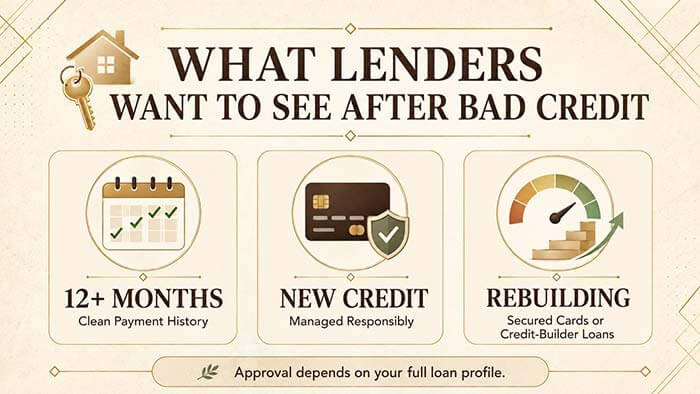
Having bad credit doesn’t necessarily lead to an automatic denial for loans. Lenders often look for signs of recovery in borrowers with a troubled credit history. Key indicators they expect include a consistent record of no late payments following a bankruptcy or foreclosure, new credit accounts that are being maintained in good standing, and at least 12 months of clean credit history.
Additionally, demonstrating active efforts to rebuild credit, such as through the use of secured credit cards or credit-builder loans, can further strengthen a borrower’s position in the eyes of lenders.
For example, David filed for Chapter 7 bankruptcy in 2021. By 2023, he had two secured credit cards and a car loan with a spotless payment history. In 2025, lenders saw progress and approved him for an FHA loan.
Compensating Factors That Strengthen Your Case
Sometimes one weakness can be offset by another strength.
What lenders want to see in a borrower with risk factors:
- High credit scores offset high DTI.
- Large down payment offsets lower income.
- Extra reserves offset limited work history.
- Long-term employment offsets borderline credit.
Tip: If you’re weak in one area, strengthen another before applying.
Common Mistakes That Hurt Approval
Even strong borrowers can trip up. Avoid these:
- Large undocumented deposits in bank accounts.
- Applying for new credit cards before closing.
- Job changes within 30 days of applying.
- Multiple overdrafts within 12 months.
What lenders want to see in a borrower is consistency—not last-minute financial surprises.
Recent Mortgage Lending Changes in 2026
The lending landscape evolves each year.
- Credit scoring: New models weigh recent payment patterns.
- Gig income: More acceptable, but requires documentation.
- Alternative verification: Automated systems speed up approvals by electronically pulling income and asset data.
- Buy Now, Pay Later accounts: Now reported on credit reports and factored into scores.
Why Work With Gustan Cho Associates
Most lenders add overlays—extra rules beyond FHA, VA, USDA, or Conventional guidelines. At Gustan Cho Associates, we don’t.
That means:
- More approvals for borrowers with high DTI or bad credit.
- Faster closings—sometimes in under 30 days.
- Loan officers are available 7 days a week, evenings, weekends, and holidays.
When other lenders say “no,” we often say “yes.”
Ready to Take the Next Step?
If you want expert help understanding what lenders want to see in a borrower and how you can qualify, please contact Gustan Cho Associates at 800-900-8569, text us for a faster response, or email us at alex@gustancho.com. The team at Gustan Cho Associates is available 7 days a week, on evenings, weekends, and holidays.
Conclusion
At the end of the day, what lenders want to see in a borrower is stability, responsibility, and proof that you can manage a mortgage. Whether through strong credit, consistent income, or compensating factors, presenting a complete financial picture helps you get approved faster.
At Gustan Cho Associates, we specialize in helping borrowers who don’t fit the perfect mold. With no overlays and flexible guidelines, we often approve loans that others can’t.
Frequently Asked Questions About What Lenders Want to See in A Borrower:
What Do Mortgage Lenders Look for in a Borrower?
They look for a low-risk borrower: solid recent payment history, stable and verifiable income, a manageable debt-to-income ratio (DTI), and sufficient documented funds for a down payment/closing costs (or eligibility for low- or zero-down programs).
What Credit Score Do I Need to Qualify for a Mortgage in 2026?
It depends on the loan type and your full file (income, DTI, reserves, and recent payment history). Many lenders still rely heavily on FICO® scoring for approvals and pricing, but the “right” score varies by program and lender overlays.
How Important is Payment History vs. Credit Score?
Payment history is often the biggest trust signal. Even if your score is improving, late payments in the most recent 12 months can weigh heavily. In short, what lenders want to see in a borrower is a clean recent trend, not just a higher number.
What is a “Good” DTI for Mortgage Approval?
DTI standards vary by loan type and automated underwriting findings, but many lenders prefer lower DTIs because they support affordability. Some programs allow higher DTIs with strong compensating factors (credit, reserves, stable income).
Can I Get Approved if I have Bad Credit or Late Payments?
Often yes—especially if the late payments are in the past and you’ve re-established on-time payments. What lenders want to see in a borrower with bruised credit is a clear “recovery story”: stabilized income, reduced revolving balances, and no new derogatory activity.
What Do Mortgage Lenders Check on Bank Statements?
They typically review bank statements to confirm you have funds to close, verify the source of your down payment/closing costs, and flag red items like repeated overdrafts or large unexplained deposits that need documentation.
How Much Money Do I Need in Savings (Reserves) After Closing?
Reserve expectations depend on loan type, risk factors, and the property scenario. Even when not required, reserves can strengthen approvals—especially when DTI is higher, income is variable, or credit depth is limited.
Do Lenders Verify Employment and Income Right Before Closing?
Commonly, yes—lenders may re-verify employment and confirm your income documents match what was underwritten. Avoid job changes or pay-structure changes during the mortgage process unless you’ve cleared it with your loan officer.
Can Self-Employed or Gig Workers Qualify for a Mortgage?
Yes. Traditional programs often want consistent history and documentation (tax returns, 1099s, etc.). Some non-traditional options use alternative documentation (such as bank statements) when tax returns don’t accurately reflect cash flow.
What Do Lenders Check by Loan Type (FHA vs VA vs Conventional vs Non-QM)?
In general, Federal Housing Administration and U.S. Department of Veterans Affairs loans may be more flexible on down payments, while Conventional (Fannie Mae/Freddie Mac) loans may be more sensitive to risk layering; Non-QM varies by lender. Across all types, what lenders want to see in a borrower is documented income, acceptable credit patterns, a workable DTI/affordability profile, and sourced funds.
This blog about “What Lenders Want to See in a Borrower for Fast Approval” was updated on February 2nd, 2026.
Increase Your Odds of Fast Mortgage Approval
From credit scores to financial stability, learn what lenders are looking for in borrowers.