
Buying a home is one of the biggest financial decisions most people will ever make, and understanding how your mortgage works is just as important as finding the right house.
When you take out a mortgage, your loan balance does not stay the same until the end of the term. Every month, your mortgage payment goes toward both interest and the principal amount you owe, and that division changes as time goes on. This whole process is known as mortgage amortization.
Understanding mortgage amortization can help you see how your loan balance declines, how equity builds, and how extra payments can reduce the total interest you pay. In this guide, we will explain how amortization works in simple terms and what it means for your long-term mortgage costs.
What Is Mortgage Amortization?
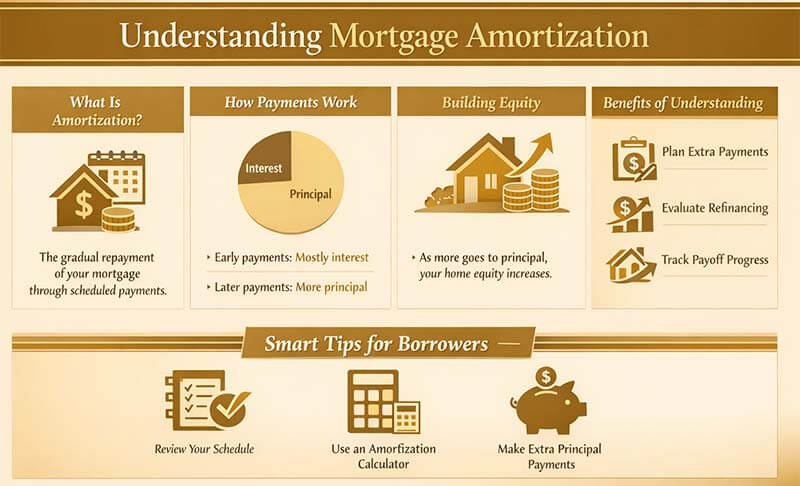
Mortgage amortization is the step-by-step process of paying off your home loan over a set term (like 30 years). Each monthly payment is split between interest (the cost to borrow) and principal (what reduces your balance).
Each payment you make covers two parts:
- Interest – the cost you pay to borrow the money.
- Principal – the amount that actually reduces your loan balance.
Initially, most of your payment goes toward interest because your loan balance is the highest. As your balance gets smaller, you’ll notice that the interest part of your payment shrinks too, which means more of what you pay goes toward paying down the principal.
Think of it like a slow shift — at first, the bank gets most of your payment; later, you’re paying more toward owning your home outright.
How to Read Your Amortization Schedule
Your amortization schedule is a month-by-month map of how your mortgage gets paid off. To understand it, begin with the interest portion of each payment. At the start of the loan, a larger share goes toward interest because your balance is still high. Then look at the principal portion, which gradually increases as the balance falls. Finally, review the remaining loan balance after each payment. This gives you a clearer picture of how fast you are building equity and how extra payments could reduce your payoff timeline.
#1 Money-Saving Move: Pay Extra Principal Early
If you can afford it, make even small principal-only extra payments early in the loan (example: $50–$200/month). Extra principal cuts your balance faster, which reduces future interest charges and can shave years off your mortgage. When you pay extra, note “Apply to principal only” (or “principal curtailment”) so it doesn’t get treated as a prepaid future payment.
How Mortgage Amortization Works
For example, your mortgage lender uses a mathematical formula to spread your payments evenly across your loan term — 15, 20, or 30 years.
Even though you pay the same amount each month (on a fixed-rate loan), the mix of interest vs. principal changes over time.
You borrow $300,000 at a 6% interest rate on a 30-year fixed mortgage.
- Your monthly payment (principal + interest) will be roughly $1,799.
- In your first payment, about $1,500 goes to interest and $299 to principal.
- By year 20, that flips — most of your payment goes to principal instead of interest.
That shift is what we call amortization — your debt “melts away” little by little every month until it’s fully paid off.
Principal vs. Interest: How Your Mortgage Payment Changes Over Time
Each mortgage payment is divided between principal and interest, but the split does not stay the same for the life of the loan. In the beginning, a larger share of your payment goes toward interest because your loan balance is still high. As that balance gets smaller, less interest is charged each month, and more of your payment goes toward principal. This gradual shift is what helps you build equity faster later in the loan term.
Amortization Schedule Explained
An amortization schedule breaks down how each mortgage payment is allocated throughout the life of the loan. In the beginning, a big chunk of your payment goes toward interest since your loan balance is still pretty high. As the balance decreases, the interest portion becomes smaller and more of each payment goes toward principal. By the later years of the loan, the opposite is true: most of your payment is reducing the balance rather than covering interest. This is why homeowners often feel like equity builds slowly at first and then faster over time.
How to Get Your Amortization Schedule
Most homeowners can get an amortization schedule from their lender, loan servicer, or an online mortgage calculator. The fastest option is usually an online calculator, where you can enter your loan amount, interest rate, and term to see how your payments are split over time. You may also find this information in your lender’s online portal or request an updated schedule directly from your servicer if you want figures based on your current balance.
How Extra Payments Affect Mortgage Amortization
One of the best ways to get ahead financially is by making extra principal payments. When you send an extra payment toward principal only, every dollar goes straight to reducing your loan balance — not to interest.
That simple move can:
- Cut years off your mortgage term
- Save tens of thousands in interest
- Build home equity faster
For example:
If you make just one extra payment of $1,799 per year on that $300,000 loan, you’ll pay off your home almost four years early and save more than $45,000 in interest.
Always note “Apply to Principal Only” when sending extra payments so your lender doesn’t treat them as prepaid interest.
Why Your Mortgage Amortization Schedule Matters
Understanding your mortgage amortization schedule helps you make smarter mortgage decisions over time. It shows how quickly your balance is falling, when equity is building more rapidly, and how extra payments or refinancing could affect your long-term costs.
Cut years off your mortgage with small extra payments
Run scenarios for biweekly and principal-only add-ons to see time and interest saved
Fixed-Rate vs. Adjustable-Rate Loan Amortization
The mortgage amortization process works differently depending on your loan type. With a fixed-rate mortgage, your monthly payments for the principal and interest stay the same for the entire loan term, but you’ll notice that the amount going towards the principal slowly grows over time. With an adjustable-rate mortgage, the interest rate can change after the initial fixed period ends, which means the payment and amortization schedule may be recalculated based on the new rate, remaining balance, and remaining term.
Common Misunderstandings About Mortgage Amortization
Many borrowers misunderstand how amortization works, especially in the early years of a mortgage. One common misconception is that a fixed monthly payment means the interest portion never changes. In reality, the payment may stay the same on a fixed-rate loan, but the share going to interest gradually falls as the balance decreases.
A common misconception is that making small extra payments on your principal doesn’t really make a difference. But the truth is, even if you throw in just a little extra here and there, it can really cut down on the total interest you pay and help you pay off your loan faster.
Some borrowers also assume refinancing always saves money if done early, but that depends on the new rate, closing costs, loan term, and how long the borrower plans to keep the mortgage. Refinancing can be a good option in the right situation, but it is not automatically the best move for everyone.
Finally, many homeowners never review their mortgage amortization schedule. While you do not need to study every line, understanding the schedule can help you see how your balance is falling, how equity is building, and how extra payments may affect your long-term costs.
Example: How Extra Principal Payments Can Reduce Interest Costs
For example, a borrower with a 30-year fixed-rate mortgage who adds $500 per month in principal-only payments may be able to shorten the loan term significantly, save tens of thousands of dollars in interest, and build equity faster. The amount you save really depends on how much you owe, what your interest rate is, and when you make those extra payments.
How to Pay Off Your Mortgage Faster
If your goal is to become mortgage-free sooner, here are proven strategies based on amortization principles:
- Make Bi-Weekly Payments: Switching to bi-weekly payments is a great way to pay off your loan quicker. Instead of making one monthly payment, you split it in half and pay that amount every two weeks. This means you’ll end up making 26 half-payments in a year, which is like making 13 full payments. Doing this can cut down the time it takes to pay off your loan and save you some cash on interest.
- Round Up Payments: Add $50–$100 extra to each payment and apply it to the principal.
- Apply Bonuses or Tax Refunds to Principal: Even occasional lump-sum payments reduce your balance dramatically.
- Refinance to a Shorter Term: Move from a 30-year to a 15-year loan for faster amortization and lower interest rates.
- Avoid Skipping Payments: Payment “holidays” or forbearance adds interest and extends your term.
Consistency is key. Every dollar you apply early saves you more interest than one paid later.
Mortgage Amortization Calculators and How They Help
Online amortization calculators can help you estimate how a mortgage is paid down over time. Just plug in the loan amount and interest rate. How long do you want to pay it off? You’ll be able to see how much of each payment goes towards interest and how much towards the principal. Many calculators also let you test extra payment scenarios so you can estimate how much time and interest you might save by paying more toward principal.
However, calculators are only estimates. They may not fully reflect taxes, homeowners’ insurance, mortgage insurance, escrow changes, or loan-specific servicing rules. That is why they are most useful as planning tools rather than exact payoff forecasts.
Track equity growth month by month
See how principal reduction builds net worth and improves LTV over time
If you are comparing mortgage options or want to understand how a loan structure affects your long-term costs, speaking with a qualified loan professional can help you review your payment strategy more clearly. The most important first step is understanding how amortization works and how it affects your balance, interest costs, and home equity over time.
Borrowers who want help reviewing mortgage options, refinancing scenarios, or extra payment strategies can also speak with the team at Gustan Cho Associates for guidance based on their goals and loan type.
Understanding Amortization Puts You in Control
Mortgage amortization shows how your home loan is paid down over time and why the balance falls slowly at first and faster later in the term. When you understand how principal and interest work together, you can make better decisions about extra payments, refinancing, and long-term budgeting. The more clearly you understand your amortization schedule, the easier it becomes to manage your mortgage with confidence.
Frequently Asked Questions About Mortgage Amortization:
How Does Mortgage Amortization Work Over Time?
- Mortgage amortization is the process of paying off your home loan through regular monthly payments over a set term. Each payment covers both interest and principal, but in the early years, more of the payment goes toward interest because the loan balance is still high. As the balance declines, more of each payment goes toward principal.
Why Do Early Mortgage Payments Go Mostly to Interest?
- Mortgage payments at the beginning lean more toward interest because the interest is calculated based on how much of the loan is left to pay off. At the beginning of the loan, that balance is at its highest, so a larger share of the payment goes toward interest. Over time, as the balance falls, the interest portion shrinks, and the principal portion grows.
How Can I Get My Mortgage Amortization Schedule?
- You can usually get your amortization schedule from your loan servicer, lender portal, closing documents, or an online mortgage calculator. The schedule shows how much of each payment goes to principal and interest and how your loan balance changes over time.
Do Extra Mortgage Payments Automatically Go Toward Principal?
- Not always. Some servicers may treat extra funds differently unless you clearly instruct them to apply the payment to principal only. If the extra money is applied directly to the principal, it can reduce your balance faster, shorten the loan term, and lower total interest paid over time.
What is Negative Amortization on a Mortgage?
- Negative amortization is when your payment doesn’t cover the interest that’s due. When this happens, the unpaid interest is added back to your loan amount, so you end up owing more rather than less. It’s basically the opposite of how a regular mortgage works.
Does Refinancing Reset Mortgage Amortization?
- When you refinance, you basically swap out your old mortgage for a new loan, which means you get a fresh start on paying it off. Depending on the new interest rate, the loan term, and any closing costs, you might save some cash. But keep in mind that it can also mean going back to those early years, where a lot of your payments go towards interest.
This article about “Mortgage Amortization: How Home Loans Get Paid Over Time” was updated on March 18th, 2026.
Understand how rate changes reset your amortization
Learn what happens when you refinance or move from ARM to fixed