A loan officer document checklist helps make sure the file is complete before pre-approval, processing, and underwriting. The exact documents depend on the borrower’s income, assets, loan program, transaction type, and AUS findings. A strong checklist should separate core documents from conditional items instead of asking every borrower for the same two years of tax returns, W-2s, and bank statements.
Scope of this checklist: This is a general mortgage file review workflow with examples from Fannie Mae and FHA. Freddie Mac, VA, USDA, and non-QM loans will have different documentation requirements. Review each file under the relevant program guidelines, AUS findings where applicable, and lender requirements.
What Is a Loan Officer Document Checklist?
A loan officer document checklist helps the MLO determine whether the borrower has provided enough information to support a reliable pre-approval and move the file into processing. Not every borrower needs the same documents. The file should be documented according to the loan program, income type, transaction, and automated underwriting findings.
Loan Officer Document Checklist
Use this checklist before issuing a pre-approval and submitting a file to processing. Request documents based on the borrower’s circumstances, loan program, AUS findings, and lender requirements.
Status options: Requested, Received, Reviewed, or Not Applicable. For AUS findings, use Current or Needs Rerun.
| Document or Review Item | When Applicable | What the Loan Officer Checks | Status |
|---|---|---|---|
| Mortgage application | Every file | Borrower information, loan purpose, occupancy, and loan terms are accurate. | ______ |
| Identification and authorizations | As required | Identity information is consistent and required authorizations are complete. | ______ |
| Credit report and debts | During qualification | Monthly liabilities and housing obligations are included correctly. | ______ |
| Income and employment | When income is used to qualify | Documentation supports the qualifying income and employment information entered. | ______ |
| Assets and funds to close | When funds or reserves are required | Account ownership, available funds, and required sourcing are documented. | ______ |
| Gifts and assistance | When used | Gift letters, transfer records, and assistance documents meet applicable requirements. | ______ |
| Housing payment history | When required | Rent, mortgage, or rent-free history is documented appropriately. | ______ |
| Other properties and rental income | When applicable | Property obligations, rental calculations, and departing-residence requirements are addressed. | ______ |
| Purchase contract and earnest money | For purchases, once under contract | Signatures, price, credits, deadlines, addenda, and required deposit evidence are reviewed. | ______ |
| Current mortgage and liens | For refinances or affected transactions | Mortgage details, other liens, and required payoff or subordination information are reviewed. | ______ |
| Property expenses | When a property is identified | Taxes, insurance, association dues, and other required expenses support the payment estimate. | ______ |
| Special borrower or program documents | When applicable | Required eligibility records, court documents, benefit statements, or other conditional documents are included. | ______ |
| AUS findings | When automated underwriting applies | Findings reflect current, supported loan data and required conditions are identified. | ______ |
| Document age and updates | At applicable review milestones | Documents meet age requirements and necessary updates or reverifications are identified. | ______ |
| Disclosures and application milestones | At the applicable stages | Required delivery, acknowledgments, and intent to proceed are tracked. | ______ |
| Final review and processor handoff | Before submission to processing | The application, calculations, documents, and findings agree. Outstanding items have an owner and next step. | ______ |
Receiving a document does not complete the review. Check its contents against the application and qualification calculations before marking it Reviewed. Use the sections below for documentation exceptions and program-specific guidance.
Pre-Approval Documents vs. Loan Estimate Requirements
Pre-approval may require documents supporting the borrower’s income, assets, and other qualifying information. For a TRID-covered loan, the Loan Estimate requirement is triggered when the consumer submits six items: name, income, Social Security number, property address, estimated property value, and requested loan amount. The creditor generally must deliver or mail the Loan Estimate within three business days after receiving the last of these items—even during a pre-approval request. Verification documents, including pay stubs, tax returns, and bank statements, must not be mandated as a prerequisite for issuing the Loan Estimate.
Core Documents to Review Before Pre-Approval
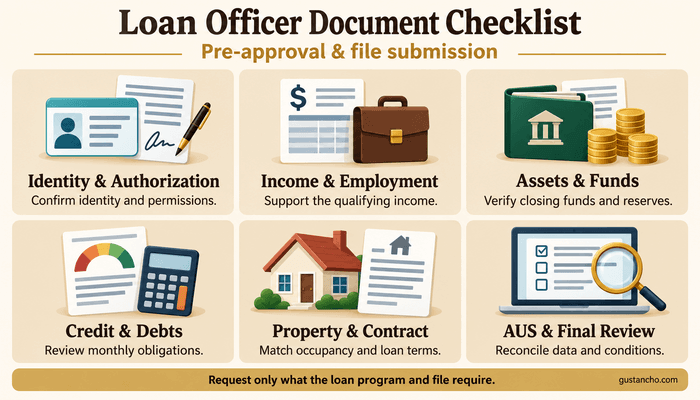
Before issuing a pre-approval, the loan officer should have enough information to verify the major facts used to qualify the borrower. A typical file may include:
- Completed mortgage application.
- Credit report.
- Income documentation.
- Employment information.
- Asset documentation is required when funds are needed for closing or reserves.
- Identification.
- Applicable borrower authorizations.
- Current housing information.
- Purchase price and estimated property expenses are known when available.
- AUS findings when the loan is submitted through automated underwriting.
Review the Numbers Before Issuing the Letter
The loan officer should confirm that the income, debts, assets, estimated housing payment, and loan terms entered into the system agree with the supporting documentation. A pre-approval based on overstated income or missing debts can create problems after the borrower is already under contract.
Identity Verification and Borrower Authorizations
Follow the identity-verification requirements applicable to the institution, loan program, and transaction.
Covered banking institutions must maintain a Customer Identification Program with risk-based verification procedures. Mortgage brokers may also perform verification on a bank’s behalf. The bank CIP framework should not be presented as an identical legal requirement for every mortgage company.
A government-issued photo ID is commonly used for documentary verification. Additional identity or Social Security number documentation may be needed under applicable procedures or to resolve discrepancies. Request a physical Social Security card when the relevant verification requirements call for it. Obtain the borrower authorizations required for credit and verification requests.
W-2 Employee Income Documents
A regular salaried or hourly W-2 borrower does not automatically need two years of federal tax returns. Depending on the loan program and underwriting findings, employment income may be documented with items such as:
- Recent paystubs.
- W-2 forms.
- Written verification of employment.
- Electronic income and employment verification.
- Other documentation accepted by the applicable mortgage program.
Review More Than the Current Pay Rate
The loan officer should determine whether the income is fixed or variable and whether the amount entered into the application is actually eligible for qualification. A recent raise, job change, employment gap, or change from hourly to salaried pay may require additional review, but none of those circumstances automatically means the borrower cannot qualify.
Variable Income: Bonus, Commission, Overtime, and Tips
Fannie Mae usually wants to see two years of bonus, commission, overtime, or tip income. Sometimes, less than two years is okay if the borrower has received this income for at least 12 months and there are good reasons to support the shorter history.
Even if the history requirement is met, the income is not automatically usable. The loan officer also needs to check how often the income is paid, year-to-date and past earnings, and whether the income is steady. If the income has gone down, it must be stable again before it can be counted.
Second-job, seasonal, and variable-hourly income should be reviewed using their own rules. Do not assume this exception applies to every type of job.
Self-Employed Borrower Documentation Exceptions
When One Year of Tax Returns May Be Sufficient
Under this Fannie Mae exception, one year of personal and business tax returns may be accepted when:
- The business has existed for at least five years.
- The borrower has continuously held an ownership interest of at least 25% throughout the preceding five years.
- Supporting records substantiate the business and ownership history reported on the application and returns.
- The lender completes and retains Form 1084 or an equivalent analysis applying the same cash-flow principles.
Evaluate each business separately.
When Less Than Two Years of Self-Employment May Be Acceptable
The latest signed personal and business federal returns must show a complete 12-month period of income from the current business. The file must also establish prior earnings at an equal or higher level from work involving the same products or services, or comparable job responsibilities. The lender must assess the borrower’s experience and the business’s debt. A reduced tax-return package and a shorter self-employment history are separate exceptions.
Asset and Bank Statement Documentation
Asset documentation should verify the funds needed for the down payment, closing costs, reserves, and any other required borrower contribution. Depending on the file, assets may be verified through bank statements, investment statements, a verification of deposit, or an approved electronic asset-verification service. For Fannie Mae purchase transactions using traditional bank statements, the statements generally cover the most recent full two-month period.
Which Asset Accounts Need Documentation?
The loan officer should identify which accounts are actually being used for the transaction. An account that is not needed for closing, reserves, income, or another underwriting purpose may not need to be included in the initial document package. When statements are used, make sure they clearly identify the borrower, financial institution, account information, statement period, transaction activity, and ending balance.
Purchase vs. Refinance Documents
Purchase and refinance files have different documentation needs.
Purchase Transactions
The file typically needs the executed purchase contract once the property is under contract, along with documentation of earnest money and any seller, lender, or third-party credits that affect the transaction. The loan officer should compare the contract terms with the loan application and loan structure before submitting the file.
Refinance Transactions
A refinance file generally requires information on the current mortgage, subject property, property taxes, homeowners’ insurance, HOA dues when applicable, and any liens that must be paid or subordinated. For cash-out refinances, verify that the transaction meets the applicable program’s seasoning, equity, and cash-out eligibility requirements rather than automatically asking the borrower for a letter explaining how the proceeds will be spent.
Getting Ready to Apply for a Mortgage?
Gathering the right documents can help move your pre-approval forward. Gustan Cho Associates can help you understand what may be needed for your application and loan file.Rental Income From Existing Investment Properties
For Fannie Mae loans, existing investment properties that are not securing the new mortgage are subject to the non-subject-property rental-income requirements. Departing residences and investment properties purchased within 45 days of the subject property are subject to separate requirements. The loan officer should review:
- The most recent personal federal tax return, including Schedules 1 and E.
- Business tax returns when required.
- Current leases and evidence that lease terms have taken effect, when the guidelines permit lease-based documentation.
- The borrower’s current housing payment, unless an applicable exception allows otherwise.
- Documentation supporting the borrower’s property-management experience.
With at least 12 months of qualifying property-management experience, positive calculated rental income may be available for qualification. With less experience, rental income generally may only offset the property’s PITIA. Any calculated rental loss must be included in the debt-to-income analysis.
Departing Residence Converted to a Rental
A departing residence is the borrower’s current primary residence being converted to an investment property when purchasing a new primary residence. Under Fannie Mae’s updated requirements, the file must document a current housing payment and support the market rent through an appraisal, Form 1007, or permitted market analysis tools. When using market analysis tools, obtain at least 3 comparable rental properties. Lease agreements are not permitted to establish departing-residence rental income under this policy. For a one-unit departing residence, multiply supported monthly gross rent by 75%, then subtract PITIA—principal, interest, taxes, insurance, and association dues. Rental income may only offset the departing residence’s PITIA; a positive result cannot be treated as additional qualifying income. Any remaining shortfall must be included in the DTI calculation. Borrowers with less than 12 months of property-management experience need six months of reserves covering the vacated property’s PITIA, in addition to applicable multiple-financed-property reserves. Multi-unit departing residences require separate documentation and calculations for tenant-occupied units.
Gift Fund Documentation
Gift funds require documentation demonstrating that the funds are a genuine gift with no expectation of repayment.
The file generally needs an acceptable gift letter identifying the donor, the donor’s relationship to the borrower, the gift amount, and confirming that repayment is not required.
Fannie Mae allows several methods for documenting the transfer, including a donor check and a borrower deposit slip; withdrawal and deposit documentation; an electronic transfer; a donor check to the closing agent; or settlement documentation showing receipt of the funds. FHA also permits multiple transfer methods and requires the lender to document both the gift and the transfer from an acceptable source.
Gift-Fund Documentation by Program and Transfer Method
A donor does not always need to provide the exact same combination of bank statements, checks, deposit slips, and teller-stamped receipts. The loan officer should determine the loan program, timing of the transfer, and acceptable documentation method before requesting the gift package.
FHA Manual Underwriting and Housing History
An FHA file that requires manual underwriting needs additional review of the borrower’s housing payment history. HUD requires the lender to document the previous 12 months of housing history using the credit report, verification of rent or mortgage, or canceled checks covering the applicable period.
Rent-Free Borrowers
If the borrower has been living rent-free, FHA requires verification from the property owner confirming:
- The borrower has been living rent-free.
- How long the borrower has lived there.
Do not create a rent history that does not exist. A rent-free borrower should be documented as rent-free and evaluated under the applicable manual underwriting requirements.
Conditional Documents for Special Borrower Situations
Some documents should be requested only when the borrower’s circumstances make them necessary. Examples include:
- Divorce decree or separation agreement.
- Child support or alimony documentation.
- Bankruptcy schedules and discharge documents.
- Chapter 13 payment history and trustee documentation.
- Foreclosure or short-sale records.
- Student-loan statements.
- Social Security or pension award letters.
- Non-occupant co-borrower documentation.
- Multiple-property documentation.
- Trust documents.
- Employment offer letters.
- Visa or residency documentation when applicable.
- Letters of explanation are provided when an actual underwriting issue needs clarification.
Do Not Use Letters of Explanation as a Substitute for Documentation
A letter of explanation can clarify facts, but it does not replace supporting evidence. If the issue involves a late payment, an employment gap, a large deposit, a recent credit inquiry, or another underwriting question, the explanation should be consistent with the documents on file.
AUS Findings and Electronic Verification
The loan officer document checklist should follow the underwriting findings rather than an old paper checklist. Desktop Underwriter can validate certain income, employment, and asset information through approved electronic verification reports. When DU validates a component, the required documentation can differ from that for traditional pay stubs, W-2s, or bank statements.
Read the Findings Before Requesting More Documents
The loan officer should review the AUS findings and determine:
- What has already been validated.
- What documentation is still required?
- Whether additional income needs support.
- Whether assets need further verification.
- Whether employment must be reverified.
- Whether any conditions require updated documentation.
Fannie Mae still requires the lender to confirm that the information submitted is accurate and complete, even when DU is used. The goal is not to collect the largest possible document package. The goal is to collect the correct documentation for that file.
Final File Scrub Before Sending to Processing
Before handing the file to processing, compare the loan application, credit report, AUS findings, and borrower documents. Check for obvious inconsistencies before they become underwriting conditions.
Loan Officer File-Scrub Checklist
Confirm that:
- Gift funds are documented when used.
- Borrower names and identifying information are consistent.
- Employment information matches the supporting documents.
- Qualifying income was calculated correctly.
- All known debts are disclosed.
- Assets entered into the application are supported.
- Funds needed for closing and reserves are documented.
- Large or unusual deposits have been reviewed when required.
- Property information and occupancy are correct.
- Purchase-contract terms match the loan structure.
- Rental properties and other real estate owned are disclosed.
- The latest AUS findings reflect the current loan data.
- Required explanations and supporting documents are included.
A clean file submitted for processing saves time because the processor is not forced to rebuild the basic qualification from scratch.
Common Documentation Mistakes
Many mortgage delays begin with small documentation problems that could have been identified during pre-approval. Common mistakes include:
- Requesting tax returns from every W-2 borrower.
- Asking for every bank account when only one is needed.
- Using gross earnings instead of qualifying income.
- Missing undisclosed real estate or monthly debts.
- Treating a two-year income history as mandatory in every situation.
- Using outdated rental-income rules.
- Requesting unnecessary letters of explanation.
- Ignoring pages of documents because they appear blank.
- Submitting outdated statements or paystubs.
- Failing to compare documents with the loan application.
- Relying on an AUS approval when the supporting documents do not match the data entered.
Match Documentation to Current Program Requirements
Mortgage documentation rules continue to change. Fannie Mae’s current guidance specifically allows income and employment to be documented through borrower documents, employer information, or approved third-party verification sources, and DU can validate certain components electronically. A good loan officer knows why a document is needed before asking the borrower for it.
FAQs About Loan Officer Document Checklist for Mortgage
Do Mortgage Documents Expire?
Yes. Document-age requirements vary by loan program and document type. For example, Fannie Mae generally requires credit reports and income, employment, and asset documents to be no more than 4 months old as of the note date. Tax returns, appraisals, and required reverifications have additional rules. Review document dates early enough to obtain updates before closing.
Can Borrowers Submit Screenshots of Their Bank Statements Instead of Complete Statements?
A screenshot showing only the current balance may not satisfy asset-verification requirements. For Fannie Mae statement-based verification, the documentation must identify the financial institution, the account holder, at least the last 4 account digits, the reporting period, the transaction activity, and the ending balance. Provide complete bank-issued statements or another accepted verification method. Do not omit pages containing information needed to verify the account and its activity.
Can Electronic Verification Replace Paystubs, W-2s, or Bank Statements?
In eligible files, yes. For conventional loans underwritten through Fannie Mae’s Desktop Underwriter, the DU validation service can validate certain income, employment, and assets using reports from authorized vendors. Follow the specific validation messages, applicable documentation, and timing requirements. An electronic report does not automatically mean every component has been validated. Additional documentation or review may still be necessary.
Final Thoughts on the Loan Officer Document Checklist
A strong loan officer document checklist is not a demand for two years of tax returns, W-2s, and bank statements from every borrower. The purpose is to ensure the information used for qualification can be substantiated before the file reaches processing and underwriting. Start with the core file. Then add documents based on:
- Income type.
- Assets are being used.
- Loan program.
- Purchase or refinance transaction.
- Credit history.
- Property ownership.
- AUS findings.
- Special borrower circumstances.
Current underwriting also allows electronic verification of income, employment, and assets in eligible files, so the required document package can be smaller than a traditional paper file. The better the initial file review, the fewer surprises the borrower, processor, and underwriter should encounter later.
This article about “Loan Officer Document Checklist: Mortgage Pre-Approval and File Submission Guide” was updated on October 27th, 2026.