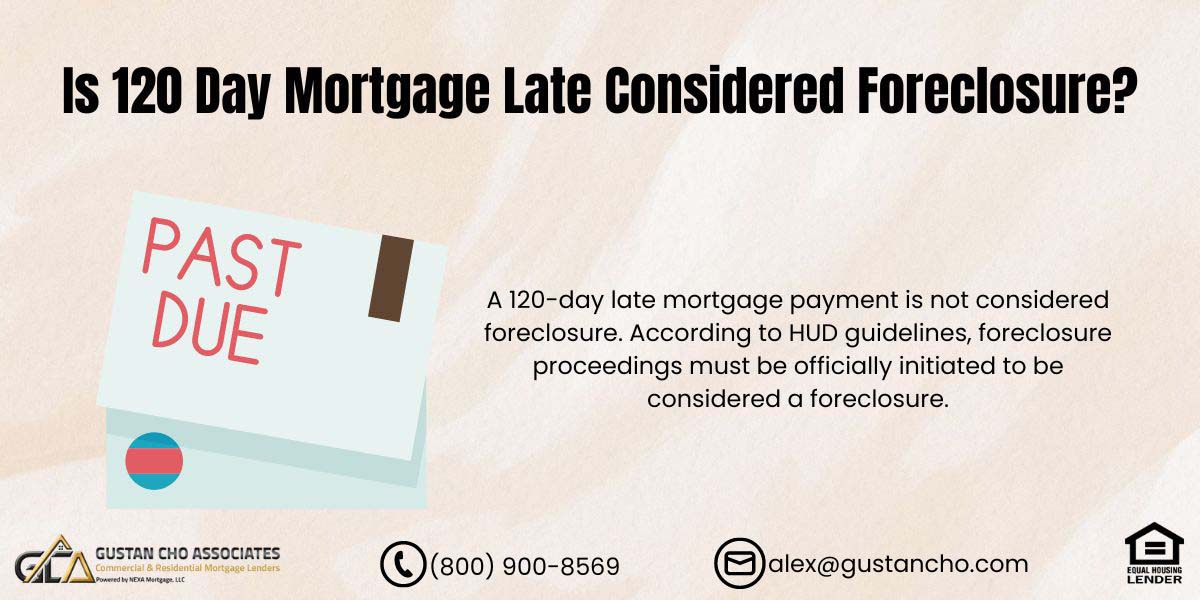
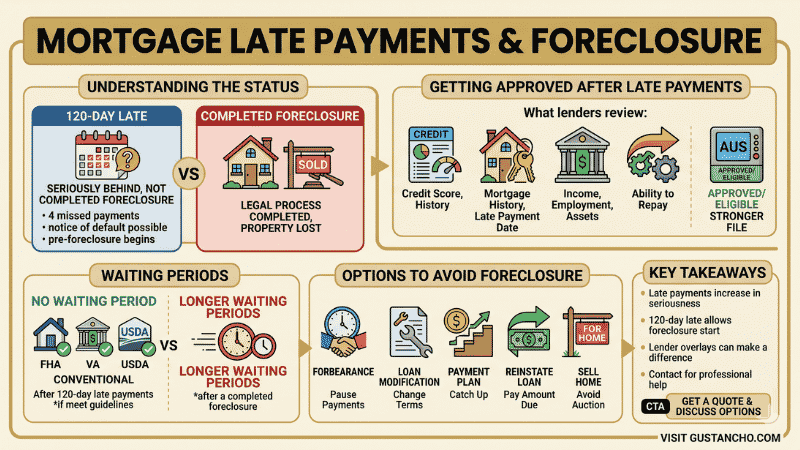
A 120-day mortgage late payment on your mortgage does not automatically mean foreclosure. It shows you are seriously behind, but being late is different from having a completed foreclosure, a short sale, a deed-in-lieu of foreclosure, or a mortgage charge-off. This difference is important because waiting periods for new mortgages depend on what actually happened with your credit. If you were 120 days late but never went through foreclosure, and you meet the loan program’s rules, you might still qualify for a new mortgage. Lenders will look at when the late payment occurred, whether your mortgage is now current, whether foreclosure has started, what the automated system says, your credit since the late payment, and any additional lender requirements.
What Mortgage Lenders Review After A 120-Day Mortgage Late
Borrowers want to know more than whether a 120-day late mortgage is considered foreclosure. The real question is: Can I still get approved for a mortgage? Lenders review the full mortgage file before making that decision. They will look at the credit report, mortgage history, the date of the last late payment, whether the mortgage is now current, and whether foreclosure proceedings ever started. If the home was sold before foreclosure, the lender will also review how the prior mortgage was paid off and reported.
Lenders will also review the borrower’s credit score, debt-to-income ratio, income stability, employment history, assets, reserves, and overall ability to repay the new mortgage. AUS findings are very important because an approved/eligible finding can strengthen the file. If the borrower does not receive automated approval, manual underwriting may be required.
Lender overlays can make the biggest difference. Some lenders may deny a borrower because of a 120-day mortgage late, even when the late payment was not a completed foreclosure. Other lenders may review the full file under agency mortgage guidelines with fewer overlays. This is why borrowers should not assume they are automatically disqualified; they should expect the lender to carefully review every part of their mortgage history.
Is There A Waiting Period After A 120-Day Mortgage Late?

Lenders will look at how recent the late payment was, whether the mortgage is now up to date, whether foreclosure has started, whether the property was sold, whether the loan was changed, and whether the borrower has rebuilt credit after the late payments.
The type of loan also matters. FHA, VA, USDA, conventional, and non-QM loans may treat serious late payments differently. For conventional loans, recent late mortgage payments can cause issues. Fannie Mae considers any 60-day, 90-day, 120-day, or 150-day late payments in the past year to be too many. This means you might not have to wait as long as after a foreclosure, but you will still need to meet certain rules before you can get a new mortgage.
What is the Difference Between a 120-Day Mortgage Late and Foreclosure?
A 120-day mortgage late occurs when a borrower fails to make three consecutive mortgage payments. Foreclosure refers to a situation where a lender starts the legal process of recapturing and auctioning a home. A 120-day delayed payment is not equivalent to foreclosure assistance.
A borrower who is four months in default and two or more periods accelerated and unpaid may still avoid foreclosure of the mortgage. If the borrower is able to make a deal or agreement with the lender then only he or she may be eligible to stay in the home.
This is significant since, with the situation other than the exact situation, the waiting period for the latest mortgage varies. A late payment was made for 120 days consecutively but after that, the terms of the foreclosure procedure started following it. Banks can still look at your entire credit history, how you have managed your past debts, if they have been paid on time, whether AUS results were approved, rules of the loan program, and any extra requirements of the lender.
Waiting Period to Qualify for Loans
There is no waiting period after 120-day mortgage late payments to qualify for FHA, VA, USDA, or Conventional loans. If you are told yes when asked If 120-day mortgage is a late considered foreclosure, contact us. If any borrowers are told that a 120-day mortgage late is considered foreclosure, contact us at Gustan Cho Associates, and we can get mortgage approval.
What is Considered an On-Time Mortgage Payment?
An on-time mortgage payment means paying your mortgage by the due date listed in your mortgage agreement or within the grace period, usually 10 to 15 days after the due date. During this grace period, you can pay without facing any late fees, which will still be considered on time. Payment made after this grace period is considered late and may result in a late fee.
Nonetheless, if the payment is made within 30 days of the due date, it will not impact your credit report as a late payment.
When it comes to being 120 days late on your mortgage, that’s a different story. Is 120 day mortgage late considered foreclosure? Being 120 days late usually means the lender can start foreclosure proceedings. You’ve missed four months of payments, and the lender can send a Notice of Default. This starts the pre-foreclosure process, and if the missed payments aren’t addressed, the lender might take legal steps to auction your property to recover the loan balance. So, it’s crucial to address missed payments as soon as possible to avoid reaching this stage.
What Happens When You Are 30, 60, 90, Or 120 Days Late On A Mortgage?
 Mortgage late payments become more serious the longer they remain unpaid. A payment that is a few days late may only cause a late fee. A payment that is 30, 60, 90, or 120 days late can affect credit, trigger collection activity, and eventually lead to foreclosure action.
30 Days Late On A Mortgage
A mortgage payment is usually reported to the credit bureaus as late once it is 30 days past due. This can hurt the borrower’s credit score and may affect future mortgage approval.
60 Days Late On A Mortgage
At 60 days late, the lender may increase collection efforts. The borrower is now two payments behind, and the credit report may show a more serious mortgage delinquency.
90 Days Late On A Mortgage
At 90 days late, the loan may be considered in default. The lender may send formal notices and may begin preparing for pre-foreclosure, depending on the state, loan servicer, and mortgage agreement.
120 Days Late On A Mortgage
At 120 days past due, the lender may be able to initiate formal foreclosure proceedings. However, being 120 days late does not automatically mean a completed foreclosure. The borrower may still have options, such as bringing the loan current, requesting a repayment plan, completing a loan modification, or selling the home before foreclosure is completed.
Is Your Mortgage 120 Days Late? Let’s Discuss How to Avoid Foreclosure!
Reach out now to learn about your options and get advice on how to avoid foreclosure.How Do Mortgage Underwriters View Late Payments
Late Payments can happen among the best of us. Mortgage Underwriters will need a letter of explanation of why mortgage borrowers were late:
- Was it for job loss?
- Was it due to a divorce?
- Was it due to other extenuating circumstances?
Periods of late payments are understandable. Lenders want to see borrowers have re-established credit after periods of bad credit. Special attention is given to the borrower’s payment patterns and behavior in the past 12 months. Past payment history is a good indicator of future payments on borrowers’ new mortgage payments. Borrowers can qualify for FHA Loans with one or two late payments in the past 12 months.
What Are Your Options If You Are Behind On Your Mortgage?
If you have missed mortgage payments or are struggling to make them, you should notify your mortgage servicer. Moving quickly gives you a good chance of avoiding foreclosure and allows for better chances to obtain a mortgage.
For example, forbearance is a common option, which allows you to reduce or stop payments temporarily if you face hardship. A loan modification is a change to your loan terms in order to change your payments. A payment plan is ideal in catching up with the payments missed. Reinstating a loan is settling any amount due on a loan, making it up-to-date.
Deciding to sell your home before foreclosing on it may be a decision you take if you cannot afford to hold it. You also have the option to speak with a housing counselor approved by the U.S. Department of Housing and Urban Development (HUD).
Different Options for Someone 120 Days Late on Their Mortgage
These effects are really very dangerous being 120 days late. It is very serious but doesn’t always mean you will lose your home. Banks will see how the default occurred, whether the borrower caught up on payments, completed a loan modification, or avoided foreclosure, and if a foreclosure occurred or is presently in process in a credit report.
Can You Qualify For FHA With A 120-Day Mortgage Late?
Yes, an FHA loan may still be open to some borrowers after a delay in payment or 120 days or more. Persons with past credit problems can qualify for FHA loan; however, the lender will assess the complete credit history through mortgage payments, and have they re-established credit
It is often a requirement of a mortgage that it is paid in full before a new loan is taken. The payment record will be examined following a loan modification, the establishment of a repayment plan, or when the loan is brought up to date.
AUS findings are also important. Lenders may provide the borrowers, especially those they consider as high-earners, an AUS/eligible decision when borrowers originally apply? Though some lenders may refuse a loan due to the lender overlays, this may sometimes differ. This is the reason a 120-day late mortgage should not be considered as an automatic foreclosure, this does not mean it should be ignored. All other borrower’s qualifications need to be met to qualify for an FHA loan such as credit history, income, debt-to-income, payment history and Automated Underwriting System (AUS), and lender overlays.
FHA Loan After A 120-Day Mortgage Late
FHA loans might let you qualify even after a 120-day late mortgage payment, but lenders will review your full payment history. A 120-day late payment is not the same as a foreclosure, but lenders will check whether your mortgage is current, whether you completed a loan modification, whether foreclosure proceedings began, and whether you have re-established your credit. Automated Underwriting System (AUS) results matter. Some borrowers may get approved automatically, while others might need manual review. Lender-specific rules can also impact your approval.
VA Loan After A 120-Day Mortgage Late
VA loans can be flexible for eligible veterans, active-duty service members, and surviving spouses. Still, a 120-day late payment is a serious credit problem. VA lenders will look at your recent payment history, your income after expenses, your debt-to-income ratio, whether you have rebuilt your credit, and whether the mortgage issue was resolved.
USDA Loan After A 120-Day Mortgage Late
USDA loans are meant for eligible rural and suburban homebuyers, but your mortgage payment history is important. If you have a 120-day late payment, you may need to show that the mortgage is now current, resolved, modified, or otherwise paid in full before applying for a new USDA loan. Getting approved for a USDA loan depends on your credit history, income, property eligibility, debt-to-income ratio, results from the Guaranteed Underwriting System (GUS), and lender-specific rules. A recent serious late payment can make approval more difficult, even if it was not a foreclosure.
Conventional Loan After A 120-Day Mortgage Late
Generally, home loans from Fannie Mae and Freddie Mac’s involve the recent last date of keeping up with the payments on your home. If late payment has been done for about 120 days, then the bank has the authority to foreclose the house.
Fannie Mae deems any 60, 90, 120, or 150-day mortgage delinquencies over a previous one-year period as . Therefore, you might not have to wait after your foreclosure. But keeping a strong payment history post-foreclosure may help you acquire another home loan in a shorter span than purchasing a home without having been foreclosed upon.
To look at the traditional mortgage a debtee must go through the credit report, mortgage history, and AUS findings. Your mortgage history, credit report, automated underwriting system (AUS) findings, loan to value ratio, savings, income stability, and credit rebuilding will be checked by a lender for conventional loans. Lender-dictated criteria can also lead to a rejection even earlier than a person gets foreclosed upon.
Does A Loan Modification After A 120-Day Late Create A Waiting Period?
A loan modification is not the same as foreclosure. Many borrowers who were 90 or 120 days late on their mortgage later completed a loan modification and kept their home. That does not automatically mean they had a completed foreclosure. However, lenders will closely review the borrower’s payment history after the loan modification. Many loan programs and lenders require the borrower to have made the modified mortgage payments on time for a specified period before approving a new mortgage. This is why post-modification payment history is critical. A borrower may avoid foreclosure through a loan modification, but they still need to show they can make on-time housing payments again. Lenders will review the modification date, the new payment terms, the payment history after the modification, AUS findings, manual underwriting eligibility, and lender overlays.
Why Some Lenders Say A 120-Day Late Is The Same As Foreclosure
Some lenders may tell borrowers that a 120-day mortgage late payment is the same as foreclosure. In many cases, this may be due to lender overlays, not because agency guidelines automatically treat every 120-day late as a completed foreclosure. A lender overlay is an extra rule added by the lender on top of FHA, VA, USDA, Fannie Mae, or Freddie Mac guidelines. For example, one lender may deny a borrower because of a recent 120-day mortgage late, while another lender may review the file based on the actual credit event, AUS findings, mortgage history, and whether foreclosure was completed. This distinction is important. A borrower may not have a foreclosure waiting period if the home was never foreclosed. However, the late payment can still affect approval. Lenders will review whether the mortgage was brought current, whether a loan modification was completed, whether the home was sold before foreclosure, and whether the borrower has re-established credit.
Can You Qualify With Late Payments After Bankruptcy Or Foreclosure?
Yes, we can qualify under the late payments even if they have been through a foreclosure or bankruptcy.
While the above-mentioned instances of public records do have long-lasting financial consequences, for a potential borrower, they may not result in immediate disqualification from securing a loan.
The banks assess the lateness of the payments, what constituted them, and the re-establishment of the credit, and the approval of the newer loan for the borrowers. The type of loan you apply for matters. There are specific waiting period requirements on qualifying for a new mortgage after major credit events on government and conventional loans. On condition that automatic approval is not forthcoming, an individual may seek manual underwriting
Talk To A Lender Who Understands 120-Day Mortgage Late Payments
A 120-day mortgage late payment is serious, but it is not automatically equivalent to a completed foreclosure. The most important question is what actually happened after the late payments. Was the mortgage brought current? Was there a loan modification? Was the home sold before foreclosure? Did foreclosure proceedings start? How does the credit report show the prior mortgage history?
Borrowers who were told they must wait several years should get a second opinion before assuming they are disqualified. Some lenders may deny the file because of lender overlays, even when the borrower did not have a completed foreclosure.
The right lender will review the full mortgage history, credit report, income, debt-to-income ratio, assets, AUS findings, and available loan programs. Gustan Cho Associates cater to borrowers that have been turned down due to late mortgage payments, prior credit issues or lender overlays. If your 120-day mortgage late only happens due to the pandemic, you can still get an FHA, VA, USDA, conventional, or non-QM loan from the wholesale lender. The suggested step says that you need to have your full file reviewed by the next lender who understands agency guidelines and overlay-free lending.
FAQs: 120-Day Mortgage Late Payments And Foreclosure
Can A Mortgage Servicer Start Foreclosure Before 120 Days Late?
In most cases, a mortgage servicer cannot make the first foreclosure notice or filing until the borrower is more than 120 days delinquent. However, foreclosure timelines can vary after that depending on the state, loan type, servicer, and whether the borrower submitted a loss mitigation application.
Does A 120-Day Mortgage Late Payment Stay On Your Credit Report?
Yes. A 120-day late mortgage payment can appear on your credit report as a serious delinquency. Mortgage lenders typically report late payments once they are at least 30 days past due, and each later stage, such as 60, 90, or 120 days late, can further damage the borrower’s credit profile.
Is Pre-Foreclosure The Same As Foreclosure?
No. Pre-foreclosure usually means the borrower is seriously behind, and the lender may be preparing to start foreclosure. It does not always mean the home has already been foreclosed. A completed foreclosure is a more serious housing event and can trigger mortgage waiting periods.
Can Making One Payment Stop Foreclosure After Being 120 Days Late?
Not always. If you are several months behind, making one payment may not bring the loan current. The servicer may require a repayment plan, reinstatement amount, loan modification, or another approved workout option. Borrowers should contact the servicer directly before assuming one payment will stop the process.
Who Can Help If I Am Behind On My Mortgage And Do Not Understand My Options?
Borrowers can contact their mortgage servicer first and may also speak with a HUD-approved housing counselor. Housing counselors can help homeowners understand foreclosure-prevention options, loss mitigation, repayment plans, and possible alternatives before the situation worsens.
For further assistance, contact Gustan Cho Associates at 800-900-8569 or email gcho@gustancho.com.
This article about “Is 120-Day Mortgage Late Considered Foreclosure?” was updated on May 22nd, 2026.