
Investment Home Mortgage Loans: 2026 Guide to No Doc, DSCR, and Non-QM Options
Getting the right investment home mortgage loan can make all the difference if you’re looking to build wealth through real estate. Many real estate investors today want flexible loan programs that don’t require traditional income verification. The good news? In 2026, more investment home mortgage loans are available than ever — including no doc loans, DSCR loans, and non-QM investment mortgages that make qualifying easier for investors without W2 income.
In this updated guide, we’ll explain the different types of investment home mortgage loans, how they work, and how you can qualify for one even if you’re self-employed or don’t show much income on tax returns.
Key Takeaways About Investment Home Mortgage Loans
- Government loans (FHA, VA, USDA) cannot be used for investment homes.
- Conventional loans are best for investors with strong credit and documented income.
- Non-QM and no doc investment loans allow qualification without tax returns.
- DSCR loans use the property’s cash flow to qualify.
- Down payments generally fall between 20% and 30%.
- Rental income can be used to help meet DTI requirements.
What Are Investment Home Mortgage Loans?

Investment home mortgage loans are loans used to purchase or refinance real estate that’s not your primary residence. These can include:
- Single-family homes rented to tenants
- Vacation rentals or Airbnb properties
- Multi-unit investment properties
- Fix-and-flip homes
Because these loans are used for income-producing properties, they come with different rules and higher interest rates than loans for owner-occupied homes.
Unlike government-backed programs such as FHA, VA, and USDA loans, which are limited to primary residences, investment home mortgage loans rely on conventional or non-QM (Non-Qualified Mortgage) programs.
Government Loans Cannot Be Used for Investment Properties
Government-backed mortgage programs like FHA, VA, and USDA loans are mainly meant for your main home, not for properties you’re buying just to rent out. There are some exceptions, like if you live in a single unit of a multi-unit building. Still, generally, these loans aren’t set up for rentals or properties that generate income. If you’re looking to buy a property just for investment, you’re usually going to need a regular investment property loan or something like a DSCR loan.
Types of Investment Home Mortgage Loans in 2026
Real estate investors now have several ways to finance a rental or other non-owner-occupied property. The best investment home mortgage loans depend on whether you want to qualify based on your personal income, the property’s cash flow, or your liquid assets. Breaking the options into clear categories makes the decision easier.
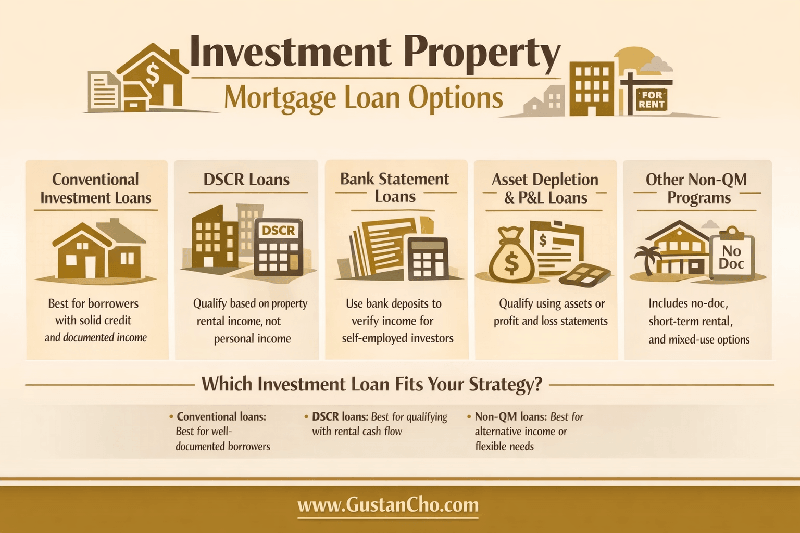
Conventional Investment Property Loans
Conventional investment property loans are the most mainstream option for borrowers with solid credit, documented income, and enough reserves. These loans generally follow Fannie Mae or Freddie Mac rules, which means lenders can use documented rental income for qualifying in eligible cases. For example, Fannie Mae accepts market rent from Form 1007 or Form 1025. She typically uses 75% of gross rent to calculate qualifying rental income. Fannie Mae also allows up to 10 financed properties for a borrower on a DU-approved second-home or investment-property transaction. At the same time, Freddie Mac requires investment-property mortgages to receive an LPA Accept decision. He does not allow manual underwriting for these loans.
Conventional financing is usually best for investors who want long-term fixed-rate financing and can fully document income, assets, reserves, and existing real estate holdings. It is often the lowest-cost option when the file fits agency rules, but it can become harder to use as a portfolio grows or when tax returns do not reflect enough income.
DSCR Loans
DSCR loans are perfect for investors looking to have their rental income from their properties do most of the heavy lifting in qualifying for the loan. Instead of focusing heavily on W-2 income or tax-return income, these loans look at whether the property generates enough rent to cover the housing payment. Many lenders describe DSCR as monthly rent divided by monthly PITIA, and a ratio of 1.0 generally means the property’s income covers the payment. Some DSCR lenders price more favorably once the ratio is around 1.2 or higher. However, exact thresholds vary by lender and property type.
This option is often a better fit for self-employed investors who own multiple properties, purchase through an LLC where allowed, or prefer simpler income documentation. DSCR loans are especially popular for scaling a rental portfolio because they are usually more focused on property performance than on personal tax-return income.
Bank Statement Investment Loans
Bank statement investment loans fall under the broader non-QM umbrella. Rather than using W-2s and tax returns the way conventional loans do, these programs review personal or business bank deposits over a set period to estimate usable income. This can help self-employed borrowers whose taxable income appears lower on paper due to legitimate business write-offs. Because these are non-QM products, lender-specific guidelines are usually more flexible than agency rules. Still, rates, reserves, and down payment requirements are often higher than standard conventional financing.
Asset Depletion and P&L-Only Options
Some non-QM lenders also offer asset depletion or profit-and-loss-based qualification for investment-property borrowers. Asset-depletion programs convert eligible liquid assets into a qualifying income stream. In contrast, P&L-based programs may rely on a CPA-prepared or borrower-prepared profit-and-loss statement, depending on lender rules. These options can help retirees, high-net-worth borrowers, and business owners with substantial assets or cash flow who do not fit conventional income-calculation formulas. Because these programs are not standardized the way agency loans are, terms and documentation rules vary significantly from lender to lender.
Other Non-QM Investor Programs
Other non-QM investor programs can include no-ratio, interest-only, short-term-rental-focused, or mixed-use solutions, depending on the lender. This is where the article should be careful with terminology: “non-QM” is the broad category. At the same time, “no doc” or “no income verification” is only one style within that category, not a separate universal loan family. Framing it this way helps readers understand that DSCR, bank statements, asset depletion, and some no-doc structures are part of the broader non-QM landscape.
Which Type of Investment Home Mortgage Loans Fit Best?
In simple terms, conventional loans are best for investors who can document income and want agency-style pricing. DSCR loans are best for investors who want to qualify primarily from rental cash flow. Bank statements, asset depletion, and other non-QM options are better for borrowers whose true financial strength does not clearly show on tax returns. That framework is much easier for readers to understand than presenting all investor loan types as if they operate the same way.
Second Home vs. Investment Property
Some buyers assume a vacation home and an investment property are treated the same, but lenders do not. A true second home is typically for the borrower’s personal use. At the same time, an investment property is purchased primarily to produce rental income or long-term profit. If a home will be rented out regularly, used as a short-term rental, or bought mainly for income, lenders will usually treat it as an investment property.
That matters because investment property loans often come with higher down payment requirements, different reserve standards, and higher rates than second-home financing. For this reason, buyers should be clear about how the property will be used before choosing any investment home mortgage loans.
Down Payment Requirements for Investment Property Loans
Down payment requirements for investment property loans are usually higher than for primary residences, but the exact amount depends on the loan program, credit profile, property type, and the overall risk of the file. In general, conventional investment loans often require a 15% to 25% down payment. In comparison, many DSCR and other non-QM investor loans fall in the 20% to 30% range. Borrowers with stronger credit, more reserves, and lower-risk properties may qualify for better pricing and more flexibility.
At the same time, riskier scenarios often require a larger down payment. Rather than treating down payment as a one-size-fits-all rule, investors should view it as part of the overall loan structure that affects approval, rate, and cash flow.
Using Rental Income to Qualify for an Investment Property Loan
A major benefit of financing investment properties is that lenders may count some of the expected rental income when deciding if you qualify for a loan. This means that the projected rent can help cover some of your mortgage payment. This is particularly useful for investors who want to grow their portfolios without depending only on their personal income.
To estimate rental income, lenders might request a rent schedule or a market rent analysis during the appraisal. For conventional loans, this is usually noted on appraisal forms, such as Form 1007 for single-family rentals or Form 1025 for small multi-unit properties. Lenders often use 75% of the market rent for qualification, with the remaining 25% set aside for potential vacancies and maintenance costs.
The exact method varies by loan program, but the main point is clear: expected rental income can strengthen your application and make it easier to qualify.
Limits for Larger Real Estate Investors
Most readers do not need to focus on financed-property limits right away, but this issue can matter once you begin scaling a portfolio. Under current Fannie Mae rules, a borrower on a DU-approved second-home or investment-property transaction can generally have up to 10 financed properties, and additional reserve requirements can apply as that number grows.
For newer investors, this is usually not the section that drives the first loan decision. But for experienced investors with several mortgaged properties already in place, these agency limits can be a reason to consider DSCR or other non-QM financing, which may offer more flexibility beyond standard conventional rules.
When to Choose a No Doc or DSCR Loan
Consider a no doc investment loan or DSCR mortgage if you:
- Are self-employed or retired
- Have strong credit and equity but low taxable income
- Own multiple properties and want to expand
- Prefer simplified underwriting without income verification
These programs are built for modern investors prioritizing cash flow and property performance over traditional W2-based lending.
2026 Financing Overview for Investment Properties
Mortgage conditions for real estate investors remain rate-sensitive in 2026, which means financing strategy matters just as much as property selection. Freddie Mac reported the average 30-year fixed-rate mortgage at 6.11% for the week ending March 12, 2026, indicating that borrowing costs remain elevated compared with the ultra-low-rate years many investors grew accustomed to. At the same time, major housing forecasts for 2026 continue to point to a market stabilizing rather than collapsing, with economists closely watching affordability, supply, and consumer demand.
For investment-property borrowers, the practical takeaway is simple: loan structure matters more than ever. Conventional financing may still be the best fit for investors with high documented income and reserves. At the same time, DSCR and other non-QM options can be more useful for borrowers who want qualification based more on rental cash flow, asset strength, or flexible documentation.
That is why investors in 2026 should focus less on broad market headlines and more on choosing the loan type that best matches their income profile, property strategy, and long-term cash flow goals.
Explore Your Investment Property Loan Options
Choosing the right investment property loan depends on several factors, including your income documentation, property cash flow, down payment, and long-term investing strategy. Knowing the differences between conventional, DSCR, and non-QM financing helps you make a better decision.
Borrowers who want to explore investment property mortgage options can review available programs through Gustan Cho Associates and compare possible financing paths based on their goals.
Final Thoughts
Investment home mortgage loans are not all the same. Some programs are designed for borrowers with high documented income, while others are better suited for investors who qualify based on rental cash flow, bank statements, or assets. The right choice depends on how the property will be used, how much you want to put down, and whether you need conventional or non-QM flexibility.
For most readers, the key takeaway is simple: conventional loans usually work best for well-documented borrowers, while DSCR and other non-QM options can open the door for self-employed investors, portfolio borrowers, and buyers whose tax returns do not fully reflect their financial strength. Understanding those differences can help you choose a loan structure that supports both approval and long-term cash flow.
Frequently Asked Questions About Investment Home Mortgage Loans:
What is the Best Loan for an Investment Property?
- The best loan for an investment property depends on your qualifications and the type of property you are buying. Conventional investment property loans are often best for borrowers with strong credit, documented income, and enough reserves. DSCR loans are often better for investors who want to qualify based mainly on the property’s rental cash flow rather than personal income. Other non-QM options, such as bank statement or asset-based loans, may work better for self-employed borrowers or investors with more complex income.
What is a DSCR Loan for an Investment Property?
- A DSCR loan is a type of non-QM mortgage designed for real estate investors. Instead of relying primarily on W-2s, tax returns, or pay stubs, the lender looks mainly at whether the property’s rental income is enough to cover the monthly housing payment. That is why DSCR loans are popular with investors buying rental properties, especially those who are self-employed or expanding a portfolio.
How is DSCR Calculated on an Investment Property Loan?
- DSCR usually means the property’s rental income divided by its monthly debt obligation. In many investor-loan programs, lenders compare rental income to PITIA, which can include principal, interest, taxes, insurance, and, in some cases, association dues. A DSCR of 1.0 generally means the property generates enough income to cover the payment, while a higher ratio usually indicates stronger cash flow.
How Much Down Payment Do You Need for an Investment Property Mortgage?
- Down payment requirements are usually higher for investment properties than for primary residences. Conventional investment loans typically start around the mid-teens and often land in the 15% to 25% range, depending on occupancy, credit, and property type, while many DSCR and no-doc-style investor loans fall in the 20% to 30% range. The exact requirements vary by lender, property type, reserves, and the overall strength of the file.
Are No-Doc Investment Property Loans Still Available?
- Yes, but they are not as common as they were before the mortgage crisis, and they are usually offered through non-QM or private-lender channels rather than through standard agency lending. In today’s market, “no-doc” often means reduced traditional income documentation rather than truly no paperwork. Many of these programs qualify the borrower using rental income, bank statements, assets, or other alternative documentation instead of standard tax-return income.
Can a Vacation Home be Treated as an Investment Property?
- Yes. If the property is rented regularly, used mainly to generate income, or purchased primarily as an income-producing asset, many lenders will classify it as an investment property rather than a true second home. That matters because investment properties usually come with different pricing, reserve requirements, and down payment rules than second homes.
This article about “Traditional and Non-Prime Investment Home Mortgage Loans” was updated on March 17th, 2026.
Use bank statements instead of tax returns
Self-employed investors qualify with 12–24 months of deposits for smoother approvals