Importance of Mortgage Qualification and Pre-Approval Before Buying a Home
This guide covers the importance of mortgage qualification and pre-approval. A pre-approval is when a home buyer or homeowner has completed a 1003 mortgage loan application and the loan officer is confident the borrower qualifies for a mortgage. A pre-approval should be issued once the loan originator has run credit, ran the file through the automated underwriting system and got an automated approval per DU FINDINGS or LP FINDINGS and is confident the borrower is qualified.
Mortgage qualification is the most important step in the mortgage process. If the loan originator does not qualify the mortgage loan applicant the right way initially, the potential of mortgage denial is imminent.
This is the main reason for mortgage denials on the 11th hour. The mortgage qualification stage is the most important stage of the qualification and application process. Poor mortgage qualification can mean a last-minute mortgage loan denial. In the following paragraphs, we will cover the importance of mortgage qualification and pre-approval.
Importance of Mortgage Qualification and Pre-Approval Before Buying a Home
Prospective homebuyers should understand mortgage qualification and pre-approval before initiating the homebuying process. Many people start searching for homes without first assessing affordability, estimated payments, or mortgage eligibility. This can lead to inefficiencies, unmet expectations, and failed transactions. Pre-approval allows buyers to evaluate their finances, make informed decisions, and submit stronger offers.
What Does Mortgage Pre-Approval Entail?
The mortgage process can be complex for both first-time and repeat buyers. Terms like income verification, debt-to-income ratio, credit score, reserves, and underwriting may seem overwhelming.
The main goal is to determine loan eligibility, borrowing capacity, and approval likelihood before starting a home search. Mortgage pre-qualification and pre-approval help achieve this.
Mortgage qualification is usually the first step, giving buyers a preliminary estimate of affordability based on self-reported information. Pre-approval goes further, requiring a thorough review of income, credit, assets, and documentation. While both are helpful, pre-approval is especially valuable in competitive markets where sellers want assurance of a buyer’s ability to close.
Why Is It Common For Buyers To Be Confused About Qualification And Pre-Approval?
Many buyers confuse ‘qualification’ with ‘pre-approval,’ though they are different. Qualification is a preliminary assessment, while pre-approval is more thorough and includes credit checks and document verification.
Qualified buyers may be at a disadvantage compared to those who are pre-approved. During qualification, lenders review income, debts, job history, credit, and down payment to estimate how much buyers can spend.
This stage helps buyers determine affordability and may also identify significant barriers, such as excessive debt, low credit scores, insufficient savings for a down payment, or unstable income. For many individuals, this represents their initial encounter with the practical challenges of homeownership.
What Information Is Necessary To Qualify For A Mortgage
Usually, the mortgage qualification process begins with the lender seeking more information about the borrower. Most importantly, the mortgage qualification process usually starts with the lender requesting information about your income, debts, credit score, employment, and intended down payment. This provides a general estimate, not a full underwriting review.
Borrowers with strong credit scores receive better loan options and interest rates, while those with lower scores may need a larger down payment and have fewer loan choices. Financial information.
Applicants are typically required to complete a full loan application and provide documentation such as recent pay stubs, employment verification, bank statements, and tax returns, as well as undergo a credit check. Lenders may request supplementary documents as needed. Upon review, the lender issues a pre-approval letter specifying the maximum loan amount for which the applicant may qualify, with the stipulation that this amount is “subject to final underwriting and the conditions of the property”.
Why Do Buyers Confuse Qualification And Pre-Approval?
The main benefit of mortgage pre-approval is a clear understanding of borrowing capacity. This reduces uncertainty and helps buyers focus on properties within their budget, streamlining the home search.
To obtain pre-approval, applicants must submit recent pay stubs, W-2 forms or tax returns as applicable, bank statements, and credit score information.
Self-employed individuals or those with variable income may be required to provide additional documentation. Lenders utilize this information to assess income stability and determine eligibility for specific loan programs.
How Is Mortgage Qualification Defined?
A qualified borrower might still face issues such as missing documents, incorrect debt calculations, or credit problems. Pre-approved borrowers usually receive a detailed review, reducing the risk of surprises after signing a purchase agreement. For active homebuyers, pre-approval confers a competitive advantage. It facilitates more effective budgeting, strengthens purchase offers, and promotes focus throughout the transaction process.
Mortgage Pre-Approval: Know Your Budget Before You Shop
Pre-approval helps you avoid wasting time on homes outside your price range, strengthens your offer, and reduces surprises in underwriting. Get a clear approval plan based on your income, credit, and down paymentWhat Do Lenders Examine When Qualifying You For A Mortgage, And When You Are Pre-Approved?
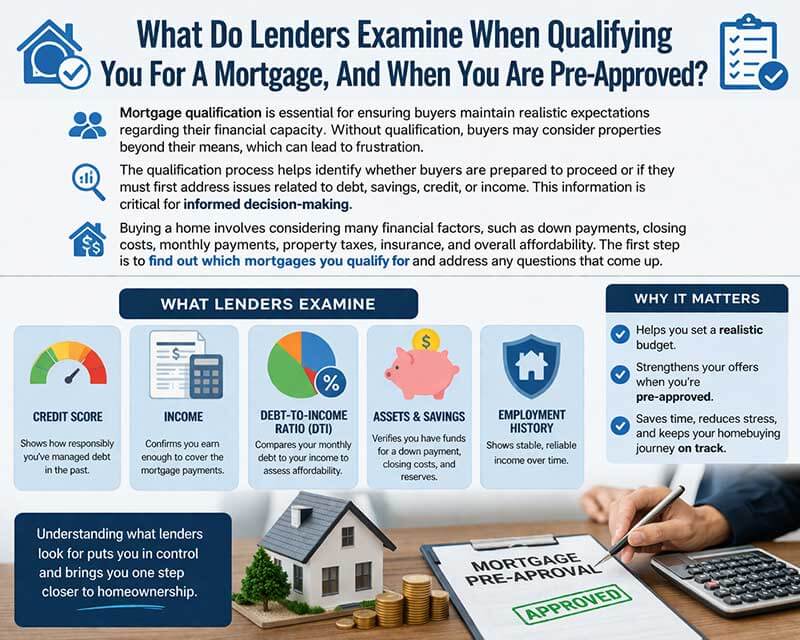
Mortgage qualification is essential for ensuring buyers maintain realistic expectations regarding their financial capacity. Without qualification, buyers may consider properties beyond their means, which can lead to frustration.
The qualification process helps identify whether buyers are prepared to proceed or if they must first address issues related to debt, savings, credit, or income. This information is critical for informed decision-making.
Buying a home involves considering many financial factors, such as down payments, closing costs, monthly payments, property taxes, insurance, and overall affordability. The first step is to find out which mortgages you qualify for and address any questions that come up.
What Is The Significance Of Mortgage Qualification And Pre-Approval?
Buying a home is an exciting milestone and a major financial commitment. Simply browsing listings without assessing your finances is not enough. Buyers should evaluate their finances, identify challenges, and set a realistic budget before making an offer.
Mortgage pre-approval, which reviews income, assets, and credit score, helps buyers focus on affordable properties and reduces unexpected issues during underwriting.
Pre-approved buyers are seen as more credible and are more likely to have their offers accepted. Pre-approval shows sellers that buyers are committed and less likely to face financing issues.
How Do Lenders Do Mortgage Qualification

Every mortgage company has different systems on doing mortgage qualification. Once you submit your signed mortgage loan application and your documents such as your tax returns, W-2s, bank statements, and other required documents, it normally gets reviewed by the mortgage loan originator. It then gets submitted to processing.
A mortgage processor will then package the whole mortgage package up and submit it to underwriting for a conditional mortgage approval.
Some mortgage companies do not really go over each mortgage loan document as they should. Others, will go over every document with a fine-tooth comb and make sure that everything is in order and no hiccups will be encountered by the mortgage underwriter. For example, mortgage lenders will require two months of bank statements. Many mortgage processors will just submit the two months bank statements the mortgage loan borrower submits to them. This can create a huge problem if there have been overdrafts in the past 60 days.
Understanding The Importance of Mortgage Qualification and Pre-Approval
Mortgage qualification and pre-approval are crucial steps in the home-buying process for several reasons: Mortgage qualification helps you determine how much house you can afford. Lenders look at your income, credit payment history, debts, and credit score to determine if you’re eligible for a mortgage loan.
Home sellers are more likely to consider offers from buyers who have already been qualified and pre-approved for a mortgage because it shows a serious homebuyer.
This helps you set a realistic budget for your home search, saving you time looking at properties that are beyond your means. In a competitive real estate market, having a pre-approval letter gives homebuyers an advantage over other buyers. Pre-approval allows you to narrow down your search to homes that are within your budget. This saves time and effort by focusing on properties that you can realistically purchase.
Narrowing Down Your Options
Imagine you find your dream home only to discover later that you can’t secure the necessary financing. Pre-approval reduces the risk of such disappointment, as it confirms that a lender is willing to provide you with a loan for a specific amount.
When you have mortgage pre-approval, you can negotiate with confidence. Home sellers may be more willing to negotiate on the purchase price or terms when they know you have financing in place.
Since much of the paperwork and financial checks have already been completed during pre-approval, the mortgage process tends to move faster. This can be beneficial if you want to close on a property quickly. Some lenders allow you to lock in an interest rate during the pre-approval process. This can protect you from surging mortgage interest rates while you shop for a home.
Avoiding Surprises
Mortgage qualification and pre-approval help uncover any potential issues with your credit or finances early on. If there are problems, you can work on improving your financial situation or addressing any issues before making an offer on a home. In summary, mortgage qualification and pre-approval are essential steps in the home-buying process that help you determine your budget, gain a competitive edge, and avoid potential setbacks in your home purchase. They provide confidence to both you and sellers, making the entire process smoother and more efficient.
Importance of Mortgage Pre-Approval in Today’s Housing Market
In a competitive housing market, mortgage pre-approval becomes increasingly important. Buyers who obtain pre-approval are perceived as more serious and better prepared than those who have not engaged with a lender. Pre-approval letters enhance sellers’ confidence in the likelihood of a successful transaction.
Why Does Mortgage Pre-Approval Assist fFrst-Time Homebuyers?
Sellers gain confidence when buyers include strong pre-approval letters with their offers. A pre-approval letter signals that the buyer is financially serious. While it does not guarantee loan closure, it strengthens the offer. In a fast-paced market, pre-approved buyers are in a stronger negotiating position than unqualified buyers.
How Does A Pre-Approval Letter Help Real Estate Agents And Sellers?
Pre-approval streamlines the process for real estate agents by allowing them to focus on properties within the buyer’s price range and reducing concerns about financing complications. Sellers can also evaluate offers with greater confidence and identify them more readily. Pre-approval streamlines the process for real estate agents by focusing on properties within the buyer’s price range and reducing financing concerns.
Sellers can evaluate offers with greater confidence and more easily identify potential financing issues, assets, and overall financial health.
Employment history is assessed for stability and consistency, while credit history and assets are examined to evaluate debt management and the availability of funds for down payment, closing costs, and reserves. Outstanding debts are particularly important because they affect the debt-to-income ratio, a key determinant in mortgage approval.
What Impact Does The Debt-To-Income Ratio Have On Pre-approval?
The debt-to-income ratio (DTI) measures monthly debt obligations compared to gross income. Lenders use it to assess a borrower’s ability to manage a mortgage with existing debts. A lower DTI makes approval easier, while a higher DTI may require other financial strengths.
The Benefits of Getting Pre-Approved Mortgages for First-Time Homebuyers
A significant challenge in the homebuying process is uncertainty regarding subsequent steps. This complexity is particularly pronounced for first-time buyers, who may lack familiarity with lender evaluation criteria or documentation requirements. Acquiring knowledge of the process and maintaining thorough records is essential. Knowing your price limit helps you avoid emotional decisions. It’s easy to fall in love with a home, but understanding the costs—like taxes, insurance, mortgage payments, and closing costs—helps you stay within your budget.
How To Increase The Likelihood Of Your Mortgage Pre-Approval
Getting a mortgage can be emotional, so it’s best not to get attached to a home too soon. A buyer’s confidence and sense of satisfaction stem not only from selecting a suitable property but also from comprehending the mortgage and financing process.
Understanding affordability provides clarity and peace of mind, facilitates the collection of necessary documentation, and aids in contract selection and issue resolution.
Potential issues may include changes in credit accounts, fluctuations in credit utilization, significant deposits, or employment changes. Online mortgage calculators provide only partial estimates and do not account for all variables. Actual payments include principal, interest, property taxes, mortgage insurance, homeowners’ insurance, association dues, and other recurring costs. Borrowers often face delays when searching for documents after signing a contract. Organizing paperwork before applying helps prevent these issues.
What Changes Can Occur Once A Buyer Is Pre-Approved?
While pre-approval is a critical milestone, it does not ensure final loan approval. Eligibility may be affected by changes in credit, income, employment, debt, or assets.
Actions such as purchasing a vehicle, changing jobs, or making substantial deposits can jeopardize approval. Maintaining financial stability from pre-approval through closing is advisable.
Applicants can improve their chances of pre-approval by preparing in advance. This includes checking credit reports, paying bills on time, reducing credit card balances, and avoiding new debt. Sufficient savings for the down payment, closing costs, and an emergency fund are also important.
What Is The Significance Of Accurate Income And Asset Documentation?
It is important to maintain realistic expectations regarding the budget. Qualifying for a substantial loan does not necessitate borrowing the maximum amount. Mortgage payments should allow for continued savings and cover additional expenses, such as repairs, utilities, and transportation.
Ready to Buy a Home? Start Your Mortgage Qualification Today
Complete a quick application or upload documents. We’ll confirm your buying power and guide you step-by-step from pre-approval to closingFinancial Preparations before Speaking with a Lender
Prior to consulting a lender, prospective buyers should review their income, outstanding debts, savings, and recent expenditures. It is advisable to check credit reports for inaccuracies and refrain from making significant purchases. Establishing a target monthly housing budget enhances the efficiency of the qualification and pre-approval processes.
Timing for Getting Pre-Approved for a Mortgage
Starting the mortgage process early is beneficial. Waiting until the last minute to contact a lender is not recommended. Consulting a lender several months before buying can strengthen your position and give you time to make financial adjustments. If you plan to buy a home soon, getting pre-approved lets you shop with purpose, work efficiently with your agent, and address any issues before signing a contract. Mortgage qualification and pre-approval are essential for clarity, preparation, and buyer confidence.
Qualification provides an initial assessment, while pre-approval offers a precise budget, strengthens offers, and reduces unexpected challenges.
Taking these steps early saves time, reduces frustration, and supports informed decisions about price range, loan options, and affordability. In competitive markets, preparation sets buyers apart. At Gustan Cho Associates, borrowers can assess their mortgage qualification and pre-approval status before starting a home search. Early preparation clarifies borrowing capacity, shows seriousness to sellers, and reduces the risk of unexpected issues after making an offer. This approach also helps buyers focus on properties within a realistic price range.
How Bank Overdrafts Can Cause Mortgage Loan Denial
Bank overdrafts are seriously taken by the underwriter and will be a cause of a mortgage loan denial. By catching a bank or bank overdrafts, the mortgage processor can omit that particular bank statement.
Mortgage underwriters can see if the applicant has other bank statements with no overdrafts he or she can use. If not, then we need to let the bank account season for 60 days.
For mortgage loan applicants with overdrafts, a bank print out that is signed, dated, and stamped by the bank teller needs to be used in lieu of actually bank statements. The reason for this is if you use actual 60 days bank statements, the year to date overdraft fees will be posted on the bank statements. This raises a red flag that there were overdrafts whereas if you get 60 bank print outs, the year to date overdraft fees will not show up.
Importance Of Mortgage Qualification With Qualified Income
Qualifying for income in the mortgage qualification process is very important: A mortgage loan originator who has not scrutinized the loan applicant’s income carefully can jeopardize the mortgage approval.
There are many times where a mortgage processor will submit a file to the underwriter with just the recent paycheck stubs and two years W-2s and wait to submit the two years tax returns.
This is because the loan applicant did not provide it to them. The mortgage underwriter can issue a conditional approval and one of the conditions may be to provide two years tax returns. When the two years tax returns are submitted, there can be a lot of unreimbursed expenses. The write-offs on the tax returns will greatly reduce the borrower’s adjusted gross income and cause in a mortgage loan denial.
Conditional Approval With Little Conditions
Most home buyers and mortgage loan originators want a fast quick conditional approval, also known as a loan commitment. A loan commitment is worthless if the conditions on the loan commitment cannot be satisfied or the mortgage loan originator has not properly qualified the borrower. The haste on not properly qualifying the loan application is the sole biggest mortgage loan denial .
Another reason for a mortgage loan denial where the loan application was not properly qualified is when a borrower is an hourly wage earner with overtime income.
Whenever a mortgage loan applicant has overtime, bonus, or part-time income, verification of employment should be ordered by the mortgage processor before submitting the file to underwriting. Many times this is not done until after the conditional approval and there is a big discrepancy on the borrower’s overtime, part-time, or bonus income. There are times where the employer states that the overtime, part-time, or bonus income is not likely to continue and this will eliminate the overtime, part-time, or bonus income from being used to qualify the borrower’s income for the debt to income ratios.
Frequently Asked Questions Importance of Mortgage Qualification and Pre-Approval
What Is The Difference Between A Mortgage Qualification And Pre-Approval?
Mortgage qualification is usually an early estimate based on basic financial information. Mortgage pre-approval is more detailed and often includes document review and a credit check. Pre-approval usually carries more weight when making an offer on a home.
Does Mortgage Pre-Approval Guarantee A Home Loan?
No, mortgage pre-approval does not guarantee final approval. Final approval still depends on underwriting, the property, appraisal results, title work, and the borrower maintaining stable credit, income, employment, and assets.
How Long Does A Mortgage Pre-Approval Last?
Mortgage pre-approval letters often last for a limited time, commonly around 60 to 90 days, although lender practices can vary. Buyers may need to update documents or refresh credit information if the home search takes longer.
What Do Lenders Check For Mortgage Pre-Approval?
Lenders usually review income, employment, credit history, monthly debts, available assets, and the overall ability to repay the mortgage. They may also review tax returns, pay stubs, bank statements, and identification.
Can I Shop For A Home Without Mortgage Pre-Approval?
Yes, but it is usually not the best approach. Shopping without pre-approval can waste time and may weaken your offer if you find a home you want to buy. Pre-approval helps you act more quickly and with more confidence.
- Related> What is conditional approval?
- Related> Conditional mortgage approval: Road to clear to close
- Related> Mortgage denial
- Related> Conditional mortgage approval