
Fannie Mae HomeStyle Mortgage: 2026 Guide to Renovate or Remodel With One Loan
Have you been dreaming of a new kitchen, a modern bathroom, or even an inground pool—but don’t want to move or pay out of pocket? The Fannie Mae HomeStyle Mortgage might be your perfect solution.
At Gustan Cho Associates, we help homebuyers and homeowners use the HomeStyle Renovation Loan to upgrade without breaking the bank or dealing with lender overlays. If you want to purchase a property that needs work or enhance your existing residence, this guide will explain how the HomeStyle loan functions, what it includes, and the qualifications required in 2026.
Quick Answer: Fannie Mae HomeStyle Mortgage
The Fannie Mae HomeStyle Mortgage is a conventional renovation loan that lets you buy or refinance a home and finance renovations with the same mortgage. So you have one loan, one closing, and one monthly payment. Your loan amount can be based on the home’s after-rehab value (ARV), and renovation funds are disbursed through an escrow account as work is completed. HomeStyle can be used for a primary residence, second home, or investment property, and it may even allow luxury upgrades (like pools), depending on the project and eligibility.
Best for: buyers purchasing a fixer-upper, homeowners upgrading instead of moving, and investors improving rental properties.
Not ideal for: full tear-downs/new construction or borrowers who need the most flexible credit guidelines (FHA options may be a better fit).
Next step: get pre-approved and gather a contractor bid/scope of work so your lender can confirm eligibility and ARV.
Who the Fannie Mae HomeStyle Mortgage Is For
The Fannie Mae HomeStyle Mortgage is a great fit if you want one mortgage that covers both the home and the renovation—without taking out a second loan.
This is for you if you:
- Want to buy a fixer-upper and roll renovation costs into your mortgage
- Love your current home, but want to remodel instead of moving
- Need major repairs (roof, HVAC, plumbing, electrical) or a complete interior update
- Want to add value-boosting upgrades (kitchen, bath, additions, layout changes)
- Want to improve energy efficiency (windows, insulation, solar in some cases)
- Are renovating a second home or investment property (HomeStyle allows these)
- Prefer one closing + one monthly payment instead of juggling multiple loans
Who the Fannie Mae HomeStyle Mortgage Is Not For
HomeStyle is powerful, but it’s not the best solution for every situation.
This may not be the best fit if you:
- Need a loan for new construction or a full tear-down/rebuild
- Want to do renovations that are not permanently attached or don’t support value/livability
- Need the most flexible credit guidelines (an FHA 203(k) may be easier for some borrowers)
- Don’t want to work with a licensed contractor or can’t provide a clear scope of work
- Need the fastest closing possible (renovation loans often take longer due to extra steps)
- Want to finance renovations, but don’t have enough appraisal support for the after-improved value
Quick “Good Fit” Test
If your project is permanent, adds value or improves livability, and you’re okay following the contractor + escrow draw process, HomeStyle is usually worth exploring.
What Is the Fannie Mae HomeStyle Mortgage?

The Fannie Mae HomeStyle Mortgage is a flexible loan that allows you to buy or refinance a house and cover renovation costs all in one go. It’s a great option for your main home, a vacation spot, or even rental properties.
Unlike many renovation loans, HomeStyle gives you the flexibility to:
- Add luxury features like swimming pools, hot tubs, or saunas
- Finance upgrades for energy efficiency
- Make major repairs or remodels
- Bundle everything into one monthly payment
This makes it a powerful alternative to FHA 203(k) or VA renovation loans.
Ready for a Home Makeover? Get a Fannie Mae HomeStyle Mortgage
One loan, endless possibilities—finance your home purchase and renovation with the HomeStyle Mortgage.
Why Choose a HomeStyle Mortgage Over Other Renovation Loans?
Most renovation loans have limits on what you can do. For example:
- FHA 203(k) doesn’t allow luxury upgrades like pools
- VA renovation loans are only for eligible veterans and their primary homes
- Personal loans and credit cards usually come with higher interest rates.
But with the Fannie Mae HomeStyle Mortgage, you can:
- Use it on a second home or investment property
- Make luxury renovations that add long-term value
- Cancel mortgage insurance once your loan-to-value (LTV) hits 80%
- Lock in lower interest rates than personal or HELOC options.
Step-by-Step: How the Fannie Mae HomeStyle Mortgage Works (Timeline + Draw Schedule)
HomeStyle makes things easy for borrowers. With just one mortgage, you can cover both your home and the renovations. The renovation funds are kept safe in an escrow account and are released in stages as the work gets done.
Step 1: Get Pre-Approved for a HomeStyle Mortgage
You’ll start with a conventional mortgage pre-approval. Your loan officer will review:
- Income and employment
- Credit, debts, and DTI
- Available funds for down payment and reserves
- Then you’ll confirm the loan is structured as a HomeStyle Renovation loan (purchase or refinance)
Step 2: Choose a Contractor and Build Your Scope of Work
HomeStyle typically requires a licensed and insured contractor. You’ll collect:
- Written bid(s) and a detailed scope of work
- Contractor license/insurance (as required)
- Timeline for completion
- This is where many loans slow down—because vague or incomplete bids often trigger revisions.
Step 3: Appraisal Based on “After-Improved Value” (ARV)
An appraiser evaluates the property using:
- The current condition
- The planned renovations (scope of work + specs)
- The key is the post-renovation value—the home’s worth after the renovations are complete. Your final loan amount is built around this.
Step 4: Final Underwriting Approval
Underwriting reviews the full file, including:
- Borrower qualification (income, credit, DTI, assets)
- Contractor bid and renovation plan
- Appraisal and ARV support
- Once approved, you move to the closing stage.
Step 5: Close the Loan (One Closing)
You sign one mortgage that includes:
- Purchase price (or current payoff if refinance)
- Renovation budget
- Any allowed contingency/reserves (if required)
- Permits/fees if applicable
- After closing, renovation funds do not go directly to you or the contractor—they are placed in an escrow account.
Step 6: Renovation Funds Go Into an Escrow Account
After closing, the renovation portion is held in a renovation escrow account managed by the lender (or a third-party admin). This ensures funds are used only for the approved work.
Step 7: Draw Schedule (How the Contractor Gets Paid)
Instead of paying all at once, HomeStyle uses draws—partial payments released as work is completed.
Here’s how draws typically work:
- Work begins after closing and requires the required permits.
- Contractor completes a phase (example: demo + framing)
- An inspection or progress review is ordered.
- The lender releases the next draw from escrow
- This continues until the final phase is complete.
Important rules borrowers should know:
- Draws are based on the approved scope of work
- Change orders usually require lender review/approval
- The contractor is generally paid in stages, not upfront
- Final draw is often held until the final inspection confirms completion
Step 8: Final Inspection + Project Closeout
When renovations are finished:
- Final inspection confirms the work matches the approved plan
- Any remaining escrow funds (if allowed) are handled per program rules
- The renovation escrow account is closed out
- From that point forward, it’s just your regular mortgage payment.
Step 9: Living Arrangements During Renovation (If Applicable)
Some HomeStyle loans can allow financing for a limited period of payments if the home is not livable during construction (when eligible). Your loan officer will confirm what applies to your scenario and occupancy type.
What Types of Renovations Are Allowed With Fannie Mae HomeStyle Mortgage in 2026?
In 2026, Fannie Mae HomeStyle Mortgage guidelines will be more flexible than ever. You can finance improvements such as:
- Kitchen and bathroom remodels
- Roof or HVAC replacements
- Room additions or layout changes
- Flooring, siding, or windows
- Accessibility features (for aging in place)
- Energy-saving upgrades like solar panels
- Inground swimming pools and spas
- Landscaping and fencing
You cannot use HomeStyle for:
- Building a new home from scratch
- Tear-downs or full reconstruction
- Any repairs that are purely cosmetic and don’t add real value
How the Fannie Mae HomeStyle Mortgage Works
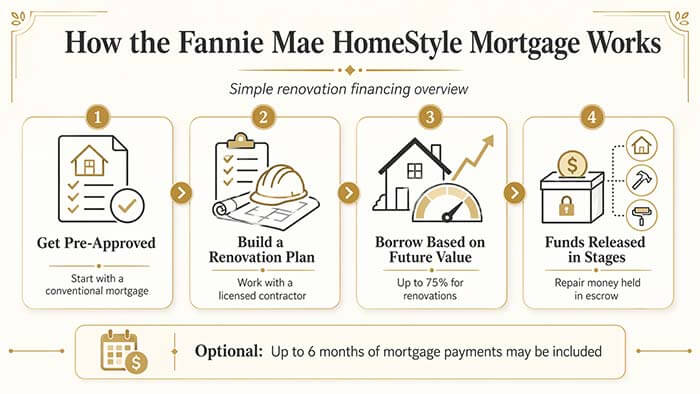
The Fannie Mae HomeStyle Mortgage is an excellent choice if you want to renovate your home. First, you’ll need to get pre-approved for a conventional mortgage with Gustan Cho Associates. Once you’ve sorted that, you can team up with a licensed contractor to assemble a renovation plan and cost estimate. Your loan amount will be based on what your home could be worth after the repairs, letting you borrow up to 75% of that value just for renovations.
The cash for the repairs will be held in a separate escrow account and handed out in parts as the work gets completed. You can also add up to six months of mortgage payments into the loan, giving you a bit more financial breathing room while you’re renovating.
HomeStyle Approval Checklist: What You’ll Need to Qualify
Use this checklist to quickly see what lenders look for on a Fannie Mae HomeStyle Mortgage. The more items you can check off upfront, the faster and smoother your approval usually goes.
Borrower Qualification Checklist
- ☐ Credit score in conventional range (HomeStyle follows standard conventional underwriting—stronger credit helps)
- ☐ Stable income and employment (W-2, self-employed, retirement, or other eligible sources)
- ☐ DTI within conventional guidelines (your loan officer will run this with your full housing payment + debts)
- ☐ Funds for down payment (based on occupancy type: primary/second home/investment)
- ☐ Cash reserves (some files require reserves—especially for multi-unit, investment, or higher-risk profiles)
- ☐ Clean documentation trail for deposits and assets (avoid large unexplained deposits right before applying)
Property + Renovation Eligibility Checklist
- ☐ The home is an eligible property type (primary residence, second home, or investment—depending on the scenario)
- ☐ Renovations are permanently attached and support value, safety, livability, or efficiency
- ☐ Project is not a full tear-down/new construction (HomeStyle is for renovations, not rebuilding from scratch)
- ☐ Your renovation plan includes realistic costs and timelines (underwriting looks for feasibility)
- ☐ After-Improved Value (ARV) supports the total loan amount (this is critical—appraisal must justify it)
Contractor + Paperwork Checklist (Biggest Delay Area)
- ☐ You’ve selected a licensed/insured contractor (required in most cases)
- ☐ A detailed scope of work is completed (line-item description of what’s being done)
- ☐ A signed contractor bid/estimate with labor + materials is included
- ☐ Contractor provides required items (commonly requested):
- ☐ License (if applicable in your state/county)
- ☐ Insurance certificate
- ☐ W-9 (often requested)
- ☐ References/experience portfolio (sometimes requested)
- ☐ Any required permits are identified (and budgeted if possible)
- ☐ You understand the escrow draw process (contractor is paid in stages after inspections)
Underwriting “Red Flags” to Fix Early
- ☐ Large new debts (auto loan, new credit cards) avoided during the process
- ☐ Credit disputes removed/resolved (depending on lender/automated underwriting findings)
- ☐ Renovation bid is not vague (avoid “miscellaneous repairs” with no detail)
- ☐ Your contractor timeline fits program expectations (extreme timelines can trigger questions)
- ☐ You have a plan for change orders (they must be approved—don’t start extra work without approval)
Fast-Track Tip
If you want the fastest approval, have these ready before you apply:
- Contractor bid + scope of work
- Your last 60 days bank statements
- Pay stubs (30 days) or income docs (self-employed)
- ID + insurance info (refi: mortgage statement too)
Transform Your Home with a Fannie Mae HomeStyle Mortgage
Turn your dream renovation into reality with just one loan—get pre-approved for the HomeStyle Mortgage.
What Documents Do I Need for a Fannie Mae HomeStyle Mortgage?
Whether you’re buying a home or refinancing, you’ll need standard paperwork:
For Purchases:
- Last 60 days of bank statements
- Last 30 days of pay stubs
- Last 2 years of W2s and tax returns
- Valid driver’s license
- Contractor contact information and project plans
For Refinancing:
- All items above, plus:
- Current mortgage statement
- Homeowner’s insurance policy
Your loan officer at Gustan Cho Associates will walk you through every step and help collect everything.
Do I Need a Contractor for a HomeStyle Loan? Can I Do It Myself?
Fannie Mae generally prefers that renovations financed through a HomeStyle Loan be carried out by a licensed and insured contractor. However, homeowners can complete up to 10% of the work themselves. This is permissible if the total cost of the work is under $5,000, or if a full inspection is provided for projects costing over that amount.
Additionally, it’s important to note that the lender must review and approve the proposed scope of work.
You cannot pay the contractor out of your own pocket. All expenses must be paid from the renovation escrow account set up for the loan. This ensures that the funds are used correctly for the renovations.
Down Payment and Loan Limits for Fannie Mae HomeStyle in 2026
The down payment is based on the total cost of the home + renovations.
- Primary residence: As little as 3% down (if first-time buyer)
- Second homes: Minimum 10% down
- Investment properties: At least 15% down
In 2026, conforming loan limits have increased in many areas. For example:
- $766,550 is the new baseline conforming limit
- Higher-cost areas may allow up to $1,149,825
Your total loan—including renovations—must stay within those limits.
Pros of the Fannie Mae HomeStyle Mortgage in 2026
One Loan, One Closing—No Second Mortgage
With the Fannie Mae HomeStyle Mortgage, you simplify your financing process by combining your home purchase or refinance and renovation costs into a single mortgage loan. This means less paperwork and only one closing process, making it more convenient for homeowners.
Luxury Upgrades Allowed (unlike FHA 203k)
The HomeStyle Mortgage allows you to finance high-end renovations and luxury upgrades, providing flexibility to customize your home to your taste. This is an advantage over the FHA 203k program, which has stricter limits on the types of improvements eligible for financing.
Cancelable Mortgage Insurance
Borrowers can cancel mortgage insurance once certain equity thresholds are reached. This feature can help reduce monthly payments and save money in the long term, enhancing the overall affordability of the mortgage.
Use for Primary, Second, or Investment Properties
The Fannie Mae HomeStyle Mortgage is versatile, allowing you to finance your primary residence, second homes, or investment properties. This broad eligibility makes it an attractive option for various real estate investment strategies.
Borrow Against After-Repair Value (ARV)
This mortgage lets you borrow money based on what the property is expected to be worth after you make some upgrades. So, you can get extra cash for improvements without waiting for the work to wrap up and seeing an increase in your home’s value.
Financing for up to 6 Months of Mortgage Payments During Renovations
Homeowners can receive financing to cover mortgage payments while renovations are underway, providing peace of mind and financial support during the remodel. This feature can alleviate the financial burden of dual payments when temporarily living elsewhere or during extensive renovations.
Competitive Interest Rates
The Fannie Mae HomeStyle Mortgage usually has good interest rates, which is great for anyone looking to keep their borrowing costs down. With lower rates, you can save quite a bit over the life of the loan, making it easier to tackle home improvements without breaking the bank.
Cons of the Fannie Mae HomeStyle Mortgage
- It can take 45–60 days or more to close
- Stricter credit and DTI requirements than FHA loans
- Cannot be used for full demolitions
- You must submit a detailed renovation plan before closing
- Requires working with an experienced lender and contractor
That’s why working with a team like Gustan Cho Associates matters—we close loans others can’t.
One Loan, Big Makeover—Fannie Mae HomeStyle Mortgage
Get the funds you need to buy and renovate your home with a simple, affordable loan.
Fannie Mae HomeStyle Mortgage vs FHA 203(k): What’s the Difference?
| Feature | HomeStyle | FHA 203(k) |
| Property Types | Primary, second, investment | Primary only |
| Credit Guidelines | Stricter | More lenient |
| Max Renovation | 75% of ARV | Limited based on program type |
| Luxury Features | Allowed | Not allowed |
| Mortgage Insurance | Cancelable at 80% LTV | Lifetime MIP (if <10% down) |
How to Apply for a Fannie Mae HomeStyle Mortgage With Gustan Cho Associates
Applying is easy. We handle everything in-house and don’t impose any lender overlays that other banks do.
Here’s how to get started:
- Call or text us at 800-900-8569
- Please email us at alex@gustancho.com
- Or visit www.gustancho.com to apply online
Once you submit your application, one of our licensed renovation loan experts will walk you through every step, from approval to final inspection.
Who Is a Good Fit for the Fannie Mae HomeStyle Mortgage?
You may benefit from a HomeStyle loan if:
- You want to buy a fixer-upper
- You love your home but want to upgrade instead of move
- You want to build wealth through home improvements
- You’re planning a second home remodel
- You’re a real estate investor looking to boost rental property value
Renovation Adds Real Value—Now More Than Ever
Home prices in the U.S. went up by 7.38% from 2022 to 2023, according to the Federal Housing Finance Agency (FHFA). Because there’s still a lot of demand and not enough homes on the market, many homeowners opt to renovate their homes instead of moving.
When you improve your home’s value, you also improve your net worth. And with a HomeStyle loan, you’re doing it smarter—with one payment, one loan, and zero hassle.
Final Thoughts: Why Work With Gustan Cho Associates for Your Fannie Mae HomeStyle Mortgage?
At Gustan Cho Associates, we specialize in helping borrowers whom other lenders deny. Borrowers who need a five-star national mortgage company licensed in 50 states with no overlays and who are experts on Fannie Mae HomeStyle Mortgage, please contact us at 800-900-8569, text us for a faster response, or email us at alex@gustancho.com.
Whether upgrading your current home or buying one with potential, the Fannie Mae HomeStyle Mortgage could be your ticket to building your dream home without breaking your budget.
Frequently Asked Questions About Fannie Mae HomeStyle Mortgage:
What is a Fannie Mae HomeStyle Renovation Loan?
A Fannie Mae HomeStyle Renovation loan is a conventional mortgage that lets you buy or refinance a home and finance renovations in the same loan. Instead of taking out a separate HELOC or personal loan, renovations are built into your primary mortgage structure.
How Does a HomeStyle Renovation Loan Work?
You get approved for a conventional loan, submit a renovation plan and bids, then the lender orders an “as-completed” appraisal (after-improved value). After closing, renovation funds are held in a renovation escrow account and released in stages (“draws”) as work is completed per the agreed schedule.
What Credit Score do You Need for a HomeStyle Renovation Loan?
Most published program guides commonly reference 620 as the minimum credit score baseline for HomeStyle Renovation (lender overlays can be higher). Your rate and approval strength typically improve with higher scores and a clean credit history.
How Much Can You Borrow for Renovations with a HomeStyle Loan?
For a purchase, the renovation costs generally can’t exceed 75% of the lesser of (a) purchase price + renovation costs, or (b) the “as completed” appraised value. For a refinance, it’s generally 75% of the “as completed” value (different rules apply to manufactured homes).
What Types of Renovations are Allowed with HomeStyle Renovation?
HomeStyle Renovation is flexible and can cover a wide range of renovation types, including repairs and improvements throughout the home. Fannie Mae describes it as allowing borrowers to renovate any part of the home (including projects like adding living space, such as an in-law suite/ADU-type improvements), depending on eligibility and lender review.
Do You have to Use a Contractor for a HomeStyle Renovation Loan?
Not always. Fannie Mae allows a “Do It Yourself” option on one-unit properties (not manufactured homes), but DIY work generally can’t exceed 10% of the “as completed” value, and items over $5,000 require inspection. The lender must review and approve the plan in advance.
Does the Property have to be Habitable at Closing?
No—Fannie Mae states the home does not have to be habitable at closing. If it’s uninhabitable, borrowers may be able to finance up to six months of PITIA payments (principal, interest, taxes, insurance, and association dues if applicable) during the renovation period (when permitted by the scenario).
Can You Use a HomeStyle Renovation Loan for a Second Home or Investment Property?
Yes, in many cases. Fannie Mae’s eligibility guidance lists HomeStyle Renovation as available for one-unit second homes and one-unit investment properties (and certain principal residence scenarios, including 1–4-unit primary residences).
Can You Include Mortgage Payments in the Loan While Renovations are Happening?
Yes—at the borrower’s request, Fannie Mae allows escrowing up to 6 mortgage payments (PITIA) as part of total renovation costs for a principal residence if the property can’t be occupied during renovation, subject to specific escrow handling requirements.
How are Renovation Funds Paid Out (Draws) with HomeStyle Renovation?
Renovation funds are deposited into a renovation escrow account and released only after work is completed, in accordance with the agreed draw schedule and a specific request. Disbursements are typically made jointly to the borrower/contractor or via wire to the contractor with written borrower consent before each disbursement.
This blog about “Fannie Mae HomeStyle Mortgage: One Loan, Big Makeover” was updated on January 23rd, 2026.
Looking to Renovate? Finance Your Home and Remodel with HomeStyle Mortgage
Finance your home purchase and renovation all in one loan with the Fannie Mae HomeStyle Mortgage.