
Is Homes for Heroes’ mortgage for firefighters a special mortgage?
No. Homes for Heroes is a savings network, not a separate mortgage, a government-backed loan, or a guaranteed-approval program. It connects eligible firefighters and other community heroes with participating real estate agents, mortgage professionals, and service providers who may offer rewards or savings. Borrowers must still qualify for an FHA, VA, USDA, conventional, or another available loan based on their credit, income, debt-to-income ratio, and property requirements. Homes for Heroes benefits may reduce certain transaction costs, but savings and availability vary. Compare the interest rate, APR, lender fees, monthly payment, and total cash needed before choosing an offer.
What Is the Homes for Heroes Program?
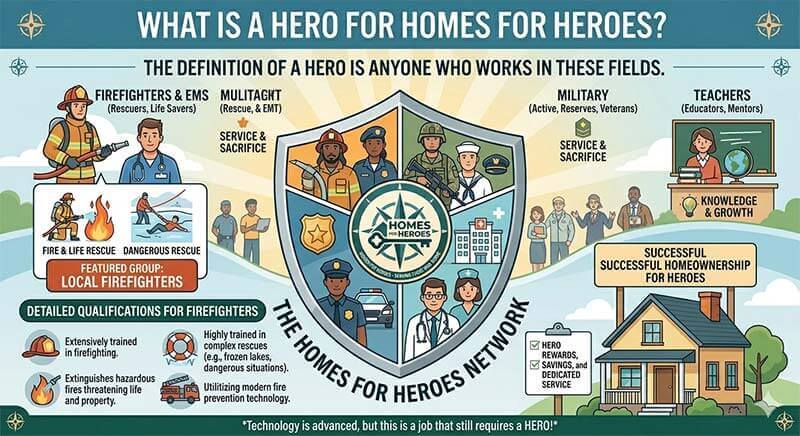
The Homes for Heroes program is a nationwide savings network for eligible firefighters and other community professionals. It is not a separate mortgage loan or government program. Through the network, a borrower may work with a participating real estate agent, lender, title company, home inspector, or other service provider. These professionals may offer rewards or savings during the home purchase, sale, or refinance process. Borrowers using a Homes for Heroes Mortgage for firefighters must still qualify for the underlying loan based on the lender’s credit, income, debt, and property requirements. Benefits, participating providers, and savings may vary by location and transaction.
Who Qualifies for Homes for Heroes?
Homes for Heroes generally serves current and former firefighters, EMS professionals, law enforcement officers, military members, healthcare professionals, and educators. Eligibility may depend on your occupation, employment status, location, and the participating providers available in your area. Before using a Homes for Heroes Mortgage for firefighters, confirm your eligibility directly with Homes for Heroes or a participating professional. Qualifying for the rewards program does not guarantee mortgage approval; borrowers must still meet the requirements of their chosen loan program and lender.
How Much Can Firefighters Save?
Eligible firefighters may receive Hero Rewards when buying, selling, or refinancing a home through participating Homes for Heroes professionals. Rewards are generally provided after the transaction closes, although the timing and form of the benefit can vary. Savings depend on the home price, transaction type, location, and participating real estate, mortgage, title, or inspection providers. A Homes for Heroes Mortgage for firefighters does not guarantee a specific reward, reduced rate, or closing-cost credit. State restrictions and program limits may apply, so confirm the estimated benefit and eligibility before choosing a provider.
Mortgage Options for Firefighters
A Homes for Heroes Mortgage for firefighters is not a separate loan program. Firefighters must qualify for an FHA, conventional, VA, or USDA loan based on the program’s standard requirements.
FHA Loans
FHA loans offer flexible credit requirements and allow down payments as low as 3.5% for qualified borrowers. Mortgage insurance is required.
Conventional Loans
Conventional loans might require down payments as low as 3% for eligible borrowers. Private mortgage insurance may be required when putting less than 20% down.
VA Loans for Eligible Veterans
Firefighters with eligible military service can qualify for a VA loan that requires no down payment, no monthly mortgage insurance, and offers flexible underwriting guidelines.
USDA Loans for Eligible Areas and Households
USDA loans may provide 100% financing for qualifying households purchasing eligible properties in rural and certain suburban areas. Income and location limits apply.
How Lenders Count Firefighter Overtime and Shift Pay
A Homes for Heroes Mortgage for firefighters may allow eligible overtime, shift differential, and other recurring pay to count as qualifying income. However, lenders do not assume every amount shown on a recent paycheck will continue. Underwriters typically review the firefighter’s income history, consistency, and current earnings. A two-year history is often preferred for variable overtime, although a shorter history may sometimes be considered when the income is stable and likely to continue. The lender may average earnings using recent pay stubs, W-2s, year-to-date totals, and a written verification of employment. The employer may also be asked whether the overtime or shift pay is expected to continue. Declining, irregular, seasonal, or one-time earnings may be reduced or excluded. Because FHA, VA, USDA, conventional, and individual lender guidelines differ, the final income calculation depends on the full employment record and the loan program.
First Responder Down Payment Assistance
State and local housing agencies may offer first responders grants, forgivable loans, or deferred-payment second mortgages to help with the down payment and closing costs. Eligibility, income limits, property rules, and funding availability vary by program. These benefits are separate from a Homes for Heroes Mortgage for firefighters, which is a savings network—not a down payment assistance program. Borrowers should confirm whether assistance can be combined with their chosen loan and Hero Rewards. HUD’s Good Neighbor Next Door program is another separate option. Eligible full-time firefighters, EMTs, law enforcement officers, and pre-K–12 teachers may purchase certain HUD-owned homes in designated revitalization areas at a 50% discount. Available homes are limited. Buyers must use the property as their primary residence for 36 months. Review the complete requirements through HUD’s Good Neighbor Next Door program.
Credit, Down Payment, and DTI Requirements
A borrower’s job as a firefighter does not create separate mortgage qualification rules. Down payment, credit score, and debt-to-income ratio requirements depend on the specific loan program (FHA, VA, USDA, or conventional) and the lender’s guidelines. A Homes for Heroes Mortgage for firefighters may provide eligible savings, but it does not guarantee approval or waive standard underwriting requirements. Lenders still review income stability, monthly debts, credit history, available funds, and the property. Some lenders also impose stricter requirements called overlays. Firefighters should compare lenders when one company’s guidelines prevent approval.
How to Compare the Savings With a Regular Mortgage
Do not choose a Homes for Heroes Mortgage for firefighters based only on the advertised reward. Compare it with at least one regular mortgage offer using the official Loan Estimates. Review the interest rate, APR, origination charges, lender fees, discount points, monthly payment, and total cash to close. Also, calculate any real estate-related savings, such as agent rewards, inspection discounts, or title-service benefits. The offer with the largest Hero Reward may not provide the lowest overall cost. Compare both the upfront savings and the long-term cost before deciding.
Documents Firefighters Need for Preapproval
When applying for a Homes for Heroes Mortgage for firefighters, borrowers should prepare:
- Recent pay stubs showing base pay, overtime, and shift differential
- W-2 forms from the past two years
- Recent bank and asset statements
- Employment verification and current job information
- A two-year history of overtime, hazard pay, or shift income
- Statements for mortgages, car loans, student loans, credit cards, and other debts
- Government-issued identification
- Military service documents if applying for a VA loan
Additional records may be required based on the loan program, income structure, and credit history. Complete documents help the lender calculate qualifying income and issue a more reliable preapproval.
Firefighter Mortgage Approval Example
The following is an anonymized example, not a promised result. A firefighter earned $72,000 in annual base pay, or $6,000 per month. Their documented overtime totaled $10,800 one year and $13,200 the next. Current year-to-date earnings supported a similar pattern, and the employer confirmed that overtime was likely to continue. The underwriter averaged the two completed years of eligible overtime, resulting in $1,000 per month. This produced $7,000 in total qualifying monthly income for the Homes for Heroes Mortgage for firefighters application. Actual calculations and approval decisions depend on the loan program, income trend, documentation, debts, credit, and lender guidelines.
How to Apply
To apply for a Homes for Heroes Mortgage for firefighters:
- Confirm your occupational eligibility and available benefits with Homes for Heroes.
- Choose a participating real estate or mortgage professional.
- Gather income, assets, debt, employment, and identification documents.
- Apply for the FHA, VA, USDA, conventional, or other mortgage that fits your needs.
- Obtain a preapproval based on verified credit, income, assets, and debts.
- Get loan estimates from various lenders and compare rates, APRs, fees, monthly payments, Hero Rewards, and cash-to-close before choosing an offer.
Program eligibility does not guarantee mortgage approval, and benefits may vary.
Final Thoughts
A Homes for Heroes Mortgage for firefighters may offer useful savings, but the reward is only one part of the decision. Compare the complete loan and benefit package, including the interest rate, APR, lender fees, discount points, monthly payment, cash to close, and real estate-related savings. Choose the offer that best supports your short- and long-term financial goals. A licensed mortgage professional can review your income, loan options, and estimated benefits without pressuring you to commit.
Frequently Asked Questions About Homes for Heroes for Firefighters:
Is Homes for Heroes Free for Firefighters?
There is no enrollment fee for eligible firefighters. However, borrowers still pay the normal costs associated with buying, selling, or financing a home. Review the Loan Estimate and closing disclosures for all lender and third-party fees.
Do Firefighters have to be First-Time Homebuyers?
No. Firefighters do not need to be first-time buyers to use Homes for Heroes. Eligible participants may receive savings when buying, selling, or refinancing, subject to program availability and restrictions.
Can I Keep My Current Real Estate Agent or Loan Officer?
Possibly. If you already have an agent or loan officer, ask that professional to contact Homes for Heroes about participating. Do not cancel an existing agreement without reviewing its terms. Hero Rewards are not automatically available through professionals outside the network.
Must I Use Every Homes for Heroes Service Provider?
No. You may choose which participating specialists to use. However, mortgage, real estate, title, and inspection savings are separate, so using fewer participating providers could reduce your total benefit.
Do Firefighters have to Repay Hero Rewards?
Hero Rewards generally do not need to be repaid because they are savings rather than a loan. They should not be confused with repayable down payment assistance or a second mortgage. Confirm the written terms before closing.
Is Homes for Heroes a Nonprofit Organization?
Homes for Heroes, Inc. is a for-profit, cause-related company. The Homes for Heroes Foundation is a separate nonprofit organization that provides grants to organizations serving heroes in need.
Can Homes for Heroes be Used When Buying New Construction?
Potentially, but the reward may differ for new construction because commissions, builder rules, and available service providers vary. Enroll before closing and confirm the estimated reward with Homes for Heroes and the builder.
Are Hero Rewards Taxable?
Tax treatment depends on how the reward is structured and the transaction involved. The IRS generally treats qualifying purchase rebates as price adjustments rather than income, which may reduce the property’s tax basis. Buyers should keep their closing records and consult a tax professional about their situation.
This article about “Homes for Heroes for Firefighters: Save More on a Home” was updated on August 3rd, 2026.