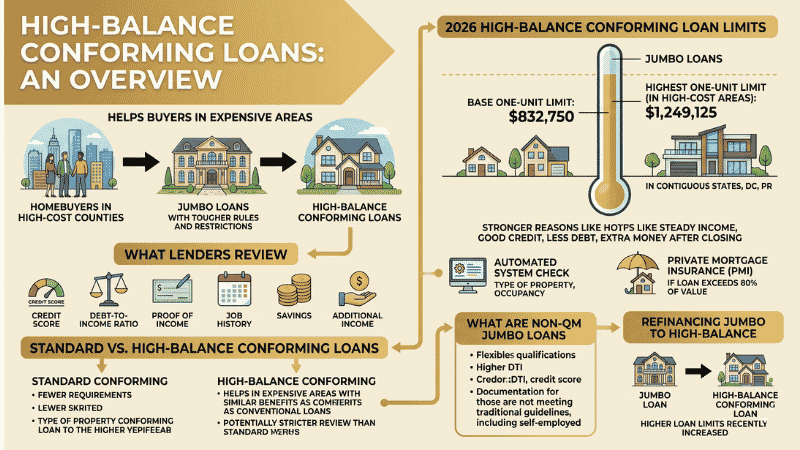
High-balance conforming loans finance amounts above the national conforming baseline but within the higher FHFA limit for an eligible high-cost county. For 2026, the one-unit baseline is $832,750, and the maximum high-cost ceiling is $1,249,125 in most of the United States. Qualification depends on the property’s county, number of units, occupancy, loan-to-value ratio, automated underwriting findings, credit, income, assets, and reserves.
What are High-Balance Conforming Loans?
A high-balance conforming loan is a conventional mortgage with an original loan amount above the national conforming baseline but within the higher limit assigned to an eligible high-cost county. A mortgage is classified as high-balance conforming when:
- The original loan amount exceeds the national baseline for the property’s number of units.
- The loan amount does not exceed the FHFA limit for that county and unit count.
- The borrower, the property, the occupancy, and the transaction satisfy the eligibility criteria set by Fannie Mae or Freddie Mac.
The number of units is important because FHFA establishes separate limits for one-, two-, three-, and four-unit properties. A loan that exceeds the one-unit baseline may remain a standard conforming loan if it finances a two- to four-unit property with a higher baseline limit. County eligibility also matters. A borrower cannot use the maximum national high-cost ceiling unless the property is located in a county assigned that limit. Some high-cost counties have limits between the national baseline and the maximum ceiling. FHFA loan limits govern the maximum original loan balances Fannie Mae and Freddie Mac may acquire. They do not establish the maximum amount that every mortgage lender can lend to a consumer. When a conventional loan exceeds the applicable FHFA limit for the property’s county and number of units, it is generally considered a jumbo or nonconforming mortgage and must follow another investor’s guidelines. Borrowers and lenders can verify the current limits using the FHFA conforming loan limit files and map.
2026 High-Balance Conforming Loan Limits
The 2026 conforming loan limit depends on the property’s location and number of residential units. In most areas, the baseline limit for a one-unit property is $832,750. A mortgage above the applicable baseline may qualify as one of the high-balance conforming loans when the property is in an eligible high-cost county, and the loan does not exceed that county’s FHFA limit.
| Units | 2026 baseline | Maximum high-cost ceiling* |
|---|---|---|
| 1 | $832,750 | $1,249,125 |
| 2 | $1,066,250 | $1,599,375 |
| 3 | $1,288,800 | $1,933,200 |
| 4 | $1,601,750 | $2,402,625 |
*These maximum high-cost ceilings apply outside Alaska, Hawaii, Guam, and the U.S. Virgin Islands. Special statutory areas have different baseline and maximum values. The maximum ceiling does not apply automatically to every property in a high-cost state. Each eligible county receives its own limit, which may fall anywhere between the national baseline and the maximum high-cost ceiling. Borrowers must use the limit for the county where the property is physically located and the property’s legal number of units. These limits apply to the original mortgage amount, not the home’s purchase price. A buyer may purchase a property for more than the county limit by making a sufficient down payment to keep the loan amount within the applicable conforming limit. Freddie Mac publishes the official 2026 one- to four-unit conforming loan limits, while FHFA provides the county-level files needed to determine the exact limit for a specific property.
How County Eligibility Works
County eligibility determines whether a mortgage amount above the national baseline qualifies as a high-balance conforming loan. Borrowers must use the FHFA limit assigned to the physical location of the property—not the borrower’s current residence, employer’s location, or lender’s office. The applicable limit depends on:
- The property’s physical address
- The correct county or county-equivalent
- The number of legal residential units
- The calendar year in which the limit applies
The number of units must match the property’s legal configuration. A single-family home with an accessory dwelling unit is not automatically considered a two-unit property. The appraisal, zoning records, and property documentation must support the reported unit count. Each unit category has a separate national baseline. Therefore, a mortgage is not classified by comparing every property with the one-unit limit. A $900,000 one-unit loan could be one of the high-balance conforming loans available in an eligible high-cost county. A $900,000 two-unit loan would remain within the 2026 national two-unit baseline of $1,066,250. It would not be classified as high-balance solely because it exceeds the one-unit baseline. Loan limits can also change annually. Borrowers should verify the limit applicable to the transaction rather than relying on a previous year’s preapproval or a limit used for another property. The FHFA county limit files and map provide the official one-to-four-unit limits for each county and county-equivalent.
Understand High-Balance Conforming Guidelines Upfront
Credit score, DTI, down payment, reserves, occupancy, property type, and automated underwriting findings can all affect approval. Get a clear review before underwriting.Fannie Mae and Freddie Mac High-Balance Guidelines
Fannie Mae and Freddie Mac purchase conventional mortgages that meet their respective eligibility requirements. Both allow larger loan amounts in designated high-cost areas, but their terminology, automated underwriting systems, and certain loan-to-value requirements differ. Borrowers seeking high-balance conforming loans must meet the rules of the agency selected by the lender.
Fannie Mae High-Balance Loans
A Fannie Mae high-balance loan must be a conventional first-lien mortgage. The original loan amount must exceed the national baseline for the property’s number of units without exceeding the FHFA limit for the county where the property is located. Fannie Mae requires every high-balance mortgage to be underwritten through Desktop Underwriter, commonly called DU. The loan must receive an eligible DU recommendation and satisfy the conditions shown in the final underwriting findings. Fannie Mae does not permit lenders to bypass this requirement by manually underwriting a standard high-balance loan. The transaction is also subject to the applicable loan-to-value, combined loan-to-value, and home-equity combined loan-to-value limits. These ratios may vary according to occupancy, loan purpose, property type, number of units, and subordinate financing. All standard Fannie Mae requirements continue to apply, including those governing:
- Borrower eligibility and credit history
- Employment and qualifying income
- Assets and funds to close
- Post-closing reserves
- Occupancy and property eligibility
- Appraisal, title, and insurance
- Condominiums and cooperative projects
Fannie Mae may also apply high-balance loan-level price adjustments in addition to other adjustments based on credit score, LTV, occupancy, property type, and transaction characteristics. Fannie Mae B5-1-01 provides the agency’s primary high-balance eligibility and underwriting requirements.
Freddie Mac Super Conforming Loans
Freddie Mac generally refers to its high-balance mortgages as super conforming loans. The mortgage must fall within the FHFA limit for the property’s county and number of units while meeting Freddie Mac’s borrower, transaction, occupancy, and property requirements. All Freddie Mac super-conforming mortgages must be submitted to the Loan Product Advisor (LPA). A mortgage receiving an Accept risk class may proceed under the applicable LPA findings. A Caution mortgage—or a submission that does not receive a risk class—may require manual underwriting and must satisfy Freddie Mac’s additional credit, DTI, documentation, and eligibility requirements. Freddie Mac super conforming loans are also subject to applicable LTV, TLTV, and HTLTV limits. Some of these limits differ from Fannie Mae’s requirements, particularly for multiunit principal residences. Freddie Mac may also assess credit fees based on the super conforming feature and other loan characteristics. Because the two agencies do not apply identical rules, a loan that does not receive an acceptable result through one agency’s system may have a different outcome when properly evaluated under the other agency’s guidelines.
Occupancy and Property Requirements
A higher county loan limit does not automatically make a property eligible for high-balance conforming loans. The home must also satisfy Fannie Mae or Freddie Mac requirements for occupancy, valuation, title, insurance, and property. Eligible properties may include:
- One-to-four-unit principal residences
- One-unit second homes
- One-to-four-unit investment properties
- Condominiums and cooperative units
- Homes in planned-unit developments
Maximum loan-to-value ratios vary by occupancy and number of units. Second homes must generally be one-unit properties, while investment and multiunit properties usually require larger down payments and additional reserves. Condominium and cooperative units are subject to project eligibility requirements. The lender may review the project’s insurance, finances, litigation, structural condition, special assessments, commercial space, and ownership concentration. An acceptable individual unit does not make an ineligible project acceptable. The property must have an acceptable appraisal or other permitted valuation, marketable title, adequate hazard insurance, required flood insurance, and sufficient condition to serve as collateral. The property rules for Fannie Mae and Freddie Mac are not identical. Fannie Mae may permit certain manufactured homes that meet its separate requirements. Freddie Mac excludes mortgages secured by manufactured homes from its super conforming program. Borrowers should confirm the county limit, occupancy, legal unit count, property type, and agency eligibility before relying on a high-balance preapproval.
Occupancy and Property Requirements
A higher county loan limit does not automatically make a property eligible for high-balance conforming loans. The home must also satisfy Fannie Mae or Freddie Mac requirements for occupancy, valuation, title, insurance, and property. Eligible properties may include:
- One-to-four-unit principal residences
- One-unit second homes
- One-to-four-unit investment properties
- Condominiums and cooperative units
- Homes in planned-unit developments
Maximum loan-to-value ratios vary by occupancy and number of units. Second homes must generally be one-unit properties, while investment and multiunit properties usually require larger down payments and additional reserves. Condominium and cooperative units are subject to project eligibility requirements. The lender may review the project’s insurance, finances, litigation, structural condition, special assessments, commercial space, and ownership concentration. An acceptable individual unit does not make an ineligible project acceptable. The property must have an acceptable appraisal or other permitted valuation, marketable title, adequate hazard insurance, required flood insurance, and sufficient condition to serve as collateral. Fannie Mae and Freddie Mac property rules are not identical. Fannie Mae may permit certain manufactured homes that meet its separate requirements. Freddie Mac excludes mortgages secured by manufactured homes from its super conforming program. Borrowers should confirm the county limit, occupancy, legal unit count, property type, and agency eligibility before relying on a high-balance preapproval.
AUS, Credit, DTI, Assets, and Reserves
Approval for high balance conforming loans is based on the borrower’s full profile and the automated underwriting system. A high county loan limit does not grant approval.
Automated Underwriting
Similar to high balance loans, loans within the super conforming range need to be underwritten using the Freddie Mac Loan Product Advisor if there is a case file. If the case file has a “Caution” flag or lacks an LPA risk class, Freddie Mac’s streamline loan process can be used.
Credit Scores
A score of 620 should not be treated as a universal agency minimum. Currently, the Fannie Mae 2026 Guide states that there is no minimum DU credit risk score, and lenders must ensure they have the required credit information. Lenders can set their own policies above the minimum score.
Debt-to-Income Ratios
For DU case files, Fannie Mae sets a 50% limit on total DTI, though DU may recommend approval even at 50% DTI. For Freddie Mac, mortgage acceptance requires approval by LPA. For super conforming loans that require manual underwriting, 45% DTI is generally the limit.
Assets and Reserves
Reserves are the remaining assets after the loan closes. For DU files, a one-unit principal residence has no standard minimum reserve requirement, although reserves are required by DU. Two- to four-unit principal residences and investment properties have a 6-month reserve requirement. Additional reserves may be required.
Down-Payment Requirements
Down-payment requirements for high-balance conforming loans depend on the agency, occupancy, and number of units. The following maximum LTV ratios apply to eligible purchase transactions:
| Purchase occupancy/property | Fannie Mae maximum LTV | Freddie Mac maximum LTV |
|---|---|---|
| One-unit principal residence | 95% | 95% |
| Two-unit principal residence | 85% | 85% |
| Three-to-four-unit principal residence | 75% | 80% |
| One-unit second home | 90% | 90% |
| One-unit investment property | 85% | 85% |
| Two-to-four-unit investment property | 75% | 75% |
Based on these maximums, an eligible one-unit principal residence may require as little as 5% down. A two-unit principal residence generally requires at least 15% down, while Fannie Mae requires 25% down on a three- to four-unit principal residence and Freddie Mac requires 20%. Second homes generally require at least 10%, and investment properties require 15% to 25%, depending on the number of units. These are maximum agency LTV ratios—not guaranteed down-payment offers. Factors such as credit history, debt-to-income ratio, automated underwriting results, mortgage insurer approval, property type, transaction structure, and lender requirements may require a larger equity contribution from the borrower. Borrowers should review the Fannie Mae Eligibility Matrix and Freddie Mac maximum LTV requirements with their lender before determining the required down payment.
PMI Requirements for High-Balance Conforming Loans
Private mortgage insurance is generally required when high-balance conforming loans exceed 80% LTV. PMI protects the lender against part of the potential loss if the borrower defaults; it does not protect the borrower or replace homeowners’ insurance. PMI approval and pricing depend on the complete risk profile, including:
- Credit score and credit history
- Loan-to-value ratio
- Occupancy
- Property type and number of units
- Debt-to-income ratio
- Loan amount and underwriting findings
A borrower may satisfy Fannie Mae or Freddie Mac requirements but still need approval from a mortgage-insurance provider. The insurer or lender may require a lower LTV or stronger borrower profile. PMI on a conventional high-balance loan is different from FHA mortgage insurance. Conventional PMI is provided by a private insurer and may eventually be canceled when applicable requirements are met. FHA loans use government mortgage insurance with separate upfront and annual premiums. Fannie Mae permits financed borrower-paid mortgage insurance on eligible high-balance loans. However, the gross LTV after adding the financed premium cannot exceed 95%. Borrowers should compare the monthly PMI, financed premium cost, interest rate, APR, and total payment before choosing a mortgage insurance structure.
High-Balance Conforming Versus Jumbo Loans
The distinction between jumbo and high-balance conforming loans depends on the county limit. A high-balance loan is above the national baseline, but still falls within the FHFA limit for an eligible high-cost county. A jumbo loan exceeds the conforming limits for both the county and the number of units.
| High-balance conforming | Jumbo |
|---|---|
| Must be in an eligible high-cost county | Begins above the county’s applicable conforming limit |
| Follows Fannie Mae or Freddie Mac rules | Follows the individual investor’s guidelines |
| Uses FHFA county and unit limits | Not governed by the FHFA acquisition limit |
| Agency AUS and documentation requirements apply | Underwriting varies substantially by lender |
| PMI may be available above 80% LTV | Mortgage-insurance and down-payment structures vary |
Jumbo loans may have tighter underwriting criteria (higher credit, higher reserves, lower DTI, greater down payment), but these criteria are not uniform across all jumbo loans. Many jumbo loan programs can be more competitive than high-balance conforming loans for borrowers with high credit. Jumbo loan rates can be, but not always, above conforming rates. Pricing on both can vary depending on numerous factors, including credit, LTV, occupancy, the type and amount of the loan, reserves, and the lender. Closing costs, required reserves, APR, PMI, and total monthly payments have to be considered before choosing a loan.
Final Thoughts on High-Balance Conforming Loans
High-balance conforming loans allow borrowers to purchase higher-cost property without transitioning to jumbo loans. Considering the 2026 HFWA limit with county and unit, eligibility starts here. The County limit is the maximum loan amount. Final approval will rely on Fannie Mae or Freddie Mac, along with findings from automated underwriting, credit, and income, DTI, assets, reserves, occupancy, down payment, mortgage insurance, and the qualifying property. The borrower should verify the County’s and the unit’s limits and obtain a property-specific preapproval. A borrower should compare high-balance conforming and jumbo financing based on the complete transaction. Don’t just base it on the advertised rate. Check APR, PMI, closing costs, cash to close, reserve, and total monthly payment.
Frequently Asked Questions About High-Balance Conforming Loans
Can a First-Time Homebuyer Use a High-Balance Conforming Loan?
Yes. High-balance conforming loans are not limited to repeat buyers. A first-time homebuyer can qualify when the property is in an eligible high-cost county, and the borrower meets the applicable Fannie Mae or Freddie Mac credit, income, asset, occupancy, and underwriting requirements. First-time buyer status does not increase the county loan limit.
Can I Refinance Into a High-Balance Conforming Loan?
Yes. Rate-and-term and cash-out refinancing may be available when the new loan amount falls within the current FHFA limit for the property’s county and number of units. The borrower must also satisfy the applicable LTV, credit, income, reserve, appraisal, and automated underwriting requirements. Cash-out refinances generally have lower maximum LTV ratios than purchase or limited cash-out transactions.
Can Gift Funds be Used with a High-Balance Conforming Loan?
Gift funds may be used for an eligible principal residence or second home. Depending on the transaction, the funds may cover some or all of the down payment, closing costs, or required reserves. The donor, transfer, and gift letter must meet agency documentation requirements. Fannie Mae does not permit gift funds on investment-property transactions.
Can the Seller Pay Closing Costs on a High-Balance Conforming Loan?
Yes, subject to conventional interested-party contribution limits. For a principal residence or second home, Fannie Mae generally permits contributions of up to 3% when the LTV exceeds 90%, 6% when the LTV is between 75.01% and 90%, and 9% when the LTV is 75% or lower. Investment-property contributions are generally limited to 2%. Contributions cannot exceed the eligible costs or replace the required down payment.
Are Adjustable-Rate High-Balance Conforming Loans Available?
Yes. Fannie Mae permits eligible adjustable-rate mortgage plans for high-balance loans. Freddie Mac allows eligible super-conforming mortgages to be fixed-rate loans or 5/6-, 7/6-, or 10/6-month ARMs. Availability can vary by lender, occupancy, property type, and underwriting findings. Borrowers should compare the initial rate, qualifying payment, adjustment schedule, margin, index, and lifetime rate cap.
Can a Non-Occupant Co-Borrower Help Qualify for a High-Balance Loan?
Potentially. Fannie Mae permits eligible guarantors, co-signers, and non-occupant borrowers on purchase and refinance transactions. However, additional LTV, contribution, occupancy, and underwriting requirements may apply. The lender must include the non-occupant borrower’s qualifying income, debts, credit, and other financial obligations when evaluating the loan. An added borrower does not guarantee an acceptable DU or LPA result.
Do High-Balance Conforming Loans have Income Limits?
Standard high-balance conforming loans do not have a general maximum household-income limit. Borrowers must have sufficient stable, documented income to meet the proposed housing payment and other debt obligations. Income limits may apply when the loan is combined with an affordable-housing product, a down-payment assistance program, a grant, or another specialized financing option.
This article about “2026 High-Balance Conforming Loans and Guidelines” was updated on August 21st, 2026.