
Do you need a real estate agent to buy a house? You generally do not need a real estate agent to buy a house. Buyers may represent themselves, work directly with a listing agent, or hire an attorney where permitted. However, buying a home involves more than finding a property and agreeing on a price.
A qualified buyer’s agent can help you review comparable home sales, prepare a competitive offer, understand contract terms, schedule inspections, negotiate repairs or seller concessions, and track important deadlines. The agent may also coordinate with your lender, appraiser, title company, inspector, and closing professionals.
Hiring a real estate agent doesn’t ensure all problems will be avoided. However, experienced representation can help you make informed decisions, reduce costly mistakes, and keep the transaction moving from the first showing through closing.
Is it Possible to Purchase a Home Without Using a Real Estate Agent?
Yes, you can buy a house without a real estate agent. Buyers are generally allowed to represent themselves, contact listing agents directly, attend open houses, prepare offers, and manage the transaction without hiring a buyer’s agent. However, self-representation means you are responsible for researching the property, reviewing comparable sales, understanding the purchase contract, scheduling inspections, negotiating repairs, meeting financing deadlines, and coordinating with the lender, title company, appraiser, and closing professionals. So, do you need a real estate agent to buy a house? Not necessarily. An experienced buyer, investor, attorney, or real estate professional may feel comfortable handling the transaction independently. A first-time buyer or someone unfamiliar with local contracts and market conditions may benefit from professional representation. Buying without an agent may also affect how you negotiate and receive advice. The listing agent usually represents the seller’s interests unless a different agency relationship is established under state law. Buyers who choose self-representation should understand that the listing agent may not be responsible for protecting the buyer’s position. Before proceeding without an agent, consider whether you can confidently:
- Evaluate whether the asking price is reasonable
- Prepare and explain the terms of an offer
- Understand contingencies and contract deadlines
- Review seller disclosures
- Arrange inspections and negotiate repairs
- Communicate with the mortgage lender
- Address appraisal or title problems
- Prepare for closing
A real estate agent is not required for every transaction, but professional guidance can be valuable when a purchase involves complex negotiations, financing requirements, property condition concerns, or strict deadlines.
What Does a Buyer’s Agent Do?
A buyer’s agent represents the homebuyer during the purchase process. The agent helps the buyer search for suitable properties, evaluate options, prepare an offer, negotiate terms, and stay on track through closing. A buyer’s agent may help with:
- Home search: Identifying properties that match the buyer’s price range, location, financing, and property requirements.
- Comparable sales: Analyzing recent sales of comparable homes to help the buyer evaluate the asking price.
- Showings: Scheduling property tours and helping the buyer compare homes.
- Offer preparation: Preparing the purchase offer with the proposed price, financing terms, closing date, and other conditions.
- Negotiation: Negotiating the purchase price, seller concessions, repairs, closing costs, and other contract terms.
- Contingencies: Explaining and tracking financing, appraisal, inspection, home-sale, and other contract contingencies.
- Inspections: Helping schedule inspections and communicating repair requests or proposed credits to the seller.
- Appraisal coordination: Communicating with the buyer and lender when an appraisal is ordered or when valuation issues arise.
- Contract deadlines: Tracking important dates for deposits, inspections, loan approval, appraisal, title work, and closing.
- Closing preparation: Coordinating with the lender, title company, attorney, and other professionals before the final walkthrough and closing.
A buyer’s agent does not replace a mortgage loan officer, home inspector, appraiser, title professional, or attorney. The agent coordinates the parties and keeps the buyer updated throughout the transaction.
What Is a Written Buyer Representation Agreement?
When asking, “Do you need a real estate agent to buy a house?”, it is also important to understand the agreement you may sign before working with a buyer’s agent. A written buyer representation agreement is a contract that explains the relationship between the homebuyer and the real estate agent or brokerage. The agreement should clearly address the following terms:
- Scope of services: The contract explains what the agent will do for the buyer. Services may include searching for homes, scheduling showings, reviewing comparable sales, preparing offers, negotiating terms, tracking deadlines, and helping coordinate the transaction through closing.
- Duration: The agreement states when the relationship begins and ends. It may apply to one property, one showing, a short trial period, or several months. Buyers can discuss and negotiate the length before signing.
- Exclusive or nonexclusive representation: An exclusive agreement generally requires the buyer to work with a single brokerage for the duration of the contract. A nonexclusive agreement may allow the buyer to work with more than one agent, subject to the contract’s terms.
- Geographic or property limitations: The agreement may apply only to certain cities, counties, price ranges, property types, or specific homes. Buyers should make sure the coverage matches their home search.
- Agent compensation: The agreement must explain how the buyer’s agent will be paid. Compensation may be a percentage, flat fee, hourly fee, or another clearly defined amount. Real estate compensation is negotiable and is not set by law. A seller or listing broker may agree to pay some or all of the buyer agent’s compensation, but buyers should not assume this will happen automatically.
- Termination provisions: The contract should explain whether the buyer or brokerage can end the agreement early, how notice must be provided, and whether any fees or continuing obligations apply after termination.
- Dual agency: In jurisdictions that permit dual agency, the contract specifies how the same agent or brokerage can represent both the buyer and the seller. This situation may lead to conflicts of interest and requires both parties to be informed and give their consent.
Buyer-agreement requirements, agency relationships, disclosures, and termination rights vary by state. Contract forms may also differ among brokerages and local real estate associations. Buyers should read the entire agreement, ask questions about unclear terms, and consider speaking with a real estate attorney when legal advice is needed. Under current National Association of Realtors rules, many agents who participate in an MLS must have a written agreement with a buyer before providing an in-person or virtual home tour. A buyer generally does not need to sign one merely to attend an open house independently or interview an agent about available services.
Do You Need a Real Estate Agent to Buy a House? Get Clear Guidance
You can buy a home with or without an agent, but the right choice depends on your experience, market, contract knowledge, and comfort with negotiations. Get a simple plan before you make an offer.Who Pays the Buyer’s Agent?
There is no fixed real estate commission for all home purchases. Agent fees are negotiable and not legally determined. Before viewing homes with buyer’s agents, buyers must sign a written agreement detailing the services offered and payment terms. Depending on the purchase agreement and local practices, a buyer’s agent may be paid through one or a combination of the following:
- The buyer pays the agent directly: The buyer may pay a percentage of the purchase price, a flat fee, an hourly fee, or another clearly defined amount stated in the representation agreement.
- The seller offers compensation: A seller or listing broker may agree to pay some or all of the buyer agent’s compensation as part of the transaction.
- The buyer negotiates a seller concession: The purchase offer may request that the seller contribute toward certain buyer expenses, including buyer-broker fees when permitted.
- The cost is divided: The seller or listing broker may cover part of the agreed compensation, while the buyer pays the remaining amount.
A seller is not automatically required to pay the buyer’s agent. Any seller-paid compensation or concession should be negotiated and documented in the purchase contract or another applicable agreement. Offers of compensation are no longer displayed through an MLS, although they may be communicated through other lawful methods. The buyer should understand the compensation terms before signing a representation agreement. The agreement should state an exact amount or a clear method for calculating the fee rather than an open-ended range. Under current NAR rules, the buyer’s agent generally cannot receive more compensation than the amount agreed to with the buyer. Seller contributions may also be limited by the buyer’s mortgage program, lender requirements, appraised value, and the terms of the purchase contract. Buyers should ask their agent and loan officer how a proposed contribution may affect the loan, required cash to close, and other closing costs before submitting an offer. When considering whether you need a real estate agent to buy a house, review both the services offered and the compensation obligation. Do not assume that using a buyer’s agent is free or that every seller will cover the fee. All payment terms should be explained, negotiated, and put in writing before the buyer commits to representation.
Benefits of Using a Buyer’s Agent
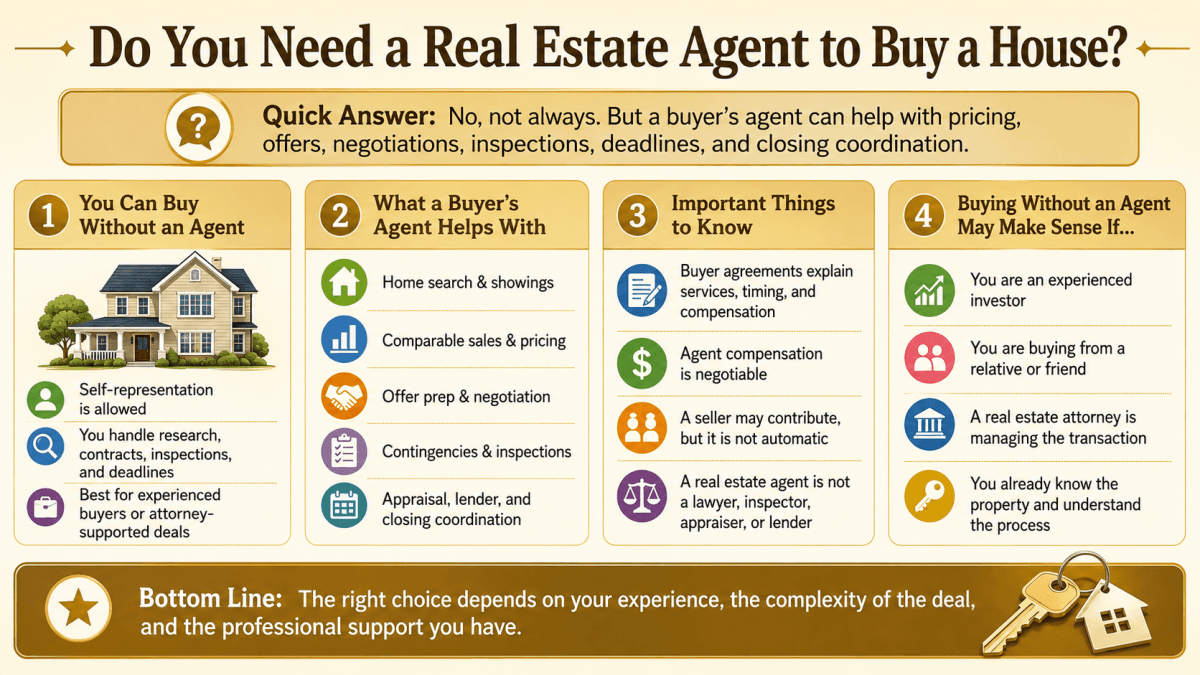 A buyer’s agent can help a homebuyer manage the financial, contractual, and logistical parts of a purchase. The value of the agent depends on the agent’s experience, local knowledge, communication, and ability to represent the buyer’s interests. Practical benefits may include:
- More efficient home searches: A buyer’s agent can identify properties that match the buyer’s budget, location, property type, and financing requirements. This may help the buyer avoid spending time on homes that do not meet the loan program or purchase criteria.
- Better pricing information: The agent can review recent comparable sales, current listings, property condition, and local market activity. This information can help the buyer decide whether the asking price is reasonable and how much to offer.
- Stronger offer preparation: A purchase offer involves more than price. An agent can help structure the proposed closing date, earnest money, financing terms, inspection period, appraisal contingency, seller concessions, and other conditions.
- Professional negotiation: The agent can communicate with the seller’s representative and negotiate price, repairs, credits, personal property, closing costs, and transaction deadlines. The buyer still makes the final decisions.
- Contract and deadline management: Home purchase contracts contain dates for deposits, inspections, financing, appraisal, title review, and closing. A buyer’s agent can track these deadlines and alert the buyer when action is required.
- Inspection support: The agent can help coordinate inspections, review the inspector’s findings with the buyer, and prepare requests for repairs, credits, or price adjustments. The agent does not replace a licensed home inspector or other property specialist.
- Coordination with the lender and closing team: A buyer’s agent can communicate with the loan officer, appraiser, title company, attorney, inspector, and seller’s agent. This coordination may help resolve issues before they delay the closing.
- Local transaction knowledge: Contract forms, disclosures, customs, taxes, inspections, and closing procedures vary by location. An experienced local agent may help the buyer understand how the process works in that market.
Using a buyer’s agent does not guarantee a lower purchase price, a successful inspection, loan approval, or an on-time closing. However, qualified representation can help the buyer evaluate information, meet important deadlines, and make more informed decisions throughout the transaction.
Limitations of a Real Estate Agent
A real estate agent can help organize and guide a home purchase, but the agent cannot provide all the professional advice a buyer may need. When considering whether you need a real estate agent to buy a house, it is important to understand both the benefits and the limits of the agent’s role. A real estate agent generally cannot:
- Provide legal advice: An agent may explain common contract terms and transaction procedures, but only a qualified attorney can interpret the law, advise a buyer about legal rights, or resolve disputes. Buyers may need an attorney for complex contracts, title concerns, estate sales, ownership disputes, or unusual transaction terms.
- Perform a professional home inspection: An agent may point out visible concerns, but the agent does not replace a licensed home inspector. Specialized inspections may also be needed for the roof, foundation, plumbing, electrical system, septic system, well, mold, radon, pests, or environmental hazards.
- Determine the property’s appraised value: An agent can review comparable sales and provide a market analysis, but a licensed appraiser determines the property’s value for mortgage-lending purposes.
- Approve a mortgage: An agent can coordinate with the lender and help the buyer search within an estimated price range, but the mortgage lender and underwriter determine loan eligibility. Questions about income, credit, debt-to-income ratios, assets, loan programs, interest rates, and closing funds should be directed to a licensed mortgage professional.
- Guarantee property condition: An agent cannot guarantee that a home is free from defects or that every problem will appear in the seller’s disclosures or inspection report.
- Provide tax or financial advice: Buyers should consult a qualified tax professional, accountant, or financial adviser about tax consequences, investment returns, affordability, or long-term financial planning.
- Resolve title or insurance issues: A title company or real estate attorney reviews ownership records, liens, easements, and title defects. An insurance professional should answer questions about homeowners, flood, mortgage, and other required coverage.
- Make decisions for the buyer: An agent may provide information and recommendations, but the buyer decides which property to purchase, how much to offer, which contingencies to include, and whether to proceed after inspections or appraisal results.
The exact duties and limitations of a real estate agent vary by state, license type, agency relationship, and brokerage policy. Buyers should ask questions whenever a matter falls outside the agent’s expertise and consult the appropriate licensed professional before making an important legal, financial, or property-related decision.
Risks of Buying Without an Agent
Buying a home without a real estate agent can work for experienced buyers, investors, attorneys, or people purchasing from someone they know. However, self-representation also means the buyer must manage the transaction, evaluate the property, and protect their own interests. When considering the question, “Do you need a real estate agent to buy a house?”, review the following potential risks:
- Paying more than the property is worth: Without access to reliable comparable sales or local market knowledge, a buyer may have difficulty determining whether the asking price is reasonable.
- Submitting a weaker offer: Price is only one part of an offer. Financing terms, contingencies, earnest money, seller concessions, closing dates, and other conditions can affect how competitive and protective the offer is.
- Missing important contract terms: Purchase agreements contain legal obligations, deadlines, and remedies. An unrepresented buyer may overlook language involving inspections, financing, appraisal, title, default, or cancellation rights.
- Missing deadlines: Delays involving earnest money, inspections, loan approval, appraisal, title review, or closing can weaken the buyer’s position and may place the deposit at risk, depending on the contract.
- Limited negotiation experience: Buyers may need to negotiate price, repairs, credits, appraisal issues, closing costs, or possession terms. It’s easy to lose objectivity when negotiating for a home you really want.
- Overlooking property concerns: A buyer may miss warning signs involving condition, zoning, permits, flood risk, homeowners association rules, insurance availability, or property eligibility for the selected mortgage program.
- Relying too heavily on the listing agent: The listing agent generally represents the seller unless a different agency relationship is established and disclosed under state law. The agent may provide factual information, but is not responsible for advancing the buyer’s interests.
- Poor coordination among professionals: The buyer may need to communicate with the lender, inspector, appraiser, title company, attorney, insurance agent, and seller’s representative. Missed information or delayed responses can create closing problems.
These risks do not mean every unrepresented buyer will make a costly mistake. A buyer with strong real estate knowledge, reliable professional support, and a clear understanding of the contract may complete the purchase successfully. Buyers who proceed without an agent should consider hiring a real estate attorney, a licensed inspector, a mortgage professional, a title company, and other specialists as needed.
When Buying Without an Agent May Make Sense
Buying without a real estate agent may be reasonable when the buyer understands the transaction and has access to the appropriate legal, financial, and property professionals. Self-representation is not automatically better or cheaper, but it can work in certain situations. Examples include:
- Experienced real estate investors: Investors who regularly analyze properties, negotiate contracts, arrange inspections, and coordinate closings may be comfortable managing the purchase themselves.
- Purchases from relatives or close acquaintances: When the buyer and seller already agree on the price and basic terms, they may choose to complete the transaction with help from an attorney, lender, title company, and other professionals.
- Attorney-managed transactions: A real estate attorney may prepare or review the contract, explain legal obligations, address title concerns, and coordinate the closing. The attorney does not usually replace the market knowledge, property search, or negotiation services of a buyer’s agent.
- Buyers with substantial transaction experience: A buyer who has completed several purchases and understands local contracts, inspections, financing deadlines, appraisal issues, and closing procedures may not need full agent representation.
- Purchases involving a specific property: A buyer who is not searching the open market and already knows which property to purchase may need fewer agent services.
- Transactions with a limited scope: Some buyers may represent themselves but hire professionals for specific tasks, such as contract review, inspection, title work, appraisal questions, or negotiation assistance.
Buying without an agent should not mean completing the purchase without professional support. Buyers may still need a mortgage loan officer, a real estate attorney, a home inspector, an appraiser, a title professional, an insurance agent, and a tax adviser. Before proceeding, the buyer should understand the purchase contract, agency relationships, compensation obligations, property condition, financing requirements, and important deadlines. Self-representation may make sense when the buyer has the knowledge and support to manage these responsibilities confidently.
How the Buyer’s Agent and Mortgage Lender Work Together
A successful home purchase often depends on clear communication between the buyer’s agent and the mortgage lender. When asking, “Do you need a real estate agent to buy a house?”, consider how valuable that coordination can be when financing requirements affect the property search, purchase offer, appraisal, and closing timeline. The buyer’s agent and lender may work together in the following ways:
- Confirming the buyer’s price range: The lender evaluates the buyer’s income, credit, assets, debts, and loan program to determine an estimated purchase price and monthly payment. The agent can then focus the home search on properties that fit those limits.
- Checking property eligibility: Some homes may not qualify for certain mortgage programs. FHA, VA, USDA, conventional, condominium, manufactured-home, and non-QM loans may have different property requirements. The agent can discuss potential concerns with the lender before the buyer spends money on inspections or an appraisal.
- Preparing a financeable offer: The agent should understand the buyer’s financing type, required down payment, estimated closing funds, appraisal contingency, and requested seller concessions. The lender can confirm whether the proposed terms are permitted under the selected loan program.
- Coordinating seller credits: A seller may agree to contribute toward eligible closing costs, prepaid expenses, discount points, or buyer-agent compensation when permitted. The lender should review the proposed credit to confirm that it complies with loan-program limits and does not exceed the buyer’s allowable costs.
- Managing contract deadlines: The agent tracks financing, appraisal, inspection, title, and closing deadlines. The lender provides updates on underwriting, required documents, appraisal status, and loan conditions so the agent can address potential delays.
- Addressing appraisal issues: When an appraisal comes in below the purchase price or identifies required repairs, the lender explains the impact on financing. The agent can then help negotiate a price reduction, repairs, credits, a reconsideration of the appraisal, or another solution.
- Resolving property-condition concerns: Certain loan programs may require health, safety, structural, or habitability issues to be corrected before closing. The agent can communicate with the seller while the lender confirms what must be completed for the loan.
- Coordinating the closing date: The agent, lender, title company, attorneys, and other parties must work toward the same closing date. The lender handles loan approval and funding, while the agent helps manage possession, the final walkthrough, contract amendments, and communication with the seller.
At Gustan Cho Associates, we often see transactions become more difficult when the agent and loan officer do not communicate early. For example, a buyer may be financially approved for an FHA or VA loan, but the selected property may have condition, insurance, condominium, appraisal, or title issues that affect financing. Early coordination can help identify these concerns before the buyer invests additional time and money. The buyer should authorize the agent and lender to communicate about transaction-related matters while protecting confidential financial information. The agent does not approve the mortgage, and the lender does not negotiate the real estate contract. Each professional has a separate role, but consistent communication can help prevent surprises and keep the purchase moving toward closing.
Questions to Ask Before Signing With a Buyer’s Agent
Before signing a buyer representation agreement, take time to understand the agent’s experience, services, availability, and compensation. When considering whether you need a real estate agent to buy a house, the quality of the individual agent matters as much as the decision to seek representation. Ask the following questions:
- How long have you worked with homebuyers in this market?
- Do you regularly represent buyers using my mortgage program?
- Which cities, neighborhoods, and property types do you specialize in?
- What services are included in the buyer representation agreement?
- Is the agreement exclusive or nonexclusive?
- How long does the agreement remain in effect?
- Can I terminate the agreement early, and are there any fees?
- How will you be compensated?
- Could I owe compensation if the seller does not cover the full amount?
- Will the agreement apply to every property or only certain locations and property types?
- How quickly can you schedule showings and respond to questions?
- Who will assist me when you are unavailable?
- How do you evaluate comparable sales and recommend an offer price?
- How will you communicate with my mortgage lender?
- What experience do you have with inspections, appraisal issues, seller concessions, and repair negotiations?
- Do you act on behalf of both purchasers and sellers in a single transaction? And how would that affect your duties to me?
The agent should answer these questions clearly and give you enough time to review the agreement before signing. Be cautious if an agent pressures you to sign immediately, avoids explaining compensation, or makes guarantees about price, loan approval, appraisal results, or closing dates. For a more detailed guide to researching, interviewing, and comparing real estate professionals, read How to Find the Best Realtor.
Final Thoughts: Do You Need a Real Estate Agent to Buy a House?
So, do you need a real estate agent to buy a house? Not always. Buyers may represent themselves, especially when they have substantial transaction experience, already know which property they want, or have support from a real estate attorney and other qualified professionals.
However, a buyer’s agent can provide practical help with pricing, property searches, offers, negotiations, inspections, contingencies, contract deadlines, appraisal issues, and closing coordination. That guidance may be especially valuable for first-time buyers or anyone purchasing in an unfamiliar market.
The decision should depend on the buyer’s experience, the complexity of the transaction, the services offered, and the terms of the buyer representation agreement. Buyers should review compensation, exclusivity, duration, termination rights, and possible conflicts of interest before signing. Using an agent does not guarantee a lower price, loan approval, a problem-free property, or an on-time closing. Likewise, buying without an agent does not automatically lead to failure. The best approach is to understand the responsibilities involved, compare the available options, and obtain legal, lending, inspection, title, tax, or insurance advice when needed.
Frequently Asked Questions About Buyer’s Agents:
Should I Get Preapproved Before Choosing a Real Estate Agent?
You do not have to get preapproved before speaking with an agent. However, preapproval can establish your price range, identify possible financing issues, and show sellers that you are a serious buyer. A preapproval is not a final loan approval and does not require you to use that lender.
Do I Need a Buyer’s Agent When Purchasing New Construction?
A buyer’s agent is not required when purchasing a newly built home. However, the builder’s sales representative generally works for the builder, not the buyer. An independent buyer’s agent may help review pricing, builder incentives, contract deadlines, inspections, upgrade costs, and financing terms. Buyers should confirm that the agent can represent them before registering with or visiting the builder.
Can a Buyer’s Agent Show Me Any House for Sale?
A buyer’s agent can usually arrange showings for homes listed by other brokerages. However, access may depend on the seller’s instructions, showing availability, property location, brokerage rules, the agent’s license, and the terms of the buyer representation agreement. Some properties may also require proof of funds or a mortgage preapproval before a showing.
Do I Need an Agent to Buy a For-Sale-By-Owner Home?
No. You may purchase a for-sale-by-owner, or FSBO, property directly from the seller. You may also hire a buyer’s agent to represent you if the seller and agent agree on access and compensation. Because the seller does not have a listing agent, buyers should consider obtaining legal, inspection, title, appraisal, and mortgage guidance before closing.
Does a Buyer’s Agent Have to Attend the Closing?
A real estate agent is not always required to attend the mortgage closing. Attendance depends on local practices, state requirements, the type of closing, and whether problems need to be resolved. An agent may attend to answer transaction-related questions, confirm contract terms, or help address last-minute issues.
Can My Agent Recommend a Lender, Inspector, or Attorney?
Yes. A real estate agent may provide names of lenders, inspectors, attorneys, title companies, and other professionals. However, buyers should compare qualifications, services, fees, and reviews rather than relying on only one recommendation. The CFPB advises buyers to seek lender options independently, even when an agent provides referrals.
Can a Buyer’s Agent Negotiate My Mortgage Interest Rate?
No. A real estate agent does not set or negotiate the lender’s interest rate, loan fees, or underwriting requirements. Those terms must be discussed with the mortgage lender. Buyers can compare lenders by requesting official Loan Estimates after they have a property address and are ready to proceed with financing.
What Is the Difference Between a Realtor and a Real Estate Agent?
A real estate agent is licensed by a state to assist with real estate transactions. A Realtor is a licensed real estate professional who belongs to the National Association of Realtors. Not every real estate agent is a Realtor, although both may represent buyers when properly licensed.
This article about “Do You Need a Real Estate Agent to Buy a House?” was updated on July 17th, 2026.