Many borrowers think a short sale means they cannot buy another home with a conventional loan. That is not always true. The bigger question is, when the short sale was completed, how your credit looks today, and whether Fannie Mae or Freddie Mac guidelines allow the new loan.
A conventional loan after a short sale may be possible once the required waiting period is met. Some borrowers need more time. Others may qualify sooner if the file shows documented hardship, rebuilt credit, stable income, and sufficient funds for the down payment and closing costs.
The mistake many borrowers make is assuming the short sale date, credit report, and lender guidelines will all line up automatically. They often do not. Before applying, it helps to know when the waiting period starts, what documents lenders may request, and why one lender may deny the file while another may still have options.
Can You Get a Conventional Loan After a Short Sale?

You can get a conventional loan after a short sale. However, you need to wait for a specific period and follow the guidelines from Fannie Mae or Freddie Mac. A short sale does not permanently stop you from buying a home again. Most borrowers need to wait four years after the short sale completion date. Some borrowers may qualify after two years if they can document extenuating circumstances and show they have recovered financially. Approval also depends on credit score, income, employment history, down payment, debt-to-income ratio, assets, and automated underwriting findings. A clean payment history after the short sale can strengthen the file.
When Does the Short Sale Waiting Period Start?
Most of the time, the wait after a short sale begins on the day it ends, not on the day payments were skipped. That part matters because people often think delays start from the first missed check, yet standard rules for regular loans start from the closing moment instead.
Borrowers should retain important documents, such as the final settlement sheet or closing disclosure, which signify the completion date of the short sale. This documentation may be necessary for the bank later on to confirm that sufficient time has elapsed before approving a conventional loan after a short sale.
Should the short sale date appear missing from the credit report, paperwork might be needed – borrower, title firm, old lender, or closer could be asked to provide it. When that detail isn’t clearly listed, proof may come from documents supplied earlier by one of the parties involved. Lenders sometimes need more than what shows up at first glance, especially if dates are vague or absent altogether. Missing info like this often leads them to reach out to someone who handled the deal before for clarification. The exact timing matters enough that they’ll check elsewhere when it’s not obvious.
Fannie Mae Waiting Period After a Short Sale
Fannie Mae generally requires a four-year waiting period after a completed short sale before you can qualify for a conventional loan. The waiting period usually begins on the short sale completion date, not the date you stopped making mortgage payments. In some cases, Fannie Mae may reduce the waiting period to two years if the short sale resulted from documented extenuating circumstances. These are events beyond your control, such as the death of a wage earner, a serious illness, or another significant hardship that caused a sudden loss of income. You must also show that you have recovered financially and meet all other loan requirements. Meeting the waiting period alone does not guarantee approval. Lenders will still review your credit score, recent payment history, employment, income, assets, debt-to-income ratio, and automated underwriting findings. A borrower who has rebuilt credit and maintained stable finances since the short sale is generally in a stronger position to qualify. If you are unsure when your waiting period began, ask your lender to verify the short sale completion date using your closing documents or settlement statement before applying for a conventional loan.
Freddie Mac Waiting Period After a Short Sale
Freddie Mac generally requires a 24-month recovery period after a completed short sale before most borrowers can qualify for a conventional loan. The waiting period begins on the short sale completion date, so it is important to keep your closing disclosure, settlement statement, or other documents showing when the transaction officially closed.
Like any conventional mortgage, meeting the waiting period does not automatically mean you will be approved. Lenders will also review your credit score, payment history, employment, income, assets, debt-to-income ratio, and the results of Freddie Mac’s automated underwriting system. A stronger overall loan file can improve your chances of approval.
If your credit report does not clearly identify the short sale or lists an incorrect completion date, your lender may request additional documentation before underwriting can move forward. Resolving these issues early can help prevent unnecessary delays. Freddie Mac guidelines are different from Fannie Mae’s in some situations, so borrowers should not assume the same waiting period applies to every conventional loan after a short sale. An experienced lender can review your loan scenario and determine which agency’s guidelines best fit your situation.
Extenuating Circumstances After a Short Sale
Extenuating circumstances are serious events beyond the borrower’s control that caused the short sale. Examples may include a major illness, job loss, death of a wage earner, divorce-related financial hardship, or another documented event that created a major loss of income or increase in expenses. To qualify for a shorter waiting period, the borrower must usually provide proof of hardship and financial recovery. This may include medical bills, termination letters, divorce documents, income records, bank statements, credit history, and documentation showing the short sale completion date. Extenuating circumstances related to a conventional loan after a short sale are reviewed on a case-by-case basis. Having a hardship does not automatically guarantee approval, so the full loan file still needs to meet conventional underwriting guidelines.
Credit Score Requirements After a Short Sale
Typically, most conventional loans require a minimum credit score of 620. However, achieving a score of 620 does not ensure automatic approval for a conventional loan after a short sale. The loan must still obtain automated underwriting approval via Fannie Mae or Freddie Mac.
Lenders also review your full credit history after the short sale. Recent late payments, high credit card balances, collections, or new debt can make approval harder, even if your score meets the minimum requirement.
A stronger file may include a clean payment history, stable income, enough reserves, a manageable debt-to-income ratio, and money saved for a down payment and closing costs. The better the overall file, the stronger the chance of approval after a short sale.
Down Payment Requirements After a Short Sale
Buying a home after a short sale involves several factors, including the lender’s guidelines, the buyer’s credit score, the nature of the property’s condition, whether it will be owner-occupied, and the risk evaluation conducted by the computer system. For those looking to secure a conventional loan after a short sale, a typical down payment is around 5%. However, first-time homebuyer assistance programs might offer options with as little as 3% down payment, provided all requirements are met. Smaller down payments might let people buy homes earlier. Yet borrowers often face extra costs because of this choice – like paying for private mortgage insurance, known as PMI. Less than one-fifth paid upfront? That’s commonly the trigger for needing coverage under standard loans. Lenders often view larger down payments as a sign of stability, which might boost approval odds even after a recent short sale. Monthly bills tend to shrink when more money goes upfront. Cutting out or shrinking private mortgage insurance is another side effect. Money talks at closing – fees pile up fast, so setting cash aside ahead of time makes sense. Bills like property taxes and homeowners’ insurance usually require prepayment, too. Stashing funds for living adjustments helps avoid stress later. Moving isn’t free, and truck rentals plus new keys add up quickly.
Debt-to-Income Ratio and AUS Approval
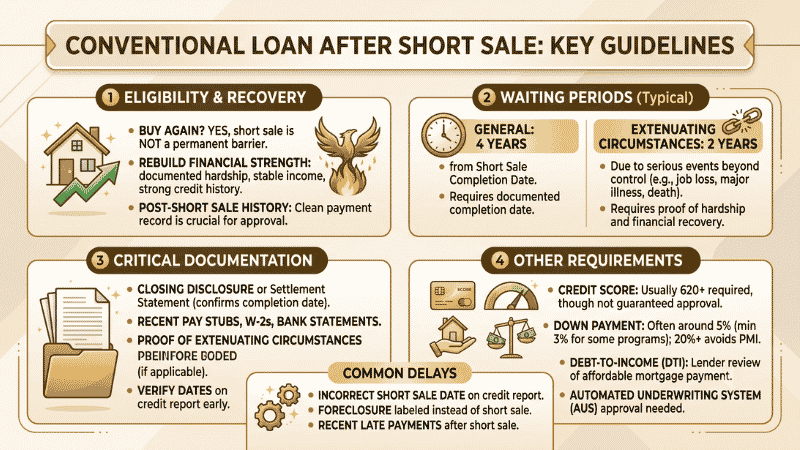
Your debt-to-income ratio (DTI) shows how much of your monthly paycheck goes toward paying off your debts. After a short sale, lenders look closely at DTI to ensure your new mortgage payment is affordable and that your finances have recovered. Even with a conventional loan after a short sale, additional criteria must be met beyond just DTI. The approval process also involves an automated underwriting system, commonly referred to as AUS. For example, Fannie Mae utilizes Desktop Underwriter (DU), while Freddie Mac employs Loan Product Advisor (LPA).
These systems review the full loan file, including credit score, credit history, income, assets, down payment, reserves, property type, and the time since the short sale.
A borrower with a higher DTI may still qualify if the rest of the file is strong. Strong credit, stable income, money left over after closing, and a clean payment history after the short sale can help. On the other hand, a borrower with a lower DTI can still be denied if there are recent late payments, weak credit, limited assets, or problems with short-sale reporting. This illustrates why two borrowers with identical debt-to-income (DTI) ratios can receive varying outcomes. The approval through automated underwriting systems (AUS) considers the complete risk profile rather than relying on a single figure. Before starting the house-hunting process, a lender needs to evaluate the file using the relevant AUS and determine whether Fannie Mae or Freddie Mac guidelines offer a borrower—especially one seeking a conventional loan after a short sale—a better chance of approval.
Documents Needed After a Short Sale
Applying for a conventional loan after a short sale often requires more documentation than a standard mortgage application. Lenders need to verify that the waiting period has passed, your finances have recovered, and you meet current Fannie Mae or Freddie Mac guidelines. You may be asked to provide:
- The closing disclosure or settlement statement showing the short sale completion date
- Recent pay stubs and W-2s, or tax returns if you are self-employed
- Bank statements to verify your assets and funds for closing
- Identification and Social Security number verification
- Authorization for the lender to access your credit report.
- Recent mortgage or rent payment history, if requested
- Documentation explaining extenuating circumstances, if you are requesting a reduced waiting period under Fannie Mae guidelines
Depending on your situation, the underwriter may request additional documents. For example, if your credit report lists the wrong short sale date or incorrectly reports the event as a foreclosure, you may need to provide supporting paperwork to clarify the record. Submitting complete and accurate documents early in the process can help prevent underwriting delays. If anything has changed since the short sale, such as a new job, additional income, or paid-off debts, be prepared to document those changes as well.
Common Problems That Delay Approval
A conventional loan after a short sale can be delayed if the short sale is not clearly documented. One of the most common problems is an incorrect date on the credit report. The lender needs to know when the short sale was completed because that date controls the waiting period. If the date is missing or incorrect, the borrower may need to provide a closing disclosure, a settlement statement, or a letter from the prior lender. Another problem is when the credit report shows the short sale as a foreclosure. A foreclosure usually has different waiting-period rules, which can create a major issue during underwriting. The borrower may need to dispute the credit reporting error or provide documents proving that the prior home was sold through a short sale rather than taken back through foreclosure. Recent late payments can also slow down approval. Even if the short sale waiting period has passed, lenders still want to see that the borrower has rebuilt credit and stayed current on debts. Late payments after the short sale may make the file look risky, especially if they happened within the last 12 months. Approval can also be delayed when the automated underwriting system does not approve the file. DU or LPA may approve or deny the loan based on credit history, a high debt-to-income ratio, limited assets, low reserves, or a weak payment history after the short sale. In some cases, the borrower may need to reduce the loan amount, pay down debt, build reserves, increase the down payment, or consider another loan program.
Short Sale Date Is Reported Wrong
The short sale completion date matters because it helps determine when the conventional loan waiting period begins. If the date on the credit report is incorrect, the automated underwriting system may deem the borrower ineligible, even if enough time has already elapsed.
This happens more often than borrowers expect. A credit report may show the date of the first missed payment, the date the account was charged off, or the date the lender updated the account, rather than the actual short sale closing date. Those dates can make the short sale look more recent than it really is.
The best way to fix this is to provide documentation showing when the short sale was completed. This may include the final closing disclosure, the HUD-1 settlement statement, the recorded deed, the payoff statement, or a letter from the prior lender. The underwriter needs a clear paper trail that supports the correct date. Borrowers should check this before house hunting. Waiting until the loan is in underwriting can delay approval, the closing disclosure, and the final clear-to-close.
Credit Report Shows Foreclosure Instead of Short Sale
A short sale and a foreclosure are not the same thing, and this difference matters when applying for a conventional loan. If the credit report shows a foreclosure rather than a short sale, the automated underwriting system may apply the wrong waiting period and make the borrower appear ineligible. This can happen when the old mortgage account is reported with unclear wording, incorrect account codes, or missing closing details. The lender may see terms such as “foreclosure started,” “settled for less than owed,” “charge-off,” or “deed transferred.” The file may need a closer review before underwriting can move forward. Borrowers should gather documents that prove the property was sold through a short sale. Helpful records may include the final closing disclosure, HUD-1 settlement statement, short sale approval letter, recorded deed, or payoff documents from the prior lender. These documents can help the underwriter confirm that the property was sold rather than taken back through foreclosure. If the credit report is wrong, the borrower may also need to dispute the reporting with the credit bureaus and the prior mortgage servicer. It is better to catch this before making an offer on a home. Fixing or documenting the issue early can prevent delays in AUS approval, conditional approval, and final clear-to-close.
Recent Late Payments After the Short Sale
The waiting period after a short sale is only one part of the approval process. Lenders also want to see that you have managed your credit responsibly since the short sale. Recent late payments can raise concerns about whether your financial situation has truly improved.
Even one or two late payments during the past 12 months may affect your loan application, especially if they involve a mortgage, car loan, or other major credit account. The automated underwriting system reviews your recent credit history along with your credit score and other risk factors.
A pattern of missed payments may result in a less favorable underwriting decision. If you have late payments after a short sale, it may be worth waiting until you have established a longer history of on-time payments before applying. Paying all bills on time, reducing credit card balances, and avoiding new debt can help strengthen your credit profile over time. Before applying for a conventional loan after a short sale, ask your lender to review your credit report. Identifying recent late payments early gives you a chance to address any reporting errors and determine whether waiting a few more months could improve your approval chances.
AUS Does Not Approve the File
AUS approval is a major part of getting a conventional loan after a short sale. Fannie Mae uses Desktop Underwriter, also called DU. Freddie Mac uses the Loan Product Advisor, also called LPA. These systems review the full loan file and decide whether the loan is eligible for conventional financing. Sometimes the waiting period has passed, but AUS still does not approve the file. This can happen due to recent late payments, high credit card balances, low credit scores, high debt-to-income ratios, limited reserves, unstable income, or incomplete short-sale documentation. The system may also flag the file if the short sale date is unclear or the prior mortgage is reported incorrectly. When AUS does not approve the file, the lender should not guess. The file needs to be reviewed carefully to see what caused the issue. In some cases, the borrower may improve the result by paying down debt, correcting credit report errors, adding reserves, lowering the purchase price, increasing the down payment, or waiting until a stronger credit history is established. If DU does not approve the file, Freddie Mac LPA may still be worth testing, and vice versa. Fannie Mae and Freddie Mac do not always read the same borrower profile the same way. If neither the AUS system approves the loan, FHA, VA, USDA, or Non-QM financing may be better options depending on the borrower’s credit, income, down payment, and short-sale history.
Conventional Loan vs FHA, VA, USDA, and Non-QM After a Short Sale
Borrowers who had a short sale may have more than one loan option. A conventional loan after a short sale often require a longer waiting period, but they can be a good choice for borrowers with strong credit, stable income, and a sufficient down payment.
FHA loans may allow borrowers to buy sooner than conventional loans, depending on the short sale date and credit history. VA loans may also offer a shorter path for eligible veterans, active-duty service members, and surviving spouses. USDA loans are available for eligible buyers purchasing in approved rural or suburban areas.
Non-QM loans may help some borrowers who do not meet FHA, VA, USDA, or conventional guidelines. These loans can be more flexible, but they often require a larger down payment and higher reserves, and may carry higher rates and costs. The best loan option depends on the short sale date, credit score, income, down payment, debt-to-income ratio, occupancy, property type, and overall file strength. Borrowers should compare programs before assuming conventional financing is the only choice.
What We Are Seeing From Borrowers Today
Many borrowers who had a short sale years ago are surprised when the issue comes back during underwriting. They may feel ready to buy again, but the credit report does not always tell the full story correctly. The most common problems we see are incorrect short sale dates, old mortgage accounts reported with unclear wording, and files in which the credit report makes the short sale look like a foreclosure. We also see borrowers who qualify under one conventional agency but not the other. A borrower may not receive an approval through Fannie Mae DU, but Freddie Mac LPA may read the same file differently. This is why the loan should be reviewed through both systems when the short sale history is close, complicated, or reported incorrectly. Recent credit behavior matters more than many borrowers expect. A short sale from several years ago may not stop the loan, but new late payments, high credit card balances, or opened accounts before applying can hurt the file. Lenders want to see that the borrower has recovered and is not repeating the same financial stress. Some borrowers may find that FHA, VA, USDA, or Non-QM financing is a better option initially, particularly when a conventional AUS does not approve their application. The best route to take often depends on factors such as the short sale date, credit score, income, debts, down payment, reserves, and the borrower’s capacity to provide documentation of their situation. This is especially true when considering a conventional loan after a short sale.
How to Improve Your Chances of Approval After a Short Sale
The best way to improve your chances of approval after a short sale is to rebuild your credit and keep your finances stable. Make all payments on time, keep credit card balances low, avoid new late payments, and do not open unnecessary new debt before applying for a mortgage.
Borrowers should also save for down payment, closing costs, prepaid items, and reserves. Having extra money left after closing can strengthen the file, especially if the short sale was recent or the credit history still needs improvement.
Before house hunting, get pre-approved by a lender who understands the guidelines of FHA, VA, USDA, Non-QM and conventional loan after a short sale. A full review of your short sale date, credit report, income, assets, and debt-to-income ratio can help determine which loan program gives you the best chance of approval.
Is a Conventional Loan After a Short Sale the Best Option?
A conventional loan can be a good option after a short sale when you have rebuilt your credit, have stable income, manageable monthly debts, and enough money for the down payment and closing costs. It may also be a strong choice if you want to avoid the upfront and monthly mortgage insurance rules that can come with some government-backed loans. However, a conventional loan after a short sale is not automatically the best answer for every borrower. Fannie Mae and Freddie Mac may apply different short-sale recovery rules, and one automated underwriting system may approve a file that another does not. Your short sale date, current credit history, down payment, debt-to-income ratio, reserves, and property type all affect which conventional option may be a good fit. Borrowers who do not receive a conventional AUS approval may still have other paths to homeownership. FHA financing may work for borrowers with lower credit scores or smaller down payments. Eligible veterans and service members may want to compare VA financing, especially if they have available entitlement. USDA loans can be worth reviewing for eligible properties in approved areas. Non-QM loans may be an option when the borrower has high income or assets but does not fit standard agency guidelines. The best loan is not always the one with the lowest advertised rate or shortest waiting period. It is the program that matches your current credit, income, assets, property, and long-term budget. Before making an offer, have a lender compare conventional and alternative loan options based on your full file.
FAQs About Conventional Loan After a Short Sale:
Should I Disclose a Previous Short Sale When Applying for a Mortgage?
Yes. Be honest about a previous short sale on your mortgage application and provide the documents your lender requests. The lender will review your credit report, prior mortgage history, and public records as part of the underwriting process. Trying to omit the short sale can delay the process or cause the lender to question the accuracy of the application.
Can I Use a Co-Borrower to Qualify for a Mortgage After a Short Sale?
A co-borrower may help if they have a high income, good credit, and low monthly debt. However, a co-borrower does not remove your short sale history or bypass the required waiting period. The lender will review both borrowers, and both people will be responsible for the new mortgage payment.
Can I Refinance After a Short Sale?
You cannot refinance the home that was sold through the short sale because you no longer own it. However, after buying another home and rebuilding your credit, you can refinance that new mortgage later. Your prior short sale can still be reviewed, along with your current credit, income, equity, and payment history.
How Long Does a Short Sale Stay on a Credit Report?
A short sale may affect your credit report for up to seven years. It may appear on the old mortgage account as late payments, a charge-off, or language indicating the loan was settled for less than the full balance. The exact way it appears can vary by credit bureau and mortgage servicer.
Can a Short Sale be Removed from My Credit Report?
Accurate negative information usually cannot be removed early, simply because you have rebuilt your credit. However, you can dispute information that is wrong, incomplete, or belongs to someone else. This may include an incorrect short sale date, a foreclosure label when there was no foreclosure, or an account balance that should show as resolved.
Can I Get a Mortgage After Both a Short Sale and Bankruptcy?
The lender needs to review both events. A short sale and a bankruptcy can each have separate waiting periods and documentation requirements. Your lender will review the dates, the type of bankruptcy, your discharge or dismissal papers, your credit since the events, and the automated underwriting findings before determining eligibility.
Can I Still Owe Money After a Short Sale?
Possibly. A short sale does not automatically erase the unpaid mortgage balance. Your short sale approval letter should clearly state whether the lender waived the remaining balance or reserved the right to collect it later. A second mortgage, mortgage insurance claim, state law, and the wording in your agreement can all matter. Speak with a real estate attorney or tax professional if you are unsure about a remaining balance or a Form 1099-C.
This is article about “Conventional Loan After a Short Sale: Avoid Costly Delays” was updated on June 25th, 2026.