Does Co-Signing Affect In Buying Home? Understanding How Co-Signing a Loan Impacts Your Future.
Have you ever considered co-signing a loan for a loved one? While it might seem like a generous way to help a family member or friend, you may find yourself asking, does co-signing affect in buying home in the future?
Learn how co-signing a loan can affect your ability to buy a home, how lenders look at co-signed debt, and what steps to take before applying for a mortgage.
This question is crucial, especially if you plan to purchase a home yourself. In this guide, we’ll explore how co-signing can impact your ability to buy a home, including the potential risks, benefits, and steps to minimize any negative effects.
Key Considerations: The Impact of Co-Signing on Future Home Purchases
People often co-sign loans for family or friends without thinking about how it might affect their own finances later. Many wonder if co-signing will make it harder to get a mortgage in the future.
Co-signing a loan can affect your ability to buy a home in ways you might not expect. When you co-sign, you become responsible for someone else’s debt, and this shows up on your credit report.
If the main borrower misses payments, your credit score could go down. Most lenders count this debt when deciding if you qualify for a mortgage. Still, co-signing does not always stop you from buying a home. If you can provide proof and the main borrower has paid on time, lenders may exclude this debt from their calculations. It all depends on how lenders view co-signed debt. Before you apply for a mortgage, make sure you know how co-signing could affect your credit, income, and what paperwork you will need.
The Basics: What Does It Mean to Co-Sign a Loan?

Co-signing means legally agreeing to take responsibility for someone else’s loan. Essentially, you’re committing to making payments if the primary borrower cannot. While co-signing might help someone qualify for a loan, it also affects your financial profile. Importantly, does co-signing affect in buying home later? Yes, it can, as it impacts your debt-to-income ratio (DTI) and credit report, both of which are critical factors in securing a mortgage.
Thinking about co-signing a loan? Make sure you know the risks and benefits!
Protect your credit and financial future—get expert guidance before signing. Contact us today!Understanding the Significance of Co-Signing for Future Homebuyers
A co-signer is just as responsible for the loan as the main borrower. If the main borrower does not pay, the lender can ask the co-signer to make the payments. The Consumer Financial Protection Bureau says missed payments show up on the co-signer’s credit report and can make it harder to borrow in the future. This is important for anyone hoping to buy a home. Mortgage lenders look at your credit report, payment history, and any co-signed loans. Because of this, underwriters usually count co-signed debts when deciding if you can get a mortgage.
Can Co-Signing Affect Your Ability To Buy A Home? There Are Three Main Ways It Can Impact Your Eligibility.
First, co-signing can affect your debt-to-income ratio (DTI). This ratio compares your total monthly debts to your monthly income. Lenders use it to decide how much you can borrow. If a co-signed loan is included, your DTI increases, which might lower the amount you can qualify for.
Second, co-signing affects your credit history. The loan shows up on both your credit report and the main borrower’s. If the main borrower misses payments or defaults, your credit score can drop, making it harder to get a mortgage later.
Third, co-signing can affect how strong your mortgage application looks. Even if a lender does not count the payment, you may need to show proof of who made the payments and the loan’s status. In short, co-signing can complicate the home-buying process. Lenders check co-signed debt to measure risk, and as a co-signer, you could be responsible if the main borrower does not pay.
Why Mortgage Providers are Concerned About Co-Signed Loans
Lenders must review all monthly debts, and Freddie Mac rules explain when debts can be counted or ignored. Co-signed payments add to your debt and can lower the amount you qualify for. A co-signed account can hurt your credit report, especially if payments are late.
If your income is not high enough, it may be hard to get a mortgage. This is common when your name is on a car loan, student loan, or personal loan, even if you have not made payments.
According to the Consumer Financial Protection Bureau, a co-signed loan appears on both people’s credit reports, and both can be affected by late or missed payments. Lenders look at your income, payment history, negative accounts, and your whole credit report. Even one account with late payments can hurt an otherwise good credit profile.
Evidence of Payment by Other Parties
Freddie Mac also says that if one person has made on-time payments for the last 12 months, the debt may be excluded. International borrowers are primarily concerned with the following: Does a lender have proof that another party has made timely payments over the last 12 months? If the answer is yes, the debt may be excluded from consideration. If the answer is no, the payment will, in all likelihood, be included in the DTI calculation.
Reduction of Other Monthly Debt Obligations
Many people think co-signing only affects home buying, but it is more complex than that. Lenders check who signed, what type of loan it is, and whether you have the required documents. Sometimes, you need to show bank statements or pay stubs to prove the main borrower paid on time. If you cannot provide these, the debt may count against you. That is why it is smart to prepare early.
Co-Signing a Car Loan and Subsequently Purchasing a Home
A co-signed loan that seemed simple can cause problems if you do not have the right paperwork when you need it. It is common to co-sign a car loan for a child or relative. However, these loans can make it harder for first-time homebuyers to get a mortgage. If the main borrower has always paid on time, the lender may not need your payment history. So, if you plan to buy a home, think carefully about when and why you co-sign an auto loan.
How Does Co-Signing Affect In Buying Home?
To address the big question, does co-signing affect in buying home? The answer is yes. Here are the primary ways it can influence your ability to purchase a home:
Debt-to-Income Ratio (DTI):
- Lenders assess your DTI to determine if you can handle mortgage payments.
- Any co-signed loans are included in your DTI calculation, even if you’re not making the payments.
- Solution: You can exclude these payments from your DTI if you prove that the primary borrower has made payments on time for at least 12 months.
Credit Score Impact:
- Co-signing can impact your credit score.
- When someone you co-signed for misses payments, it can hurt your score.
- This could mean you get higher interest rates or even face loan denials later.
- So, if you’re wondering, “does co-signing affect in buying home?” the answer is yes, it can definitely have consequences for your ability to get a mortgage and the terms you might receive.
Delayed Mortgage Approval:
- Higher DTI or a lower credit score caused by co-signing can delay or limit your ability to qualify for a home loan.
FHA Loans and Co-Signers: Unique Considerations
If you co-sign for an FHA loan, the rules might work in your favor. FHA loans allow non-occupying co-borrowers, which means you don’t have to live on the property to co-sign. This flexibility can make it easier to navigate the impacts of co-signing.
Quick Tip: When asking, “Does co-signing affect in buying home?” remember that lenders often exclude FHA co-signed payments from your DTI if you provide proper documentation proving you’re not responsible for the payments.
Risks of Co-Signing and How to Avoid Them
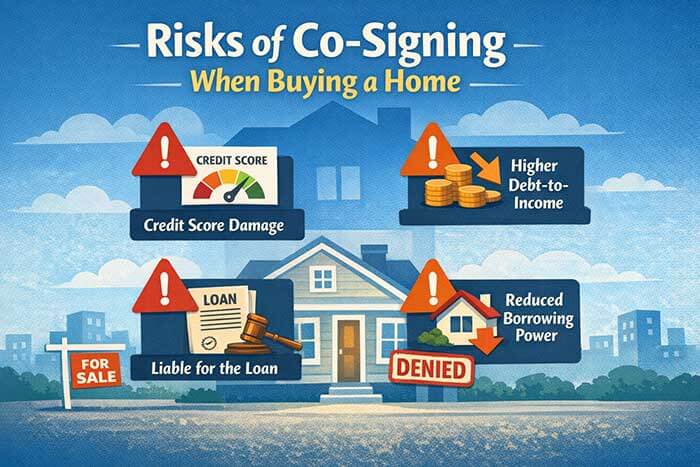
Before you co-sign for someone, it’s important to consider the risks, especially if you’re hoping to buy a home soon. So, how does co-signing affect in buying home?
- Credit Damage: Your credit score can drop if the borrower misses payments.
- Increased DTI: Your borrowing capacity might decrease, making it harder to qualify for a mortgage.
- Liability for Payments: You’re legally responsible for the loan if the borrower defaults.
- Reduced Borrowing Power: Even with strong income and credit, lenders may see you as a higher-risk borrower due to the co-signed loan.
Pro Tip: To reduce the impact, consider co-signing for a short-term loan or helping the borrower refinance, removing yourself as a co-signer before you apply for your own mortgage.
Co-Signing a Student Loan Before Getting a Mortgage
There are potential issues with co-signing student loans. The CFPB states that co-signers are responsible for repayment. Furthermore, late or missed payments harm the student’s and co-signer’s credit history. If you want to buy a home, keep in mind that student loan debt you co-signed for can stay on your credit report for years, even if payments are always on time.
Steps to Take Before Obtaining a Mortgage After Co-Signing
Lenders will look at this debt when you apply for a mortgage, depending on the loan type and the paperwork you have. It is also important to know the difference between co-signing and co-borrowing. A co-borrower shares responsibility and may own the asset, while a co-signer helps someone qualify but does not own anything. Either way, you are responsible for the debt, which can make it harder to get a mortgage.
Steps to Take After Co-signing Someone and Before Getting a Mortgage
If you have co-signed for someone and now dream of buying your own home, there are steps you can take to get ready. For many, getting a mortgage is a big achievement. I should take specific preparatory steps. Securing a mortgage is a significant milestone. Since co-signed loans appear on both credit reports, correct any errors before the lender reviews your file.
The Impact of Co-Signed Loans on Your Debt-to-Income Ratio
Getting approved for a mortgage depends on how your monthly debts compare to your income. Lowering other debts can reduce the effect of a co-signed loan. Paying off credit cards, car loans, or other bills improves your debt-to-income (DTI) ratio. The Consumer Financial Protection Bureau says DTI is an important factor in mortgage approval. It is a good idea to keep up with payments on the co-signed loan and get proof quickly. Often, lenders need proof that the other person has made payments on time to exclude the debt from their calculations.
Preparing to Buy a Home After Co-Signing
So, does co-signing affect in buying home in the long term? Not necessarily. If you plan carefully and ensure the primary borrower makes timely payments, co-signing might have minimal long-term effects. Here’s how to prepare:
Document Payments:
- Save records proving the borrower has been making payments. After 12 months of consistent payments, lenders may exclude the co-signed loan from your DTI.
Communicate With The Borrower:
- Regularly check in to ensure they’re meeting their payment obligations.
Encourage Refinancing:
- Help the borrower refinance the loan by removing your name as a co-signer.
Choose Flexible Lenders:
- Some lenders are more willing to exclude co-signed loans with proper documentation.
Can You Still Buy a House If You Co-Signed for Someone Else?
Co-signing for someone else does not mean you cannot buy a home. The main things lenders look at are whether the co-signed debt affects your debt-to-income ratio, whether payments have been made on time, and whether they can document your payment history. If you can show a 12-month record of on-time payments, the lender may leave out the debt from their calculations. If payments are late or your credit is already stretched, the lender will have to include the co-signed debt when reviewing your application. That is why it is smart to check all your co-signed loans before you start looking for a home.
Worried about qualifying after co-signing? We’ll help you navigate your options
Apply now for expert guidance!How to Protect Yourself When Co-Signing
If you decide to co-sign despite the potential challenges, here are steps to safeguard your finances:
Have a Written Agreement:
- Clearly outline responsibilities with the borrower.
Monitor Your Credit:
- Make it a habit to look at your credit report now and then to catch any mistakes or problems. If you’re wondering,
- “Does co-signing affect in buying home?”
- Remember that co-signing can help someone qualify for a mortgage, but it also means that you’re responsible for that debt, too.
- It can impact your credit and home-buying options, so it’s important to think it through.
Maintain a Financial Cushion:
- Keep savings if you need to cover payments temporarily.
Set Boundaries:
- Be upfront about expectations to avoid misunderstandings.
Alternatives to Co-Signing
If you’re still wondering, “does co-signing affect buying a home?” Remember that it can impact your credit, too. Here are some alternatives:
- Gift a Down Payment: Offer financial assistance without becoming a co-signer.
- Help Improve Their Credit: Guide the borrower on building their credit profile.
- Become a Co-Borrower: Unlike co-signers, co-borrowers share ownership and responsibilities.
Is it Possible to purchase a House After Co-Signing for Another Person?
The most straightforward, uncomplicated, no-frills response to “does co-signing affect buying a home in the future” is “it absolutely can, and in most situations, it does a lot more than the average borrower anticipates.”
Co-signing introduces a layer of liability to the debt. Such liability can result in negative consequences for your credit, increase your debt-to-income ratio, affect your mortgage eligibility, and affect your final account status.
However, it doesn’t necessarily preclude homeownership. In most instances, the influence is a function of the payment records, the file, and the specific mortgage scheme involved.
Does Co-Signing Impact Future Home Purchases? Things to Consider
For prospective homeowners, the most prudent approach is to practice foresight. Before co-signing for anyone, be aware of the potential ramifications of mortgage qualifying hurdles.
Conversely, if you’ve already co-signed, tackle the account as soon as possible so you can understand the extent of the repercussions on your forthcoming home purchase.
Co-signing a loan is an important decision that affects your ability to buy a home. However, by understanding how does co-signing affect in buying home, you can take proactive steps to mitigate the risks.
Final Remarks on Does Co-Signing Affect Future Home Buying
Whether it’s maintaining clear documentation, choosing flexible lenders, or encouraging refinancing, careful planning can help you achieve your homeownership goals while supporting a loved one. If you’re thinking about how does co-signing affect in buying home, it’s a good idea to reach out to Gustan Cho Associates at 800-900-8569. We can help you understand your options and find the best loan for your needs. Our goal is to make the process easier for you!
Frequently Asked Questions About: Does Co-Signing Affect in Buying Home?
Does Co-Signing Affect Buying a Home Right Away?
- Yes. Because co-signed loans can show up on your credit report and contribute to your overall monthly debt, they could affect your eligibility for a mortgage as soon as you apply for a home loan. (Consumer Financial Protection Bureau).
Can I Get A Mortgage If I Co-Signed For A Car Loan?
- Yes, in some cases. While car loans and payments may be considered with the mortgage application, it is still possible to qualify for the mortgage loan. The primary borrower must have been making the payments, and the payments must be documented in accordance with the applicable underwriting. (Fannie Mae Selling Guide).
Does Co-Signing Hurt My Credit Score?
- Yes, but only in certain cases. The primary borrower may have a negative payment history due to a late payment or loan default, which will affect the co-signer’s credit report, as the account can be reported on both files.
Will A Mortgage Lender Always Count A Co-Signed Loan Against Me?
- Generally Yes. With some conventional underwriting guidelines, mortgage lenders have the discretion to exclude the co-signed loan payment as debt only if they have sufficient proof that a third party made payments for the previous 12 months.
Is Co-Signing A Student Loan A Problem When Buying A House?
- It could be. In DTI-based mortgage underwriting, both debt and payment history may be problematic and negatively impact your credit.
What Is The Difference Between A Co-Signer And A Co-Borrower?
- A co-borrower typically has an ownership stake in the asset being financed and liability for the debt, whereas a co-signer has neither and is mainly there to assist the primary borrower in obtaining financing. Both must be considered when determining future mortgage qualifications due to the associated debt liability.
Does Co-Signing Affect in Buying Home if the Borrower Pays on Time?
Yes, co-signing still affects your debt-to-income ratio (DTI), but if the borrower makes consistent on-time payments for at least 12 months, lenders may exclude that loan from your DTI calculation.
Will Co-Signing Hurt My Credit if I’m Not Making Payments?
Your credit score should stay good if the primary borrower makes timely payments. However, missed payments can significantly hurt your credit score and lead to problems.
Does Co-Signing Affect in Buying Home if I’m Planning to Purchase Soon?
Yes, co-signing can temporarily limit your borrowing capacity due to the impact on your DTI and credit report. Planning ahead and documenting the borrower’s payments can help minimize this.
How Long Should I Wait to Buy a Home After Co-Signing?
Waiting at least 12 months with proof of on-time payments by the borrower can improve your chances of qualifying for a mortgage.
Can I be Removed as a Co-Signer to Improve My Chances of Buying a Home?
The primary borrower can refinance the loan to remove your name as a co-signer, which will release you from financial responsibility.
Does Co-Signing Affect in Buying Home if I Co-Sign on a Car Loan Instead of a Mortgage?
Absolutely, any loan that has a co-signer—be it a car loan, personal loan, or mortgage—will influence your credit report and debt-to-income ratio, which in turn affects your chances of qualifying for a home loan.
How Can I Protect Myself When Co-Signing a Loan?
Monitor your credit regularly, document the borrower’s payments, and maintain a financial cushion to cover payments if needed.
Are There Alternatives to Co-Signing that won’t Affect My Ability to Buy a Home?
Yes, you can provide a financial gift for the down payment, help the borrower improve their credit, or become a co-borrower instead of a co-signer.
Does Co-Signing Affect in Buying Home if the Borrower Misses Payments?
Missing payments can hurt your credit score. This can make it harder to get a mortgage.
Can Lenders Overlook Co-Signed Loans Ahen I Apply for a Mortgage?
Some lenders may exclude co-signed loans from your DTI if you provide documentation showing the borrower has made consistent payments for 12 months.
This blog about “Does Co-Signing Affect In Buying Home In The Future” was updated on April 10, 2026.