Buying your first home with bad credit is possible, but your options depend on your credit score, income, down payment, debt, and the type of loan you choose. Many first-time buyers assume they need perfect credit to qualify, but that is not true. FHA, VA, USDA, and some conventional programs may still be available even if your score is lower than you want.
The key is understanding which loan programs fit your situation, what lenders look for, and what steps can improve your chances of approval.
If you are buying your first home with bad credit, the most important things to review are your credit score, down payment amount, debt-to-income ratio, employment history, and the loan program you may qualify for.
Buying Your First Home With Bad Credit for First Time Homebuyers

Buying your first home and our first time home buyer program assistance was created and structured to give you the confidence and knowledge to attain your buying your first home goals with minimal problems while saving you money. Future home buyers will receive a 1 one 1 session with one of our Alabama licensed loan consultants who will answer any questions. Dale Elenteny, a senior mortgage loan originator at Gustan Cho Associates says the following about buying your first home with bad credit and low credit scores:
Our experienced loan officers at Gustan Cho Associates offers a variety of the different types of mortgage programs out there that best suits a home buyer’s needs and goals.
This program was designed to promote homeownership in our local Florida, Illinois, California, Kansas, Alabama, and other markets in the United States through our network of licensed mortgage loan originators. It is offered at no cost or obligation and homebuyers can choose any lender of their choice and does not need to be obligated to use us.
Buying Your First Home With Bad Credit and Low Credit Scores
Buying your first home is a huge achievement. Don’t let a low credit score stop you! A home can still be purchased even if your credit score isn’t great. At Gustan Cho Associates, we guide first-time buyers who are turned away by banks and credit unions every day.
- A 580 score?
- Past collection accounts?
- Not enough credit history?
- There are mortgage programs for every situation.
This guide will teach you how to buy a house with bad credit. You will explore the right loan options and find tips to boost your approval chances. Soon, you will walk through the door of your new home, even when your credit score is still a work in progress.
Talk With a Mortgage Professional About Your Options
Buying your first home with bad credit can feel overwhelming, especially if you are unsure which loan program fits your situation. A licensed mortgage professional can help you review your credit, income, down payment, and loan options so you can understand what may be possible and what steps may improve your approval odds.
What is Considered Bad Credit When Buying Your First Home?
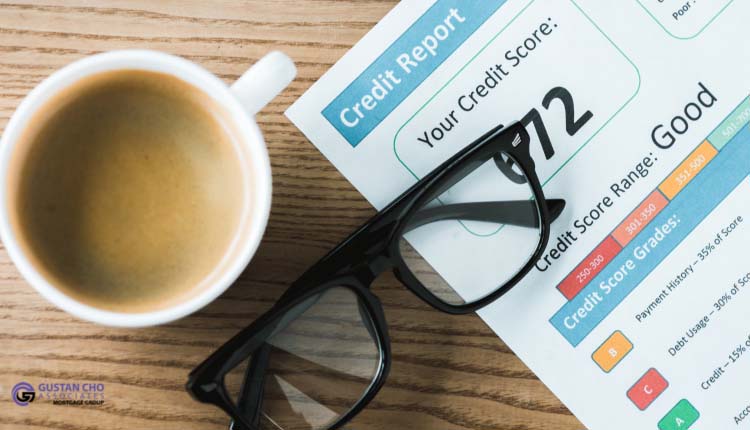
“Bad credit” usually means a FICO score under 620, yet lenders can have varying cutoffs. Here’s a quick guide on what each score range means:
- 740 Plus = Excellent
- 700–739 = Good
- 620–699 = Fair
- Below 620 = Bad
- 500–579 = Poor but still FHA-eligible
- Below 500 = Non-traditional options or plans to rebuild
Remember, a credit score is just one piece. Your income, debt-to-income ratio, job history, and how you pay your bills are also important. At Gustan Cho Associates, we review your financial situation, not just the score.
Best Home Loan Options for Buying Your First Home with Bad Credit
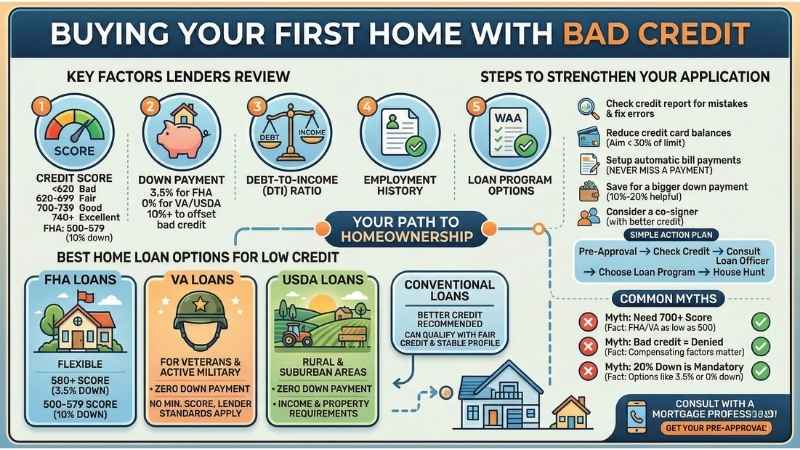
Several mortgage programs may help with buying your first home with bad credit, but the best option depends on your full financial profile. Your credit score matters, but lenders also review your income, employment history, down payment, debt-to-income ratio, and recent payment behavior. For most first-time buyers with bad credit, the most realistic starting points are FHA, VA, USDA, and sometimes conventional financing.
FHA Loans
FHA loans are often the first program buyers look at when they have bruised credit. They are popular because they allow more flexibility than many conventional loans. Individuals with a credit score of 580 or higher may be eligible with a 3.5% down payment. Buyers with scores between 500 and 579 may still be eligible, although a 10% down payment is generally required. Because of that flexibility, FHA loans are often among the strongest options for first-time home buyers who are rebuilding credit or have a short credit history.
VA Loans
VA loans are a great choice for veterans, active-duty military folks, and some surviving spouses who qualify. These loans can offer zero-down-payment benefits and do not have a government-set minimum credit score. Even so, lenders often apply their own credit standards. For qualified buyers, a VA loan may be one of the most affordable paths to homeownership because it can combine flexible underwriting with low upfront cash requirements.
USDA Loans
USDA loans are meant for buying homes in some rural and a few suburban areas that qualify. They also offer zero down payment for borrowers who meet income and property requirements. These loans can be helpful for first-time buyers with limited savings, but eligibility depends on location, household income, and lender standards. For buyers who qualify, USDA financing can be a strong option because it reduces the cash needed at closing.
Conventional Loans
Conventional loans usually require stronger credit than FHA, VA, or USDA loans, but they should not be ruled out automatically. Some first-time buyers with fair credit, stable income, manageable debt, and cash reserves may still qualify. In general, conventional financing becomes more realistic as the borrower’s credit profile improves. If your score is rising and the rest of your application is strong, this option may be worth comparing.
Which Loan Program Is Best for You?
When buying your first home with bad credit, the best mortgage is typically one that aligns with both your current qualifications and long-term affordability. FHA loans are often a realistic starting point for buyers with lower credit scores. Additionally, VA and USDA loans can be excellent options for borrowers who meet the eligibility requirements. For those with stronger or improving credit, conventional loans may also be a viable choice.
Instead of trying to navigate every mortgage product, first-time buyers should focus on the mainstream loan programs most likely to fit their unique situations.
When a Specialty Loan May Be Worth Discussing
In some cases, a buyer may have unusual income documentation or a nontraditional financial profile that makes a specialty loan worth discussing. However, these are not the first option most first-time home buyers with bad credit should focus on. For most borrowers, it makes more sense to review FHA, VA, USDA, and conventional loan options before considering more specialized alternatives.
How to Strengthen Your Mortgage Application When You Have Bad Credit
A low credit score doesn’t mean homeownership is out of reach.
You can boost your application by taking these steps:
- Reduce your credit card balances – Aim for under 30% of your credit limit to improve your score.
- Set up automatic bill payments.
- Missing a single payment can drop your score.
- Check your credit report for mistakes.
- Correct errors online for a quick score increase.
- Stack up a bigger down payment.
- Putting down 10% to 20% helps offset credit issues.
- Bring in a co-signer.
- A relative with better credit can improve your chances of getting approved.
These actions are like adding a brick to your credit wall. Over time, they create a solid foundation for your mortgage.
Low Scores? No Problem—Buy Your First Home
Learn how FHA loans, co-borrowers, and credit-builder tools can get you into a home faster.
We have plenty of non-QM loan options for anybody ready to buy now. Check them out:
- Bank statement loans work great for self-employed borrowers.
- Asset-based loans let you use savings or other assets instead of income.
- Investors love our DSCR (Debt Service Coverage Ratio) loans, focusing only on rent income.
- ITIN loans let foreign nationals buy homes without a Social Security number.
- P&L-only low-doc loans ask for just profit-and-loss statements for income verification.
- We close fast and have flexible guidelines, so we’re your lender of second chances.
Simple Steps to Buy Your First Home with Bad Credit
Ready to move? Follow this easy action plan:
- Get pre-approved: Find out what you can afford.
- Check your credit report: Look for errors to fix and areas to improve.
- Speak to a loan officer who knows low-credit options.
- Pick the best loan choice—FHA, VA, USDA, or a non-QM loan.
Then you can start house hunting with confidence. Homeownership is closer than you think.
Common Myths About Buying Your First Home with Low Credit
Let’s clear up some myths that keep first-time buyers on the sidelines:
- Myth: You need a 700+ credit score to get a mortgage.
- Truth: FHA and VA loans let scores go as low as 500 with the right lender.
- Myth: Bad credit means you’ll get denied for a mortgage.
- Truth: Many lenders will look at low scores if you show strong compensating factors.
- Myth: You must have 20 percent saved up for a down payment.
- Truth: FHA loans let you buy with just 3.5 percent down, and VA and USDA loans can get you in with zero down.
- Myth: You have to sit and wait for years to get financed.
- Truth: You can get pre-approved now with the right mortgage plan and lender.
Tips to Rebuild Credit While Shopping for Your First House
You can get your credit in shape and look for a home simultaneously.
Here’s the plan:
- Open a secured credit card and keep the balance under 30 percent.
- Ask a trusted relative to add you to a credit card where they have a perfect payment history.
- Don’t apply for any new credit while you’re under mortgage review.
- Keep older accounts open because a longer credit history can bump your score.
- Set up auto-pay on loans and credit cards to never miss a payment.
Buying Your First Home With Collections or Charge-Offs
You can still get a mortgage if you have collections, charge-offs, or late payments. FHA loans don’t require collections to be paid off unless they’re for government loans or add up to more than $2,000. In those cases, special rules kick in. We’ll recommend whether to pay off a debt now or let it sit to keep your score higher. Charge-offs and old medical bills usually won’t prevent your mortgage approval. Our underwriting team can review your information quickly and show you the best path forward.
Buying Your First Home: You’re Closer Than You Think
You can buy your first home even with bad credit. Don’t let your score keep you from the wealth and security homeownership can bring. With the right advice, flexible loan programs, and a lender understanding second chances, you can soon step into your dream home.
At Gustan Cho Associates, we help borrowers with credit struggles become proud homeowners. We fund deals that other lenders turn down. Contact us today, and we’ll show you how.
Ready To Take the First Step to Buying Your First Home?
Call us at (800) 900-8569 or go to gustancho.com to get your pre-approval now. We’re here to support you—no extra rules, just results.
Your Path to Homeownership with Bad Credit
Step-by-step roadmaps, real-world examples, and expert advice to overcome credit hurdles.
FAQs for First-Time Homebuyers at Gustan Cho Associates
Is Buying Your First Home with Bad Credit Possible?
Yes, buying your first home with bad credit may still be possible if the rest of your application is strong. Lenders usually look at your full financial picture, including income, employment history, debt-to-income ratio, down payment, and recent payment behavior, not just your credit score.
What Credit Score do I Need to Buy My First Home with Bad Credit?
The answer depends on the loan program. FHA loans are often the most flexible, with commonly cited thresholds of 580 for 3.5% down and 500-579 with 10% down, while conventional loans usually require stronger credit. USDA and other programs may also have lender-specific score expectations.
How Much Money do I Need for a Down Payment and Closing Costs?
Many first-time buyers assume they need 20% down, but that is not always true. Some programs allow much lower down payments, and buyers should also plan for closing costs in addition to the down payment. Recent mortgage guides commonly advise budgeting at least a low single-digit down payment plus roughly 2% to 6% in closing costs, depending on the loan and transaction.
Which Loan Program is Usually Best for First-Time Buyers with Lower Credit Scores?
For many borrowers, FHA is the most practical starting point because it is widely known for more flexible credit standards. VA loans can also be a strong option for eligible military borrowers, and USDA loans may be a good option for buyers in eligible areas who meet income requirements. Conventional financing may become more realistic as credit improves.
How Can I Improve My Approval Odds Before Applying?
When buying your first home with bad credit, the most helpful steps usually include checking your credit report for errors, paying bills on time, lowering revolving debt, avoiding new major credit obligations, and building savings for the down payment and reserves. Stronger qualifications in these areas can improve both approval odds and loan options.
Ready to Buy Your First Home? Let’s Get Started
Buying your first home with bad credit may still be possible, but the best path depends on more than your credit score alone. Your income, debt-to-income ratio, down payment, employment history, and loan program all play a role in mortgage approval. For many first-time buyers, FHA, VA, and USDA loans can offer more flexibility than they expect.
The most important next step is to understand where you stand today and what may improve your approval odds. Reviewing your credit, lowering debt where possible, building savings, and comparing realistic loan options can help you move closer to homeownership with more confidence.
This article about “Buying Your First Home With Bad Credit and Low Credit Scores” was updated on March 26th, 2026.
Bad Credit? Buy Your Home Now
From FHA streams to rehab loans, get the tools and support you need to secure financing.