If you are behind on your mortgage, everything is moving too fast. The calls, letters, and uncertainty can make it hard to know what to do next. The good news is that foreclosure is usually a process, not a single event, so you may still have time to act. Knowing how to avoid foreclosure starts with understanding your options early and taking the right steps before the situation gets worse.
This guide explains how to avoid foreclosure in plain English. You will learn what happens when payments are missed, which options may help you keep your home, how to speak with your mortgage servicer, and what to do if time is running short. Whether you are 30, 60, or 90 days late, the goal is the same: protect your home, your credit, and any equity you may have left.
The most important thing to know is that many homeowners wait too long because they assume there is no solution. In reality, there are often several ways to respond, including repayment plans, forbearance, loan modification, selling before a foreclosure sale, or other legal and financial strategies, depending on your situation. Learning how to avoid foreclosure as early as possible gives you more control, more choices, and a better chance of reaching the best outcome.
Why This Guide Matters
Foreclosure is a legal process, not a single event. It takes time. Those weeks give you chances to act. Knowing how to avoid foreclosure early helps you keep control, pick the best option, and cut costs. Even small actions—like calling your servicer, opening mail, or sending a one-page hardship letter—can change the outcome.
What is Foreclosure? (and What Triggers It)

You usually have time before a sale happens:
- 30 days late: You’re “delinquent.” Late fees start.
- 60 days late: Collections escalate. Loss-mitigation options are still wide open.
- 90+ days late: You’re “seriously delinquent.” Foreclosure steps can begin (timelines vary by state).
- Timeline: Some states require court action (judicial); others don’t (non-judicial). Either way, you have a right to seek help, submit documents, and request a workout.
Key point: The earlier you show a plan, the more ways you can avoid foreclosure.
The Golden Rule: Communicate Early and Often
One of the most important steps you can take is to contact your mortgage servicer as early as possible. Many homeowners lose valuable options simply because they wait too long to call. Reaching out early shows that you are trying to solve the problem, and it can open the door to more solutions.
What to Say:
When you call, ask for the loss mitigation department. Explain your hardship in one clear sentence, such as a job loss, reduced hours, medical issue, divorce, or temporary income gap. Let them know you want to review all available options on how to avoid foreclosure.
What to Ask:
Ask which solutions may fit your loan and hardship, including forbearance, repayment plans, payment deferral, or loan modification. Request a full list of required documents and instructions for submitting them. You should also confirm any deadlines, whether a sale date has been scheduled, and how long the review process usually takes.
What to Write Down:
Keep a record of every call. Write down the name of the representative, the date and time, any reference number, the documents requested, and the next steps they give you. Good records help prevent confusion and make it easier to follow up if your file stalls.
Your Fast-Start Checklist to Avoid Foreclosure
If you are behind on your mortgage, the most important thing is to take the next right step instead of trying to do everything at once. Use this simple timeline to stay organized and keep moving.
Do Today
Open every letter or notice from your mortgage servicer, HOA, and county. Check for deadlines, default notices, or any mention of a sale date. Then call your mortgage servicer and ask for the loss mitigation department. If a foreclosure sale has already been scheduled, contact a local real estate or consumer attorney the same day.
Do Within 48 Hours
Set up online access to your mortgage account to track notices, payments, and document requests. Write a simple hardship letter explaining why you fell behind, when the hardship began, and whether your income has improved or is expected to improve. Start gathering your key documents, including recent pay stubs, bank statements, tax returns, mortgage statements, insurance information, and property tax records.
Do This Week
Create a basic household budget to determine which payments may be realistic going forward. Pull your credit report to review other debts and identify any problems that could affect your options. Contact a HUD-approved housing counselor for free guidance and help reviewing your next steps.
Know Your Options to Avoid Foreclosure
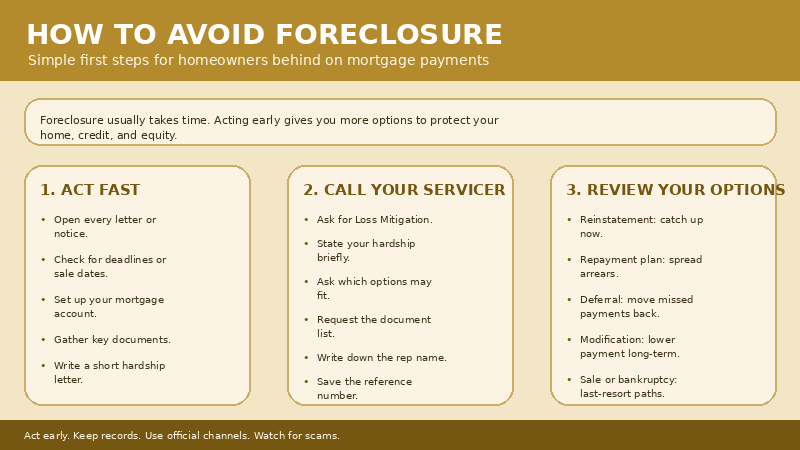
There is no one-size-fits-all method for how to avoid foreclosure. The best solution depends on your specific circumstances, such as how far behind you are on payments, whether your income has improved, how much equity you have in your home, and whether keeping the home is still a realistic option. Just pick the way that works best for you and make sure to do something before deadlines start piling up.
1) Reinstatement
What it is: Reinstatement means paying the full past-due amount in a single lump sum, including missed payments, late fees, and any legal or servicing costs added to the account.
Best when: This is often the best fit if your hardship was short-term and you now have access to cash through savings, a tax refund, a bonus, or family help.
What to watch out for: Always ask your servicer for an itemized reinstatement quote with a deadline. The amount can change as fees continue to accrue.
Why it may help: Reinstatement is often the fastest way to bring the loan current and how to avoid foreclosure activity if you can afford the full amount.
2) Repayment Plan
What it is: A repayment plan helps you get back on track with missed payments by tacking on a fixed amount to your regular monthly mortgage payment.
Best when: This option can work if your income has recovered and you can afford a higher payment for a limited period, usually several months.
What to watch out for: The payment must be realistic. If the catch-up amount is too aggressive and you miss another payment, the problem can grow quickly.
Why it may help: A repayment plan can help you save the home without needing a large lump-sum payment upfront.
3) Payment Deferral or Partial Claim
What it is: Payment deferral generally moves missed payments to the end of the loan so you can resume your normal monthly payment. For some FHA borrowers, a partial claim may place the overdue amount into a separate junior lien that does not require immediate repayment.
Best when: This option may fit borrowers whose hardship has ended and who can afford their normal payment again, but not a higher catch-up payment.
What to watch out for: Ask exactly what is being deferred, including missed principal and interest, escrow shortages, taxes, and insurance advances. Terms vary by loan type.
Why it may help: This can be one of the most practical ways to resolve a temporary hardship without permanently changing the first mortgage payment.
4) Loan Modification
What it is: A loan modification permanently changes one or more terms of the mortgage to make the payment more affordable. This may include extending the term, changing the interest rate, or adding arrears to the balance.
Best when: This option is often considered when your income is stable again, but the current payment is no longer affordable on a long-term basis.
What to watch out for: Some modifications begin with a trial period before becoming permanent. Read the terms carefully and make sure you understand whether the payment can change later.
Why it may help: A loan modification is one of the most common long-term solutions for borrowers who want to keep the home but need a more sustainable payment.
5) Refinance to Resolve the Delinquency
What it is: Refinancing replaces your current mortgage with a new loan. In some cases, the new loan can pay off missed payments, fees, and other arrears at closing.
Best when: This may be an option if you still qualify based on income, credit, home equity, and loan program rules.
What to watch out for: Refinancing is not always available once you are seriously delinquent, and qualification standards can be stricter when you are already in trouble.
When available, refinancing can bring the loan current and replace an unaffordable mortgage with a structure that better fits your financial situation.
6) Forbearance
What it is: Forbearance is a temporary reduction or pause in mortgage payments during a documented hardship. It is designed to provide short-term breathing room, not a permanent fix.
Best when: This option may work if your hardship is temporary and you expect your income to recover within a reasonable period.
What to watch out for: Before accepting forbearance, ask how you will repay the missed amount when the forbearance ends. The exit strategy matters just as much as the relief period.
Why it may help: Forbearance can give you time to stabilize income and avoid immediate escalation while you prepare for the next step.
7) Sell the Home and Protect Your Equity
What it is: Selling the home before foreclosure allows you to pay off the mortgage and use any remaining equity to support your next housing move.
Best when: This is often the strongest option when keeping the home is no longer affordable, but you have enough equity to sell conventionally.
What to watch out for: Waiting too long can reduce your flexibility, especially if fees increase or a sale date gets close. Pricing and timing matter.
Why it may help: A voluntary sale is usually less damaging than a completed foreclosure and can protect both your credit and your remaining equity.
8) Short Sale
What it is: A short sale happens when the lender agrees to let the home be sold for less than the total amount owed on the mortgage.
Best when: This may be an option if you cannot afford the home, do not have enough equity to sell normally, and you don’t know how to avoid foreclosure on your record.
What to watch out for: Short sales require lender approval and can take time. You also need to understand whether the lender is waiving the deficiency balance in full.
Why it may help: A short sale can provide a more controlled exit than foreclosure and may reduce long-term financial damage, depending on the final terms.
9) Deed in Lieu of Foreclosure
What it is: A deed in lieu of foreclosure is when you choose to hand over your home to the bank to clear your mortgage debt, but it still needs the bank’s approval.
Best when: Consider this when you cannot keep the home, a sale has not worked, and foreclosure is otherwise likely.
What to watch out for: Not every lender will approve this option, and the impact on future borrowing and deficiency liability depends on the terms of the agreement.
Why it may help: A deed-in-lieu can sometimes be a cleaner exit than going through the full foreclosure process.
10) Bankruptcy
What it is: Bankruptcy is a legal process that may stop or delay foreclosure and provide a structured way to deal with mortgage arrears and other debts. Chapter 13 is often used to catch up on past debts under court protection, while Chapter 7 may offer broader debt relief in some cases.
Best when: This may be worth exploring if a sale date is close, your arrears are too large to cure on your own, or other debt problems are making the mortgage impossible to manage.
What to watch out for: Bankruptcy is a major legal decision with long-term consequences. It should be reviewed with a qualified bankruptcy attorney who understands local law and timing.
Why it may help: In the right situation, bankruptcy can create time, structure, and legal protection when other foreclosure-avoidance options are no longer enough.
How to Choose the Right Option
If your income is already back, options like reinstatement, repayment, deferral, or modification may be worth exploring first. If the payment is no longer affordable in the long term, a modification, refinance, or sale may be more realistic. If you have strong equity but cannot keep the home, selling before foreclosure may help you keep more of your money and credit. If a sale date has already been posted, urgent loss mitigation and legal review should move to the top of your list.
Which Foreclosure Option May Fit Your Situation?
The best way to avoid foreclosure depends on what has changed in your finances, how much time you have, and whether keeping the home is still realistic. Start with the situation that sounds most like yours.
If Your Income Recovered
If your hardship was temporary and your income is now stable, you may have more options to keep the home. Options such as reinstatement, a repayment plan, payment deferral, or a partial claim may be worth reviewing first. These solutions are often strongest when the problem was short-term, and you can now afford either your regular payment or a reasonable catch-up plan.
If the Payment Is No Longer Affordable
If your income has not fully recovered or your mortgage payment no longer fits your budget long-term, a loan modification may be the most realistic option to explore. In some cases, refinancing may also help if you still qualify and have enough equity. The goal here is not just to stop foreclosure for a month or two, but to create a payment you can realistically sustain.
If You Have Equity but Cannot Keep the Home
If keeping the home is no longer practical but you have built up equity, selling before foreclosure may be the best way to protect your finances. A traditional sale can help you pay off the loan, avoid a completed foreclosure, and keep any remaining equity after closing costs and payoff amounts are satisfied.
If You Owe More Than the Home Is Worth
If you owe more on your mortgage than your home is worth, and it just doesn’t make sense to keep it, you might want to consider a short sale or a deed-in-lieu of foreclosure. These options can sometimes offer a more controlled exit than allowing the foreclosure process to run to completion.
If a Sale Date Is Already Posted
If a foreclosure sale has already been scheduled, time matters more than ever. You should immediately contact your servicer’s loss mitigation department, ask whether any review is still possible, and speak with a local attorney about your legal options. In some cases, Chapter 13 bankruptcy may also be reviewed if you need to stop a sale and create time to catch up under court protection.
Documents That Can Help Speed Up Approval
One of the most common reasons mortgage relief requests get delayed is missing paperwork. The more complete your document package is, the easier it is for your servicer to review your file and determine which options may be available.
- Hardship letter (one page, plain language)
- Last 30 days of income (or YTD P&L if self-employed)
- Two months of bank statements (all pages)
- Most recent tax return (W-2/1099s)
- Mortgage statement, property tax bill, insurance invoice
- ID and signed disclosures
- Budget (income vs. expenses) showing the proposed payment works
State timelines and why they matter
Every state’s process differs. Judicial states take longer, giving you more time to submit a complete application and avoiding foreclosure with a proper workout. Non-judicial states move faster, so acting in the first 30–60 days is even more critical. Your housing counselor or attorney can explain exact notices, cure periods, and sale posting rules where you live.
How to avoid foreclosure when you’re self-employed
- Keep a current profit-and-loss (even if simple).
- Show business bank statements proving deposits.
- Explain seasonality and why income is stable going forward.
- Consider loan options that look at bank statements to qualify if refinancing is the path.
- Ask your servicer for a mod that reflects variable income.
A clean, believable story—backed by numbers—is how to avoid foreclosure when your income is non-W-2.
Protect Your Credit and Cash While You Work the Plan
- Prioritize housing, utilities, transportation, and food.
- Stop unneeded autopays that risk overdrafts.
- Avoid new credit unless it lowers your total outflow.
- Keep insurance active (home and car). Lapses cause force-placed premiums.
- Save proof of every payment and keep copies of everything you send.
Small, steady wins make a big difference in how to avoid foreclosure and rebuild quickly.
Money Moves That May Help While You Work on a Solution
If you are trying to stop foreclosure, small sources of cash can sometimes make a big difference. A tax refund, work bonus, or family gift may help cover part of a reinstatement, reduce other urgent bills, or give you enough breathing room to complete a workout plan. Cutting down on things you don’t really need for a little while can help you save some cash to put towards housing.
At the same time, be careful not to solve one problem by creating a bigger one. Cash advances, new personal loans, and other high-cost borrowing can worsen your monthly financial situation. Borrowing from a 401(k) or taking a hardship withdrawal may also have tax consequences, repayment risks, or long-term retirement costs. Before making a major financial move, it is wise to carefully review the trade-offs.
Scams to Avoid (Red Flags)
- Up-front “guarantee to stop foreclosure” fees.
- If someone tells you to stop chatting with your servicer, ignore that.
- Title transfer or “rent-back” schemes.
- Pressure to sign blank documents.
- “Attorney-backed” firms that won’t give bar numbers.
When in doubt, call your servicer and a HUD-approved counselor. Staying in official channels is how to avoid foreclosure safely.
What to Do After You Catch Up or Get Approved
Once your mortgage is current again, focus on maintaining the recovery. Set up automatic payments, build a small emergency cushion over time, and review your updated loan terms carefully. If your payment changed through a modification or workout, make sure you understand when it starts, whether it can be adjusted later, and how taxes and insurance will be handled going forward. The goal after curing the default is simple: avoid falling behind again.
Sample Hardship Letter (Copy/Paste and Edit)
Subject: Hardship Letter – Loan #_________
Dear Loss-Mitigation Team,
I fell behind on my mortgage due to [brief reason: job loss, hours reduced, medical issue, divorce, tenant vacancy] from [date] to [date]. My income has now stabilized at $______ per month. I can afford a payment of $______ going forward. I am requesting [repayment plan / payment deferral / loan modification / reinstatement quote] so I can keep my home. Attached are my pay stubs/bank statements/tax return/budget. Thank you for reviewing my complete package and helping me avoid foreclosure.
Sincerely,
[Your Name]
[Address | Phone | Email]
A clear letter plus a complete doc set is exactly how to avoid foreclosure with the fastest approval.
When to Get Outside Help
If you’re looking to understand how to avoid foreclosure, it’s important to act quickly, especially if your foreclosure timeline is moving fast or your situation is complicated. Getting outside help early can be beneficial. A HUD-approved housing counselor can assist you in understanding your options at no cost. If a sale date has already been posted or if you have legal questions about notices, timelines, or state-specific rights, consulting a local attorney may be particularly crucial. Additionally, if you choose to meet with a mortgage professional, find one who can clearly explain your options, timelines, and total costs without putting any pressure on you. Taking these steps can help you navigate the challenges and potentially avoid foreclosure.
One-page action Plan (Print This)
- Call your servicer’s loss-mitigation team today.
- Write your hardship letter and gather documents.
- Submit a complete workout package via the official portal.
- Ask for confirmation and a response timeline in writing.
- If you have equity but not affordability, list the home now.
- Call a local attorney and a HUD counselor if a sale date is set.
- Explore refinance and modification options with a team that knows how to avoid foreclosure.
- Pick the path, follow through, and confirm your account is current in writing.
Final Thoughts
If you are behind on your mortgage, the most important step is to act early and stay engaged. Many homeowners still have options, even after missed payments begin to add up. The right solution depends on your income, equity, loan type, and how far the process has moved, but waiting usually makes every option harder. A clear plan, complete paperwork, and fast follow-through can make a major difference.
Need Help Understanding Your Next Step?
If you are uncertain about how to avoid foreclosure and which option may be suitable for your situation, it could be beneficial to consult with a HUD-approved housing counselor, a local attorney if a sale date has been posted, or a mortgage professional who can provide clear explanations of your options. The aim is to understand your best next steps before time runs out.
Frequently Asked Questions About How to Avoid Foreclosure:
How Many Mortgage Payments Can You Miss Before Foreclosure Starts?
- In many cases, foreclosure does not begin after just one missed payment. Late fees can start early, but federal mortgage-servicing rules generally prevent a servicer from making the first notice or filing required for foreclosure until a loan is more than 120 days delinquent, with some exceptions. State timelines and loan type can still affect what happens next, so borrowers should act long before that point.
Can You Stop Foreclosure Once it has Already Started?
- Yes, in many cases, you still have options after the process begins. Depending on timing and eligibility, borrowers may be able to stop or delay foreclosure through reinstatement, forbearance, a repayment plan, payment deferral, loan modification, a sale before auction, or bankruptcy. The sooner you contact the servicer and submit a complete package, the better your chances will be.
What Should I Say When I Call My Mortgage Servicer?
- Ask for the loss mitigation department and clearly say that you want to review your options to avoid losing your home. Be ready to explain what caused the missed payments, whether the hardship is temporary or ongoing, and what payment you may be able to afford going forward. HUD and the FTC both emphasize contacting the servicer early, opening all mail, and preparing your income and expense information before the call.
Will Forbearance Make Everything Due at Once?
- Not always. Forbearance is temporary relief, but the missed amount still has to be resolved afterward. In many cases, the next step may be a repayment plan, a payment deferral, a partial claim, or a loan modification rather than a single lump-sum payment. That is why borrowers who are asking how to avoid foreclosure should always ask what the exit plan will be before accepting forbearance.
Can I Sell My House if it is Already in Foreclosure?
- Often yes. In many states, homeowners can still sell the property before the foreclosure sale. If there is sufficient equity, a traditional sale may preserve cash and cause less damage than a completed foreclosure. If the home is worth less than the mortgage balance, a short sale may be possible with lender approval.
How do I Find Real Help and Avoid Foreclosure Rescue Scams?
- Start with official channels. HUD recommends contacting your servicer right away and working with a HUD-approved housing counselor. At the same time, the FTC warns borrowers to be cautious of companies that charge upfront fees, promise guaranteed results, tell you to stop talking to your servicer, or pressure you to sign documents quickly. For homeowners searching for how to avoid foreclosure, trusted help should be transparent, documented, and never based on high-pressure promises.
This article about “How to Avoid Foreclosure: Guide to Save Your Home” was updated on March 20th, 2026.
Refinance out of trouble if equity allows
Lower your payment, consolidate arrears, or switch programs to stay in the home.