Many people still search for coronavirus stimulus check information because they are not sure how much they received, whether they missed a payment, or where to check their records. The payments were officially called Economic Impact Payments, but most Americans knew them as stimulus checks.
The first coronavirus stimulus checks were issued during the COVID-19 pandemic to help families cover basic needs as businesses closed and jobs were lost. These payments were not loans, so families did not have to repay them. They were part of the federal government’s effort to provide emergency help during a tough time for many.
The IRS has already issued the first, second, and third rounds of Economic Impact Payments. Today, the most important step is understanding how payments worked, who qualified at the time, and where taxpayers can review their payment history in official IRS records.
Last updated: June 2026. The IRS has issued all first, second, and third Economic Impact Payments. This guide explains how the COVID stimulus checks worked and how taxpayers can review their payment history through official IRS records.
What Were Coronavirus Stimulus Checks?
Coronavirus stimulus checks were federal relief payments sent to eligible Americans during the coronavirus pandemic. The official name for these payments was Economic Impact Payments, but most people called them stimulus checks because the money was meant to help households during a sudden financial crisis. These payments were designed to provide families with extra cash when many people lost their jobs, businesses shut down, and household income became uncertain. Families could use this money for basic needs like food, rent, mortgage payments, utilities, medical costs, or other personal expenses. Coronavirus stimulus checks were not loans. Eligible taxpayers did not have to repay the money. The IRS sent the payments by direct deposit, paper check, or prepaid debit card, depending on the information it had on file at the time.
Are Stimulus Checks Still Being Sent?
Regular coronavirus stimulus checks are no longer being sent. According to the IRS, the first, second, and third rounds of Economic Impact Payments have already been issued. Most eligible people received their payments by direct deposit, paper check, or prepaid debit card during the original rollout.
Taxpayers can no longer use the old Get My Payment tool to check payment status. Anyone unsure how much they received should review their IRS Online Account or past tax records. If a taxpayer missed a payment or did not receive the full amount, the issue may be tied to the Recovery Rebate Credit for the 2020 or 2021 tax year.
Because stimulus check rumors still appear online, readers should be cautious about any website, social media post, or message claiming that a new federal stimulus check is automatically on the way. The safest place to confirm payment information is always the official IRS website.
How Much Were the COVID Stimulus Checks?
There were three rounds of coronavirus stimulus checks, officially called Economic Impact Payments. The first round was created under the CARES Act in 2020. Eligible individuals could get up to $1,200, and if you’re a married couple filing together, you could receive up to $2,400. Plus, families could get an extra $500 per qualifying child. The second round was smaller. Eligible individuals could receive up to $600, married couples filing together could receive up to $1,200, and families could receive an extra $600 for each qualifying child. This second payment was also tied to the 2020 tax year. The third round was larger for many households. Eligible people could receive up to $1,400 per person. This included eligible adults, qualifying children, and some adult dependents. The total payment depended on income, filing status, and the number of eligible people listed on the tax return. Not everyone received the full amount. Payments were reduced for taxpayers with income above certain limits. Some people received less, and others did not qualify based on their income, filing status, or tax information at the time.
Who Qualified for the First Stimulus Check?
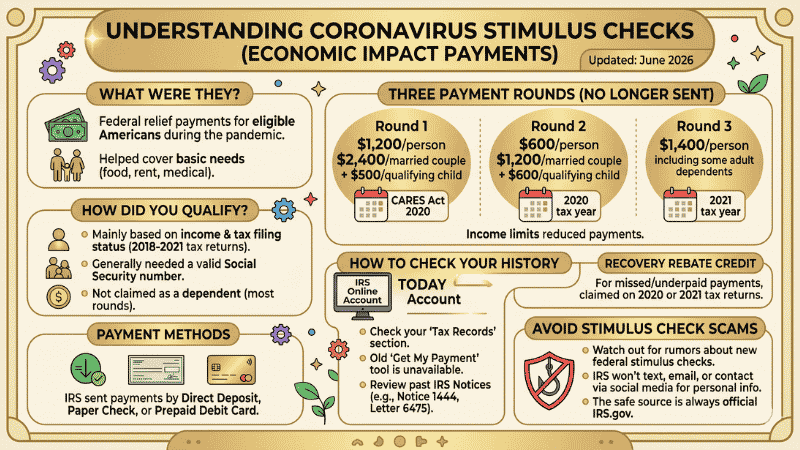
The first coronavirus stimulus check was based mainly on income, tax filing status, Social Security number rules, and qualifying children. The IRS used a taxpayer’s 2019 tax return when available. If a 2019 return has not yet been filed, the IRS could use the 2018 tax return. Single filers could receive the full first stimulus check if their adjusted gross income was up to $75,000. Head-of-household filers could receive the full amount if their income was up to $112,500.
Married couples filing jointly could receive the full amount if their income was up to $150,000. Payments were reduced for taxpayers above those limits and phased out completely at higher income levels.
Taxpayers generally needed a valid Social Security number to qualify. For married couples, Social Security number rules could affect whether either spouse or both qualify. Dependents who were claimed on someone else’s tax return did not qualify for their own separate first stimulus check. Families could also receive an extra $500 for each qualifying child. For the first stimulus payment, a qualifying child generally had to be under age 17 and listed as a dependent on the tax return. Older dependents, such as college students age 17 or older, did not qualify for the extra $500 under the first round.
How Did the IRS Send Payments?
The IRS sent coronavirus stimulus payments in several ways. The fastest method was direct deposit. If the IRS already had a taxpayer’s bank account information from a recent tax return, refund, Social Security payment, or other federal benefit, the payment could be sent straight to that bank account. Some taxpayers received a paper check in the mail. This usually happened when the IRS did not have direct deposit information on file or could not send the payment electronically. Mailed checks took longer because they had to be printed, processed, and mailed. Other taxpayers received their stimulus payments on prepaid debit cards. These cards were mailed to the taxpayer’s address and could be used like a regular debit card. Some people almost threw them away because they did not realize the card was connected to their Economic Impact Payment. The payment method depended on the information the IRS had at the time. That is why some people received their money quickly by direct deposit, while others waited longer for a check or debit card in the mail.
Take First Step Toward Making Your Dream A Reality
Apply Now And Get recommendations From Loan ExpertsHow Can You Check Your Stimulus Payment History Today?
Taxpayers who want to check their coronavirus stimulus payment history can use their IRS Online Account. The IRS says payment information for the first, second, and third Economic Impact Payments can be found under the Tax Records section of an individual’s online account.
Tax records are important because the old Get My Payment tool is no longer available. If someone is unsure how much they received, they should not rely solely on memory, bank statements, or old news articles. The IRS Online Account is the best place to confirm the official payment amounts tied to that taxpayer.
Some taxpayers may also have IRS notices or letters from the original payment years. Notice 1444 showed information about the first payment, Notice 1444-B showed information about the second payment, and Letter 6475 showed information about the third payment. These records can help taxpayers review what was already sent. Anyone who believes they missed a payment or received less than they should have should review their 2020 or 2021 tax records. Missing first or second payments were generally tied to the 2020 Recovery Rebate Credit, while missing third payments were tied to the 2021 Recovery Rebate Credit.
What Was the Recovery Rebate Credit?
The Recovery Rebate Credit was a tax credit for people who did not receive the full amount of their coronavirus stimulus checks. If a taxpayer missed a payment, received less than they qualified for, or had a change in family size or income, they may have been able to claim the missing amount on their federal tax return. The first and second stimulus checks were connected to the 2020 Recovery Rebate Credit. The third stimulus check was connected to the 2021 Recovery Rebate Credit. This means a taxpayer who did not get the full payment during the original rollout may have had a chance to claim the missing money when filing the correct tax return. The Recovery Rebate Credit was not a separate loan or extra monthly payment. It was handled through the tax return. If the credit was approved, it could increase the taxpayer’s refund or reduce the amount of tax owed. Taxpayers who are unsure whether they claimed the credit should review their 2020 and 2021 tax returns, IRS notices, or IRS Online Account. Those records can show whether the stimulus payment was already issued or whether the credit was used on a tax return.
Watch Out for Stimulus Check Rumors and Scams
Stimulus check rumors still spread online, especially on social media. Some posts claim a new federal stimulus check is coming soon, while others use old news articles to make it look like payments are being sent again. This can confuse people who are still trying to understand what happened with past coronavirus stimulus payments.
Be cautious with any messages that ask for your Social Security number, bank info, debit card details, or IRS login. The IRS will not text, email, or contact you by social media to ask for your personal information before you receive your stimulus payment. Scammers often use a sense of urgency to push people into acting quickly without double-checking the source.
Old articles can be confusing. For example, a headline from 2020 might say that stimulus checks are being sent “this week,” but that doesn’t mean new payments are being issued now. Always check the article’s date and verify payment information with the official IRS website or your IRS Online Account. If the government approves a new federal payment program, it will be confirmed through official sources. Until then, be cautious with viral posts, random emails, and claims about “new stimulus checks.”
Final Thoughts on COVID Stimulus Checks
Coronavirus stimulus checks helped many families during one of the most difficult financial periods in recent history. The payments gave households extra money for basic needs when jobs, income, and business operations were disrupted by the pandemic. The important thing to remember today is that the first, second, and third Economic Impact Payments have already been issued. Anyone unsure what they received should check their IRS Online Account, old IRS notices, or 2020 and 2021 tax records instead of relying on old headlines or social media posts. For mortgage borrowers, stimulus payments may have helped with short-term expenses, but they were not the same as a steady income. Lenders still review regular income, credit, debts, assets, and overall ability to repay when approving a home loan. Because stimulus check rumors still circulate online, always confirm payment information through official IRS sources. An old article saying checks are being sent “this week” may have been true in 2020, but it does not mean new payments are being sent today.
FAQs About Coronavirus Stimulus Checks
Were Coronavirus Stimulus Checks Taxable Income?
Coronavirus stimulus checks were not taxable income. The IRS treated them as advance payments of a tax credit, not regular income. That means eligible taxpayers did not have to report the money as taxable income on their federal tax return.
Did Taxpayers Have To Pay Back Stimulus Checks?
Most eligible taxpayers did not have to pay back their stimulus checks. These payments were not loans. If someone received a payment based on the IRS information available at the time, the payment generally did not need to be repaid later.
Did Stimulus Checks Affect Social Security, SSI, SSDI, or VA Benefits?
Stimulus checks generally did not count as income for federal benefit programs such as Social Security, SSI, SSDI, or VA benefits. Many federal benefit recipients received payments automatically if the IRS or the paying agency already had the information needed to send the payment.
Could College Students Get Their Own Stimulus Checks?
Some college students did not qualify for their own stimulus checks if they were claimed as dependents on a parent’s tax return. For the first stimulus payment, older dependents aged 17 or older were not eligible for the extra child payment. Rules changed for the third round, which allowed payments for some adult dependents.
What Happens If A Stimulus Check Goes To A Closed Bank Account?
If a stimulus payment was deposited into a closed or inactive bank account, the bank would usually reject the deposit and return the funds to the IRS. After that, the IRS could issue the payment another way, such as by paper check or debit card, based on the information available at the time.
Could People With No Income Receive Coronavirus Stimulus Checks?
Yes, some people with little or no income could still qualify for stimulus checks. The payments were not limited only to people who owed taxes. During the original rollout, the IRS created options for some non-filers so they could provide the information needed to receive their payments.
Can Someone Still Claim Missing COVID Stimulus Money in 2026?
In most cases, the deadlines to claim missing COVID stimulus money through the Recovery Rebate Credit have passed. Missing first and second payments were tied to the 2020 tax return, while missing third payments were tied to the 2021 tax return. Anyone with questions about an old tax return should review IRS records or speak with a qualified tax professional.
Did Stimulus Checks Count As Income For A Mortgage?
Stimulus checks usually did not count as stable qualifying income for a mortgage because they were one-time government payments. A lender may review bank deposits and assets. However, mortgage approval is still based mainly on regular income, credit, debts, assets, and the borrower’s ability to repay the loan.