

The home appraisal process timeline is often one to two weeks from the lender placing the order to receiving the completed report. This is an industry estimate, not a federal deadline. Timing can vary based on the property’s location, size, condition, and complexity, as well as appraiser availability, loan program requirements, requested revisions, and repairs that must be completed before final approval.
What Is a Mortgage Appraisal?
A mortgage appraisal assesses a property’s market value and its suitability as collateral. The lender uses the appraisal to calculate the loan-to-value ratio and determine whether the property provides sufficient security for the requested mortgage. It is an important step in the home appraisal process timeline, but a satisfactory appraisal does not replace the lender’s review of the borrower or other property documents.
The appraiser must develop an impartial opinion of value based on the property’s characteristics, condition, location, and comparable sales. The lender, borrower, seller, and real estate agents cannot pressure the appraiser to reach a purchase price or any other predetermined value.
An appraisal is also different from a home inspection. An appraiser focuses primarily on value, marketability, and applicable property requirements. A home inspector performs a more detailed review of the home’s systems and physical condition for the buyer. Borrowers generally pay an appraisal fee for the appraiser’s time, research, inspection, and completed report. Paying that fee does not guarantee that the home will appraise at the contract price, support the requested loan amount, or meet every mortgage program requirement.
Home Appraisal Process Timeline
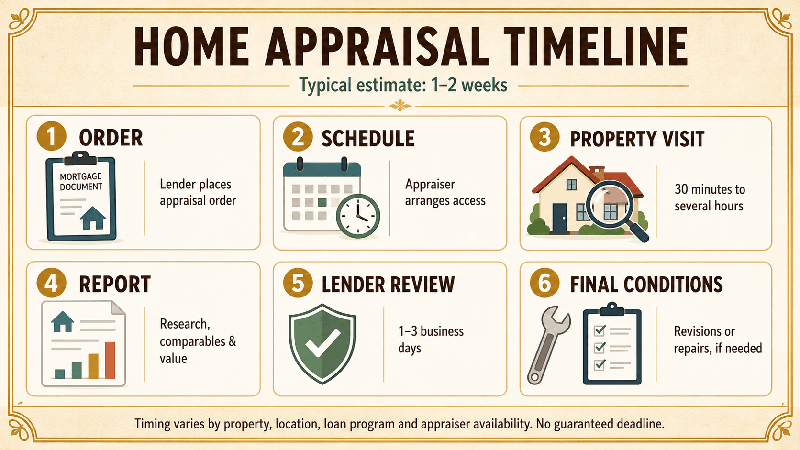
The home appraisal process timeline often takes approximately one to two weeks from the initial order to the lender’s acceptance of the report. However, these timeframes are industry estimates—not guaranteed deadlines. Appraiser availability, property location, loan program, home complexity, required repairs, and report revisions can make the process shorter or longer.
1. The Lender Orders the Appraisal
The lender normally orders the appraisal after receiving the borrower’s intent to proceed, payment authorization, and a fully executed purchase contract. The order may be placed within one or two business days after these requirements are satisfied.
2. An Appraiser Is Assigned
An appraisal management company or the lender’s approved appraisal department assigns a qualified, independent appraiser. Assignment may take one to three business days, although rural areas, unusual properties, and busy markets may require additional time.
3. The Property Visit Is Scheduled
The appraiser or appraisal management company contacts the listing agent, homeowner, builder, or another authorized person to arrange access. Scheduling typically takes 2 to 7 business days, depending on availability and the property’s location.
4. The Appraiser Inspects or Collects Property Data
A traditional appraisal generally includes an interior and exterior inspection of the property. The visit may take 30 minutes to several hours, depending on the home’s size, condition, acreage, outbuildings, and complexity. Some eligible conventional loans may use a desktop appraisal, hybrid appraisal, property data collection, or appraisal waiver. The lender’s underwriting system and applicable loan guidelines determine whether one of these alternatives is permitted.
5. The Appraiser Researches Comparable Sales
After collecting the property information, the appraiser reviews public records, multiple listing service data, market conditions, and recent comparable sales. Complex homes or properties in areas with limited comparable sales may require more research.
6. The Appraiser Completes the Report
The completed report is submitted to the lender or appraisal management company. Many reports are delivered within two to five business days after the property visit, but rural properties, unique homes, and heavy appraiser workloads can cause delays.
7. The Lender Reviews the Appraisal
Receiving the report does not automatically clear the property for closing. The lender, underwriter, or collateral review department must confirm that the report supports the value and complies with the selected mortgage program. This review may take one to three business days.
8. Revisions, Repairs, or Additional Documents Are Completed
The lender may ask the appraiser to correct errors, explain adjustments, provide better comparable sales, or address missing information. FHA, VA, USDA, and some conventional appraisals may also identify required repairs. Minor revisions may take one or two business days, while repairs and follow-up inspections can add several days or weeks.
9. The Property Is Cleared for Closing
Once the lender accepts the appraisal and all required repairs, revisions, and inspections are complete, the property condition can be cleared. The mortgage file must still satisfy the borrower, title, insurance, and final underwriting requirements before the lender issues a clear-to-close. A straightforward appraisal may move through the entire process in less than a week. A more typical transaction may take one to two weeks, while a complex property, low appraisal, required repairs, or limited appraiser availability may extend the timeline beyond two weeks.
When Is the Appraisal Ordered?
 The appraisal is usually ordered after the borrower has chosen to proceed with the mortgage and the lender has enough information to identify the property and transaction. The exact timing can vary by lender, loan program, closing deadline, and whether the loan has received an initial processing or underwriting review. Before collecting an appraisal fee, the lender generally must provide the Loan Estimate and obtain the borrower’s intent to proceed. Federal rules do not require borrowers to sign the Loan Estimate, although an individual lender may require signed disclosures as part of its internal process. The lender may also need separate authorization to charge the borrower’s credit card or another payment method for the appraisal fee. The only fee normally permitted before the Loan Estimate and intent to proceed is a bona fide and reasonable credit report fee.
For a purchase loan, the lender will typically wait until the purchase contract is fully executed before ordering the appraisal. The contract identifies the property, purchase price, interested parties, seller concessions, personal property, financing terms, and closing date.
Fannie Mae mandates that the appraiser obtain the complete ratified sales contract and all addenda when conducting an appraisal for a purchase transaction. The lender does not always have to wait for full underwriting approval. In our mortgage-processing experience, many lenders complete an initial review of the borrower’s credit, income, assets, debts, automated underwriting findings, and purchase contract before charging for an appraisal. This can help identify major qualification issues before the borrower pays a potentially nonrefundable fee. The appraisal may be ordered immediately when the closing deadline is short and the loan appears eligible. Processing, underwriting, title work, and the appraisal can then move forward at the same time. If the borrower has complex income, unresolved credit issues, uncertain funds to close, or an unusual property, the lender may wait for an initial underwriter review before ordering it. Ordering early may shorten the home appraisal process timeline, but it also creates a financial risk for the borrower. Once the appraiser begins the assignment, the appraisal fee may remain due even if the loan is later denied, the purchase contract is canceled, or the borrower changes lenders. Borrowers should ask their loan officer whether the initial loan review is complete and whether the appraisal fee is refundable before authorizing the order.
What Happens During the Appraisal Visit?
During a traditional appraisal, the appraiser observes the home’s interior and exterior, confirms the square footage and room count, and notes its overall condition. The appraiser may identify visible safety concerns, needed repairs, or property-standard issues that could affect the loan program. The appraiser also photographs the property and documents features such as upgrades, garages, basements, outbuildings, and additions. After the visit, the appraiser researches comparable sales and local market conditions to develop an independent opinion of value and marketability. This stage of the home appraisal process timeline is not a substitute for a home inspection. The appraiser evaluates value and general property acceptability but does not perform the detailed testing that a home inspector conducts.
Need Help With the Home Appraisal Process?
Complete a quick application or send your scenario. We’ll guide you through appraisal ordering, review, conditions, value issues, and the next steps toward closing.What Happens After the Appraisal Is Completed?
After the appraiser submits the report, the lender may send it through collateral review and underwriting. The reviewer confirms that the value is supported, the comparable sales are appropriate, and the property meets the requirements of the selected loan program.
The underwriter may request corrections, additional photographs, explanations, or clarification from the appraiser. Complex, unusual, or higher-risk properties may require a second appraisal review. When repairs are required, the lender may also need photographs, invoices, or a completion inspection before clearing the property.
An appraisal marked “completed” does not mean the mortgage is clear to close. The home appraisal process timeline continues until the lender accepts the report, clears all property conditions, and completes the remaining reviews by the borrower, title, insurance, and underwriting.
What Can Delay the Appraisal?
Several issues can extend the home appraisal process timeline, including:
- Rural or remote locations: Travel distance and a smaller pool of appraisers can slow the assignment.
- Appraiser shortages: Busy markets may have fewer qualified appraisers available.
- Unique or complex properties: Acreage, mixed-use features, unusual construction, accessory units, or multiple buildings may require additional research.
- Missing property access: Locked rooms, unavailable occupants, or scheduling conflicts may require another visit.
- Incorrect property information: Errors involving the address, parcel, square footage, contract, or property type may need correction.
- Limited comparable sales: Rural, luxury, or uncommon homes may have few recent comparable properties.
- Required repairs: FHA, VA, USDA, and some conventional loans may require repairs and proof of completion.
- Appraisal revision requests: The lender may ask the appraiser to correct errors, explain adjustments, or provide additional support.
- New construction: The appraisal may remain subject to completion until construction and required inspections are finished.
- Low appraised value: A reconsideration-of-value request can add time because the lender must review supporting evidence and send an eligible request to the appraiser.
Borrowers can reduce avoidable delays by providing complete property information, arranging prompt access, and responding quickly to lender requests. However, neither the borrower nor the lender can require the appraiser to reach a particular value or complete the report by a guaranteed date.
Conventional, FHA, VA, and USDA Appraisal Timelines
No single home appraisal process timeline applies to every mortgage. Completion times depend on the loan program, location, property condition, appraiser availability, and whether repairs or additional reviews are required.
Conventional Loan Appraisals
Conventional loans may use a traditional, desktop, or hybrid appraisal. Some eligible transactions may receive value acceptance or value acceptance plus property data. These options are determined by the lender’s automated underwriting findings and program requirements; the borrower cannot select an appraisal waiver. A desktop or hybrid option may reduce some scheduling delays, but property data collection and lender review may still be required.
FHA Appraisals
An FHA appraisal reviews both market value and whether the property meets FHA’s minimum property requirements. Peeling paint, missing utilities, safety hazards, damaged roofing, or other deficiencies may require repairs and a completion inspection. These conditions can extend the timeline beyond the initial report.
VA Appraisals
VA appraisal completion expectations vary by state and, in some cases, by county. The VA publishes location-specific timeliness requirements, so borrowers should not rely on one nationwide estimate. Repairs, Tidewater procedures, or additional value support may add time.
USDA Appraisals
USDA appraisals review value and compliance with applicable property requirements. Rural locations may have fewer available appraisers or comparable sales, which can affect timing. Required repairs, new-construction documentation, or completion verification may also delay final property approval. Current requirements are available in the USDA Single Family Housing Guaranteed Loan Program Handbook.
What Happens If the Appraisal Is Low?
When the appraised value is below the purchase price, the lender generally calculates the loan-to-value ratio using the lower of the two. This can increase the buyer’s required funds and extend the timeline for the home appraisal process. The borrower and real estate agents should first review the report for factual errors involving the square footage, room count, property condition, amenities, or comparable sales. If stronger comparable sales or other credible evidence exists, it must be submitted through the lender as part of a reconsideration-of-value request. A request does not guarantee that the appraiser will change the value. Depending on the contract and loan program, the buyer may also:
- Renegotiate the purchase price.
- Pay the difference with additional funds.
- Restructure the loan or down payment.
- Ask the seller to change other terms of the contract.
- Exercise an appraisal contingency and cancel the transaction when permitted.
For a more detailed explanation of these options, read our guide on handling a low appraisal on a home purchase.
Hypothetical Appraisal Timeline Example
Hypothetical Example—Not a Guaranteed Timeline A buyer has an accepted purchase contract, has received the Loan Estimate, and has given the lender permission to proceed. The home appraisal process timeline could look like this:
- Monday: The lender orders the appraisal.
- Wednesday: The appraiser completes the property inspection.
- Following Monday: The lender receives the completed appraisal report.
- Tuesday: The underwriter reviews the report and requests one factual correction.
- Wednesday: The appraiser submits the revised report.
- After the revision: The underwriter accepts the appraisal and clears the property condition.
This example shows why receiving the initial report does not always complete the appraisal process. Actual timing may be shorter or longer depending on the property, appraiser availability, lender workload, loan program, repairs, and required revisions.
Borrower Checklist to Prevent Appraisal Delays
Borrowers cannot control the appraiser’s workload or final opinion of value, but they can prevent avoidable problems that extend the home appraisal process timeline.
- Pay the appraisal fee promptly after receiving the Loan Estimate and providing intent to proceed.
- Confirm that the listing agent, seller, homeowner, or other property contact responds to scheduling requests.
- Provide access to every room, the basement, the garage, the accessory unit, and the outbuilding.
- Tell the lender about additions, acreage, mixed-use features, unusual construction, or other property characteristics.
- For a refinance, keep renovation permits, receipts, contracts, and a list of completed improvements available.
- Make sure utilities are operating when required by the loan program.
- Respond quickly when the lender requests clarification or additional property documents.
- Complete required repairs as early as possible and keep invoices or photographs.
- Do not pressure the appraiser to reach the purchase price or another target value.
Accurate information, prompt access, and quick responses can keep the appraisal moving, but neither a borrower nor a lender can guarantee the completion date or appraised value.
When Must the Borrower Receive the Report?
For a loan secured by a first lien on a dwelling, the lender must provide the borrower with a free copy of each appraisal or valuation promptly after it’s completed or at least three business days before closing, whichever comes first. This requirement applies even if the loan does not close.
If the lender receives a revised appraisal after providing an earlier version, the borrower must also receive the updated report as required. A borrower may be allowed to waive the advance-delivery timing and receive the report at or before closing, subject to federal rules and applicable state law.
Receiving the report is an important part of the home appraisal process timeline because it gives the borrower time to review the value, property information, comparable sales, and required repairs before closing.
Final Thoughts on the Home Appraisal Process Timeline
The home appraisal process timeline often takes one to two weeks, but there is no guaranteed deadline. Property location, appraiser availability, loan type, repairs, report revisions, and lender review can all affect how quickly the appraisal is cleared. Borrowers can help prevent delays by paying the appraisal fee promptly, arranging property access, providing accurate information, and responding quickly to lender requests. However, a completed appraisal does not automatically mean the loan is clear to close. The lender must still approve the report and clear all remaining borrower, title, insurance, and underwriting conditions. Borrowers with questions about an appraisal, required repairs, a low value, or an approaching closing deadline can contact Gustan Cho Associates. Our team can review the mortgage file, explain the outstanding conditions, and help identify the next steps without promising a particular appraised value or closing date.
Frequently Asked Questions About Home Appraisals
Can the Borrower Choose the Mortgage Appraiser?
Generally, no. The lender or its authorized appraisal management company selects a qualified appraiser in accordance with appraisal-independence requirements. A borrower may obtain a separate private appraisal, but the mortgage lender is not automatically required to use it.
Can a Buyer Attend the Home Appraisal?
There is no universal rule prohibiting a buyer from attending, but the appraiser, lender, seller, or property contact may limit who is present. Buyers usually do not need to attend. The appraiser works for the lender and normally cannot discuss the expected value or preliminary findings during the visit.
What Happens If the Home Appraises Higher Than the Purchase Price?
A value above the purchase price generally allows the transaction to proceed without an appraisal shortage. The lender usually calculates the loan-to-value ratio based on the lower amount between the purchase price and the appraised value. The additional value cannot usually replace the buyer’s required down payment or be received as cash at closing.
Does Cleaning or Staging a Home Increase Its Appraised Value?
Cleaning and staging do not automatically increase market value. However, a well-maintained and accessible property makes it easier for the appraiser to observe its condition, layout, features, and improvements. Deferred maintenance, damage, or inaccessible areas may affect the report or create additional questions.
How Long Is a Mortgage Appraisal Valid?
Appraisal validity depends on the loan program and transaction. Under Fannie Mae guidelines, an appraisal generally must be dated within 12 months of the mortgage note date. An appraisal update is normally required when the report is more than four months old, while a desktop appraisal more than four months old requires a new appraisal. FHA, VA, USDA, and individual lenders may apply different requirements.
Can an Appraisal Be Transferred to a Different Lender?
It depends on the loan program. FHA case numbers and appraisals can generally be transferred between approved lenders through the FHA Connection process. Conventional appraisal transfers are subject to the new lender’s acceptance and applicable investor requirements. Borrowers should request the transfer immediately because changing lenders can still delay closing. Learn more about an FHA appraisal transfer to a new lender.
Can a Lender Require a Second Appraisal?
Yes. A second appraisal may be required by the loan program, applicable law, investor guidelines, or lender policy. It may also be necessary when the original report is deficient or the property presents unusual risk. When multiple appraisals exist, Fannie Mae requires the lender to select the most reliable report—not simply the one with the highest value.
Can the Appraisal Affect the Mortgage Interest Rate?
The appraiser does not set the mortgage rate. However, the appraised value affects the loan-to-value ratio, which may influence the available interest rate, mortgage insurance, required down payment, or loan eligibility. A lower value can result in a higher loan-to-value ratio and alter the original financing terms.
This article about “Home Appraisal Process Timeline: How Long It Takes and What Happens Next” was updated on August 18th, 2026.