This guide covers mortgage interest rates on conventional versus FHA loans. Mortgage interest rates on conventional loans are more sensitive to credit scores and loan-to-value than FHA loans. The higher the borrower’s credit scores, the lower their conventional mortgage rate.
For the best conventional mortgage rate, the borrower should put down 25% down payment. The higher the credit score, the lower private mortgage insurance is on conventional loans. Putting less than 20% down payment is higher rates. In this article, we will discuss and cover mortgage interest rates on conventional versus FHA loans.
Mortgage Interest Rates: Conventional vs. FHA Loans Explained

Mortgage interest rates matter more than many buyers think, shaping both the size of monthly bills and the overall cost of a house. That’s why anyone hoping to buy a home should look closely at how traditional (conventional) loans stack up against FHA loans. This easy-to-read guide breaks down today’s mortgage rates, walks through the key differences between the two loan types, offers reasons why conventional rates can be higher, and shares tips on boosting your chances of landing the best deal.
What Are Mortgage Interest Rates?
Simply put, the mortgage interest rate is the fee lenders charge, shown as a yearly percentage, for lending you money to buy a home. Rates apply to the entire loan amount and, because they run for fifteen, twenty, or even thirty years, little changes early on add up to big dollar differences later on. Daily economic shifts, lender rules, a consumer’s credit strength, and the kind of mortgage all influence where that rate lands on any given morning. The two routes most buyers choose are conventional loans from banks and credit unions and FHA loans backed by the federal government. Each path comes with its own rules, perks, and rate pattern, and the next sections will lay those out side by side.
Conventional Loans: Overview and Mortgage Interest Rates
Conventional loans are home loans not insured or guaranteed by any government program, and they come from banks, credit unions, and other private lenders. People with good credit and a steady income tend to like these loans because they offer clear terms and predictable payments. As of mid-2025, the interest rate on a thirty-year fixed conventional mortgage averages between 6.5 percent and 7.5 percent, but what any one borrower pays can be higher or lower based on the overall market and on that persons credit score, down payment, and debt. John Strange, a senior loan officer at Gustan Cho Associates says the following about standard versus high-balance conforming loans:
There are two main kinds of conventional loans. Conforming loans stay within dollar limits set each year by Fannie Mae and Freddie Mac; in 2025, for example, that limit is $806,500 for a single-family house in most areas. Loans that go above that limit are called jumbo or non-conforming loans. Jumbo conforming loan limits for 2025 is $1,209,750.
They usually cost more because lenders see them as riskier. Borrowers who want steady payments often choose a fixed-rate mortgage, while those comfortable with future rate changes might look at an adjustable-rate mortgage, or ARM, which starts cheaper but can rise later.
FHA Loans: Overview and Mortgage Interest Rates
FHA loans are government-backed mortgages made especially for first-time buyers, moderate-income families, or anyone worried their credit score is too low. Because the Federal Housing Administration provides insurance on each loan, lenders feel safer and can relax some standard rules. For a thirty-year fixed FHA mortgage in mid-2025, the interest rate is usually around 6.0 percent to 7.0 percent, and that is often a bit better than the rate on a similar conventional loan.
FHA loans ask for a down payment of 3.5% if your credit score is 580 or higher. If your score sits between 500 and 579, the required down payment can go up to 10%. There are also two kinds of mortgage insurance you must pay. The first is an upfront fee equal to 1.75% of the loan amount, and the second is a yearly premium that ranges from 0.15% to 0.75%. These insurance charges add to the total cost of the loan but do not change the interest rate itself.
Comparing Conventional and FHA Loan Mortgage Interest Rates
Both conventional loans and FHA loans can have good interest rates, but FHA loans usually come in a little lower. Take July 2025, for example; a 30-year fixed-rate conventional loan might average 7.0%, while a similar FHA loan could sit around 6.5% for borrowers with the same credit profile. That gap of 0.25% to 0.5% exists mainly because of the way each loan is set up and the risks each one is designed to cover.
Conventional Loans vs. FHA Loans: Understanding Interest Rates
Conventional home loans usually ask for stronger credit scores, often above 620, and the best rates show up around 740. They also expect a down payment that can range from 3 percent to 20 percent, depending on the borrower’s profile. Alex Carlucci, a senior mortgage loan originator at Gustan Cho Associates explains about mortgage interest rates between conventional and FHA loans.
When applicants have solid income, low debt, and high scores, lenders reward them with the most attractive terms. Yet those with thinner credit or a debt-to-income (DTI) ratio close to the limit see rates climb because the lender feels exposed.
In comparison, Federal Housing Administration (FHA) loans welcome scores as low as 500, ask for smaller down payments, and accept DTI ratios that touch 50 percent in some cases. The governments insurance on these mortgages cushions lenders, so they can offer a lower monthly cost to people who might be shut out by a conventional route.
Why Are Mortgage Interest Rates Higher on Conventional Loans
Multiple reasons explain the habitually higher rates attached to conventional loans, especially for borrowers deemed riskier. First, these loans carry no government insurance. Because lenders cover every dollar lost if a borrower defaults, they hedge that exposure with steeper interest. The effect shows clearly: a borrower with a small down payment and a fair credit score pays a penalty that a similar FHA applicant avoids. In other words, FHA programs transfer much of the risk away from private lenders and let them price loans more gently, even for buyers who have struggled in the past.
Borrower Credit Profile
Conventional mortgage programs want solid credit scores, usually above 700, along with steady income and manageable debt. If a borrowers score sinks below that line or their debt-to-income (DTI) ratio is high, they may still get approved but the rate will climb. In contrast, an FHA loan can step in with scores starting at 500. Because after-the-fact insurance helps all FHA loans, lenders feel less need to pad the rate as much when credit is shaky.
Down Payment Differences
A standard conventional mortgage calls for at least 5 percent down, and putting down only 3 percent almost always brings maximum private mortgage insurance, or PMI. The bigger the down payment, the gentler the PMI charge and the lower the interest rate. FHA, on the other hand, asks only 3.5 percent down and bundles its own insurance into the life of the loan, so borrowers trade lower monthly cost for a longer obligation period.
Loan Size and Type
Once a conventional mortgage climbs above the conforming limit-numerically $806,500 in most U.S. areas for 2025-it is classified as a jumbo loan, and the absence of federal backing usually lifts the rate further. FHA loans, meanwhile, stay under a separate ceiling-$524,225 in most counties or $1,209,750 in the highest markets for 2025-resulting in a portfolio that feels predictable and less risky to lenders, and that stability supports a lower borrowing cost.
Market Perception and Pricing
Lenders set the price of a conventional mortgage by looking at how many buyers want such loans and how many investors will snap up the bundles of payments sold as mortgage-backed securities. Because these loans travel to the secondary market without a government stamp of approval, their interest rates wiggle in tune with the wider economy-inflation numbers, jobs reports, and what the Federal Reserve says and does-and sometimes end up higher than those on FHA loans.
Even though FHA loans usually carry lower advertised rates, the program’s mandatory mortgage insurance premium, or MIP, adds to the monthly tab and keeps it there for the life of the loan unless the borrower refinances.
On a $300,000 FHA mortgage priced at 6.5 percent and loaded with 0.55 percent annual MIP, the extra charge works out to roughly $137.50 each month; a similarly sized conventional loan priced at 7.0 percent and tagged with private mortgage insurance, or PMI, could save money over many years for borrowers who start with good credit and build 20 percent equity.
Factors Influencing Mortgage Interest Rates
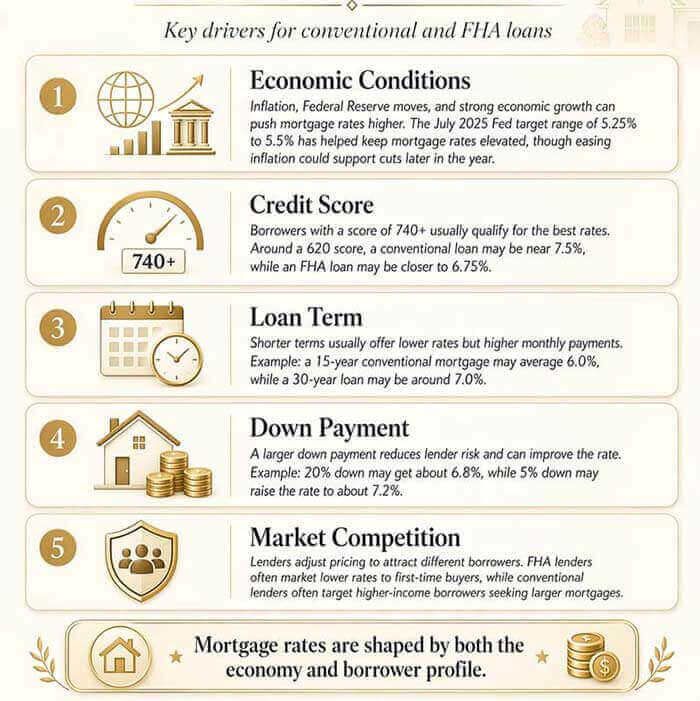
Wider economic forces and personal borrower facts steer interest rates for both conventional and FHA products:
- Economic Conditions: Rates tend to creep higher in times of rising inflation, big Fed rate moves, or unusually strong growth.
- On July 2025 the Fed’s own guiding range of 5.25 to 5.5 percent has kept mortgage rates up, yet early signs of easing inflation raise hopes for cuts later in the year, a shift that could nudge rates back down.
- Credit Score: A credit score of 740 or higher usually unlocks the lowest interest rates for either loan type.
- For a conventional mortgage, a score around 620 might come with a 7.5 percent rate, while an FHA loan at the same score could be closer to 6.75 percent.
- Loan Term: Shorter loan terms, like a 15-year mortgage compared to a 30-year, tend to carry lower rates but require bigger monthly payments.
- For instance, a 15-year conventional mortgage may average 6.0 percent, whereas the same loan at 30 years could sit around 7.0 percent.
- Down Payment: Putting down more money eases the lender’s risk and can lead to better rates.
- With a conventional loan, a 20 percent down payment might score a 6.8 percent rate, while only 5 percent down could nudge the rate up to 7.2 percent.
- Market Competition: Lenders tweak their rates to pull in new customers.
- FHA lenders often advertise lower rates to attract first-time buyers, while conventional lenders focus on higher-income borrowers who need larger mortgages.
Conventional Loans
- Benefits: No private mortgage insurance, or PMI, is required if you put 20 percent down, which cuts costs over the life of the loan.
- Conventional mortgages offer higher loan limits to cover expensive homes, including jumbo options.
- Borrowers with strong credit can choose fixed or adjustable-rate mortgages for flexible terms.
- Drawbacks: Interest rates can be noticeably higher for buyers with lower credit scores or for those who make smaller down payments.
- Eligibility standards are stricter, usually looking at credit score, debt-to-income ratio, and solid income proof.
- Because these loans aren’t backed by the government, lenders take more risk, and that risk shows in the rates offered.
FHA Loans
Benefits:
- Interest rates usually sit about a quarter to half a point below most conventional loans.
- The credit bar is lower, needing only a 580 score and three and a-half percent down.
- That makes the program friendly to first-time buyers and anyone short on savings.
Drawbacks:
- Mandatory mortgage insurance (MIP) still tags on extra cost each month and at closing.
- FHA loan limits cap how much you can borrow, especially in pricey metro areas.
- Homes must pass a special FHA appraisal that checks for safety and soundness.
Save a Bigger Down Payment
Putting down 10 to 20 percent trims the rate and may wipe out PMI on a conventional loan.
- Lock Your Rate: When markets look bumpy, lock your rate for 30 to 60 days to shield yourself from sudden jumps.
- Think About Points: Buying discount points- one percent of the loan- can cut your rate another one-eighth to one-quarter percent, a smart move if you plan to stay long.
- Evaluate total costs before choosing a loan: FHA mortgages include monthly mortgage insurance premium (MIP), while conventional options may charge private mortgage insurance (PMI) and come with higher interest rates.
- Taking these fees into account shows which program truly makes the most sense for your budget.
- Mortgage interest rates still guide almost every lending option.
- In mid-July 2025, conventional loans sit between roughly 6.5% and 7.5%, making them attractive mainly for homeowners with excellent credit and a sizable down payment.
- Because they carry no government backing, however, lenders often price these deals higher and demand stricter income and debt-to-income limits.
- FHA alternatives hover around 6.0 % to 7.0 %, so even buyers with light credit can qualify at a lower base rate.
- The trade-off is the lifetime MIP fee, which slightly dulls that initial advantage yet remains friendlier than some jumbo products.
- Comparing offers side by side is critical.
- Reach out to well-known names such as Preferred Mortgage Rates and FHA Lenders for Bad Credit and dont overlook local credit unions.
- Ask each lender for an itemized loan estimate detailing rates, closing costs, and long-term monthly payment projections.
- Only after collecting Apples-to-Apples data can you spot the truly best deal for your home-buying journey.
Mortgage Interest Rates on FHA Loans
With FHA loans, here is how mortgage rates work:
- Credit Scores does affect mortgage rates on FHA Loans but not like conventional loans
- Borrowers can get the best FHA mortgage rates with 680 credit score
Loan to Value on government loans such as FHA, VA, USDA loans does have impact on rates if credit scores are under 680.
Mortgage Rate Locks
A mortgage interest rates lock, also called a rate lock or rate commitment, is a lender’s promise to hold a certain interest rate and a certain number of points for you, usually for a specified period of time, while your loan application is processed. Depending upon the lender, borrowers may be able to lock in the interest rate and number of points that they will be charged when they complete the mortgage application and get disclosures back or, during the mortgage process. Or borrowers can lock their loan once they get a conditional loan approval
Mortgage interest rate locks should be done as soon as possible on refinance mortgage loans. This is because if the mortgage interest rates rise, then the refinance mortgage loan may not go through.
Or the refinance borrower may need to wait until the mortgage interest rates come back down. There are 15-day locks, 30-day locks, 45-day locks, and 60-day locks. The longer the lock period, the more it will cost for the pricing adjustments.
Mortgage Interest Rates on Shorter Term Home Loans
Shorter loans, such as a 20-year or 15-year note, can save homeowners thousands of dollars in interest payments over the term of the loan. The monthly Principal and Interest Payments will be higher due to being amortized over a shorter period. An adjustable rate mortgage may get you started with a lower interest rate than a fixed-rate mortgage. Payments on ARM could get higher when the interest rate changes after the ARM fixed rate period is over.
Larger Down Payment on Home Purchase
A larger down payment greater than 20% will give you the best possible rate. With a down payment of 5% or less, you should expect to pay a higher rate as you are starting with less equity as collateral on conventional loans. If you’ve got the cash now and want to lower payments, borrowers can buy down rates with discount points to lower mortgage rate
It’s a simple concept. In exchange for more money upfront, lenders are willing to lower the interest rate they charge, cutting the borrower’s payments. Closing costs are fees paid by the lender if you do not want to pay all of the closing costs, expect a higher rate which will pay the lender additional interest over the life of the loan.
Credit and Debt-to-Income Ratios
Credit Scores and debt-to-income ratio affects the type of loans borrowers qualify for. Borrowers who have good credit and sufficient monthly income that surpasses monthly debt obligations, they will get lower debt to income ratios. Borrowers who have monthly income that barely covers minimum debt obligations. This holds true even if they have high credit scores, will not be eligible for certain loan programs due to debt to income ratio requirements.