Is closing a mortgage under LLC possible?
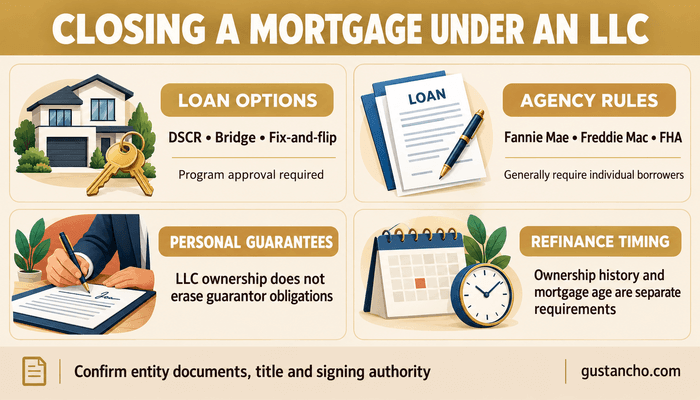
An LLC can get a mortgage if the loan program allows business entities as borrowers. Many DSCR, bridge, and fix-and-flip loans work with this setup. Standard Fannie Mae, Freddie Mac, and FHA home loans usually require individual borrowers, depending on trust rules. If you transfer the property to an LLC later, different servicing rules may apply. Before you apply, make sure you know who will own the property, who will sign the loan, and who will give any personal guarantee.
What does ‘Closing Mortgage Under an LLC’ Mean?
Closing a mortgage under an LLC generally means the LLC takes title to the property and then borrows via a program which will allow an entity to be the borrower. Forming an LLC in itself doesn’t get you eligible for financing. Three roles are relevant. The property owner is the one who holds the title and is on the deed. The borrower is the one who is on the note and who takes on the primary obligation to repay the loan. A personal guarantor takes on specific obligations under a separate guarantee. For instance the LLC may own the property and be the one who signs the note, with an individual member of the LLC providing a guarantee. The extent of the individual’s obligation under that guarantee will of course vary. If the individual has the mortgage and then deeds the property to an LLC, that title transfer does not in itself substitute the LLC as the borrower on the existing note.
Conventional Investment-Property Loans vs. Loans That Allow LLC Borrowers
Conventional investment-property mortgages evaluate the eligible borrower’s credit, income, assets, debts, and property. Programs that permit LLC borrowers may instead place greater emphasis on rental income, property value, investor experience, liquidity, and guarantor qualifications. The exact underwriting approach depends on the product.
Borrower eligibility is separate from a loan’s legal classification. The CFPB’s commentary to Regulation Z, Section 1026.3 treats credit used to acquire, improve, or maintain a non-owner-occupied rental property as business-purpose credit. Owner use can change the analysis, and separate rules apply to owner-occupied rental properties.
A rental-property loan made to an individual can therefore be business-purpose credit. That classification does not make an LLC eligible under an agency program. Confirm the program’s borrower requirements and the applicable credit classification for the transaction separately.
Can Agency Mortgages Close With an LLC Borrower?
Fannie Mae
Under Fannie Mae Selling Guide B2-2-01, borrowers generally must be natural persons, with specified exceptions. An ordinary LLC does not replace the individual borrower on a standard investment-property mortgage. Eligible trusts follow their own requirements.
Freddie Mac
Freddie Mac’s Guide glossary identifies individuals and qualifying living trusts as eligible Home Mortgage borrowers. An ordinary LLC is not an eligible substitute for the individual borrower under that structure.
FHA
For most individual FHA loans, HUD Handbook 4000.1 says that both occupying and non-occupying borrowers must hold the title in their own names or in an eligible living trust, and they must be responsible for the loan. FHA loans are mainly for eligible owner-occupied homes. Loans for investor LLCs follow different rules.
Buying an Investment Property in an LLC?
DSCR, business-purpose, and other investor loan programs may allow title to be held in an LLC, depending on the lender, property type, guarantor requirements, and loan structure.Can You Transfer a Conventionally Financed Property Into an LLC?
Sometimes. Review the mortgage documents, identify the loan’s owner, and ask the servicer how the applicable transfer requirements will be handled before recording a deed. An agency exemption applies only when its conditions are satisfied.
Fannie Mae Post-Closing Transfer Rules
Fannie Mae Servicing Guide D1-4.1-02 permits qualifying LLC transfers when Fannie Mae purchased or securitized the mortgage on or after June 1, 2016, and the original borrower controls the LLC or holds a majority interest. The date refers to Fannie Mae’s purchase or securitization of the mortgage. Any associated change to investment-property occupancy must comply with the security instrument, including an applicable principal-residence occupancy commitment. The servicer must notify the borrower that the property must be returned to a natural person to qualify for a subsequent Fannie Mae refinance and to meet its Selling Guide requirements.
Freddie Mac Post-Closing Transfer Rules
Under Freddie Mac Guide Section 8406.1, this permitted LLC transfer generally requires 12 months to have elapsed since mortgage origination. The original borrower must be a managing member. With multiple original borrowers, all must be members and at least one must be a managing member. An associated occupancy change must comply with the security instrument. The servicer must notify the borrower that title must be returned to the original owner or another eligible natural person before any subsequent refinance or modification application is submitted. This servicing notice has an earlier timing reference than the separate cash-out underwriting provision discussed below. A permitted title transfer changes property ownership without automatically releasing the original borrower from the mortgage debt. A release of liability requires a separate applicable servicing process.
Refinancing a Property Currently Owned by an LLC
The new program will determine whether the property can stay in the LLC. Some DSCR or portfolio lenders will allow entity ownership as part of the refinance. A standard agency refinance will typically require an eligible individual borrower and an acceptable title structure.
LLC Ownership Can Count Toward Cash-Out Seasoning
Ownership seasoning is the qualifying ownership history. Mortgage seasoning is the age of the existing mortgage being paid off. These are separate requirements. Fannie Mae’s cash-out refinance rules typically require six months of ownership before the disbursement date of the new loan. Time held by an LLC which is majority owned or controlled by the borrower may be counted, but title must pass into the individual borrower’s name at closing. An existing first mortgage being paid off generally must be 12 months old (measured from note date to note date), with appropriate exceptions. Freddie Mac Guide Section 4301.5 generally uses six months of ownership from the date of the new loan’s note as the measurement period. LLC ownership may be counted if at least one borrower has held majority ownership or control of the LLC since the LLC purchased the property. The title has transferred into the borrower’s name on or before the new note date. This underwriting provision does not in any way supplant the earlier application timing as set out in the servicing notice. Freddie Mac generally requires 12 months between note dates when paying off an existing first mortgage, though there are exceptions. An investor with 8 months of qualifying LLC ownership can meet the ownership requirement, whilst an 8-month-old first mortgage is still too new to qualify for a standard agency cash-out payoff. Check both requirements and any applicable exceptions.
Loan Options That May Allow LLC Borrowers
DSCR Rental-Property Loans
DSCR programs typically compare rental income to property payments and expenses. Many do not require W-2 income, tax returns, or a personal debt-to-income ratio to qualify. However, you will still need to provide documents like credit information, an appraisal, proof of rental income, reserves, and records for your LLC. Each lender sets its own rules for how it calculates eligibility, what the minimum requirements are, and which ownership structures it accepts.
Bridge and Fix-and-Flip Loans
These short-term loans can help finance property purchases, renovations, or the move to permanent financing. Lenders may consider the purchase price, renovation budget, current or expected finished value, your experience as an investor, and the cash you have available. Make sure to check the payoff plan, loan term, extension options, prepayment rules, and any requirements if you plan to refinance later.
Investor Construction Loans
Some construction lenders allow LLCs to borrow for projects meant for rental or resale. They may look at the land value, building plans, construction budget, builder’s experience, how funds will be drawn, and the expected finished value. As an investor, you should plan how you will cover the required equity, interest payments, reserves, and any unexpected costs.
Personal Guarantees, Liability, and Tax Treatment
Many LLC mortgage programs require members to provide a guarantee of repayment. You need to check whether that guarantee covers the entire debt or only certain obligations, who actually has to sign, and how the liability is apportioned between the partners. Holding title in an LLC doesn’t in any way negate a guarantee that an individual has signed.
Entity liability protection is a separate issue under state law. An owner’s personal exposure can be affected by their conduct, how the entity is run, and how funds are handled. You should have your ownership arrangement reviewed by an attorney and ensure that appropriate insurance is in place.
An LLC doesn’t automatically result in tax savings. IRS guidance makes a clear distinction between the legal entity and its federal tax status. A single-member domestic LLC is typically treated as a disregarded entity for federal income tax, while a multi-member domestic LLC is usually treated as a partnership unless a corporate election is made. It’s important to consult a qualified tax professional about the proposed structure and any elections.
LLC Documents, Ownership, and Signing Authority
Lenders usually ask for your formation documents, operating agreement, tax ID records, ownership details, and proof of your business’s status. Depending on the deal, they might also need a recent certificate of good standing, a borrowing resolution, bank statements, and ID or financial records for guarantors.
Single-Member, Multi-Member, and Layered Ownership
A single-member LLC is often easier for lenders to review, but you still need to provide the right documents. If your LLC has more than one member, the lender will review ownership percentages, management roles, and who must approve decisions. If another business or trust owns your LLC, be ready to show records that trace ownership and control at every level.
Who Can Sign for the LLC?
The governing documents must establish who can bind the company to the transaction. A member’s ownership interest does not necessarily give that person authority to borrow. If the agreement requires additional consent, obtain the necessary resolution or written approval before the documents are prepared for closing.
Examples of LLC Financing Decisions
The following are purely hypothetical scenarios.
An investor purchasing a rental via a new LLC would select a DSCR program which will accept borrowing by entity. The lender will review the rental income and all the other normal criteria, and will separately verify the status of the LLC and the authorised signatory.
An investor refinancing a long held LLC property into an agency loan will independently check the title history and the age of the first mortgage. They will also coordinate the title transfer with the servicing and the new loan. Two investors intend to purchase via a multi-member LLC whose operating agreement requires the consent of both members before any borrowing can occur. Getting their consent prior to the preparation of the closing documents will prevent a completely avoidable delay in the signing of authority.
Tips to Help You Prepare and Prevent Closing Delays
Pick your loan program and decide who will be borrowing before you apply. Figure out if your project is a long-term rental, renovation, construction, or something else, and make sure the program allows your planned ownership and use. Send in all your entity documents as soon as possible. Make sure the LLC’s legal name, state of formation, membership percentages, and authorized signer match on all your paperwork. Take care of any inactive status, old documents, missing members, or guarantor details before closing. Work with your lender and closing agent to ensure the purchase contract, approved borrower, title, and insurance are all in order. Check with your insurer that your planned ownership and use are covered. If you change the LLC or add members late, you may need new underwriting and updated documents. Keep your leases, bank statements, proof of closing funds, and reserve records handy. Ask what else might delay your documents or funding, and address it before you sign.
FAQs About Closing a Mortgage Under LLC
Can a Newly Formed LLC Qualify for a Mortgage?
Some investor programs will accept a new LLC in which the members, guarantors, property, and required funds all meet the program’s requirements. A long operating history is not required in all cases.
Does an LLC Need its Own Bank Account Before Closing?
The lender may require an entity account or specific documentation of the closing funds and reserves. Make sure you know which source they will accept and which account they will accept it into before making any money movements.
Can Two Investors Use the Same LLC to Buy a Rental Property?
Yes, where the program will accept multi-member LLCs. The operating agreement, member consents, and any requisite guarantees must be in place to support the proposed transaction.
Can a Trust Own an LLC which Owns the Property?
Potentially. The system has to allow for that structure, and underwriting may well require both trust and entity docs to establish ownership, control, and signing authority.
Can an LLC Mortgage Appear on My Personal Credit Report?
Reporting practices vary. Ask the lender whether it reports regular payments, delinquencies, or defaults to consumer or commercial credit bureaus and how a personal guarantee affects that policy.
Can I Move a Property from One LLC to Another After Closing?
Check the loan’s transfer provisions first. Permission for the original entity structure does not automatically authorize a later transfer to another LLC.
Does Closing in an LLC Automatically Mean a Higher Mortgage Rate?
Pricing depends on the product, property, leverage, credit profile, rental-income qualification, and other factors. Compare quotes for the same investment transaction, including fees, reserves, prepayment provisions, and any balloon payment.
Final Thoughts on Closing a Mortgage Under LLC
The financing program, ownership structure, and loan documents all need to align. Agency borrower eligibility, allowed post-closing transfers, and refinance seasoning each cover a different part of the process. Meeting one requirement does not mean you qualify for the whole transaction. Before you apply or record a new deed, make sure you know who the borrower, owner, and authorized signer will be. Gather the program and servicing requirements, and organize your supporting documents. If you are refinancing, check the ownership history and mortgage age separately, then arrange the title, insurance, and closing details.
This article about “Closing a Mortgage Under LLC: Loan Options and Transfer Rules” was updated on October 16th, 2026.