VA New Construction to Permanent One-Time Close Mortgages: 2026 Guide for Veterans
Buying a house is hard in today’s market. Finding one you actually like? Even harder. But what if you could build a brand-new home, just as you want, with no down payment and only one loan closing?
You can with a VA new construction to permanent one-time close mortgage in 2026.
At Gustan Cho Associates, we make this process simple for eligible veterans and service members. We work with approved VA construction lenders to help you build your home, finance the lot, and get permanent financing—all in one loan and one closing.
Quick Answer: A VA new construction to permanent one-time close mortgage lets eligible veterans build a brand-new home with one loan, one closing, and up to 100% financing. Instead of taking out a separate construction loan and then refinancing later, this VA loan can cover land (or land you already own), construction costs, and the final VA mortgage—all in one streamlined process.
This is a good fit if you want to:
- Build a custom primary residence (not an investment or vacation home)
- Combine land + construction + permanent financing into one loan
- Avoid monthly PMI and keep out-of-pocket costs low
Most lenders offering VA one-time close construction loans typically require:
- A valid VA Certificate of Eligibility (COE)
- A VA-approved/qualified builder and a signed construction contract
- Solid income/assets documentation and a credit profile that meets lender requirements (often 620+)
What Is a VA New Construction to Permanent One-Time Close Mortgage?
A VA New Construction One-Time Close Loan is a special VA-backed mortgage that lets you build a new home from the ground up. The loan includes:
- Purchase of the land (or use the land you already own)
- Construction costs
- Final VA permanent mortgage
- All with just one loan application and one closing
Unlike most construction loans, which require a bridge loan first, the VA One-Time Close eliminates extra paperwork, stress, and costs.
Build Your Dream Home with a VA One-Time Close Loan
Combine land, construction, and permanent financing into a single, stress-free VA mortgage.
Benefits of VA New Construction One-Time Close Loans in 2025
With the shortage of home inventory, many pre-approved home buyers are getting priced out of the housing market. Some homebuyers are leaving to lower-taxed and affordable housing states due to high home prices. Now with our VA New Construction To Permanent Loan Program, homebuyers can custom build their homes with one closing process.
There are many reasons why this is the best VA loan for building a home in today’s booming housing market.:
- 100% financing (zero down payment required)
- No monthly private mortgage insurance (PMI)
- No interest payments during construction
- One closing only – saves time and money
- Streamlined loan process from start to finish
- Work with approved VA builders to build your custom home
And best of all? You still get all the perks of a regular VA new construction loan—but with the power to build.
Who Can Qualify for a VA New Construction Loan?
This program is only for those eligible for a VA loan. You must:
- Be active duty, veteran, reservist, or qualifying surviving spouse
- Have a valid Certificate of Eligibility (COE)
- Plan to live in the home as your primary residence
And while VA itself has no minimum credit score, most investors offering this loan program through Gustan Cho Associates require a 620 credit score or higher.
Types of Homes Allowed for VA Construction Loans
When considering a VA One-Time Close Construction Loan, it’s important to know the types of homes that qualify for financing. Eligible properties include single-family stick-built homes and manufactured homes, provided they are placed on a permanent foundation and adhere to VA property guidelines.
These options ensure that you can construct a dwelling that meets your needs while taking advantage of the benefits of a VA loan.
However, specific restrictions exist on the properties that cannot be financed with this loan. Condominiums, multi-unit buildings, condotels, and non-warrantable properties are excluded, along with investment and vacation homes. The VA construction loan is intended solely for your owner-occupied primary residence, ensuring it supports veterans and active-duty service members in obtaining a home they will live in.
Can I Use Land I Already Own?
Yes! If you own land, you can use it in various ways. You can finance the lot as part of a VA loan, use land deeded to you, or even accept a land gift from family members. To proceed, we must verify your ownership and confirm that the land meets the eligibility standards set by the VA for property.
Step-by-Step: VA One-Time Close Construction Loan Process
Here’s how the VA New Construction Loan process works:
- Pre-Approval with Gustan Cho Associates
- Submit your Certificate of Eligibility (COE)
- Choose a VA-approved builder
- Finalize your construction plans and contract
- Appraisal is ordered based on plans and specs
- Final loan underwriting and approval
- One loan closing covers everything
- Construction begins!
We help coordinate everything between you, the builder, the title company, and the lender.
Builder Approval Checklist (VA One-Time Close Construction Loan)
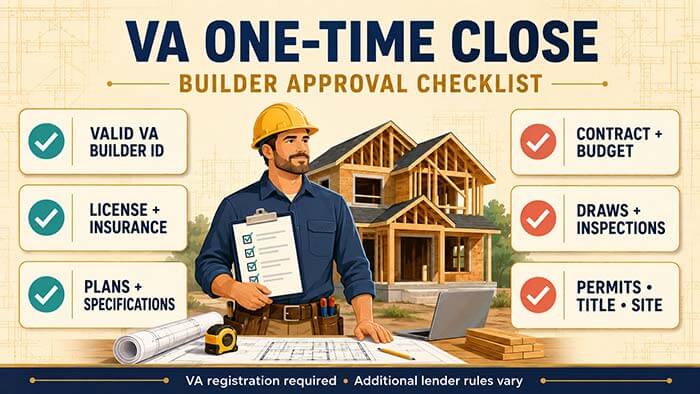
Before you can close on a VA one-time close construction loan, the builder must meet the lender’s and VA-related requirements. Use this checklist to avoid delays.
1) Builder licensing and insurance
- ☐ Builder is properly licensed in the state/county where the home will be built
- ☐ Builder has active general liability insurance
- ☐ Builder has workers’ compensation coverage (or valid exemption, if applicable)
- ☐ Builder can provide copies of all licenses/insurance certificates
2) Builder experience and track record
- ☐ Builder has documented experience building similar homes (size/type/price range)
- ☐ Builder can provide recent project addresses/photos (or portfolio)
- ☐ Builder can provide references from recent buyers (or third-party reviews)
- ☐ Builder has no unresolved major complaints, liens, or litigation that would block approval
3) Contract package (must be complete and signed)
- ☐ Signed construction contract with start/finish timeline
- ☐ Detailed plans and specifications (floor plan, elevations, materials list)
- ☐ Itemized cost breakdown/budget (labor + materials + allowances)
- ☐ Change order policy spelled out (how upgrades/overages are handled)
- ☐ Warranty terms included (builder warranty + any manufacturer warranties)
4) Draw schedule and inspections (how the builder gets paid)
- ☐ Builder agrees to a draw schedule (funds released in stages)
- ☐ Builder understands draws require inspections before funds are released
- ☐ Builder can work with the lender/title company on required forms
- ☐ Builder is okay with lender “holdbacks” (if required) until final completion
5) Permits, utilities, and site readiness
- ☐ Builder confirms local permits can be obtained (and who pulls them)
- ☐ Site has a plan for utilities (water/sewer or well/septic, electric)
- ☐ If rural: clear plan for well/septic approvals and timelines
- ☐ Lot is buildable and accessible (no surprises with zoning or easements)
6) Title and land documentation (if you own the land already)
- ☐ Proof of land ownership (deed, survey if available)
- ☐ Title company can confirm a clear title (or identify what must be cleared)
- ☐ Any liens/easements understood and acceptable to lender/VA guidelines
7) Builder paperwork commonly required by lenders
- ☐ Builder application/profile completed (lender-specific)
- ☐ W-9 and business entity docs (LLC/Corp documents, if requested)
- ☐ Financials or credit references (sometimes required for construction lending)
- ☐ Builder agrees to the lender-required construction forms and the disbursement process
Fast tip to avoid the #1 delay
Choose a builder who has done lender-financed builds before (draw schedules + inspections). Custom builders who only do “cash builds” often get slowed down by the paperwork and payout rules.
How the One-Time Close Construction Payments Work
One of the biggest questions veterans ask is: “Do I make payments while my home is being built?” With a VA one-time close construction-to-permanent loan, the payment structure differs during construction and after you move in.
Here’s the simple breakdown.
During Construction: How Money Is Paid Out (Draws)
Your builder does not get all the money up front. Instead, the lender releases funds in stages called draws. These draws happen after inspection milestones confirm work is completed (for example: foundation, framing, mechanicals, drywall, final).
This protects you and the lender by making sure the home is progressing before more funds are released.
During Construction: What You Pay Each Month
While the home is being built, you typically do not make a full principal-and-interest mortgage payment like you would on a standard VA home loan.
Instead, one of these two payment methods is most common (your exact setup depends on the lender and loan structure):
Option A: Interest-only payments on the amount drawn
- You pay interest-only on the funds that have been disbursed so far.
- Early in construction, drawings are smaller, so payments often start lower and may rise as more funds are released.
Option B: Interest is financed/reserved during construction (often called an “interest reserve”)
- In some programs, the loan is structured so that interest payments during construction are covered by the loan’s budget (not paid out of pocket monthly).
- This doesn’t mean “no interest”—it means the interest is handled within the construction financing plan.
We’ll explain which option applies to your loan upfront so there are no surprises.
After Construction: When Full Mortgage Payments Start
Once the home is finished and passes final inspection, the loan “converts” to the permanent VA mortgage portion. At that point, you begin making your regular monthly payment, which typically includes:
- Principal and interest
- Property taxes (if escrowed)
- Homeowners insurance (if escrowed)
- VA funding fee (if financed into the loan, if applicable)
Can You Lock Your Rate Before Construction Starts?
With many VA new construction loans, you can lock your rate at or before closing, which can protect you from rising rates during the build. Some lenders also offer lock options that depend on the estimated construction timeline.
What Happens If the Build Takes Longer Than Expected?
Construction delays can happen due to weather, permits, supply chain issues, or change orders. If the timeline extends, the lender may require:
- Updated documentation (in some cases)
- Extension approvals
- Additional inspections
- Proof the project is still within budget and scope
That’s why choosing an experienced builder and having a solid construction contract matters.
Costs & Fees for a VA One-Time Close Construction Loan
A VA new construction-to-permanent loan can be a powerful way to build with one closing, but you still need to plan for the costs that come with buying land, building, and converting to the final VA mortgage. Here’s what most borrowers should expect.
VA Funding Fee (If Applicable)
Most VA loans include a VA funding fee that helps fund the VA loan program. The amount depends on factors like:
- Whether this is your first VA loan or you’ve used VA before
- Your down payment (if any)
- Your service category
Many veterans are exempt from the VA funding fee (for example, certain disability-related eligibility). If you’re exempt, this can significantly reduce your total cost.
Standard Closing Costs
Even with 100% financing, there are still normal mortgage closing costs, which may include:
- Lender fees (origination/processing/underwriting) vary by lender
- Title and escrow fees
- Recording fees and local government charges
- Credit report and flood certification (if applicable)
- Prepaid items (homeowners’ insurance premiums, initial escrow deposits, etc.)
Depending on the lender and your scenario, some costs can be paid by:
- Seller concessions (if you’re buying land from a seller)
- Builder concessions (in some cases)
- Lender credits (often tied to rate options)
Construction-Phase Costs (What’s Different About This Loan)
Construction loans add a few cost categories you don’t usually see on a standard home purchase:
- Construction draw inspections: Funds are released in stages (draws), and inspections are typically required before each draw.
- Plans, specs, and budget review: The lender needs a complete construction package and cost breakdown. Some lenders charge fees for construction administration.
- Appraisal based on plans and specs: The appraisal is ordered using the blueprints, specs, and the final “as-completed” value—not a finished home.
Contingency Reserve (Important for New Builds)
Many lenders require a contingency reserve to cover unexpected costs or change orders during construction. This can be a percentage of the build cost, depending on:
- Property type and complexity
- Builder history
- Your credit and overall file strength
The goal is to protect you from getting stuck mid-build if costs rise.
Change Orders and Over-Budget Items
If you upgrade materials, change the floor plan, or add features after closing, that’s a change order. Change orders can:
- Increase the total cost of the build
- Require lender approval
- Need extra funds from you if the project exceeds the approved budget
Tip: Keep upgrades and design changes to a minimum once construction starts to avoid delays.
Monthly Payments: What You’ll Pay and When
During construction, payments are typically structured as:
- Interest-only on funds drawn, or
- Interest handled through a financed/reserved structure (depends on lender)
After construction is complete, you transition into your regular VA mortgage payment that typically includes:
- Principal + interest
- Taxes and insurance (if escrowed)
Bottom Line
A VA one-time close loan can reduce “double closing” costs compared to doing a separate construction loan and later refinancing—but you still need to budget for normal closing costs, construction inspections, and a contingency reserve.
VA One-Time Close Mortgages: Hassle-Free Home building
Lock in your interest rate from the beginning and simplify your construction financing process.
Credit Score and VA Construction Loan Requirements in 2026
When it comes to VA construction loans in 2026, Gustan Cho Associates collaborates solely with lenders who impose no additional guidelines, ensuring a streamlined experience for borrowers. This approach means there are no extra requirements beyond those established by the VA, leading to greater accessibility for those seeking loans.
Notably, no overlays on credit scores or debt-to-income (DTI) ratios indicate that if the Automated Underwriting System (AUS) approves the application, Gustan Cho Associates will follow suit.
To get a VA construction loan, you’ll need a credit score of at least 620, which certain investors insist on. The cool thing is that the VA doesn’t have a limit on debt-to-income ratios, so there’s more leeway in meeting the loan requirements. Instead, it all hinges on what automated systems find, making it easier for borrowers to qualify.
Is Manual Underwriting Allowed?
Yes, manual underwriting is allowed on VA new construction loans. This is ideal for:
- Borrowers with thin credit or no credit scores
- Those with past credit events (e.g., bankruptcy, foreclosure)
- Buyers who don’t get AUS approval
We work closely with borrowers who need manual underwriting and compensating factors to approve the loan.
VA Appraisal and Inspections During Construction
A common question: How does appraisal work with a VA construction loan?
The VA appraisal is based on plans and specs, not the finished home. During construction, the lender will also do:
- Draw inspections before funds are released
- Final inspection once construction is complete
We handle all this behind the scenes with the builder.
Why Work with Gustan Cho Associates for Your VA Construction Loan?
We specialize in helping borrowers that other lenders turn away. Here’s what makes us different:
- No lender overlays on VA loans
- Manual underwriting experts
- Over 300 wholesale lenders to choose from
- 7-day availability — nights, weekends, and holidays
- We handle everything in-house with personal support
We don’t just offer loans. We help you build your dream home with the support, knowledge, and experience you deserve.
Ready to Build with a VA New Construction to Permanent One-Time Close Loan?
Let’s make it happen. Borrowers who need a five-star national mortgage company licensed in 48 states with no overlays and who are experts on VA new construction loans, please contact us at 800-900-8569, text us for a faster response, or email us at gcho@gustancho.com.
Build smarter. Close once. Move in when it’s done. With Gustan Cho Associates, it’s that simple.
Custom-Build Your Home with a VA One-Time Close
Enjoy simplified paperwork, one approval, and peace of mind during the entire homebuilding journey.
Frequently Asked Questions About VA New Construction Loans:
What is a VA One-Time Close Construction Loan?
A VA one-time close (construction-to-permanent) loan combines construction financing and the permanent VA mortgage into a single loan and a single closing. You close before construction starts, then the loan transitions to the permanent phase after the home is completed.
Can You Buy Land with a VA New Construction Loan?
You typically can include the land cost when it’s part of a construction-to-permanent loan (land + build together). VA loans generally don’t allow buying land alone without plans to build.
Do You Make Mortgage Payments During Construction with a One-Time Close Loan?
Most construction-to-permanent loans require interest-only payments on the amount drawn during construction (the structure can vary by lender). After completion, you begin regular principal-and-interest payments like a standard mortgage.
How do Construction Draws Work on a One-Time Close Loan?
Funds are released in stages called draws as construction progresses. The lender typically orders draw inspections before releasing each draw to confirm work is completed.
Do VA New Construction Loans Require a VA-Registered Builder?
Rules can be confusing because they’ve evolved over time. Some lenders may still have builder requirements, but at least one major VA lender notes that builders are no longer required to register or obtain a VA Builder ID. At the same time, the home must still meet VA property standards. Always confirm your lender’s builder approval process.
Can I Be My Own General Contractor on a VA Construction Loan?
Usually, most construction lenders won’t approve borrowers acting as their own general contractor unless it’s a specialized “owner-builder” type program (which is uncommon). Plan to use a licensed, insured builder approved by your lender.
How Long Does a VA One-Time Close Construction Loan Take?
Many lenders allow roughly 6–12 months for the construction phase (extensions may be possible depending on the lender and the project).
What Credit Score is Needed for a VA One-Time Close Construction Loan?
The VA itself doesn’t set a universal minimum credit score, but VA new construction-to-permanent lenders often do (typically in the 580–620+ range, depending on the program and lender). Your exact requirement depends on the lender offering the construction financing.
What Happens if Construction Goes Over Budget or There are Change Orders?
Overages and upgrades are handled through change orders, and lenders typically require approvals to ensure the project still meets the loan’s budget and guidelines. If costs exceed what’s approved, borrowers may need to bring in funds or adjust scope—rules vary by lender.
Is a VA New Construction to Permanent One-Time Close Construction Loan Better Than a Two-Time Close Loan?
A one-time close loan can reduce hassle because you close once and then convert to a permanent mortgage at completion. A two-time close construction loan generally involves two closings (a construction loan first, then a permanent mortgage later), which can add costs and rate uncertainty.
This blog about “VA New Construction To Permanent One-Time Close Mortgages” was updated on January 23rd, 2025.
One Loan. One Closing. Your VA Home Built Easier
Discover how VA one-time close loans streamline building your dream home from the ground up.