Quick Answer:
Yes, you may qualify for an FHA or VA mortgage while you’re still in an active Chapter 13 repayment plan — but timing and payment history matter. In general, HUD late payment mortgage guidelines commonly summarize as requiring at least 12 months of the payout period with on-time plan payments and written permission from the bankruptcy court if your Chapter 13 hasn’t been discharged yet.
VA underwriting guidance also allows favorable consideration when you’ve made at least 12 months of satisfactory plan payments, and the trustee or bankruptcy judge approves new credit.
The catch: many lenders add stricter “overlays” (for example, requiring 24 months with zero late payments). Gustan Cho Associates specializes in FHA and VA lending with no lender overlays on many programs. We follow HUD late payment mortgage guidelines to the T, so we can often help when other lenders say no.
Eligibility Checklist: FHA vs VA During an Active Chapter 13 Repayment Plan (Late Payment Focus)

FHA (HUD) Eligibility Checklist
Use this FHA checklist based on the HUD late payment mortgage guidelines, if you’re trying to qualify for an FHA loan while you are still in an active Chapter 13 repayment plan:
- ✅ Chapter 13 has been in place long enough: Generally, you want at least 12 months into the repayment plan (many lenders prefer longer).
- ✅ On-time Chapter 13 plan payments: Your trustee payments should be made on time (late trustee payments are a major red flag).
- ✅ On-time housing history: Ideally, no late housing payments (rent/mortgage). If you have lates, expect manual underwriting and a strong explanation.
- ✅ Court/Trustee permission to incur new debt: If your Chapter 13 is not discharged, you’ll typically need written approval to take on a mortgage.
- ✅ Manual underwriting readiness: FHA loans during Chapter 13 are commonly manually underwritten, which means you must show stability and compensating factors (see below).
- ✅ Stable income + job history: Consistent employment/income, plus documentation that supports repayment ability.
- ✅ DTI and affordability make sense: Even if automated approval isn’t available, your payment must be reasonable for your income and debts.
- ✅ Funds and reserves (if needed): Depending on the file strength, reserves help—especially with manual underwriting.
- ✅ No new major derogatory credit events: Avoid new collections, charge-offs, or new late payments while in the plan.
- ✅ Letter of Explanation + supporting docs (if any lates): A clear, documented reason + proof that the issue is resolved.
FHA red flags that often trigger denial (or a hard manual underwrite):
- ❌ Late trustee payments
- ❌ Multiple late mortgage/rent payments in the last 12 months
- ❌ New credit problems after filing (new lates, collections, charge-offs)
- ❌ No court permission for new debt
VA Eligibility Checklist
VA can be more flexible than FHA in practice, but you still need a clean story and a lender that knows how to underwrite Chapter 13 files.
- ✅ Satisfactory Chapter 13 plan payment history: Typically, 12+ months of on-time plan payments is the baseline that most lenders look for.
- ✅ Trustee/judge approval for new credit: You’ll need documented permission to take on a mortgage while in an active plan.
- ✅ Housing history is strong: Ideally, no late housing payments. If there are late payments, you’ll need a strong explanation and documentation.
- ✅ Residual income and budget work: VA underwriting leans heavily on residual income, so your after-expense cash flow matters.
- ✅ Stable income: Consistent earnings and ability to document them.
- ✅ No new derogatory credit: Avoid new late payments and new collections during the plan.
- ✅ Manual underwriting readiness (common): Many VA Chapter 13 loans are manual underwrites, meaning the underwriter looks at the whole story (not just the score).
- ✅ LOX + paper trail if there were lates: VA can allow a well-documented exception with compensating factors, especially if the issue was isolated and resolved.
VA red flags that commonly cause trouble:
- ❌ Late trustee payments
- ❌ Pattern of late mortgage/rent payments
- ❌ Overextended budget / weak residual income
- ❌ No documented permission to incur new debt
Quick “Pass/Maybe/Problem” Guide (Late Payments)
Use this quick guide so borrowers instantly understand where they stand:
- PASS (strong file): No late trustee payments + no late housing payments during the plan
- MAYBE (manual underwrite): One isolated late payment with a documented hardship and strong recovery
- PROBLEM (often decline): Multiple housing lates or any recent trustee lates, especially within the last 12 months
What Helps If You Have Late Payments (Compensating Factors)
If you had a late payment during Chapter 13, these factors can help offset risk on a manual underwrite according to the HUD late payment mortgage guidelines:
- Documented hardship that was temporary (medical, job gap, verified emergency)
- Proof the issue is resolved (new job, restored income, payment plan caught up)
- Strong income stability (long-term employment, consistent deposits)
- Cash reserves after closing
- Lower DTI / strong residual income (VA)
- Clean payment history since the late payment
Late Payments and Your HUD Mortgage Application
Understand how late payments are viewed by HUD and what you can do to improve your chances of approval.
What Counts as a “Late Payment” for FHA/VA During Chapter 13?
When borrowers hear “late payment,” they often think it only means a missed mortgage payment. As per HUD late payment mortgage guidelines, during an active Chapter 13 plan, lenders usually consider three types of “lates,” and each can affect approval differently.
1) Trustee (Chapter 13 plan) late payments
These are the monthly payments you make to the Chapter 13 trustee under your court-approved repayment plan.
- Counts as late if you miss a trustee payment, pay it after the due date, or fall behind and have to “catch up.”
- Why it matters most: A late trustee payment signals you’re not following the court plan, and many underwriters treat that as the biggest risk factor.
Bottom line: Trustee lates are typically the hardest to overcome.
2) Housing payment lates (mortgage or rent)
This is your primary housing history—mortgage payments if you own, or rent payments if you rent.
- Counts as late when your payment becomes 30+ days past due (commonly reported as 30/60/90 late on credit).
- Also counts if your mortgage is being paid through the plan, but you’re still showing missed or delinquent housing payments (depending on how it’s structured and reported).
Bottom line: In HUD late payment mortgage guidelines, housing lates matter because lenders view housing as the first bill borrowers prioritize. A pattern of housing lates can stop approval even when other credit looks fine.
3) Other credit lates (auto loans, credit cards, personal loans, student loans)
These are late payments on non-housing debts.
- Counts as late when the creditor reports the account 30+ days past due.
- Underwriters generally view these as less severe than trustee or housing lates, but they still impact your overall “payment behavior.”
Bottom line: A single isolated late payment on a credit card may be explainable; repeated late payments across accounts usually won’t be.
Late Payment vs. “One-time slip”
A key difference is whether the late payment is:
- Isolated: one 30-day late tied to a documented hardship, followed by a strong on-time history
- Patterned: multiple lates or a rolling delinquency (30 → 60 → 90) showing ongoing payment stress
Most approvals with late payments occur only when the underwriter can clearly see that it was a one-time event and that the cause is resolved.
What Does NOT Usually Count as a “Late Payment” (But Can Still Cause Issues)
Some items may not be reported as a traditional 30-day late, but can still hurt the file:
- Short-term “payment arrangement” notes with a creditor (sometimes shows financial stress)
- Forbearance (not automatically negative, but must be documented properly)
- Partial payments (can lead to delinquency if the lender doesn’t apply them as a full payment)
- Returned payments / NSF (may not show as “30-day late,” but underwriters may ask)
How Underwriters Typically Evaluate Late Payments During Chapter 13
While every lender is different, underwriters usually weigh lates payments in this order:
- Trustee late payments (most serious)
- Mortgage/rent late payments
- Other credit late payments (least serious, but still relevant)
If there were late payments, expect to provide:
- A clear Letter of Explanation
- Proof that the hardship was temporary
- Proof the problem is fixed (income restored, expenses stabilized, reserves built)
Quick Self-Check
If you answer “yes” to any of these, you’re likely looking at manual underwriting and/or fewer lender options:
- Have you ever been late making a trustee payment?
- Have you had any 30-day late housing payments since filing Chapter 13?
- Do you have two or more late payments in the last 12 months on any accounts?
Manual Underwriting During Chapter 13: What It Is and Why It Happens (FHA + VA)
When you apply for a mortgage, many lenders rely on an automated decision system (often called an “automated underwriting” approval). But if you’re in an active Chapter 13 repayment plan—or if your credit profile has recent events like late payments—the loan often can’t be approved through automation. That’s when a lender uses manual underwriting and needs HUD late payment mortgage guidelines.
What “Manual Underwriting” Means (in Plain English)
Manual underwriting means a human underwriter reviews your full financial picture instead of relying on an automated “Approve/Eligible” result.
The underwriter will look closely at:
- Your Chapter 13 payment history (trustee payments)
- Your housing history (rent or mortgage payments)
- Why the late payment happened (if any)
- Whether the issue is resolved and your finances are stable now
- Income consistency and how reliable your earnings are
- Debt-to-income and overall affordability
- Compensating factors (things that make the loan safer)
Manual underwriting is not “bad”—it’s simply more documentation and more explanation based on the HUD late payment mortgage guidelines, because the underwriter needs to be confident the late payment was an exception, not a pattern.
Why Does Manual Underwriting Happen During an Active Chapter 13?
Manual underwriting is common in Chapter 13 files because:
- Your bankruptcy is still active, so the underwriter must confirm you’ve demonstrated stable payment behavior while under court supervision.
- Court/trustee approval may be required to take on new debt.
- Late payments during or after bankruptcy can prevent an automated approval and require a “common-sense” review of the whole story.
The 3 “Make-or-Break” Areas Underwriters Focus On
If you’re in Chapter 13 and/or have had late payments, underwriters usually decide the file based on these three categories:
1) Trustee payment history
- On-time trustee payments show you’re following the plan.
- Any missed/late trustee payments usually require strong documentation and may severely limit options.
2) Housing history (rent/mortgage)
- Underwriters typically treat housing as the most important payment.
- A pattern of late housing payments is one of the most common reasons for denial.
3) Stability after the late payment
If there was a late payment, the underwriter wants proof that:
- It was temporary and explainable
- It’s resolved
- You’ve been on time since
- Your budget is now stable enough to handle a mortgage long-term
What Helps You Get Approved on Manual Underwriting (Compensating Factors)
If your file needs manual underwriting, these are the “strength boosters” that often help:
- Documented hardship + clear recovery (job loss then re-employed, medical event resolved, etc.)
- Strong on-time history since the late payment
- Lower overall debt load (or evidence you’ve reduced monthly obligations)
- Cash reserves after closing
- Stable job history and predictable income
- Conservative payment shock (new housing payment not dramatically higher than current rent/mortgage)
What Manual Underwriting is NOT According to HUD Late Payment Mortgage Guidelines
To reduce confusion for readers:
- Manual underwriting is not an automatic denial
- Manual underwriting is not “no credit score needed”
- Manual underwriting is not “anything goes”
- It simply means your approval depends on your story, documents, and recovery, not an automated recommendation.
Quick Takeaway
If you’re in an active Chapter 13 plan, manual underwriting is often the path to approval—especially if you had a late payment. The goal is to prove the late payment was a one-time event and that you’ve regained stable finances.
What To Do If You Have Late Payments During or After Chapter 13 (Exact Scenarios)
If you have late payments during an active Chapter 13 plan (or after discharge), your mortgage approval will depend on what kind of late payment it was, how recent it is, and whether it was a one-time event or a pattern. Below are the most common real-world scenarios and the exact steps to take next.
Scenario 1: Late Trustee Payment (Chapter 13 Plan Payment)
Why it’s serious: Underwriters treat trustee payments as proof you’re following the court plan. A late trustee payment is often the hardest type of late payment to overcome.
What to do:
- ✅ Get current immediately. Read HUD late payment mortgage guidelines. (no rolling delinquency)
- ✅ Request a Trustee Payment History showing you are now caught up
- ✅ Provide a Letter of Explanation (LOX) describing:
- What caused the late payment (job gap, medical, temporary hardship)
- Why it won’t happen again
- What changed (new job, increased income, reduced expenses)
- ✅ Show proof of recovery, such as:
- Recent pay stubs showing stabilized income
- Bank statements showing reserves
- Budget showing affordability
Best “approval positioning”:
- One isolated trustee late with strong documentation + a long stretch of on-time payments after it
- Harder case:
- Multiple trustee lates or trustee lates within the last few months
Scenario 2: Late Mortgage Payment During Chapter 13 (Housing Late)
Why it matters: Late mortgage/rent is a top risk indicator because housing is the bill lenders expect you to protect first.
What to do:
- ✅ Gather 12 months of housing proof (mortgage statement history or 12 months canceled checks/bank statements / VOR from landlord)
- ✅ Provide LOX + supporting docs for the month(s) you were late
- ✅ If the payment was impacted by servicing/plan setup confusion, include:
- trustee distribution records
- correspondence showing how payments were applied
- ✅ Show you are now fully current and have been on time since
Best “approval positioning”:
- One isolated 30-day late tied to a documented hardship + clean on-time housing since
- Harder case:
- 60/90-day housing delinquency or a pattern of lates (more than one)
The “Fast Approval File” Checklist if You Have Lates
If you want the smoothest possible underwrite, gather these items from HUD late payment mortgage guidelines upfront:
- Trustee payment history (and proof you’re current)
- 12 months housing history proof (mortgage/rent)
- LOX explaining each late payment (one page, factual, non-emotional)
- Hardship documentation (medical bills, job loss letter, reduced hours, etc.)
- Proof of recovery (pay stubs, bank statements, reserves)
- Court/trustee permission to incur new debt (if still in active plan)
Simple Rule of Thumb
- Trustee or housing lates = the biggest underwriting hurdle
- One isolated late with documentation + strong recovery = often workable
- Multiple lates = expect fewer lender options and a longer “rebuild” period
Qualifying For FHA and VA Loans After Bankruptcy
Borrowers can qualify for FHA and VA loans after bankruptcy. There is a two-year waiting period to qualify for FHA and VA loans after Chapter 7 Bankruptcy. Borrowers can qualify for FHA and VA loans during the Chapter 13 Bankruptcy repayment plan without Chapter 13 being discharged. The guidelines for late payment of a mortgage during Chapter 13 bankruptcy are typically determined by the terms of Chapter 13 approved by the bankruptcy court and the policies of the mortgage lender.
Here are some general points to consider. Maintaining open communication with your mortgage lender throughout the Chapter 13 bankruptcy process is essential. If you anticipate difficulty making payments, please contact your lender as soon as possible to discuss possible modifications or accommodations.
HUD Chapter 13 Guidelines After Bankruptcy Discharge
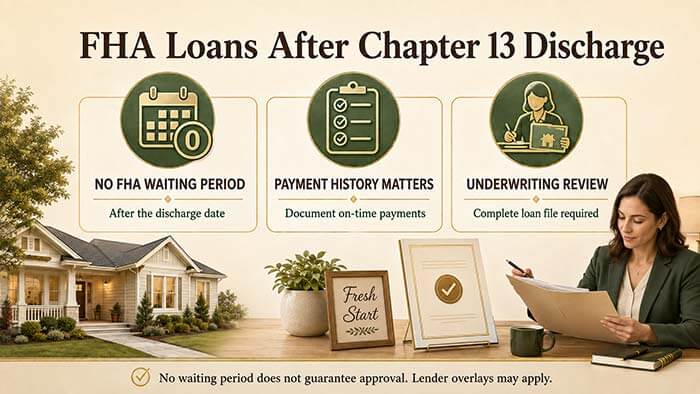
There is no waiting period after the Chapter 13 Bankruptcy discharge date to qualify for VA and FHA loans. VA and FHA loans have the exact same Bankruptcy Guidelines. One problem borrowers will encounter when applying for a mortgage after bankruptcy is most lenders will not allow late payments during and after bankruptcy. Any changes to your mortgage payments, including late payment arrangements, may need to be approved by the bankruptcy court.
You should consult your bankruptcy attorney to ensure any proposed changes comply with your repayment plan and local bankruptcy rules.
VA and HUD Late Payment Mortgage Guidelines
Under VA and HUD late payment mortgage guidelines, borrowers can qualify for VA and FHA loans with late payments during or after bankruptcy. Most lenders have overlays were no late payments during and after bankruptcy are allowed. Gustan Cho Associates has helped many borrowers with late payments during and after bankruptcy.
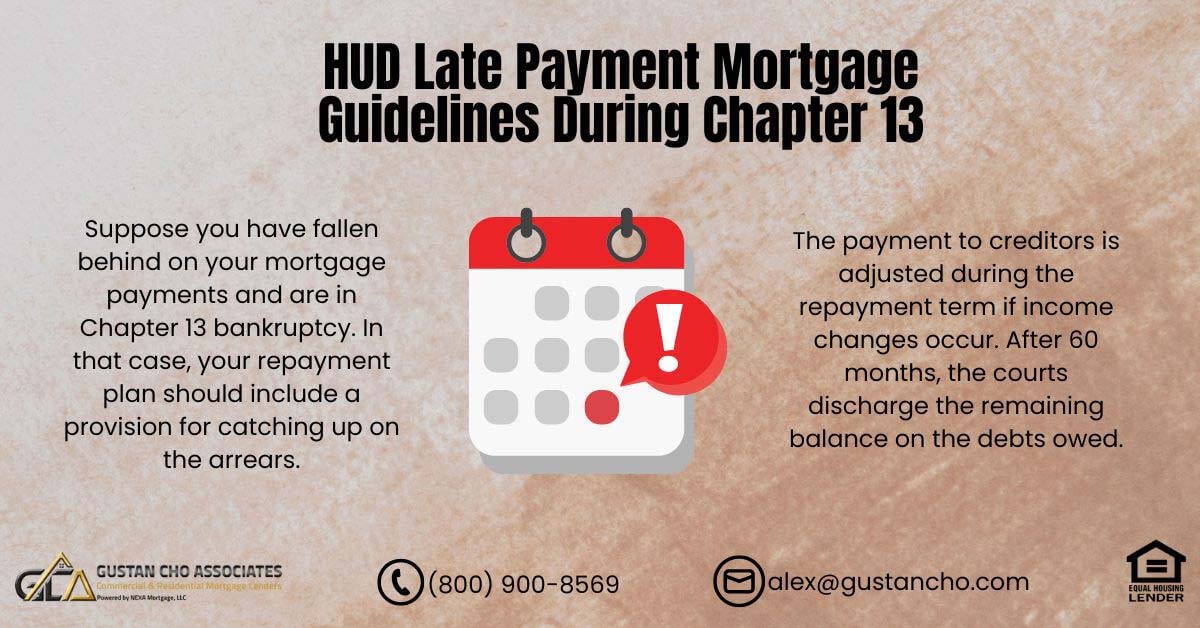
Suppose you have fallen behind on your mortgage payments and are in Chapter 13 bankruptcy. In that case, your repayment plan should include a provision for catching up on the arrears.
This means you must make monthly payments to the bankruptcy trustee, who will be distributed to your creditors, including your lender. It’s crucial to adhere strictly to the repayment plan and make all the required payments on time. Failing to do so can lead to serious consequences, including dismissing your bankruptcy case or foreclosure proceedings by the mortgage lender.
HUD Late Payment Mortgage Guidelines During Chapter 13 Bankruptcy and How To Avoid Late Payments
Consumers with income can file Chapter 13 Bankruptcies. If a consumer does not have a job, they cannot file Chapter 13 and must explore filing Chapter 7 Bankruptcy. Chapter 13 Bankruptcy is a court-supervised repayment plan over 60 months. A percentage of the consumer’s wages is allocated every month by the trustee. That portion of wages is used to pay creditors.
The payment to creditors is adjusted during the repayment term if income changes occur. After 60 months, the courts discharge the remaining balance on the debts owed.
The consumer is then debt-free. Filing for Chapter 13 bankruptcy typically triggers an automatic stay, which prevents creditors, including your mortgage lender, from taking collection actions, including foreclosure, during the bankruptcy process. However, the lender may seek relief from the automatic stay if you fail to make the agreed-upon payments. Connect with our expert for HUD late payment mortgage guidelines.
Objections By Creditors on Chapter 13 Bankruptcy Filings
A creditor can contest and object to a petitioner’s Chapter 13 Bankruptcy repayment plan. The creditor did not agree on how they would be paid the amount owed. If the consumer is behind on their mortgage payments and a Chapter 13 repayment plan does not pay back the total mortgage payments due, the creditor will most likely object to their payment plan.
How Long Does It Take To Clear Chapter 13 Bankruptcy?
The creditor will be filing an objection with the courts to advise the arrearage sum that needs to be paid through the Chapter 13 Plan. This also holds true when petitioners change the terms of an auto loan, and the auto finance company does not agree with the rate and balance. Completing your Chapter 13 repayment plan, including catching up on mortgage arrears, is essential to retaining your home. Once the plan is completed, you should continue making regular mortgage payments to your lender to avoid future issues.
How Much Will My Payment Be In Chapter 13 Bankruptcy?
The Bankruptcy Trustee determines how much your payment be in your Chapter 13 Bankruptcy. Your payment for a mortgage needs to be approved by the Bankruptcy Trustee. Again, this is easily fixed and your attorney will get notice of it and make the necessary corrections, or contact you to discuss the possible correction or modification to your plan so that the objection can be resolved. Here is what Chicago Bankruptcy Attorney Vanessa Favia says about Creditors’ Objections:
If you change the terms of a car loan in an impermissible way and your auto lender does not agree with the interest rate, balance of the loan, or value provided for the vehicle in your schedules, your creditor may file an objection.
Filing an objection will necessary so that they are not bound by such negative treatment. The relief requested in the objection often states to not confirm the plan or dismiss the case. The value of your car is important in situations where you obtained the loan more than 910 days before filing your case because under those circumstances, you can lower the amount of the debt to the value of your car.
So, if you owe $20,000 on your car loan, the car is only worth $15,000 and you obtained the loan more than 910 days before you filed, you can lower the balance of the loan to $15,000. The remaining $5,000 would be paid at the same percentage as your other unsecured creditors which may be as low as 10%.
HUD Late Payment Guidelines: Are You Ready to Apply?
Know the ins and outs of late payment guidelines for HUD loans before you apply for a mortgage.
Letter of Explanation For Late Payments During Chapter 13 Bankruptcy Repayment Plan
We have also helped borrowers with late payments after bankruptcy and foreclosure. I am not saying it is easy, but it is not the end of the world. Borrowers who need to qualify for a mortgage with late payments during and after bankruptcy and who are need of a mortgage lender who knows HUD late payment mortgage guidelines in and out, please contact Gustan Cho Associates at 800-900-8569, text us for a faster response, or email us at gcho@gustancho.com.
We are a national mortgage company licensed in multiple states with no lender overlays on government and conventional loans. We are available seven days a week, evenings, weekends, and holidays.
Frequently Asked Questions About HUD Late Payment Mortgage Guidelines:
Can You Get an FHA Loan While in an Active Chapter 13 Bankruptcy?
Yes. A Chapter 13 bankruptcy does not automatically disqualify you from an FHA-insured mortgage. As per the HUD late payment mortgage guidelines, you’ll need a solid payment history in the plan and typically bankruptcy court permission to take on new debt while the case is active.
Can You Get a VA Loan While in Chapter 13 Bankruptcy?
Yes, it can be possible. VA guidance allows favorable consideration when you’ve made satisfactory payments for a period of time (commonly 12 months), and you obtain trustee/judge approval for new credit.
How Long do You Need to be in Chapter 13 Before Qualifying for FHA or VA?
Many lenders look for at least 12 months of on-time payments in the repayment plan before approving an FHA/VA mortgage during an active Chapter 13, in accordance with the HUD late payment mortgage guidelines. (But, some lenders require longer due to overlays.)
Do I Need Trustee or Court Approval to Get a Mortgage During Chapter 13?
In most cases, yes. If your Chapter 13 is still active, you’ll typically need written permission to incur new debt (a mortgage), and your bankruptcy attorney/trustee will guide that process.
What Late Payments Matter Most When Applying During Chapter 13?
Underwriters follow HUD late payment mortgage guidelines and usually care most about:
- Late trustee (plan) payments
- Late housing payments (mortgage or rent)
- Then other credit lates (auto/credit cards)
- VA underwriting guidance also flags more than one 30-day late on mortgage debt in the past 12 months as a problem that requires deeper review/explanation.
Can You Get Approved with Late Payments During Chapter 13?
Sometimes, depending on what kind of late payments, how recent, and whether it was isolated or a pattern. Some lenders will not allow any lates due to overlays, but guidelines and lender practices vary widely, so your best path is usually a manual underwrite + strong documentation.
What is Manual Underwriting, and Why does Chapter 13 Trigger it?
Manual underwriting is when a human underwriter evaluates the full file rather than relying solely on automated approval. Chapter 13 files often require manual review because the lender must document payment performance, stability, and (usually) court permission while the bankruptcy is active.
What Documents do I Need if I had Late Payments During Chapter 13?
HUD late payment mortgage guidelines require you to provide the following:
- A Letter of Explanation (LOX) for each late
- Proof you’re caught up/current
- Trustee payment history
- Housing payment history (rent/mortgage verification)
- Evidence that the hardship was temporary and resolved (income restored, reserves, etc.)
Is There a Waiting Period After Chapter 13 Discharge for FHA or VA?
Many lenders allow FHA/VA right after discharge, but underwriting will still focus heavily on your recent payment history and overall stability. Some lenders may impose additional waiting time as an overlay.
Why do Lenders Deny Loans During or After Chapter 13, Even if the FHA/VA “Allows It”?
Because lenders can add stricter internal rules called lender overlays even with the HUD late payment mortgage guidelines—for example, requiring longer time in the plan, more stringent late-payment standards, higher credit scores, or additional reserves—beyond the baseline agency guidance.
This blog about “HUD Late Payment Mortgage Guidelines You Must Know was updated on January 26th, 2025.
HUD Late Payment Guidelines: Key Things Every Homebuyer Should Know
Ensure your mortgage application is on track by understanding HUD’s stance on late payments.