Irregular income may be eligible for a mortgage if a reliable monthly income history can be demonstrated. Income that is declining will be subject to a more detailed examination of the current trend in earnings and the rules of the loan program selected. Older higher earnings cannot simply be averaged to produce a higher qualifying income. This guide addresses how FHA and conventional loans assess declining and irregular income.
Declining Income vs. Irregular Income
Irregular income fluctuates from one pay period or season to another, but it does not always decline over time. Declining income means earnings are dropping over time. Sometimes, a borrower has both. For example, commissions might change each month and also be lower than last year.
How Underwriters Review Income Stability and Calculate Qualifying Income
Underwriters review each source of income before determining how much to count toward monthly qualifying income. They usually follow five main steps:
- Identify the income type. Fixed salaries, hourly pay, overtime, bonuses, commissions, and self-employment income may each need different paperwork and calculations. Base pay and extra earnings should be looked at separately.
- Establish the earnings history. Paystubs, job verification, W-2s, and tax returns show when the income started and how steady it has been. The amount of history needed depends on the type of income and the mortgage program.
- Compare earnings over appropriate periods. Current year-to-date earnings are consistently compared with prior earnings. The review must account for the period covered and the payment frequency; an annual bonus, for example, should not be evaluated as though it were paid monthly.
- Investigate meaningful changes. Reduced hours, a new compensation structure, temporary leave, or a business interruption may explain a decrease. Employer records or business documents should support the explanation and show whether the change is temporary or ongoing.
- Apply the program’s calculation. The lender determines whether the documentation supports an average, a lower qualifying amount, or exclusion of the income source. If a decline has not stabilized as required by the program, that income cannot be used simply because earlier earnings were higher.
The resulting monthly qualifying income may differ from the borrower’s stated annual salary or the amount on a recent paycheck.
How Underwriters Determine Whether Income Is Stable
Stable income does not mean the borrower has to earn the exact same amount every month.
The underwriter reviews how long the income has been received, whether the source is expected to continue, and whether recent earnings support the amount being used for qualification.
The required history depends on the type of income and the loan program.
Current Income Still Matters
Historical earnings help establish a pattern, but current income cannot be ignored. If a borrower earned significantly more last year than this year, the lender may not be able to use a simple two-year average. The most recent pay history often shows whether the income has held steady or continued to decline.
Stable, Increasing, and Declining Income Trends
Mortgage underwriters generally look at income as stable, increasing, or declining. Stable income usually supports an average based on the applicable documentation period. Increasing income may also be averaged when the history supports the trend and the increase is considered sustainable. Declining income requires more analysis.
When Declining Income May Still Be Used
Declining or irregular income may still qualify if the lower earnings have stabilized and the loan program allows the lender to use the current level. The underwriter may need to determine when the decline stopped and whether recent earnings show a consistent pattern. If the income is still falling, it may not be acceptable for qualification.
Variable Hourly Income
Hourly employees do not have to work the same number of hours every week to qualify for a mortgage.
When hours fluctuate, the lender generally reviews the earnings history rather than multiplying the current hourly rate by an assumed full-time schedule.
The calculation considers the borrower’s actual earnings over the required period and compares them with current year-to-date income.
Reduced Hours Can Change the Calculation
If a borrower previously worked 40 hours per week but now consistently works 28 to 30 hours per week, the lender cannot simply qualify the borrower at the previous level. The underwriter needs to determine whether the reduced schedule is temporary or represents the borrower’s new normal. That distinction can materially change qualifying income.
Denied Because Your Income Was Considered Unstable? Get a Second Opinion
Some lenders calculate variable income too conservatively or apply overlays. We’ll review your history, current earnings, DTI, and available loan programs.Hourly Income: Guaranteed Hours vs. Fluctuating Hours
An hourly rate doesn’t in any way establish how many hours can be used for qualification. Fannie Mae treats a fixed hourly rate with guaranteed minimum hours as fixed base income and hours that fluctuate or a variable hourly rate as variable base income. You need to provide documentation of the actual schedule and any guaranteed hours, rather than assuming a 40-hour work week.
Overtime Income
Separate out overtime from regular wages when looking at earnings. If a pay stub shows $6,000 in gross earnings, that doesn’t mean the employee is earning $6,000 in base pay if $1,000 of that is, in fact, overtime. The employer’s breakdown of earnings is what will prevent overtime from being treated as base pay and therefore counted as such.
Bonus Income
Payment frequency is important when bonuses are paid monthly. A $12,000 annual bonus is $1,000 per month for the purposes of trend analysis, rather than $4,000 per month, just because it was received in March. The same applies to a bonus that is normally paid in December, which may not appear on your June pay stub. You must provide records showing the payment frequency and the period to which each bonus relates.
Commission Income
Moving from a salary to a commission arrangement will change the income picture even if the employer and job title are the same. You need to provide the compensation agreement (including the effective date) and a breakdown of the commissions actually received. This enables the lender to separate any guaranteed base salary from the commission and ascertain which earnings history relates to the commission.
Tip Income
Employer-reported tips can be documented via the relevant payroll and W-2 records. If tips are not reported by the employer, Fannie Mae will accept two years of personal tax returns, along with IRS Form 4137, in lieu of a W-2. Receipt of cash tips does not relieve the documentation requirement. Tips must be kept separate from regular wages to avoid double counting.
Part-Time and Second-Job Income
A primary job with fewer weekly hours is different from an additional job used to supplement another source of income. For example, a borrower whose only job provides 25 guaranteed hours per week is evaluated under the applicable base-income requirements. When income from multiple jobs is needed, the lender must also apply the program’s multiple-employment requirements and evaluate each source of income separately.
FHA Guidelines for Declining and Variable Income
FHA allows several types of variable income, including overtime, bonuses, tips, commissions, part-time earnings, and self-employment income, when the applicable history and stability requirements are met. The lender must determine that the income being used is reasonably likely to continue. Prior higher earnings should not be used simply to increase qualifying income when current earnings show a meaningful decline.
FHA Guidelines for Declining Business Income
For an FHA loan evaluated through the TOTAL Mortgage Scorecard, a business-income decline greater than 20% over the analysis period requires the lender to downgrade the file to manual underwriting. The relevant measure is self-employment Effective Income—the qualifying income determined under FHA’s rules—rather than gross business sales or deposits into a bank account.
A Manual Downgrade Does Not Establish Eligibility
The downgrade changes how the file must be underwritten. It does not automatically make the declining income acceptable or guarantee mortgage approval. The lender must separately evaluate the income under FHA’s manual-underwriting requirements, determine the supported qualifying amount, and establish that the complete application meets the applicable requirements.
Fannie Mae Guidelines for Declining and Variable Income
Fannie Mae separates base pay from bonuses, commissions, overtime, and tips because different calculation rules apply to each.
Fixed Base Income
Fixed base income includes a set salary or a fixed hourly rate with guaranteed minimum hours. Minor variations in hours do not automatically make the income variable. The calculated monthly amount must be consistent with documented year-to-date base earnings.
Variable Base Income
Variable base income includes hourly pay with fluctuating hours or an hourly rate that varies. Fannie Mae requires at least a 12-month history of receiving this income. Under the average-income method, stable or increasing earnings are averaged using year-to-date and prior-year earnings, covering at least 12 months. When earnings decrease, the lender must confirm that the current level has stabilized. The calculation then uses year-to-date income divided by the months elapsed in the current year. Without stabilization, the income is ineligible. Fannie Mae also permits an average-hours method: multiply average monthly hours from at least the most recent 12 months by the current fixed hourly rate.
Bonuses, Commissions, Overtime, and Tips
For these earnings, Fannie Mae recommends a two-year history. A shorter history of at least 12 months may be acceptable when positive factors reasonably support its use. Stable or increasing earnings are averaged using year-to-date and prior-year earnings over the documented months, with at least 12 months included. For declining earnings, the lender must confirm stabilization; Fannie Mae’s specified calculation uses year-to-date income divided by the months elapsed since the income stabilized. Payment frequency also matters. An annual bonus should be divided by 12 to establish its monthly amount for trend analysis. The lender must apply the calculation for the specific income category rather than substitute the variable-base formula.
Freddie Mac Guidelines for Declining and Fluctuating Employment Income
Freddie Mac’s 10% threshold applies within the analysis of applicable fluctuating employment earnings, such as variable hourly pay, overtime, bonuses, commissions, and tips. Under Guide Section 5303.1, a decline exceeding 10% between prior-year earnings and/or current year-to-date earnings requires further analysis to support the qualifying income calculation.
What the Threshold Means for Borrowers
If your income drops by more than 10%, it does not automatically mean your mortgage will be denied. On the other hand, a smaller drop does not guarantee your income is acceptable or that your application will be approved. The lender still needs to review your documents, assess the stability of your income, and comply with the rules for your type of earnings. The percentage shows when the lender needs to take a closer look. It is not a strict cutoff for mortgage approval.
Income Interruptions, Temporary Leave, and Business Disruptions
A Completed Interruption in Employment Income
A completed interruption may receive special consideration if documentation shows the event meets the program’s exclusion rules. For eligible fluctuating employment income, Freddie Mac allows certain periods affected by a rare event to be excluded. There must still be at least 12 months of total income in the calculation, but these months do not need to be consecutive. The lender must explain why the exception applies. Simply having lower earnings is not enough to remove a period.
Temporary Leave When the Mortgage Closes
For a Fannie Mae loan, if you need to use income from a borrower who is on temporary leave at closing, the expected return date is important:
- Returning by the first mortgage payment date: The lender may consider regular employment income.
- Returning after that date: The lender must initially use the lower of temporary-leave income or regular employment income. Eligible surplus liquid reserves may supplement leave income under Fannie Mae’s formula, after accounting for transaction funds and required reserves. Total qualifying income cannot exceed regular employment income.
The lender needs the borrower’s written statement that they plan to return, along with proof from the employer showing the expected return date. Furloughs and layoffs set by the employer do not count as temporary leave under this policy, even if there is a planned return date.
A Self-Employed Borrower After a Business Interruption
If a self-employed borrower’s business is interrupted, the lender must review it using the self-employment rules. Tax returns, current financial statements, and other records help show the business’s health and the borrower’s income. A profit-and-loss statement can help prove income is stable or ongoing, but a recent recovery does not mean you can skip the required income calculation or leave out a bad business period.
When Declining Income Cannot Be Used
Declining income may be deemed unusable if the lender cannot show that the lower earnings have stabilized.
If current year-to-date income continues to decline, using older, higher earnings could overstate the borrower’s ability to repay the mortgage.
The same concern applies when hours have been permanently reduced, commissions have continued to drop, overtime has disappeared, or a business is still losing revenue.
A Strong Two-Year Average Does Not Fix an Ongoing Decline
A borrower may have excellent earnings over the previous two years and still qualify with less income today. Underwriters must consider what the borrower is actually earning now. Historical income helps establish a pattern, but it cannot be used to ignore a current downward trend. When the income cannot be supported, the loan may need to qualify without that income source.
Self-Employed Borrowers With Declining Income
Business revenue and mortgage qualifying income are two very different things. Revenue is sales before expenses. Qualifying self-employment income is calculated using the loan program’s cash flow analysis, which accounts for business expenses, allowable adjustments, and the borrower’s ownership interest. A fall in sales won’t necessarily result in the same percentage fall in qualifying income as sales have fallen (expenses and allowable adjustments may have changed as well). The underwriter will also assess whether the business can continue to generate income and whether distributions to the borrower can be made without undermining the business’s financial position.
Illustrative Example: Calculating Declining Overtime Income
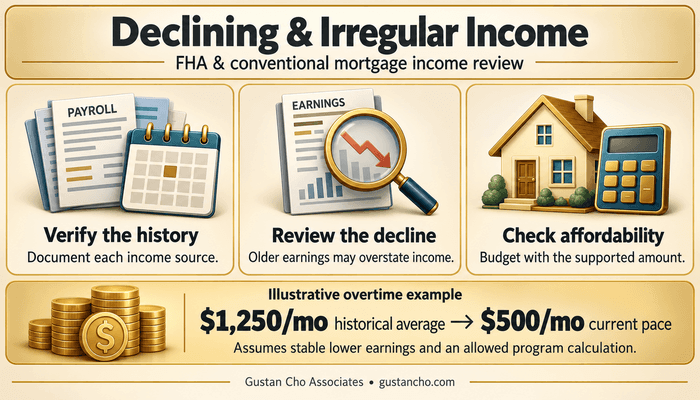
The borrower earned $18,000 in overtime two years ago, $12,000 last year, and $3,000 from January 1 to June 30 of this year. Assume payroll records show that the lower overtime level remained stable throughout those six months, and the lender confirms that the selected mortgage program permits its use. The comparison is:
- Historical two-year average: ($18,000 + $12,000) ÷ 24 months = $1,250 per month.
- Current six-month pace: $3,000 ÷ 6 months = $500 per month.
- Reduction in monthly income: $1,250 − $500 = $750 per month.
Under these assumptions, $500 is the supported monthly overtime amount used in this example. The historical average includes higher earnings that no longer reflect the borrower’s current overtime. Using $1,250 would therefore overstate usable monthly income by $750.
How the Income Adjustment Changes DTI
Assume the borrower has $5,000 in other qualifying monthly income and $2,600 in total monthly obligations, including proposed housing expenses and other qualifying debts.
- Using the historical overtime average: 2,600÷(5,000 + $1,250) × 100 = 41.6% DTI.
- Using the supported overtime amount: 2,600÷(5,000 + $500) × 100 = 47.3% DTI.
The lower overtime amount raises the debt-to-income ratio by approximately 5.7 percentage points. That adjustment may change program eligibility or the loan amount the borrower can qualify for. Neither percentage alone establishes approval; the complete application must meet the selected program’s requirements. Having variable income reviewed before setting a purchase budget helps borrowers base their plans on the income the lender can actually use.
Common Income Problems and How to Address Them
Review the income documentation before underwriting. Collect the most recent paystubs, W-2s, and any other employment verification that you’re asked for. Self-employed borrowers will need to have their tax returns, their business financial statements, and all other supporting documentation required for the program they have selected. Address discrepancies early:
- Paystubs and employment verification disagree: Get the employer or payroll provider to sort it out and provide an accurate earnings statement or corrected records.
- Hours recently decreased: Record when the change comes into effect and get confirmation from your employer as to whether the reduced hours are temporary or permanent.
- Business financial records conflict: The P&L must be reconciled with supporting records to ensure that revenue, expenses, and net income align and make sense.
- Application income exceeds the supported amount: Recalculate the monthly qualifying income and re-assess the proposed payment before you go on to rely on the earlier figure.
What to Ask When Qualifying Income Is Reduced
Ask the loan officer to tell you which of the income sources has been reduced or excluded, to explain the calculation and the period that’s been used, and to confirm whether that’s in accordance with the requirements of the mortgage program or indeed a separate lender policy. If the records are missing or inaccurate, establish what documentation would resolve the issue. If the lower calculation is correct, then use that amount to go back to the purchase budget.
FAQs About Declining and Irregular Income
Can a Recent Raise Help Me Qualify for a Mortgage?
Yes, if your higher pay is documented and meets the program’s calculation rules. For Fannie Mae variable base income, your raise needs to be in place before closing. Keep in mind, a higher hourly rate alone does not guarantee you will work more hours.
How does Switching from Salary to Commission Affect Qualification?
The lender will review your new pay structure and your history of earning commissions. Fannie Mae usually wants to see two years of commission income, but at least 12 months may be enough if you have strong supporting factors. Neither a compensation agreement nor projected sales can replace the required earnings history.
Can Union Workers Qualify when Their Job Assignments Change?
Yes, as long as your documented work and earnings pattern meets the program’s requirements. If you are a Fannie Mae borrower and your union arranges short-term assignments, the lender can get employment verification from the union. Changing assignments does not automatically mean you do not have an acceptable work history.
Can Income from Two Employers be Combined?
Yes, if both jobs meet the program’s requirements for income type and multiple employment. Fannie Mae usually wants to see two years of history for each job, but at least 12 months may be enough with strong supporting factors. There are also rules for employment gaps when you change jobs. Just starting a second job does not automatically mean that income can be used.
Can I Qualify After Starting a New Job or having an Employment Gap?
Having a new job or a gap in employment does not automatically disqualify you. The lender will look at your work history, current job, and how you are paid. Fixed base income and variable earnings have different history requirements. Be sure to provide your current job records and explain any gaps so the lender can review your situation.
Can Increasing Income from One Source Offset Declining Income from Another?
An eligible increase in income can help your overall calculation, but it will not make an unacceptable income source count. For example, higher base pay may help if your overtime is reduced or not included. The lender must review each part of your income under the rules before adding them together.
Final Thoughts on Declining and Irregular Income
Before you settle on a purchase price, confirm how much monthly income you can actually use and why that figure is different from your previous income. Compare the proposed total housing payment against your household budget (i.e. your actual outgoings apart from the mortgage) as part of the debt to income calculation. Decide whether the payment is still comfortable in the light of your current earnings. Have Gustan Cho Associates review your income documentation and your qualifying income calculation prior to relying on an estimated approval amount. Provide them with your most recent pay records and any supporting documentation that explains any changes to your hours, your rate of pay or your business performance. Ask them to explain the supported income figure and how that impacts the price range you’re looking at.
This article about “Declining and Irregular Income: How Mortgage Underwriters Calculate Qualifying Income” was updated on October 14th, 2026.