When comparing 15-year vs 30-year FHA loans, the right choice comes down to one simple question: do you want the lowest monthly payment possible, or do you want to pay off your home faster and save more on interest over time? Both loan options are backed by the Federal Housing Administration, but they work very differently when it comes to monthly payment, total interest paid, mortgage insurance costs, and how quickly you build equity.
A 30-year FHA loan usually gives homebuyers a lower monthly payment and more room in their budget. A 15-year FHA loan, on the other hand, usually comes with a higher monthly payment but helps borrowers pay off their mortgage sooner and reduce long-term borrowing costs.
The best option depends on your income, financial goals, and the level of payment flexibility you need. This guide explains the key differences between 15-year vs 30-year FHA loans in a straightforward way. We’ll cover topics such as how payments work, mortgage insurance, potential interest savings, and who each loan might be best for. By the end, you will have a clearer idea of which FHA loan term makes the most sense for your situation.
15-Year vs 30-Year FHA Loans: Which Is Better For You?
When buying a home with an FHA loan, one of the first and biggest decisions you must make is getting a 15-year or 30-year FHA loan. Each of them has its advantages and disadvantages. The best choice will depend on your budget, income, and the financial goals you aim to achieve in the long run. In this article, we’ll cover the most important differences between the two loan terms, the ins and outs of FHA mortgage insurance, and help you select the best option.
What’s the Difference Between 15-Year and 30-Year FHA Loans?
The Federal Housing Administration guarantees both 15-year and 30-year FHA loans. The most notable Difference is the repayment term, which dictates how much you will pay in interest and mortgage insurance over the life of the loan.
15-Year vs 30-Year FHA Loans at a Glance
30-Year FHA Loan
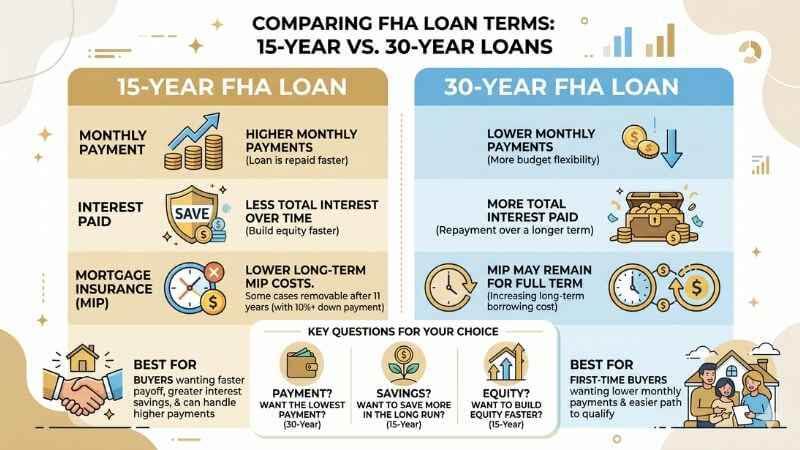
A 30-year FHA loan is often the better fit for homebuyers who want a lower monthly mortgage payment and more room in their monthly budget. Because the repayment period is spread out over a longer term, the payment is usually more affordable. This can make it simpler for first-time homebuyers and people with moderate incomes to get approved. The tradeoff is that you will usually pay more in total interest over the life of the loan. In many cases, FHA mortgage insurance also remains on the loan for the full term, increasing the long-term cost of borrowing.
15-Year FHA Loan
A 15-year FHA loan is a solid option for folks who can manage a bigger monthly payment but want to save cash over time. Since the loan is paid back in half the time, you build equity faster and pay much less total interest. A 15-year FHA loan may also reduce long-term mortgage insurance costs compared to a 30-year FHA loan. For borrowers focused on paying off their home sooner and building wealth faster, this option can offer major long-term benefits.
Which FHA Loan Term Is Better?
Neither option is automatically better for every borrower. A 30-year FHA loan is often best for buyers who need lower monthly payments and more financial flexibility. A 15-year FHA loan is often best for buyers who want to pay off their mortgage faster, build equity sooner, and save more on interest over the long run. The right choice depends on your income, monthly budget, and long-term homeownership goals.
FHA Mortgage Insurance: What Homebuyers Need To Know
FHA loans require mortgage insurance, which is part of the cost of borrowing under this loan program. This is true whether you choose a 15-year FHA loan or a 30-year FHA loan. The reason FHA requires mortgage insurance is to protect lenders when they make loans to borrowers with lower down payments or more flexible credit guidelines.
FHA mortgage insurance has two main parts. First, there’s the upfront mortgage insurance premium, which is often added to your loan amount at closing. Then, there’s the annual premium that you pay monthly as part of your mortgage.
That monthly cost can change depending on factors such as the length of your loan, how much you put down, and the overall size of your loan. This is where the difference between a 15-year and 30-year FHA loan becomes important. With a 30-year FHA loan, the monthly payment is lower, but mortgage insurance often stays in place for much longer. With a 15-year FHA loan, the monthly payment is higher, but the long-term cost of mortgage insurance may be lower. In some cases, it can be removed eventually. For many buyers, that means the real decision is not just about the monthly payment. It is also about how much interest and mortgage insurance you may pay over time. A 30-year FHA loan can be easier on your budget now, while a 15-year FHA loan can cost less over the long run if you can afford the higher payment. When it comes to mortgage insurance rules, there’s one simple idea to keep in mind: picking a shorter loan term means your monthly payments will be higher, but you’ll save more money in the long run. If you choose a longer loan term, your monthly payments will be more manageable, but you’ll pay more overall.
FHA Mortgage Insurance Costs For 15-Year vs 30-Year Loans
 When comparing 15-year vs 30-year FHA loans, mortgage insurance is one of the biggest long-term cost differences. Both loan options require you to pay a mortgage insurance fee upfront, and there’s a monthly charge for that insurance, too. The difference is how much the monthly mortgage insurance costs and how long you may have to keep paying it. In general, 30-year FHA loans are designed to give borrowers lower monthly principal and interest payments, but they often come with mortgage insurance that lasts much longer. In many cases, borrowers with a 30-year FHA loan will pay annual mortgage insurance for the life of the loan. That means even if the monthly payment feels more affordable, the total long-term cost can be much higher.
A 15-year FHA loan usually works differently. The monthly payment is higher because the loan is being repaid faster, but the long-term mortgage insurance costs can be lower. In some cases, borrowers with a 15-year FHA loan may be able to stop paying annual mortgage insurance after 11 years if they meet the required down payment and loan-to-value conditions.
For many homebuyers, this creates a simple tradeoff. A 30-year FHA loan may be easier to qualify for and easier to manage month to month, but it often costs more over time. A 15-year FHA loan may stretch your monthly budget more, but it can reduce both interest costs and mortgage insurance costs over the life of the loan. The most important takeaway is this: FHA mortgage insurance is not just about the rate you pay. It is also about how long the cost stays attached to the loan. That is why buyers comparing 15-year vs 30-year FHA loans should look beyond the monthly payment and consider the total cost over time.
Why Buyers Choose a 30-Year FHA Loan
Many homebuyers choose a 30-year FHA loan because it offers a lower monthly payment. Spreading the loan over a longer period reduces the principal and interest portion of the payment, making homeownership more affordable. This is especially helpful for first-time homebuyers, borrowers with moderate income, and anyone who wants more room in their monthly budget. A 30-year FHA loan can also make it easier to qualify. Since the monthly payment is lower, it may help borrowers stay within debt-to-income ratio limits. That added flexibility can make a big difference for buyers who are close to qualification thresholds or who want to keep cash available for savings, repairs, or other expenses. The downside is that a 30-year FHA loan usually costs more over time. Because the repayment period is longer, borrowers typically pay much more in total interest. FHA mortgage insurance may also remain on the loan for the full term, which adds to the total borrowing cost.
15-Year vs. 30-Year FHA Loans: Which Is Right for You?
Compare payments, interest savings, and equity-building power side-by-side.Why Some Buyers Choose a 15-Year FHA Loan
A 15-year FHA loan appeals to buyers who want to pay off their mortgage faster and reduce long-term costs. Because the loan term is shorter, borrowers usually receive a lower interest rate and build equity much faster. Over time, this can lead to significant savings compared to a 30-year loan. Another reason some buyers prefer a 15-year FHA loan is the potential to reduce mortgage insurance costs. While the monthly payment is higher, the total interest and mortgage insurance payments can be significantly lower. For borrowers with high income and a stable budget, this option can put them in a stronger financial position over the long run. The tradeoff is affordability. A 15-year FHA loan requires a much higher monthly payment, which can make qualifying harder. It may also leave less room in the budget for other financial goals or unexpected expenses. For that reason, this loan term is usually better suited for buyers who want long-term savings and can comfortably handle the larger payment.
Which Option Feels Better for Most Buyers?
For many buyers, the decision comes down to payment flexibility versus long-term savings. A 30-year FHA loan is often the better fit for those who need a lower payment and more budget breathing room. A 15-year FHA loan is often the stronger choice for those who want to pay off their home sooner and save more over time.
Payment and Cost Comparison Between 15-Year vs 30-Year FHA Loans
A 30-year FHA loan usually means you’ll have a lower monthly payment since the amount gets spread out over a longer time. That can make it easier to qualify and manage your budget month to month. The tradeoff is that you will usually pay more total interest over the life of the loan, and FHA mortgage insurance often stays in place much longer. A 15-year FHA loan usually comes with a higher monthly payment because it is repaid faster. While that can make qualifying more difficult, it also means you build equity sooner and often pay much less in total interest over time. In many cases, the long-term mortgage insurance cost can be lower than that for a 30-year FHA loan. For buyers deciding between the two, the biggest difference is not just the monthly payment. It is the total cost over time. A 30-year FHA loan may feel more affordable now. Still, a 15-year FHA loan may save you much more money over the long run if the higher payment fits comfortably within your budget. Instead of focusing too heavily on one sample scenario, it is often better to compare the two loan terms based on three simple questions:
Which Loan has the Lower Monthly Payment?
In most cases, the 30-year FHA loan will have the lower monthly payment because repayment is stretched over a longer term.
Which Loan Costs Less Over Time?
In most cases, the 15-year FHA loan will cost less over time because borrowers usually pay less total interest and may also reduce mortgage insurance costs.
Which Loan Builds Equity Faster?
A 15-year FHA loan builds equity faster because more of each payment goes toward reducing the balance sooner.
Can FHA Mortgage Insurance Be Canceled?
FHA mortgage insurance can sometimes be canceled, but the answer depends on the loan term and how much money you put down. This is one of the biggest differences between 15-year vs 30-year FHA loans, and it can have a major impact on your total long-term borrowing cost.
For many borrowers, a 30-year FHA loan comes with mortgage insurance that stays for the life of the loan. Even if you build equity over time, the annual mortgage insurance premium usually does not automatically go away. That is one reason a 30-year FHA loan may cost more in the long run, even though the monthly payment is lower.
A 15-year FHA loan can be different. In some cases, annual mortgage insurance can be removed after 11 years, provided the borrower has made a down payment of at least 10 percent and meets the required loan-to-value ratio. This can make a 15-year FHA loan more attractive for buyers who want to reduce long-term mortgage insurance costs and pay off their home faster. The main takeaway is simple: if you are comparing 15-year vs 30-year FHA loans, do not just look at the monthly payment. You also need to consider how long mortgage insurance may remain attached to the loan. That difference can meaningfully affect the total cost of homeownership.
Who Should Consider a 15-Year FHA Loan?
Think about a 15-year FHA loan if you:
- Have room in your budget for a higher monthly payment.
- Would like to pay off the mortgage faster.
- Want to cut down on interest and mortgage insurance.
- Intend to stay in the house for a long time.
Who Should Choose a 30-Year FHA Loan?
A 30-year FHA loan may be better if:
- You are constrained by lower monthly payments due to needing to qualify for a loan.
- You want more flexibility with your budget.
- Are you planning to refinance or sell in a few years?
Which FHA Loan Term is Right for You
Your choice of 15-year vs 30-year FHA loans will largely depend on your finances and long-term aspirations.
- Go with a 30-year FHA loan if you require reasonable monthly payments and prefer a gradual approach to homeownership.
- Choose between 15-year vs 30-year FHA loans if you want to save thousands in interest and insurance and can afford higher payments.
- At Gustan Cho Associates, we provide options for side-by-side comparison.
- We can assist with purchasing your first home or refinancing an existing loan to ensure you receive the best FHA loan that meets your needs.
- We offer no lender overlays and fast closings.
- Our dedicated team is ready to assist you every step of the way.
Final Thoughts About 15-Year vs 30-Year FHA Loans: Which FHA Loan Term Is Right For You?
Choosing between a 15-year vs 30-year FHA loans comes down to what matters most to you: a lower monthly payment today or greater long-term savings over time. A 30-year FHA loan is often the better fit for homebuyers who want lower monthly payments, more budget flexibility, and an easier path to qualifying. This option can make homeownership more manageable, especially for first-time buyers or borrowers who want to keep more cash available for savings, repairs, and other expenses.
A 15-year FHA loan might be a great option for buyers who can handle a bigger monthly payment and want to pay off their mortgage sooner. It can help you build equity sooner, reduce total interest paid, and lower long-term mortgage insurance costs in certain situations.
There is no one-size-fits-all answer. The best FHA loan term depends on your income, budget, future plans, and overall financial goals. The most important thing is to compare both options carefully and look beyond just the monthly payment. A loan that feels more affordable now may cost more over time, while a loan with a higher payment may save you significantly more in the long run. Before choosing between 15-year vs 30-year FHA loans, make sure you look at the full picture: monthly payment, total interest, mortgage insurance, and how long you plan to stay in the home. When you evaluate all of those factors together, it becomes much easier to decide which loan term truly fits your needs.
Frequently Asked Questions About 15-Year vs 30-Year FHA Loans:
Is A 15-Year FHA Loan Harder To Qualify For Than A 30-Year FHA Loan?
Yes, in most cases, a 15-year FHA loan is harder to qualify for because the monthly payment is higher. Even though the loan is paid off faster and may carry a lower interest rate, the larger payment can make it harder for some borrowers to stay within debt-to-income limits. A 30-year FHA loan is often easier to qualify for because the payment is spread over a longer term.
Do 15-Year FHA Loans Have Lower Interest Rates Than 30-Year FHA Loans?
Often, yes. A 15-year FHA loan usually comes with a lower interest rate than a 30-year FHA loan. The specific difference really relies on what’s happening in the market and how lenders set their prices. The bigger advantage is that a shorter term usually reduces total interest paid over the life of the loan.
Is The Monthly Payment Always Lower On A 30-Year FHA Loan?
Usually yes. A 30-year FHA loan generally has a lower monthly principal-and-interest payment because repayment is stretched over a longer period. That lower payment is one reason many buyers choose a 30-year term, even though it usually costs more in total interest over time.
Can You Refinance From A 30-Year FHA Loan Into A 15-Year Loan Later?
Yes, many borrowers start with a 30-year loan for payment flexibility and later refinance into a 15-year loan if their income improves or rates are more favorable. Whether refinancing is worth it depends on the new rate, closing costs, and how long you plan to keep the home.
Which Loan Helps You Build Equity Faster: 15-Year vs 30-Year FHA Loans?
A 15-year FHA loan is a great option if you want to build equity more quickly. With this loan, more of your monthly payment goes toward the principal right away, and you’ll pay off the balance in half the time compared to a longer loan. A 30-year FHA loan builds equity more slowly, especially in the early years of the loan.
Is A 15-Year or 30-Year FHA Loan Better For First-Time Homebuyers?
For many first-time homebuyers, a 30-year FHA loan is often the better fit because the lower monthly payment can make homeownership more manageable. A 15-year FHA loan may be better for buyers with higher incomes who want faster payoff and lower long-term costs. It really comes down to what you can spend, what you’re aiming for, and how much flexibility you want with payments.
This article about “15-Year vs 30-Year FHA Loans: Which Is Better for You?” was updated on April 20th, 2026.