This guide covers why do lenders have different requirement on credit scores. There are mortgage lending guidelines on the minimum requirement on credit scores in order to qualify for a particular mortgage loan program. For example, to qualify for a 3.5% down payment FHA Loan, the minimum credit score required by the mortgage loan applicant is 580 FICO. This minimum 580 FICO credit score is the bare minimum required per HUD lending guidelines to qualify for a 3.5% down payment mortgage loan.
Individual lenders can set higher standards than the minimum HUD guidelines with regards to which minimum credit scores they are willing to accept.
The higher mortgage lending standards set by the mortgage lender is called lender overlays. Most mortgage companies and banks have lender overlays. Good news is that there are lenders like myself that do not have lender overlays and will just go off the DU FINDINGS from the Automated Underwriting System. Same with Conventional Loans. Minimum credit scores required on conventional loans per Fannie Mae and/or Freddie Mac mortgage guidelines are 620 credit scores.
What Accounts for the Difference in Credit Score Assessment by Mortgage Lenders?
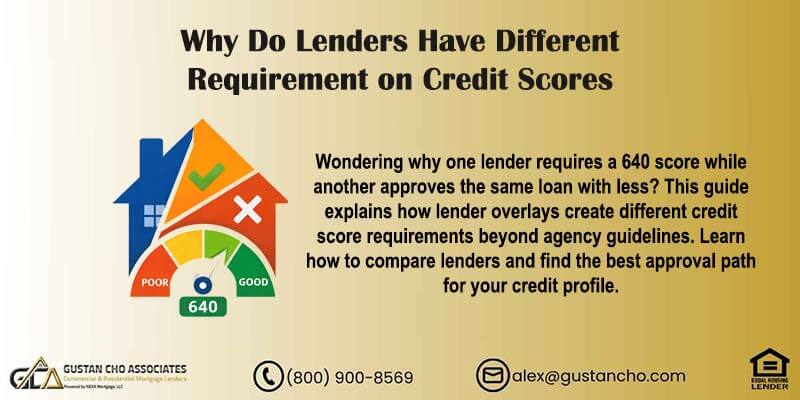
When looking at mortgage options, many home buyers wonder why lenders set different credit score requirements for the same loan type. For example, a borrower might talk to one lender and hear they need a 640 credit score, but another lender might say a lower score is enough. These differences can be confusing, especially if borrowers are not aware of lender overlays.
What Are Lender Overlays?
Lender overlays are additional rules that a mortgage lender adds to the standard agency guidelines. These overlays can affect factors such as credit scores, documentation, reserves, and past credit issues.
Even if FHA, VA, USDA, Fannie Mae, or Freddie Mac set certain requirements, a lender can choose to set stricter rules. This is why there are so many different mortgage lenders.
Lender overlays are a big reason why credit score requirements vary from one lender to another. They help explain why one lender might approve a borrower while another denies them. Overlays can also affect the interest rate and overall mortgage pricing.
The Main Reason Lenders Have Different Requirements: Lender Overlays
Overlays are additional rules lenders apply to the federal guidelines for FHA, VA, USDA, Fannie Mae, and Freddie Mac loans. While federal guidelines set the minimum requirements, overlays help protect the lender from legal and financial risks. For example, overlays might raise the minimum credit score, lower the allowed debt-to-income ratio, limit late payments, or require more savings. A borrower might qualify for a loan under the official rules, but the lender could still require a higher credit score and only approve borrowers with stronger credit. This explains the range of lender variability across loan types and credit score combinations.
Lender Overlays And Added Credit Score Restrictions
There are a number of reasons why overlays exist, and for added credit score restrictions. Lenders use overlays to limit the likelihood of loan default. Lenders are more or less strict in managing. There are several reasons for overlays and extra credit score rules. Lenders use overlays to reduce the risk of loan defaults and manage legal liability. Sometimes, the company buying the loan from the lender requires stricter rules. On the other hand, some lenders may offer more flexibility to help borrowers with lower credit scores. There are also perceptions about mortgages that are not entirely accurate.
Why Mortgage Guidelines Differ From Lender Requirements
There are specific guidelines for mortgages set by processing companies (like FHA, VA, USDA, Fannie Mae, or Freddie Mac), and then there are rules set by each individual. Some common ideas about mortgages are not completely accurate. Processing companies like FHA, VA, USDA, Fannie Mae, or Freddie Mac set certain guidelines, but each lender also sets its own rules.
More lenient processing entities (programs) do not mean they will qualify with the individual lender, because the lender may choose more strict underwriting practices.
Lenders decide how strict or flexible they want to be, so mortgage practices vary from one place to another. For example, a borrower might get automatic underwriting approval but still be denied by the lender. This happens more often than people think. Different lenders can give different results for the same borrower. It is important to know the difference between a lender’s own rules and the main program’s rules. Even if the program allows a loan, the lender might not approve it if their guidelines are stricter.
Why Do Lenders Have Different Requirement on Credit Scores
If you have been shopping for an FHA loan, you probably ran into a lender requiring a 640 credit score while a different lender required a 620 score. Yet Gustan Cho Associates require the minimum HUD agency guideline on credit scores which is credit scores down to 500 FICO. Each lender of government-backed and conventional loans can have different lending requirement that is above and beyond the minimum agency guidelines. This is called a lender overlays. John Strange, a senior mortgage loan originator at Gustan Cho Associates explains why do lenders have different requirement on credit scores:
Lender overlays are extra rules mortgage lenders tack on top of the baseline guidelines from agencies like FHA, VA, USDA, Fannie Mae, and Freddie Mac. These extra hoops are not baked into the government or secondary market rules. Lenders invent them to protect themselves from loans that feel too risky.
Overlays pop up all over the mortgage world. One lender may say your credit score must be 700, while another might approve you at 660. Some might only accept a DTI of 43%, while others have a hard line at 40%. You may also face a longer job history requirement than the main guidelines spell out, or even a need to pay off collections that the official rules say a lender could overlook. Some lenders flat-out won’t give a mortgage unless you have two years with the same job, even if you just switched to a nearby company in the same field.
Why Do Lenders Have Different Requirement on Credit Scores and Guidelines
No two lenders has the same lender overlays. All lenders need to meet the minimum agency guidelines but each lender can set higher lending requirements that is above and beyond the minimum agency guidelines.
Why do lenders do this? They want to be more careful than the minimum rules require. By adding these extra guidelines, they think they can avoid lending to people they believe could struggle to repay.
Javier Munoz of Gustan Cho Associates says many lenders often rely on these extra guidelines because they can’t absorb losses like bigger firms can. The main reason lenders have different credit score requirements is lender overlays. This is the key idea borrowers need to understand.
Understanding the Differences in Credit Score
Each loan program has its own minimum credit score, but lenders can add their own rules on top of that. This is why it is important to know your lender’s guidelines, since a loan might qualify for several programs but not every lender.
Credit Score Requirements on FHA Loans
FHA loans usually offer the most flexibility with credit scores. Many see this as a big advantage, but your actual experience depends on the lender you choose, since each one can set different credit score requirements. Lenders are more cautious if a borrower has a history of default, high debt-to-income ratio, low savings, or other risk factors. In these cases, even FHA loans may require a higher credit score, despite their generally flexible rules.
Credit Score Requirements on VA Loans
VA loans are often the best option for veterans and active-duty service members, and they offer flexible underwriting rules. However, the idea that VA loans are always flexible with credit scores is not entirely true. Most lenders set their own credit score limits for VA loans, and these can vary. This means that a borrower could be eligible for a VA loan at one lending institution but not at another, as the lending institution with the credit score threshold is the one that chooses to do business with the borrower.
Credit Score Requirements for USDA Loans
USDA loans help people in rural areas become homeowners and often have flexible lending criteria. However, lenders can still add their own overlays, even if a borrower meets USDA’s basic requirements. This means that eligible borrowers may face different credit score expectations depending on the lender.
Credit Score Requirements for Conventional Loans
Conventional loans usually require higher credit scores than government-backed loans, especially if the borrower has a small down payment, a high debt-to-income ratio, or credit problems. Still, each lender sets its own credit score requirements based on how much risk it is willing to take. Some lenders offering conventional loans prefer borrowers with strong savings and income, while others are stricter with borrowers with borderline credit. This is why it is important not to assume all lenders use the same approval process.
What Does it Mean When Lenders Have Varying Credit Score Criteria?
If lenders have different minimum credit score requirements, it means they have extra internal rules beyond the basic loan program guidelines. Government-backed and conventional loans set minimum standards, but lenders can choose to be stricter. They set their own minimum scores based on risk, ease of loan sale, investor needs, and company policies.
For borrowers, being denied by one lender does not always mean they cannot get a home loan. It often just means that a particular lender has stricter rules than the basic program allows.
Because of this, one lender might accept a conventional loan applicant with a 620 credit score, while another might require a higher score for the same loan. This also applies to FHA, VA, and USDA loans. The main difference comes from the lender’s own policies, not the loan program itself.
Why One Lender Approves You While Another Denies You
Suppose you’ve been denied a loan due to a low credit score, collection account, high debt-to-income ratio, or job history. In that case, it’s good to know that another lender may still say yes by skipping the extra loan rules many institutions add on top of the standard ones. Lenders like Gustan Cho Associates focus on saying yes when the official FHA, VA, or Fannie Mae rules say you’re good to go, without adding tougher rules of their own. In plain language, if the standard agency guidelines give you the green light, they give you the loan without trying to find more reasons to say no.
The Takeaway Is Clear:
Extra rules from a lender are often the line between a denial and an approval. A “no” from one lender is not a “no” from every lender. If you’ve been told you’re out of the running, testing your facts with a loan officer who sticks only to the published agency rules is smart. Many borrowers see that lenders have different credit score rules when shopping for a mortgage, especially when comparing government-backed loans to conventional ones. Knowing why these rules vary can help you pick the mortgage that fits you best and make it easier to get approved.
Why Are the Credit Score Requirement Different?
The main reason is risk. Conventional loans don’t have a government guarantee. If a borrower stops paying, the lender loses money. Lenders raise their standards to protect themselves, which usually means a minimum credit score of 620 or so. If your score is 680 or more, you’ll likely get the best rates and loan features. Dale Elenteny, a senior mortgage loan originator at Gustan Cho Associates explains why do lenders have different requirement on credit scores: Take the FHA, which lets you get a mortgage with a credit score as low as 580 and a 3.5% down payment. A lender, however, may decide that it still feels too loose and bump that minimum score to 620. That bump-up is an overlay. You’re still following the FHA program, but with tougher credit rules that the agency never required.
Confused by Different Credit Score Rules? We’ll Break It Down
Not all lenders follow the same rules—and that’s why you may get denied by one and approved by another.Agency Guidelines vs. Lender Guidelines
On the other hand, loans backed by the government—like FHA, VA, and USDA loans—come with a safety net since federal agencies insure or guarantee them. This coverage lowers the danger for lenders because the government promises to repay some or all the money lost if the borrower can’t keep up with payments.
Because the loan is less risky, lenders can accept borrowers with lower scores. For instance, FHA loans can accept scores down to 580 with just a 3.5% down, and in some cases, they can go down to 500 if the borrower puts down 10%.
USDA and VA loans also have friendlier score limits, often letting borrowers in when a conventional loan would say no. Still, most lenders will set their minimum score slightly higher than the rules say.
Lender Overlays Explained
Even when a government agency or the best mortgage investor spells out a low credit score limit, the lender can still say, “Not so fast,” and set a higher one. This extra rule is called a “lender overlay.” For example, the FHA might say a borrower can have a credit score of 580, but a certain lender might say, “We need you to have at least a 620.” Because every lender differs, a mortgage company might say yes when another says no. Lender overlays are common with government loans since they help the lender feel more secure while giving lower scores a chance.
How Government Loans and Conventional Loans Set Their Guidelines
Government loans, like FHA and VA mortgages, let lenders approve borrowers with bruised credit, small down payments, or limited credit files. This happens because the government promises to cover some costs if the borrower fails to repay.
The lender feels safer taking the risk. On the other hand, conventional loans sit on the lender’s balance sheet, so approval hinges on a solid credit file.
Conventional lenders want borrowers with clean credit histories, steady jobs, and low debt, as these traits cut the likelihood of a default. Suppose a loan is sold to Fannie Mae or Freddie Mac. In that case, the borrower usually has to start with a credit score of at least 620, yet many lenders prefer scores of 680 or better to offer the best rates.
Credit is Just the Start: Other Deciding Factors
Your credit score is important, but it is not the whole story. A bigger down payment for FHA loans can help balance the scales if your score isn’t great. Lenders will carefully check your debt-to-income ratio, which measures how much of your monthly income goes to monthly bills, to ensure you can still pay your mortgage. Other strong points—like a steady job history, a record of on-time bill payments, or a nest egg of cash savings—can also tip the scales in your favor, even with a score that needs work.
Key Takeaways for Borrowers
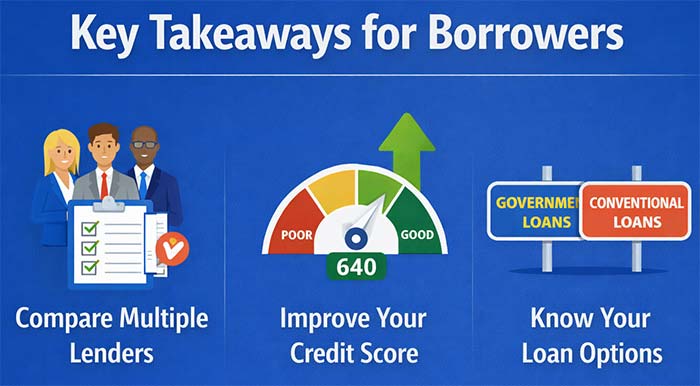 When you’re in the market for a mortgage, it pays to reach out to multiple lenders. Each one may read the same rules differently or add extra rules, which can affect your offer.
If you take the time to research and compare, you’ll put yourself in the strongest position to land the mortgage that matches your financial goals.
Getting your credit score in better shape gives you more choices and can lower your interest rate. Knowing the difference between government-backed loans (like VA or FHA) and conventional loans keeps you organized. It helps you choose the mortgage that best fits your situation. While the many rules for different loan types and lenders feel overwhelming, that same variety can give you an advantage.
Why One Lender May Approve You While Another Denies You
It is common for borrowers to have very different experiences with different mortgage lenders. One lender might preapprove you, while another could deny your application, especially if they have stricter rules than the first lender did not apply.
Risk Tolerance And Mortgage Approval Standards
Every lender has a different level of risk they are willing to take. Some work only with low-risk borrowers, while others are more open to borrowers with credit issues or unusual situations. This affects their credit score, savings, and approval requirements. Lenders willing to take more risk may accept lower credit scores. Those who know the guidelines well and have flexible investors are often more willing to work with a wider range of borrowers.
Why Mortgage Investors Impact Credit Score Criteria
Most lenders plan to sell their loans to the secondary mortgage market. Investors and partners can influence what types of loans a lender prefers. If a lender believes loans with lower credit scores are harder to sell or riskier, they may require higher credit scores. In other words, inveIn short, what investors want can affect your experience as a borrower, even if the official loan rules are more flexible.actors
Work to Borrowers’ Advantage
A borrower with a low credit score but strong compensating factors can still benefit. These factors include a large down payment, a low debt-to-income ratio, cash savings, a steady job, higher income, or a good recent payment history. However, not all lenders weigh compensating factors equally. One lender might consider your whole financial picture and approve you, while another might focus only on your credit score and deny the loan. This is another reason why credit score requirements differ between lenders.
What To Do If Denied By A Lender
If one lender denies a loan because of credit score requirements, many people assume all lenders will do the same. But that is not true. Some lenders have stricter overlays, while others are more flexible.
Borrowers should check their credit reports for errors, keep credit card balances low, avoid new credit applications until the loan closes, and always pay on time.
These steps can help improve credit scores. It is also important to find a lender who is flexible and does not add unnecessary rules beyond the basic program guidelines.
Why Shopping Around For Lenders Is Beneficial
When comparing lenders, most people focus on interest rates. But it is just as important to find a lender with policies that fit your situation. A lender with fewer extra rules may approve you faster, offer more options, and help you avoid delays. Choosing the right lender is especially important for borrowers with lower credit scores, past housing issues, unusual income, or who need manual underwriting. For these borrowers, the lender’s rules can make the difference between approval and denial. That is why understanding why lenders have different credit score requirements matters so much.
Why Working With The Right Mortgage Lender Matters
A good mortgage lender does more than just offer rates. They understand the difference between agency guidelines and overlays, know how to look at compensating factors, and can match you with the best loan program for your needs.
Many borrowers spend time with lenders who use strict internal rules without explaining that these are overlays. This can be confusing and make the process seem harder than it is.
A knowledgeable lender will help you understand if the problem is your credit, paperwork, debt ratios, savings, or just the lender’s own rules. For homebuyers and those looking to refinance, understanding overlays is important. If you understand them, you will not give up after one denial and can find a better path to mortgage approval.
Final Thoughts On Why Lenders Have Different Requirements On Credit Scores
If you have ever wondered why lenders have different credit score requirements, it mostly comes down to lender overlays. Mortgage programs set minimum standards, but lenders often add stricter rules based on their risk tolerance, investor needs, and company policies. This is why two lenders can look at the same borrower and make different decisions.
At Gustan Cho Associates, we believe in educating borrowers about mortgage guidelines, lender overlays, and real loan options to help homebuyers make informed choices.
This is why you should not assume that one denial means you cannot get a mortgage. Often, the problem is not the official loan rules but the lender’s overlay. Knowing this helps you shop smarter, ask better questions, and find the lender that fits your financial situation.
Lenders Have Different Requirement Because of Agency Guidelines vs Overlays
However, many conventional lenders may have overlays on credit scores where the minimum credit scores required may be 680, 660, or 640 FICO. This holds true even though the minimum credit scores required is 620 FICO per Fannie Mae and/or Freddie Mac lending guidelines. In this blog, we will discuss Why Do Lenders Have Different Requirement On Credit Scores.
Why Do Lenders Have Different Requirement on Credit Scores
Unfortunately, many mortgage loan applicant goes to a lender to qualify for a mortgage loan and are often told that they do not qualify because they do not meet the mortgage lender’s minimum credit score requirements. Many loan officers do not tell home loan applicants that just because they do not meet the particular mortgage lender’s minimum credit score requirements that they can qualify with a lender with no overlays.
For example, just this morning, a mortgage loan applicant called me and told me that she was told that she did not qualify by multiple mortgage lenders.
Some lenders told her that she did not qualify because minimum credit scores to qualify for FHA Loans was 640 FICO. Other lenders told her that the minimum credit scores required to qualify for a 3.5% down payment FHA insured mortgage loan was 620 FICO. This mortgage loan applicant’s credit scores were 589 FICO. Not a single loan officer told her that she meets minimum FHA guidelines with regards to credit scores and just told her she does not qualify for a mortgage loan.
Agency Mortgage Guidelines Versus Lender Overlays
Minimum FHA lending guidelines with regards to credit scores is 580 FICO. Fortunately, this mortgage loan applicant was one of those consumers who will not take no for an answer and found me on the internet. After talking to her and going over her credit and financial profile, she is more than qualified for an FHA insured mortgage loan with 3.5% down payment
She has no late payments in the past 12 months, full-time employment, verification of rent, and more than enough funds for the down payment. More than 75% of our borrowers are folks who were told they did not qualify elsewhere.
If you are told that you do not qualify for an FHA or Conventional Loans because of the overlays, please contact us at Gustan Cho Associates at 800-900-8569 or text us for faster response. Or email us at gcho@gustancho.com. We are mortgage bankers and correspondent mortgage lenders with no overlays.
Frequently Asked Questions Why Do Lenders Have Different Requirement on Credit Scores
Why Do Lenders Have Different Requirements For Credit Scores?
Lenders have different credit-score requirements, mainly due to lender overlays. These are additional internal rules that lenders add on top of FHA, VA, USDA, and conventional loan guidelines. One lender may allow more flexibility, while another may require a higher score for the same loan program.
What Are Lender Overlays In Mortgage Lending?
Lender overlays are stricter standards set by individual mortgage lenders beyond the official agency or government guidelines. These overlays can affect minimum credit score requirements, debt-to-income ratios, cash reserves, manual underwriting, and documentation.
Can One Lender Deny Me And Another Lender Approve Me?
Yes. One lender can deny your loan while another lender approves it because lenders do not all use the same overlays. This is one of the most common reasons borrowers get mixed answers when applying for a mortgage.
Do FHA and VA Loans Have The Same Credit Score Requirement At Every Lender?
No. FHA and VA loan guidelines may allow flexibility, but lenders often set their own minimum credit score requirements. That is why borrowers may receive different answers from different mortgage companies.
Why Are Conventional Loan Credit Score Requirements Different From Lender To Lender?
Conventional loan credit score requirements can vary because lenders manage risk differently. Some lenders want higher scores, larger down payments, or more reserves, while others may follow the standard guidelines more closely, adding fewer overlays.
Should I Apply With Another Lender If I Was Denied بسبب Credit Score Requirements?
Yes, in many cases it makes sense to get a second opinion. A denial may be due to lender overlays rather than the actual loan program rules. If you are asking why lenders have different credit score requirements, this is exactly why shopping multiple lenders can matter.
This Guide On Why Do Lenders Have Different Requirement On Credit Scores Was UPDATED On April 14, 2026.