
What Is a Portfolio Loan?
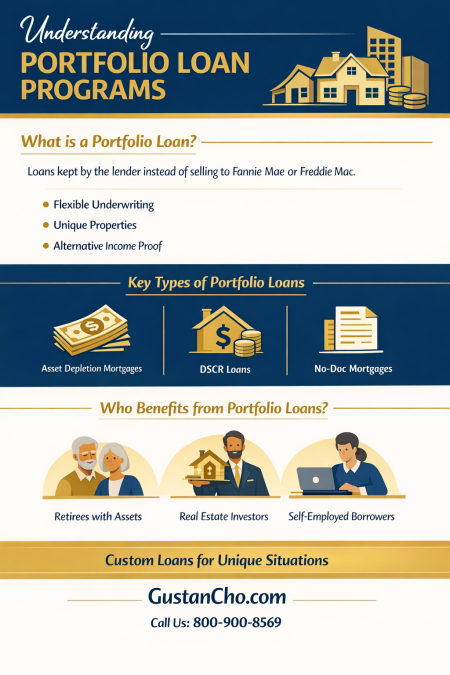
A portfolio loan is when a lender decides to keep the mortgage in-house rather than sell it to big investors like Fannie Mae or Freddie Mac. Since they’re holding the loan, they can be much more flexible with the rules than with typical FHA or conventional loans. This is especially great for folks with non-traditional income, lots of assets, or unique properties.
What You’ll Learn in This Guide
In this article, you’ll learn:
- What a portfolio loan is and how it’s different from FHA, VA, and conventional loans
- Why portfolio lenders can be more flexible (and what they still require)
- The most common portfolio loan program types, including:
- Asset depletion mortgages (qualify using assets instead of paychecks)
- Bank statement loans (qualify using deposits instead of tax returns)
- DSCR investor loans (qualify based on rental cash flow)
- No-income-documentation options (when available, and what they typically require)
- Who portfolio loans are best for (self-employed, retirees, investors, unique properties)
- The most important trade-offs to know upfront (rates, down payment, reserves, and lender-specific rules)
- How to get started and what to prepare before you apply
What Are The Characteristics of a Portfolio Loan

A portfolio mortgage lender is a lender that originates, processes, underwrites, and funds the porfolio loan and the portfolio mortgage loan is kept on the lender’s own portfolio balance sheet instead of selling it to a secondary market investor. Portfolio lenders have more flexibility in their underwriting criteria compared to conforming loans sold to GSEs. This allows them to serve borrowers who may not qualify for traditional mortgages.
Don’t Qualify for Traditional Loans? Portfolio Loans May Be the Solution
Perfect for unique credit, income, or property situations. Explore Portfolio Loan Options Today!
Key Portfolio Loan Programs Available at Gustan Cho Associates
1. No Income Documentation Loans
- Perfect for borrowers who don’t have a regular income to document.
- Suitable for self-employed, investors, or those with non-traditional income.
2. Asset Depletion Mortgages
- It enables borrowers to be assessed based on their assets instead of consistent income.
- It is ideal for retirees or individuals with substantial investments rather than a paycheck.
Both programs offer the flexibility that conventional and government loans lack, making them increasingly popular.
Understanding Asset Depletion Mortgages: No Income Required
One of the most in-demand portfolio loan programs is the Asset Depletion Mortgage. Asset depletion loans are built for borrowers who have substantial assets but may lack a steady income. This loan program allows lenders to use a borrower’s assets — stocks, bonds, mutual funds, or gold — to calculate eligibility.
How Asset Depletion Income Is Calculated
Asset depletion mortgages let you qualify using verified liquid assets instead of (or in addition to) job income. The lender converts a portion of your eligible assets into a monthly “qualifying income” number.
Here’s the key point: there is no single universal divisor. The “months” used depend on the lender’s portfolio guidelines.
Most commonly, lenders use one of these methods:
- 120 months (10 years) – common in many asset depletion programs
- 240 months (20 years) – used by some lenders for a more conservative calculation
- 360 months (30 years) – used by some lenders, especially when aligning with a 30-year term
Simple Example (Using 120 Months)
Let’s say you have $1,200,000 in eligible assets.
- Apply the lender’s eligibility haircut (example):
- Cash: often counted at 100%
- Stocks/bonds: often counted at 70% (to account for volatility)
- Convert the adjusted assets into monthly income:
- If the program uses 120 months:
- $1,200,000 ÷ 120 = $10,000/month qualifying income
If the same lender used 360 months, the qualifying income would be lower:
$1,200,000 ÷ 360 = $3,333/month
Why the Divisor Matters
The divisor (120 vs 360) changes the monthly income used for qualification, which impacts:
- how much house you qualify for
- your allowable DTI under that lender’s rules
- whether you need a larger down payment or more reserves
Bottom line: Asset depletion is a portfolio product, so the math varies by lender—but the concept stays the same: assets are converted into qualifying income using a set month divisor.
How Does Portfolio Loan Work?

A portfolio loan is a mortgage loan where a lender is not concerned about selling it on the secondary market. Examples of portfolio loans are the following:
- bank statement mortgage loans
- Fix and flip investment property loans
- Jumbo Mortgages With 5% Down Payment With No Mortgage Insurance
- condotel financing
- non-warrantable condo mortgages
- NON-QM Loans
A portfolio loan can be sold but the majority of them are kept in the lender’s portfolio. The lender uses their own funds and keeps the mortgage loan for the term of the loan.
Who Benefits from Asset-Based Lending?
These portfolio loan programs are great for borrowers who:
- They don’t have a steady paycheck but have significant assets.
- Need flexibility around income documentation.
- They have experienced recent life changes (like retirement) that affect their taxable income.
Common borrowers benefiting from asset-based loans include:
- Retirees: Those with substantial retirement savings but no regular income.
- Investors: Individuals with high net worth from investments rather than monthly income.
- Entrepreneurs and Business Owners: Those with fluctuating or minimal taxable income.
With this program, your wealth works in your favor, allowing you to secure financing that standard loans may not provide.
How Asset Depletion Programs Work for Mortgage Qualification
Asset depletion programs operate distinctly compared to standard loans. Below is an outline of the usual steps and factors to consider:
- Assess Your Total Assets: Lenders typically examine liquid assets and apply a percentage to offset market risks (e.g., 70% of your stock investments).
- Deduct Closing Costs: Any costs associated with closing will be subtracted.
- Calculate Monthly Income: The adjusted assets are divided by 360 months to determine your monthly qualifying income.
The amount required for a down payment can differ depending on the loan amount and your financial situation, but it typically falls between 10% and 30%.
Looking for Flexible Financing? Explore Our Portfolio Loan Programs Today!
Contact us today to learn how a portfolio loan can help you achieve your homeownership goals.
Portfolio Loans Are Non-Conforming Mortgage Loans
Portfolio loans are typically non-conforming, meaning they don’t meet the standard guidelines for loans that can be sold to Fannie Mae, Freddie Mac, or other investors in the secondary mortgage market. Portfolio lenders may offer unique mortgage products tailored to specific borrower needs, such as jumbo loans, investment property loans, or loans for self-employed individuals.
When a lender keeps a loan in their portfolio, they also retain the servicing rights, allowing them to manage the loan from origination through payoff.
The main advantages of portfolio loans include more flexible underwriting, the ability to retain customer relationships, and the potential for higher profit margins for lenders. However, portfolio lenders also take on the full credit risk of the loans they originate. Portfolio lending allows banks, credit unions, and other financial institutions to customize their mortgage offerings and cater to borrowers who may not fit the standard conforming loan mold. This can expand home ownership opportunities for some consumers.
Portfolio Loans Are Also Called Non-Conforming Loans
Homebuyers who need to purchase residential property but cannot get comps on the appraisal, the chances are they will not qualify for an FHA or a conventional mortgage loan. Both FHA and conventional mortgage loans have specific appraisal requirements. Appraisals require three recent comparable sales similar to the subject property.
Appraisers usually use recent comparable sales, but they can expand the search area and use other accepted valuation methods when nearby comps aren’t available. Unique properties may still be harder to support under standard programs, which is where some portfolio lenders may offer added flexibility.
This holds true even though there are no recent comparable sales. A portfolio lender has the luxury to do that. This is because they are keeping mortgage loans they fund and not selling it on the secondary market.
Unique and Special Properties
Homebuyers or high-end luxury homes or unique properties with no comparable sales can qualify for portfolio loan programs. Bank Statement Mortgage Loans for self-employed borrowers are also classified under Portfolio Loan Programs. If that is the case, the chances are that borrowers will not qualify for a conforming conventional or FHA mortgage loan.
On conforming conventional mortgage loans and FHA insured mortgage loans, there need to be at least three recent nearby comparable sales on the appraisal.
If there are no three nearby recent appraisals, the mortgage loan borrower cannot qualify for that particular property under government or conventional loans. In cases like these, a luxury home purchaser needs to obtain a portfolio loan from a portfolio loan mortgage lender. Any unique or odd residential properties will have a hard time getting comparable to an appraisal. Each portfolio lender has its own lending requirements.
Portfolio Loan Guidelines are Different
On cases where there are no appraisal comparable, the best bet borrowers has is to seek the guidance of portfolio lender. This is so loan officer can match the borrower with a portfolio loan lender like Gustan Cho Associates. With bank statement mortgage loans for self employed borrowers, there are lenders that require 24 months bank statements while a few lenders require 12 months bank statements.
Most non-QM loans are portfolio loans where the lender keeps the loan in their portfolio after it funds. There is no waiting period after bankruptcy, foreclosure, short sale with NON-QM Loans on day out of bankruptcy or foreclosure.
Gustan Cho Associates offers no-doc fix and flip portfolio loans and non-doc investment property loans where income documentation is not required by borrowers. Homebuyers who do not qualify for government or conventional loans and need to get qualified for a portfolio loan can contact us at 800-900-8569 or text for a faster response. Or email us at gcho@gustancho.com.
Post Coronavirus Pandemic Update on Portfolio Loan Programs
Gustan Cho Associates Mortgage Group suspended all non-QM loans, especially the bank statement loan program for self-employed borrowers, due to the coronavirus pandemic. However, the great news is that we have reopened the bank statement mortgage loan program for self-employed borrowers. The new update on the bank statement mortgage loan program for self-employed borrowers is borrowers will need to provide 24 months of bank statements. The 12-month bank statement loan program is still suspended. We do expect the 12-month bank statement loan program will reopen in the coming months. Gustan Cho Associates will keep our viewers updated when the 12-month bank statement loan program for self-employed borrowers reopens.
Self-Employed? Investor? Unique Income? Portfolio Loans Have You Covered
We offer custom loan solutions when banks say no. Get Pre-Approved for a Portfolio Loan Now!
Investor Portfolio Loan Programs
If you’re an investor, portfolio loans can give you access to high LTV (loan-to-value) ratios and more flexible income sources. At Gustan Cho Associates, our investor portfolio loan program allows you to finance 10 properties and hold up to 15 total real estate-owned (REO) properties. Here’s how it breaks down:
- 100% Asset Use: No reduction for stocks or bonds, meaning you get maximum value from your assets.
- Up to 75% LTV: Cash-out refinancing options are available with no rate adjustments.
- Multiple Income Sources: Asset depletion can be combined with other sources, such as W-2s, rental income, or retirement income.
This portfolio loan program is designed to support investors who need access to financing without rigid income documentation or investment restrictions.
Qualifying Properties and Eligible Asset Types
Portfolio loans can be applied to a wide range of properties:
- Owner-occupied residences
- Second homes
- Investment properties
- Condotels, non-warrantable condos, and co-ops
Eligible asset types typically include:
- Cash in U.S. bank accounts
- Stocks, bonds, and other marketable securities
- Retirement funds (age requirements apply)
Funds held in private investments or trusts generally cannot be used unless unrestricted.
Conconforming Portfolio Loans on Co-Ops, Condos, and More
One standout feature of portfolio loan programs is that they allow financing on property types generally ineligible for conventional loans. This includes:
- Condotels and Non-Warrantable Condos: Up to 75% LTV for second homes.
- Co-Ops: Typically require only a single appraisal, saving time and expense.
- Investment Properties: Up to 60% LTV, even on cash-out refinances.
Income Documentation vs. DTI: How Portfolio Lenders Actually Qualify Borrowers
Portfolio loan programs aren’t all underwritten the same way. Some programs require a DTI calculation, while others qualify you using assets or property cash flow instead of traditional income.
Here’s the simple breakdown:
1) Programs that still use DTI (even with “alternative income”)
Some portfolio loans don’t require tax returns or W-2s. However, they still calculate a DTI using a lender-approved income method, such as:
- Asset depletion “qualifying income” (assets converted into monthly income)
- Bank statement income (deposits averaged over 12–24 months)
- P&L-based income (supported by CPA or lender guidelines)
In these cases, the lender may set a maximum DTI (often around 40%, but it varies by program and lender).
2) Programs that don’t rely on borrower DTI
Some programs qualify you primarily based on something else, such as:
- DSCR loans (approval based on the property’s rental income covering the mortgage payment)
- Certain true no-income-verification programs (approval emphasizes equity/down payment, credit, and reserves)
Bottom line: “No income documentation” usually means no tax returns/W-2s, not “no qualification.” The lender may still verify your ability to repay using assets, deposits, rent cash flow, reserves, and credit, and the DTI rule (if any) depends on the specific program.
How to Get Started with Portfolio Loan Programs
If you’re interested in exploring your options with a portfolio loan, here’s a simple guide to help you get started:
- Connect with a Loan Officer: Schedule a meeting to explore your financial objectives and identify the portfolio loan option that suits your requirements best.
- Evaluate Your Assets: Make a list of liquid assets, such as cash, stocks, or retirement funds, that you can use to qualify.
- Review Property Requirements: Check which property types qualify, especially considering a condotel, non-warrantable condo, or investment property.
- Choose Your Program: Asset depletion, no-income documentation, and foreign national loans offer unique benefits.
Portfolio loan programs require fewer traditional income documents but still involve a careful review of your assets and property type. By working with a lender who understands portfolio loans, you can streamline the process and get pre-approved faster.
Ready to Explore Portfolio Loan Programs?
Gustan Cho Associates is here to simplify the process. We recognize that borrowers with unconventional profiles have distinct needs, and we provide tailored solutions to help you reach your real estate goals.
Whether you’re buying, refinancing, or investing, our team of loan specialists at Gustan Cho Associates can guide you through each step.
Ready to start? Call us today or apply online to see how easy it can be to find a portfolio loan tailored to your needs. We’re excited to help you unlock the door to your next property with a portfolio loan that suits your financial picture.
Benefits of No Income Documentation Mortgages
Going with a no-income-doc mortgage can pay off well for the right buyer:
- ✔ You skip submitting tax returns.
- ✔ Lenders weigh other factors, like bank cash, monthly rent rolls, or profit-and-loss statements.
- ✔ You might snag a bigger loan than with other programs.
- ✔ It’s a hit with self-employed pros and property buyers who flip buildings.
- ✔ The rules are looser for property kinds—think short-term or mixed-use.
Types of Portfolio Loan Programs
Asset Depletion Mortgage Loans
What it is:
An asset depletion loan works by allowing you to qualify based on cash and investments rather than paycheck stubs. You move the amount you have stashed in accounts into income for the loan—breaking it down into a monthly hit—so you don’t need a steady paycheck to fit the standard debt-to-income ratio.
How it works:
The lender takes the borrower’s verified assets and splits them over a fixed period to create a monthly income. A common term used is 120 months (or 10 years).
Best for:
- Retirees sit on a healthy nest egg but receive little cash each month.
- High-net-worth borrowers without another visible income stream.
Example:
A client shows $1,200,000 in assets, which the lender treats as $10,000 in monthly qualifying income since $1,200,000 ÷ 120 months equals $10,000.
Would you be ready for a Loan That Fits Your Needs? Let’s Explore Portfolio Loan Programs!
Contact us now to discuss how our portfolio loan programs can help you get the financing you need.
Debt Service Coverage Ratio (DSCR) Loans
What it is:
A DSCR loan is for real estate investors. Approval hinges not on borrower income but on cash flow from the rental property itself.
Qualification standards:
- Most lenders want a minimum ratio of 1.0, ensuring the property’s income completely covers the mortgage.
- A few providers accept lower DSCRs if the borrower makes a bigger down payment.
Best for:
- Investors managing several rental units.
- Borrowers focus on financing, which is determined mostly by property cash flow.
Profit and Loss (P&L) Statement Loans
What it is:
A P&L statement loan streamlines the approval process for self-employed individuals. Instead of the usual tax returns, the borrower uses a P&L created in-house or prepared by a CPA to show income.
Advantages:
- You don’t need to show all your business or personal tax returns.
- It’s easier to gather paperwork for business owners who have complicated deductions.
Best for:
- Self-employed people.
- Owners of small businesses that write off a lot of expenses.
No-Doc Loans (True No Income Verification)
What it is:
- A no-doc loan means very little paperwork is needed.
- You might only need to confirm your name, credit history, and assets rather than proof of income.
Features:
- You’ll likely need a big down payment, usually between 20% and 30% or more.
- Interest rates might be slightly higher since the lender takes on more risk.
- Your credit score is still a key factor.
Best for:
- People who want to keep their financials private.
- Borrowers whose income is hard to show, like freelancers or gig workers.
Who Should Consider Portfolio Loan Programs?
Portfolio loans aren’t for everyone, but they work well for:
- Those who don’t meet standard loan guidelines.
- Real estate investors need fast, simple approvals.
- Clients with many assets but little documented income.
- Self-employed workers whose paychecks vary a lot from month to month.
Potential Downsides of No Income Documentation Mortgages
Though these loans give you more flexibility, keep these cons in mind:
- Interest rates are usually higher than those on standard mortgages.
- You’ll need a larger down payment than many traditional loans require.
- Your credit score must meet stricter benchmarks.
- Not as many lenders offer these loans compared to regular mortgages.
How to Qualify for a Portfolio Loan
To get your loan application ready for a portfolio lender:
- Keep your credit score healthy.
- Aim for at least 660.
- Collect your financial documents.
- This includes bank statements, rental agreements, or other proof of income.
- Prepare for a bigger down payment.
- Expect to put down 20–30% of the purchase price.
- Partner with a broker who knows no-doc or portfolio loan options well.
Why Work With Gustan Cho Associates
Gustan Cho Associates focuses on no-overlay mortgage lending, which means we give the green light on loans that other lenders commonly turn down. Our portfolio programs fit:
- Self-employed workers who don’t show high income on tax returns.
- Investors who want debt service coverage ratio (DSCR) financing.
- Retirees are relying on asset depletion calculations.
- Clients who really need a true no-doc mortgage.
We’re licensed in 48 states, delivering solutions coast to coast for borrowers with one-of-a-kind needs.
- Call us at 800-900-8569 or check out Gustan Cho Associates for your mortgage options.
A Customized Path to Homeownership and Investment
- Portfolio loans—like asset depletion mortgages, DSCR loans, P&L statement loans, and no-doc mortgages—create real options for borrowers who don’t fit standard guidelines.
- Whether you are self-employed, an investor, or a retiree with significant assets, these programs can help you achieve homeownership and investment.
At Gustan Cho Associates, we know that no two financial stories are the same. Our team is skilled at matching borrowers with the right portfolio loan—even when other lenders say no.
Reach out now at 800-900-8569 to explore our no-income documentation mortgage options.
Frequently Asked Questions About Portfolio Loan Programs:
What is a Portfolio Loan?
A portfolio loan is basically a type of mortgage that the lender keeps for themselves instead of selling it off to companies like Fannie Mae or Freddie Mac, or any other investors. Because the lender keeps the loan, it can set its own guidelines—often offering more flexibility than standard agency loans.
Are Portfolio Loans Harder to Get Than Conventional Loans?
It depends on why you need one. Portfolio loans can be easier if you don’t fit agency rules (self-employed income, unique property, recent credit event), but they may be stricter in other ways—like requiring a larger down payment, more reserves, or higher rates because the lender is keeping the risk.
Do Portfolio Loans have Higher Interest Rates?
Often, yes. Since portfolio lenders keep the loan and assume more risk, rates can be higher than those for conforming loans—but pricing varies widely by credit score, LTV, reserves, property type, and the specific program.
What Credit Score do You Need for a Portfolio Loan?
There isn’t one universal minimum because portfolio lenders set their own guidelines. Many programs start around the low-to-mid 600s, but better terms usually come with stronger scores, lower LTV, and more reserves. (Always ask for the lender’s current matrix for your scenario.)
How Does an Asset Depletion Mortgage Work?
An asset depletion (asset dissipation) mortgage lets you qualify using liquid assets (cash, stocks, bonds, etc.) by converting a portion of those assets into a monthly “qualifying income” figure. Many explanations use a 360-month divisor, but in practice, portfolio lenders may use different divisors depending on their program, so the math can vary.
Are No-Doc Mortgages Still Available?
Yes, but they’re less common than they were before 2008, and they typically come with trade-offs such as higher rates, larger down payments, and stronger reserve requirements. Also, “no-doc” usually means no W-2/tax-return style income documentation—not “no qualification.”
This blog about “Portfolio Loan Programs: No Income Documentation Mortgages” was updated on February 18th, 2026.
Need a Loan That Works for You? Discover The Benefits of Portfolio Loans!
Contact us now to learn more about how a portfolio loan can help you with your home purchase or refinance.
