
Californians are moving to other states mainly because of high housing costs, overall affordability pressures, job changes, family needs, and the opportunity to buy more home elsewhere. Taxes influence some relocation decisions, especially for higher-income households, but they are not the only reason. Californians fleeing to low-taxed states frequently consider Texas, Nevada, and Arizona while comparing home prices, insurance, employment, taxes, and total monthly housing costs.
Latest Data on Californians Fleeing To Low-Taxed States
As of August 2026, the newest complete federal state-to-state migration figures cover moves made in 2024. The Census Bureau released this dataset in January 2026. More recent 2025 population estimates show California’s overall domestic migration trend, but complete state-to-state figures for calendar year 2026 are not yet available. Any source claiming to have final 2026 interstate migration totals would be relying on projections or private moving-company data rather than complete Census results.
What the Latest Census Data Show
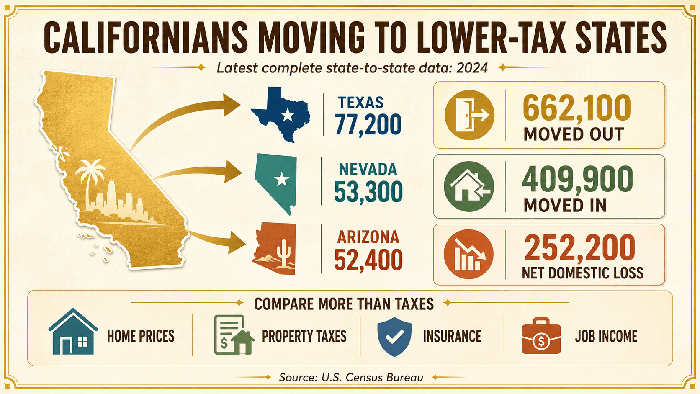
The 2024 American Community Survey estimates that approximately 662,100 California residents moved to another state. Around 409,900 people moved to California from elsewhere in the United States, resulting in a net domestic migration loss of approximately 252,200 people. Three states received more than one-quarter of the Californians who moved elsewhere:
- Approximately 77,200 moved to Texas.
- Approximately 53,300 moved to Nevada.
- Approximately 52,400 moved to Arizona.
Texas, Nevada, and Arizona accounted for approximately 27.6% of California’s total interstate outflow. These are gross outflow figures, meaning they count people moving from California without subtracting people moving in the opposite direction.
California Continued Losing Residents in 2025
The Census Bureau’s Vintage 2025 population estimates provide a more recent look at the overall trend. California lost nearly 230,000 residents due to domestic migration between July 2024 and July 2025. That was slightly lower than the state’s domestic migration loss during the previous year. The numbers indicate that California continued to lose residents to other states, but the pace was no longer accelerating to the levels seen during the pandemic. International migration also declined sharply in 2025. During the previous year, international arrivals and natural population growth from births exceeding deaths helped offset California’s domestic outmigration. By 2025, international migration had fallen enough that it could no longer fully offset the state’s domestic migration loss.
What 2026 Research Says About the Reasons People Leave
The latest research does not support the conclusion that taxes are the only reason behind Californians fleeing to low-taxed states. Housing affordability plays a major role, particularly for lower- and middle-income households. A March 2026 California Policy Lab study found that the average person leaving California moved to a neighborhood where monthly housing costs were approximately $672 lower. Renters moved to communities where rents were about $631, or 30%, lower. Homeowners relocated to neighborhoods where the median home value was approximately $396,000, which was 48% lower than in the communities they left. The study also found that homeownership was more common in the destination communities. Approximately 60% of households owned their homes in the new neighborhoods, compared with 53% in the California communities they left. However, the new locations also had lower average incomes. Monthly neighborhood income was approximately $339, or 8%, lower. This means borrowers should not assume that moving automatically improves their finances. Employment income, housing expenses, taxes, insurance, and mortgage payments must be evaluated together.
Higher-Income Outmigration Has Slowed
A January 2026 analysis from the Public Policy Institute of California found that 28% fewer higher-income adults left California in 2024 than in 2021. Although California continues to experience net losses among higher-income households, their departures remain relatively small compared with the state’s total higher-income population. Lower-income adults have experienced a much larger proportional net loss. Over the previous decade, California recorded a net loss of approximately 532,000 lower-income adults, representing more than 10% of the state’s current lower-income adult population. The latest information available in 2026, therefore, shows a continuing but slowing migration trend. Texas, Nevada, and Arizona remain leading destinations, while housing affordability, employment, family considerations, remote work, taxes, and lifestyle all influence where Californians move. Homebuyers should compare total monthly housing costs and obtain mortgage preapproval using their expected post-move income before choosing a destination.
Buying a Home Out of State? Get Pre-Approved First
Before you make offers in a new state, confirm your income, credit, DTI, down payment, and property budget. We’ll help you avoid relocation surprises.Where Are Californians Moving?
As shown by the latest migration data, Texas, Nevada, and Arizona are the three leading destinations for residents leaving California. Rather than repeat the migration totals, this section explains why these states attract Californians and what homebuyers should evaluate before choosing a destination. Proximity and state population help shape these migration patterns. Nearby states are easier to reach, while larger states offer more communities, employers, housing markets, and family connections. Research from the Public Policy Institute of California shows that Californians also move in meaningful numbers to Oregon, Washington, Florida, and Idaho.
Texas
Texas attracts Californians because of its large employment centers, broad selection of housing markets, and absence of a broad individual state income tax. Austin, Dallas–Fort Worth, Houston, and San Antonio each offer distinct home prices, industries, property tax obligations, and insurance risks. Home prices may be lower than in many California coastal communities, but buyers should not judge affordability from the purchase price alone. Texas property taxes, homeowners’ insurance, flood exposure, HOA fees, and utility expenses can significantly affect the monthly housing payment.
Nevada
Nevada is a popular choice because it borders California and does not impose a broad individual state income tax. Las Vegas and Reno are the primary employment and housing centers, while communities such as Henderson and Sparks provide additional suburban options. The short distance makes Nevada convenient for people who want to remain close to relatives, business relationships, or property in California. However, prospective buyers should compare local home prices, HOA assessments, summer utility costs, water restrictions, employment stability, and insurance before moving.
Arizona
Arizona appeals to Californians seeking more attainable home prices, warm weather, and access to growing employment areas. Phoenix, Scottsdale, Mesa, Chandler, Gilbert, and Tucson offer a wide range of home prices and community types. Arizona does impose an individual state income tax, which demonstrates that Californians fleeing to low-taxed states are not choosing destinations based on income taxes alone. Housing supply, proximity, employment, family connections, and lifestyle can be equally important. Buyers should also account for summer cooling expenses, water availability, property taxes, homeowners’ insurance, and possible HOA fees.
Florida
Florida remains attractive to some California residents because it has no broad individual state income tax, a warm climate, and a large selection of metropolitan areas. Popular markets include Miami–Fort Lauderdale, Tampa, Orlando, Jacksonville, and Southwest Florida. Florida’s home prices may look affordable compared with coastal California, but insurance, flood coverage, hurricane exposure, property taxes, condominium assessments, and HOA fees can increase the total monthly cost. Buyers considering a condominium should also review the project’s financial condition, reserves, insurance, and eligibility for mortgage financing.
Oregon, Washington, Idaho, and Tennessee
Some Californians choose Oregon or Washington because they want to stay on the West Coast and remain within a shorter flight or drive of family. Idaho has attracted households seeking smaller communities and different housing costs, while Tennessee offers growing employment centers such as Nashville, Knoxville, Chattanooga, and Memphis. These states have different combinations of income taxes, sales taxes, property taxes, insurance costs, wages, and housing prices. A state described as “tax-friendly” may not be the least expensive choice for every household.
The City and Property Matter as Much as the State
Statewide averages can hide major differences between individual communities. Housing costs in Austin can differ substantially from those in San Antonio, just as prices in Miami can differ from those in Jacksonville. Before deciding where to move, buyers should compare:
- Home prices in the specific county or metropolitan area
- Property taxes and special assessments
- Homeowners, flood, wind, and wildfire insurance
- HOA or condominium fees
- Employment opportunities and local wages
- Transportation and utility costs
- School, healthcare, and family needs
- The amount required for the down payment, closing costs, and reserves
Mortgage preapproval should be based on the borrower’s expected income after the move and the estimated expenses of the target property. Borrowers changing employers may need an acceptable offer letter or proof that employment will begin within the loan program’s required timeframe. Remote employees may need written confirmation that they can continue working from the new state. Californians who plan to keep their current home must also determine whether its mortgage payment will count toward their debt-to-income ratio and whether expected rental income can be used. Reviewing these details before making an offer can help prevent an out-of-state job or housing change from creating a mortgage-qualification problem. For additional guidance, see GCA’s out-of-state job relocation mortgage guidelines.
Taxes, Housing Costs, and Other Reasons Californians Leave
Californians leave the state for many reasons. Taxes influence some moves, particularly for high-income households and business owners, but research shows that housing affordability is one of the strongest pressures. Employment changes, remote work, family needs, retirement, insurance costs, traffic, and lifestyle preferences can also affect the decision.
High Home Prices Limit Homeownership
California remains one of the country’s most expensive housing markets. In the second quarter of 2026, a mid-priced California home was worth approximately $775,000—more than twice the value of a typical mid-priced home nationally. Even a lower-priced California home costs about 30% more than a mid-priced home elsewhere in the United States. High prices create several challenges:
- Buyers need larger down payments.
- Mortgage balances and monthly payments are higher.
- Property taxes are based on the value of more expensive homes.
- Renters may struggle to save enough to buy a home.
- Families may need to choose smaller homes or longer commutes.
- First-time buyers may remain renters longer than planned.
The Public Policy Institute of California reports that housing affordability has played an important role in outmigration, with lower-income households more likely to leave than higher-income households. For many Californians fleeing to low-taxed states, the opportunity to purchase a home is more important than the state income-tax difference alone.
California Income Taxes Influence Some Moves
California’s individual income-tax rates range from 1% to 12.3%. An additional 1% tax applies to the portion of taxable income exceeding $1 million, producing a maximum marginal rate of 13.3%. Moving to a state without a broad individual income tax may reduce state income taxes for certain households. The potential benefit depends on income, filing status, deductions, the source of the income, and whether the former resident continues receiving California-source income. However, a state with no individual income tax is not automatically less expensive. It may have higher property taxes, sales taxes, insurance premiums, HOA fees, utility charges, or transportation costs. Households should compare their complete financial picture and consult a qualified tax professional before relying on estimated tax savings.
Employment and Business Opportunities
Some residents leave after accepting a new job, receiving an employer transfer, or finding better career opportunities elsewhere. Others move when their employer relocates an office or allows permanent remote work. Remote employment can allow you to maintain a California-based salary while living in a lower-cost community. However, employees should confirm that their employer permits them to work from the destination state. Employers may face different payroll, tax, licensing, or benefits requirements when an employee changes states. Mortgage lenders may require written confirmation that remote employment will continue after the move. Borrowers starting a new job may need an executed offer letter, verified start date, and evidence that the income meets the selected loan program’s requirements.
Family and Lifestyle Considerations
Not every move is primarily financial. Californians may relocate to:
- Live closer to children, parents, or extended family
- Find a shorter commute or less traffic
- Retire in a different climate
- Obtain more living space or a larger yard
- Access different schools, healthcare, or community services
- Return to a state where they previously lived
- Pursue a different pace of life
Political preferences and attitudes toward government policies may influence some moves, but they should not be presented as the reason all Californians leave. Migration decisions are personal and often involve several factors at once.
Insurance and Natural-Hazard Concerns
Wildfires, earthquakes, floods, and other hazards can affect where people feel comfortable owning a home. Insurance cost and availability may influence a homeowner’s decision to remain in a community, sell a property, or move elsewhere. Relocating does not eliminate natural-hazard risk. Florida and parts of Texas may have hurricane and flood exposure, while Nevada and Arizona face extreme heat and water concerns. Buyers should obtain property-specific insurance quotes before making an offer rather than assuming coverage will be less expensive outside California.
Lower Costs Can Come With Tradeoffs
A lower-priced home does not guarantee a better financial outcome. Wages may be lower in the destination market, and homeowners may face costs they did not pay in California. These could include higher property tax rates, flood insurance, longer drives, private school tuition, substantial HOA dues, or increased utility expenses. Before moving, households should compare expected income with the complete monthly cost of the new home. That calculation should include principal, interest, property taxes, homeowners’ insurance, mortgage insurance, HOA fees, utilities, transportation, and maintenance. The best destination is not necessarily the state with the lowest advertised tax rate—it is the place where the household’s income, housing needs, and long-term financial plans work together.
What Makes a State Tax-Friendly?
“Tax-friendly” is not an official government classification. It generally describes a state where a particular household pays less in state and local taxes. The answer depends on the person’s income, property value, spending, retirement benefits, investments, and business ownership. A state may have no individual income tax but collect more through property, sales, fuel, lodging, or other taxes. Census data show that states rely on different combinations of income, property, and sales taxes to fund public services. In 2025, sales and gross receipts taxes represented the largest share of state tax revenue nationally.
Individual Income Taxes
Income taxes receive the most attention because they directly affect paychecks, business income, investment income, and retirement distributions. Some states have no broad individual income tax, while others use a flat rate or graduated tax brackets. The potential savings depend on:
- Taxable household income
- Filing status
- Wages and self-employment income
- Capital gains and investment income
- Pension and retirement-account distributions
- State deductions, exemptions, and credits
- Income that remains taxable in another state
For Californians fleeing to low-tax states, moving does not automatically end all California tax obligations. Income earned from California property, businesses, or other California sources may remain taxable after the person becomes a resident elsewhere. A qualified tax professional should review residency and income-sourcing questions.
Property Taxes
Property taxes can reduce or eliminate the benefit of moving to a state without an individual income tax. Buyers should compare the estimated annual property tax bill for the actual home, not only the statewide average tax rate. The calculation may depend on:
- The property’s assessed value
- County, city, and school-district rates
- Homestead exemptions
- Special taxing districts
- New-construction assessments
- Voter-approved bonds
- Senior, veteran, or disability exemptions
- How frequently assessed values can increase
Property taxes directly affect mortgage qualification because lenders generally include the monthly property-tax amount in the proposed housing payment. A lower home price does not always produce a lower total payment if the destination property carries a substantially higher tax bill.
Sales and Excise Taxes
Sales taxes affect how much households pay for goods and services. State rates tell only part of the story because counties, cities, and special districts may add local sales taxes. Excise taxes may apply to gasoline, tobacco, alcohol, utilities, vehicles, or other purchases. These costs may be especially important for families with long commutes or high household spending. Some states without a broad sales tax permit local sales taxes or rely more heavily on other revenue sources. Buyers should compare the combined state and local rate rather than looking only at the advertised state rate.
Taxes on Retirement Income
A tax-friendly state for a working household may not be the best choice for a retiree. States differ in how they treat:
- Social Security benefits
- Traditional pension income
- Military retirement pay
- IRA withdrawals
- 401(k) distributions
- Public-employee pensions
- Investment income
Some states exempt certain retirement income, while others offer age-based deductions or income limits. A retiree should evaluate the taxes that apply to the specific income sources expected during retirement.
Estate and Inheritance Taxes
Federal estate tax rules apply nationwide, but some states impose their own estate or inheritance taxes. These taxes can matter to households with substantial assets, family businesses, investment property, or detailed estate plans. An estate tax is generally charged against the estate before assets are distributed. An inheritance tax may be charged to the person receiving the property. Rules, exemptions, and family-member exclusions vary by state.
Business and Investment Taxes
Business owners may need to consider more than just individual income tax rates. A state may impose franchise taxes, gross-receipts taxes, entity-level fees, payroll taxes, or business licensing costs. Investors should also review how the destination state treats capital gains, dividends, interest, rental income, and pass-through business income. A state that appears attractive to a W-2 employee may produce a different result for a self-employed borrower or real estate investor.
Total Tax Burden Matters More Than One Rate
Tax rankings can be useful for research, but they do not calculate what a specific household will pay. Some rankings measure tax-system structure, while others measure total collections or estimate household tax burdens. These methods can produce different results. The 2026 State Tax Competitiveness Index, for example, evaluates how states structure their tax systems rather than promising that every resident will owe less. A complete comparison should include:
- State and local income taxes
- Property taxes
- Sales and excise taxes
- Retirement-income treatment
- Estate or inheritance taxes
- Business and investment taxes
- Available exemptions and credits
Homeowners should separately compare insurance, HOA dues, utilities, transportation, and maintenance. These expenses are not taxes, but they can make a supposedly tax-friendly destination more expensive overall. Mortgage lenders normally calculate debt-to-income ratios using gross qualifying income, so state income taxes are generally not listed as a separate monthly debt. Property taxes, however, are included in the housing payment. Borrowers should therefore consider both mortgage qualification and their actual after-tax household budget before deciding where to move. Because state tax laws can change, consumers should verify current rules through the appropriate state revenue department. The Federation of Tax Administrators provides links to official state tax agencies and filing resources.
Comparing Housing Costs in Popular Destination States
Housing costs are a major reason behind Californians fleeing to low-taxed states. As of July 31, 2026, Zillow reported a typical California home value of approximately $773,735. Popular destination states were considerably less expensive:
- Texas: $301,806
- Florida: $378,167
- Arizona: $421,381
- Nevada: $447,473
- California: $773,735
These statewide figures are useful for general comparisons, but prices can vary widely by city and county. A home in Austin, Miami, Scottsdale, or Reno may cost considerably more than the statewide figure, while smaller communities may be more affordable. Buyers should also compare property taxes, homeowners’ insurance, HOA fees, utilities, maintenance, and transportation expenses. The least expensive home price does not always produce the lowest monthly housing payment. Mortgage preapproval should use the estimated taxes, insurance, and association fees for the specific property and location being considered.
Mortgage Requirements When Moving Out of California
Moving to another state does not prevent a borrower from qualifying for a mortgage, but the lender must verify that the borrower’s income will continue after the move. The lender will also review the new housing payment, existing California property, employment arrangement, assets, credit, debts, occupancy, and property type. For Californians fleeing to low-tax states, obtaining preapproval before choosing a home can reveal whether a job change, a remote-work arrangement, or an unsold California property will affect the maximum loan amount.
Verify Income After the Move
Income earned in California cannot automatically be used to qualify for a home in another state. The lender must determine whether the employment and income will continue after relocation. Documentation may include:
- Recent pay stubs and W-2s
- Verification of employment
- An employer transfer letter
- Written approval for permanent remote work
- A fully executed offer letter for a new job
- A confirmed start date and rate of pay
- Additional documentation for overtime, bonuses, commissions, or other variable income
Remote employees should obtain a letter confirming that their position can be performed from the destination state. The employer may also need to verify that the borrower’s job title, compensation, and employment status will not change.
Qualifying With a New Job or Offer Letter
Certain mortgage programs allow borrowers to qualify based on an employment offer or contract before receiving their first paycheck. The rules vary by loan program and lender. For example, Fannie Mae permits this option under specific conditions for the purchase of a one-unit principal residence using fixed-income. The employment start date generally cannot be more than 90 days after the note date, and the lender must obtain a fully executed offer or contract that identifies the employer, position, pay, and start date. Additional reserve and documentation requirements may apply. A borrower should not assume that an informal email, verbal promise, or conditional offer will be acceptable.
Keeping or Selling the California Home
Borrowers who still own a California home may need to qualify with both housing payments. The lender will review whether the property is:
- Listed for sale
- Under an executed sales contract
- Scheduled to close before the new purchase
- Being converted into a rental
- Remaining as a second home
- Owned free and clear
Under Fannie Mae guidelines, both the current home’s PITIA and the proposed PITIA generally must be included if the sale will not close before the new mortgage. The existing payment may be excluded when the lender documents an executed sales contract and confirms that the buyer’s financing contingencies have been cleared. If the California property is going to be rented, the lender may ask for a signed lease, proof of the security deposit and first month’s rent, a market rent analysis, and evidence of the borrower’s property management experience or rental income history. Not all projected rent can necessarily be used to offset the mortgage payment.
Calculate the Complete New Housing Payment
Mortgage qualification is based on more than principal and interest. The proposed monthly housing expense may include:
- Principal and interest
- Property taxes
- Homeowners insurance
- Flood insurance
- Mortgage insurance
- HOA or condominium dues
- Special assessments
- Ground rent, when applicable
These expenses can differ substantially from California costs. The lender should use realistic estimates for the specific property and destination county. Fannie Mae refers to the combined payment as PITIA. The complete payment is combined with car loans, credit cards, student loans, personal loans, child support, and other qualifying obligations to calculate the debt-to-income ratio.
Document the Down Payment and Closing Funds
Borrowers may use eligible funds from savings, investments, gifts, or proceeds from selling their California home. The lender must document the source and transfer of the money. If sale proceeds are needed for the new purchase, the California closing may need to occur first. The lender may request the final closing disclosure and proof that the proceeds were deposited into the borrower’s account. Large deposits, recently transferred funds, and money moved between accounts may require additional documentation. Borrowers should avoid depositing unexplained cash.
Meet Occupancy Requirements
A home financed as a principal residence must become the borrower’s genuine primary home. Occupancy requirements vary by program, but borrowers are generally expected to move into the property shortly after closing. For FHA financing, at least one borrower must occupy the property as a principal residence within 60 days. A borrower should not apply for primary-residence financing if they plan to use the home primarily as a vacation home or rental property. Misrepresenting occupancy can constitute mortgage fraud.
Prepare for State and Property Differences
Loan limits, property taxes, insurance requirements, down-payment assistance, and closing practices can vary by location. Condominiums, manufactured homes, rural properties, and homes in flood or disaster-risk areas may require additional review. The lender or loan officer must also be authorized to originate loans in the state where the property is located. Before making an offer, relocating borrowers should provide the lender with their employment plan, destination, estimated purchase price, current California housing payment, and whether the existing home will be sold or retained. A complete preapproval can identify problems early and establish a realistic housing budget before the move.
Qualifying With a New Job or Remote Employment
Borrowers moving out of California must show that their income will continue in the destination state. The documentation depends on whether they are transferring with the same employer, starting a new job, or continuing in a remote position.
Starting a New Job
A lender may accept income from a new job when the borrower provides a fully executed offer letter or employment contract. It should identify the employer, position, pay structure, start date, and any conditions that must be satisfied. Certain conventional loans allow qualification before the borrower receives a first paycheck. For example, Fannie Mae permits qualifying with future fixed-base income under specific conditions for the purchase of a one-unit principal residence. The start date generally cannot be more than 90 days after the note date, and additional reserves may be required. Salary or guaranteed hourly income is usually easier to document than commissions, overtime, bonuses, or other variable earnings that may require an established history.
Continuing Remote Employment
Remote employees should obtain written confirmation that:
- The employer permits permanent work from the new state.
- The borrower’s position and employment status will continue.
- Compensation will not decrease after relocation.
- The borrower is not required to report regularly to a California office.
This is especially important for Californians fleeing to low-taxed states while keeping their current employer. A general company remote-work policy may not be enough if the employer has not approved the borrower’s specific location. Employment is commonly reverified close to closing. Fannie Mae generally requires verification of employment income within 10 business days before the note date. Borrowers should tell their lender before changing jobs, compensation, hours, or work location. An undisclosed employment change can require the loan to be re-underwritten and may delay or prevent closing.
Buying Before Selling Your California Home
You can buy a new home before selling your California property, but qualifying may be harder. The lender may count the full monthly payments for both homes—including principal, interest, taxes, insurance, and association dues—when calculating your debt-to-income ratio.
Under Fannie Mae guidelines, the California home’s payment may be excluded if you have an executed sales contract and the buyer’s financing contingencies have been cleared. Otherwise, you may need enough income and cash reserves to carry both homes.
Possible funding sources include savings, a bridge loan, or a home equity line of credit. Because borrowed funds can add debt and change your qualification, speak with a loan officer before making an offer or borrowing against your current home.
California Relocation Mortgage Example
The following example is hypothetical and does not guarantee mortgage approval. A borrower is moving from California to Nevada while keeping the same remote W-2 position. The employer confirms in writing that the borrower may work permanently from Nevada without a change in pay.
- Nevada purchase price: $450,000
- Down payment: $45,000 or 10%
- Conventional loan amount: $405,000
- Gross monthly income: $10,500
- Estimated new housing payment: $3,100
- Auto and credit-card payments: $650
- California home payment: $3,000
The California home is under contract, and the buyer’s financing contingencies have been cleared. If the lender documents these conditions and excludes the existing home payment under applicable guidelines, the borrower’s debt-to-income ratio would be approximately 35.7%: $3,100 + $650 ÷ $10,500 = 35.7% DTI If the California payment were included, the DTI would rise to approximately 64.3%. This example shows why Californians Fleeing To Low-Taxed States should discuss employment, available assets, and the sale of their current home with a loan officer before making an offer. Final approval depends on the completeness of the loan file and the applicable underwriting requirements.
Steps to Take Before Moving and Applying for a Mortgage
Californians fleeing to low-taxed states should prepare before making an offer:
- Get preapproved with a lender licensed in the destination state.
- Confirm that your new or remote employment can be used to qualify.
- Decide whether to sell, rent, or keep your California home.
- Avoid opening new credit accounts or increasing card balances.
- Keep funds for the down payment, closing costs, moving expenses, and reserves.
- Compare property taxes, homeowners’ insurance, HOA dues, and total monthly payments.
- Gather recent pay stubs, bank statements, tax returns, and employment documents.
Tell your loan officer about any job, income, debt, or asset changes before closing. Early planning can reduce delays and unexpected underwriting problems.
Final Thoughts on Californians Fleeing To Low-Taxed States
The trend of Californians fleeing to low-taxed states is driven by more than income taxes. Housing affordability, employment, family, insurance costs, and lifestyle preferences also influence where people move.
A state with no personal income tax is not automatically the least expensive place to live. Buyers should compare home prices, property taxes, homeowners’ insurance, HOA dues, wages, utilities, and other household expenses before choosing a destination.
Mortgage planning should begin before the move. Your lender needs to understand your employment arrangement, available funds, debts, and plans for your California home. A complete preapproval can help identify potential problems before you make an offer. Gustan Cho Associates can review your relocation plans and explain the mortgage programs that may fit your financial profile. Final approval remains subject to the applicable loan guidelines and full underwriting.
Frequently Asked Questions About Californians Moving Out of State
Does California Charge an Exit Tax When You Move?
California does not impose a general tax simply because someone moves to another state. However, California may continue taxing a person as a resident until the move is considered permanent. Former residents may also owe tax on California-source income, such as rent from California property or income from work performed in the state. Review the California FTB residency guidelines or consult a tax professional.
Is There a 183-Day Rule for Leaving California?
No single 183-day rule automatically establishes California residency or nonresidency. The Franchise Tax Board considers the purpose and length of an absence and where a person has their closest personal and financial connections. Spending more than nine months in California creates a presumption of residency, but spending fewer days in the state does not automatically make someone a nonresident. See FTB Publication 1031 for details.
How Do You Prove That You are no Longer a California Resident?
No single document proves that someone has ended California residency. Relevant evidence may include establishing a permanent home, obtaining a driver’s license, registering vehicles, registering to vote, moving family members, changing mailing addresses, and conducting daily financial and personal activities in the new state. The FTB reviews the complete facts, so movers should keep records showing when and why the relocation became permanent.
Do You Need to File a California Tax Return for the Year You Move?
You may need to file California Form 540NR if you are a part-year resident. California generally taxes worldwide income received while you were a resident and California-source income received after you became a nonresident. Filing requirements depend on income, filing status, and other circumstances.
Can California Tax the Sale of Your Home After You Move?
A gain from selling California real estate remains California-source income even after the owner moves away. However, qualifying homeowners may exclude up to $250,000 of gain, or up to $500,000 for eligible married couples filing jointly. Ownership, occupancy, and prior-use requirements apply. California real estate withholding may also be required unless an exemption applies.
Can You Transfer Your Proposition 13 Tax Basis to Another State?
No. An eligible homeowner may transfer a California base-year value to a qualifying replacement residence located within California under Proposition 19. The benefit does not transfer to a home in Nevada, Texas, Arizona, or another state. Property taxes on the new home will be calculated under the destination state’s laws.
Does Moving to Another State Affect Your Credit Score?
Changing your address does not directly raise or lower your credit score. Your payment history, account balances, credit utilization, new applications, and other credit-report information remain important. Update your address with creditors so bills and notices reach you, and avoid missing payments during the move. Experian confirms that address and employer information do not affect credit scores.
Can You Close on an Out-of-State Home Without Traveling There?
A remote or mail-away closing may be available, depending on the destination state, lender, title company, and notarization requirements. Some documents may be signed electronically, while others may require a notary or original signatures. Ask the settlement company about remote-closing options early so travel or document-delivery requirements do not delay the purchase.
This article about “Californians Fleeing To Low-Taxed States: Mortgage and Homebuying Guide” was updated on August 18th, 2026.