The mortgage industry has gone through dramatic shifts over the past few years. From rising interest rates to new loan limits and updated underwriting standards, mortgage guidelines on home loans continue to evolve.
At Gustan Cho Associates, we know how confusing these changes can be for borrowers. That’s why this 2026 guide breaks down the most important updates to help you understand what it takes to qualify for a home loan — even in a tough housing market.
Whether you’re buying your first home, refinancing, or recovering from a credit setback, this guide will help you navigate the latest mortgage guidelines on home loans with confidence.
Key Takeaways
- Mortgage rules have changed, but many buyers can still qualify.
- Higher loan limits may let you buy a larger home without a jumbo loan.
- FHA and VA loans still offer flexible options for many borrowers.
- Lenders look closely at credit, income, debt, and paperwork.
- Self-employed borrowers and buyers with credit issues may still have options.
- Choosing the right loan program early can make the process much easier.
Mortgage Guidelines on Home Loans: The 2026 Overview

The term “mortgage guidelines on home loans” refers to the rules set by government agencies and investors (like FHA, VA, USDA, and Fannie Mae/Freddie Mac) that determine who qualifies for a mortgage and under what terms.
These guidelines cover factors like:
- Minimum credit scores
- Down payment requirements
- Debt-to-income (DTI) ratios
- Employment and income verification
- Waiting periods after bankruptcy or foreclosure
- Loan-to-value (LTV) limits
- Property and appraisal standards
Each year, we review and update these requirements based on changes in the economy, housing market, and what borrowers need.
What Changed in 2026 Mortgage Guidelines?
Several important mortgage limits were updated for 2026. In many areas, the conforming loan limit for a one-unit home jumped up to $832,750 for 2026. FHA also raised its 2026 low-cost area limit for a one-unit home to $541,287, while the high-cost area FHA limit increased to $1,249,125. These updates matter because they can let buyers borrow more before needing a jumbo loan or moving outside standard agency loan rules.
VA loans still do not have a standard loan limit for eligible veterans with full entitlement. In practical terms, that means a qualified borrower is not capped by a preset national maximum in the same way as conforming borrowers are, or FHA borrowers are, although the borrower still must qualify based on income, credit, and the property value.
One rule that still catches many homeowners by surprise is the FHA cash-out refinance limit. FHA reduced the maximum cash-out refinance loan-to-value ratio from 85% to 80%, and that tighter cap remains an important part of the program today.
Who Do These 2026 Changes Affect
These updates matter most for three groups of borrowers. First, they help homebuyers in higher-priced markets who may now qualify for a larger standard loan amount before crossing into jumbo territory. Second, they affect FHA borrowers who need more buying power because local home prices have risen. Third, they affect homeowners’ thinking about an FHA cash-out refinance, since the lower 80% cap limits how much equity they can pull from the property.
VA borrowers should pay attention to, but for a different reason. The key issue is usually not a national loan cap. It is whether the payment fits the borrower’s income, credit profile, residual income, and lender requirements.
Ready to Apply for a Mortgage? Let Us Guide You Through the Home Loan Guidelines!
Reach out now to get expert advice on meeting the necessary criteria for your home loan.
What Borrowers Should Do Next
Borrowers should start by checking which loan category fits their situation before worrying about the maximum loan amount. If you are shopping for a home, find out whether your target price falls within current FHA or conforming loan limits in your county. If you are a veteran using full entitlement, focus more on payment affordability and qualification than on a national cap. If you want to tap home equity with an FHA cash-out refinance, plan around the 80% maximum loan-to-value rule before estimating how much cash you can receive.
Why Lenders May Ask for More Documentation in 2026
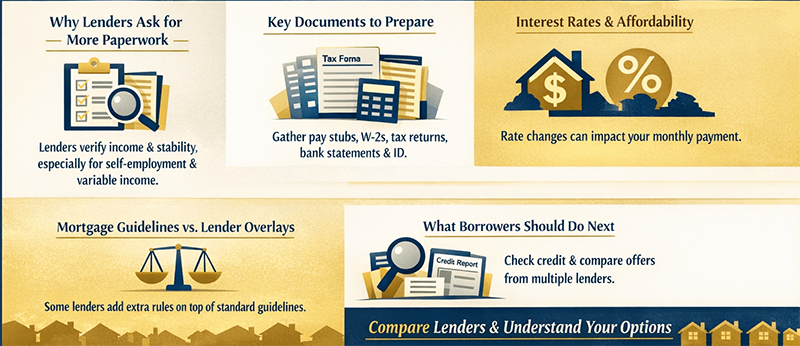
Today, lenders are paying close attention to a borrower’s income stability. They want to make sure this income is well-documented and likely to keep coming in. This is why underwriters may ask for more paperwork than borrowers might expect, especially if the income is not fixed, such as for self-employed people, those who earn commission, or those with income from multiple jobs.
According to Fannie Mae’s current mortgage guidelines on home loans, lenders still need to check a borrower’s employment income and decide if it is likely to continue.
For borrowers, the main point is clear: needing more documents doesn’t always mean there’s a problem. It often means the lender wants to make sure they have all the right information before giving final approval.
Documents Borrowers Should Prepare Early
Borrowers can make the mortgage process much easier by gathering their key documents before applying. In most cases, lenders will review items such as recent pay stubs, W-2s and tax returns (when needed), bank statements, identification, and information about current debts. Self-employed borrowers often need additional income documentation because agency rules generally require a longer history and closer review of the stability of that income.
At the early Loan Estimate stage, federal rules require only six basic pieces of information: the borrower’s name, income, Social Security number, property address, estimated property value, and desired loan amount. Borrowers do not have to submit full income documents to receive a Loan Estimate. However, sharing documents early can help make the estimate more accurate.
How Recent Rate Changes Affect Affordability
Mortgage rates still have a major effect on affordability because even a modest rate change can raise or lower the monthly payment. Freddie Mac reported that the average 30-year fixed mortgage rate was 6.11% on March 12, 2026, compared with 6.65% a year earlier. That means affordability may look different from one week or month to the next, even if home prices stay the same.
For borrowers, the practical lesson is to focus on the monthly payment, not just the maximum loan amount. A home that technically fits the loan guidelines may still stretch the budget once principal, interest, taxes, insurance, and other housing costs are included.
What Borrowers Should Do Next
Borrowers should check their credit, estimate their monthly housing budget, and gather income and asset documents before they start shopping seriously. They should also request Loan Estimates from multiple lenders to compare terms and closing costs side by side. The CFPB specifically advises consumers to request Loan Estimates from three or more lenders when applying for a mortgage.
Mortgage Guidelines vs. Lender Overlays
Mortgage guidelines on home loans are the base rules set by the agency or loan program. For example, FHA, VA, USDA, and conventional loans each have their own standards for credit, down payment, debt-to-income ratio, income documentation, and property eligibility.
Lender overlays are extra rules added by an individual lender on top of the base guidelines. In other words, the official loan program may allow a borrower to qualify. However, a specific lender may still say no because that lender has stricter internal standards.
Common lender overlays may include a higher minimum credit score, a lower maximum debt-to-income ratio, larger reserve requirements, more conservative rules for self-employed income, or tighter limits on certain property types. These extra rules can vary from one lender to another, even when the borrower is applying for the same type of mortgage.
This matters because two lenders can look at the same borrower and reach different decisions. One lender may approve the loan under standard program rules, while another may decline it due to additional internal restrictions.
For borrowers, the key takeaway is simple: do not assume one denial means you do not qualify everywhere. It may mean that a lender’s internal overlay was the issue, not the underlying mortgage program itself.
What Borrowers Should Do
If you are turned down, ask whether the reason is due to the mortgage guidelines on home loans or the lender’s own overlay. That question can save time and help you decide whether it makes sense to apply elsewhere, improve your file, or consider a different loan program.
Take First Step Toward Making Your Dream A Reality
Apply Now And Get recommendations From Loan Experts
Get Pre-Approved Before You Shop
Before looking at homes, it helps to get pre-approved so you know your price range, monthly payment, and likely loan options. In some cases, lenders may offer a more detailed review upfront, reducing surprises later in the process.
Example: When a Bank Statement Loan May Help
Some borrowers are denied traditional financing despite strong cash flow, particularly self-employed individuals whose tax returns reflect lower net income from business write-offs. Adhering to strict mortgage guidelines on home loans, lenders may overlook these applicants.
In situations like this, a bank statement loan could provide an alternative solution. Rather than relying solely on tax returns, some non-QM lenders assess personal or business bank statements to evaluate income. This approach can help certain self-employed borrowers qualify for a loan when conventional income calculation methods do not accurately reflect their full financial situation.
The key takeaway is that a loan denial does not necessarily mean that homeownership is unattainable. It may indicate that the borrower requires a different loan program that aligns with how income is documented under current mortgage guidelines on home loans.
How to Prepare for a Mortgage in 2026
Rather than stressing over where the market might head next, borrowers are often better off concentrating on what they can actually manage in the mortgage process. That means checking credit early, keeping monthly debt manageable, saving for down payment and closing costs, and gathering income and asset documents before applying.
Because lenders review income and documentation closely, borrowers should be ready to provide recent pay stubs, W-2s, bank statements, and other records that help verify stable income. For self-employed borrowers, the review is often more detailed because lenders typically look for a longer history of earnings and documentation showing the income is likely to continue.
Borrowers should also pay close attention to affordability, not just qualification. Mortgage rates still have a big impact on the monthly payment. Freddie Mac reported that the typical interest rate for a 30-year fixed mortgage reached 6.11% on March 12, 2026.This just goes to show how even little changes in rate can really change what a mortgage feels like from month to month.
One of the smartest steps is to compare lenders before making a final decision. The CFPB advises borrowers to request and review multiple Loan Estimates so they can compare costs, terms, and lender fit side by side.
What to Do Next
If you are planning to buy a home or refinance, start by reviewing your credit, income, debts, and down payment options. Then compare loan programs and ask lenders whether their requirements are set by the mortgage program or by lender overlays. Taking those steps early can help you avoid surprises and choose the loan option that best fits your situation.
If you need help understanding the mortgage guidelines on home loans and which program fits your situation, speak with a lender who can explain both program rules and lender overlays clearly.
Conclusion
Mortgage guidelines can seem confusing at first, but the basic idea is simple: lenders look at your credit, income, debt, down payment, and the type of loan you choose. Loan limits, documentation rules, and lender overlays can all affect approval, which is why it helps to understand the process before you apply.
The most important steps are to match your financial situation with the right mortgage program and to prepare your documents early. When you understand the rules ahead of time, you can compare options more confidently and move forward with fewer surprises.
If you need help understanding which loan program may fit your situation, speak with a lender who can clearly explain your options.
Frequently Asked Questions About Mortgage Guidelines on Home Loans:
What are the Mortgage Guidelines on Home Loans?
- Mortgage guidelines on home loans are the basic rules used to decide whether you qualify for financing. They usually cover your credit score, income, debt-to-income ratio, down payment, property type, and documentation. The exact rules depend on whether you apply for an FHA, VA, USDA, or conventional loan.
What Credit Score do I Need Under Current Mortgage Guidelines on Home Loans?
- It depends on the loan type. FHA allows 3.5% down with a 580 credit score, and borrowers with scores from 500 to 579 may still qualify with 10% down. Conforming conventional loans generally require a minimum score of 620. At the same time, VA does not set a hard minimum score at the federal level, though lenders may apply their own standards.
How Much Down Payment Do I Need for a Home Loan?
Many buyers do not need 20% down. FHA allows 3.5% down for qualified borrowers, conventional first-time buyer programs may allow as little as 3% to 5% down, and eligible VA borrowers can still buy with 0% down. Putting 20% down can help avoid private mortgage insurance on a conventional loan, but it is not required in many cases.
What Documents Do Lenders Usually Ask for During Mortgage Approval?
- Lenders commonly review pay stubs, W-2s, tax returns when needed, bank statements, identification, and details about your debts and assets. Self-employed borrowers usually need more documentation because lenders must verify that income is stable and likely to continue. At the Loan Estimate stage, federal rules require a lender to have only six key pieces of information to issue an estimate.
What is the Debt-to-Income Ratio for Mortgage Approval?
Your debt-to-income ratio, or DTI, is just a fancy way of looking at how much you pay in monthly debts compared to what you make each month before taxes. The exact limit depends on the loan program and the overall file strength. In practice, FHA often allows more flexibility than conventional financing, while conventional loans usually require a stronger balance of credit, income, and assets.
Can I Still Qualify for a Mortgage if I am Self-Employed or was Denied Before?
- Yes, sometimes. A denial from one lender does not always mean you cannot qualify elsewhere. Some borrowers run into lender overlays or stricter income-documentation requirements, especially if they are self-employed. In those cases, another lender or a different loan type may be a better fit, depending on how income is calculated and documented.
This article about “Mortgage Guidelines on Home Loans Explained Simply” was updated on March 13th, 2026.
Take First Step Toward Making Your Dream A Reality
Apply Now And Get recommendations From Loan Experts