Manufactured Home Financing Requirements for FHA, VA, USDA, and Conventional Loans
This guide covers manufactured home financing requirements. Many home buyers of manufactured home financing have a difficult time getting it. The Department of Veteran Affairs (VA) and the U.S. Department of Housing and Urban Development (HUD) have the same mortgage guidelines on manufactured home financing. The reason is that lenders view manufactured homes as high-risk properties. Dale Elenteny, a senior loan officer at Gustan Cho Associates and a contributor editor at GCA Forums says:
Most, if not all, lenders will have overlays on manufactured home financing. Mortgage lender overlays are additional lending guidelines on top of minimum federal mortgage lending guidelines.
For instance, to be eligible for a Federal Housing Administration (FHA) loan with a 3.5% down payment, a prospective home buyer merely needs a credit score of 580. Nevertheless, while some lenders might approve the home buyer for a loan on a manufactured home, they might stipulate higher credit score requirements. As an immediate example, I can recall at least twelve lenders who mandate that applicants for manufactured home financing loans possess a credit score of 680 or above.
FHA, VA, USDA, and Conventional Loans for Manufactured Homes
Buying a manufactured home can open doors for first-time buyers seeking affordability, but the journey is often more intricate than purchasing a traditional house. The hurdles you face depend on your loan program, the home’s age and condition, whether the home and land are permanently joined, title status, and strict foundation and appraisal rules. Ultimately, the biggest question is whether the property itself qualifies for the loan—not just your finances.
What Are Manufactured Home Financing Requirements?
Not every manufactured home fits the mold for FHA, VA, USDA, or conventional loans. Some are treated as real estate, while others are seen as personal property. Many lenders only consider double-wide homes, and most have strict rules about the home’s age, condition, or how you plan to use it. Before you start your search, it pays to understand the world of manufactured home financing.
What Makes a Manufactured Home Eligible for Financing?
Most mortgage programs look for HUD-code construction, a permanent foundation, and real property status. Lenders set the bar high for both you and the property when it comes to manufactured home loans. You’ll need to meet credit, income, debt-to-income ratio, down payment, and cash reserve requirements. Meanwhile, the home itself must hit minimum size marks, display HUD certification labels, rest on a permanent foundation, pass occupancy and appraisal checks, and be officially titled as real property.
How To Improve Your Chances of Getting Approved for a Manufactured Home Loan
Getting approved for a manufactured home loan is a two-part test: your finances and the property itself must both make the grade. Even if you have stellar income and credit, your loan can still be denied if the home is missing a permanent foundation, HUD labels, or the right title. Each loan program adds its own twists, which is why many buyers find the process confusing. A manufactured home, as defined by federal regulation (specifically, the HUD Code), is a home constructed on or after June 15, 1976.
Prior to that date, a home may be referred to as a mobile home, and mobile homes may not be eligible for standard FHA forward financing.
Unlike manufactured homes, modular homes are not defined as manufactured homes because they comply with state and local building codes (instead of the HUD Code) and are financed in a manner similar to site-built homes. Your financing options hinge on the type of home you choose. For instance, what many call “mobile home loans” are usually loans for manufactured homes.
Manufactured Home Financing Requirements By Lenders

FHA loan programs allow manufactured home financing. The manufactured home financing requirements must be built on a solid concrete foundation. The minimum down payment is 3.5% for a home purchase.
The loan to value is 97.75% of a refinance mortgage on a manufactured home. Cash-out refinance mortgage loans on a manufactured home require a loan-to-value of 80% LTV. VA loans require no down payment. Fannie Mae and Freddie Mac require a 3% to 5% down payment on conventional loans on manufactured homes.
What Are the Requirements to Finance a Manufactured Home?
Most manufactured home loan programs have similar initial criteria. The home must be built to the HUD Code, have a HUD certification label, meet size and principal residence standards, and be installed on a permanent foundation for standard real estate financing. Fannie Mae requires eligible manufactured homes to be at least 400 square feet, 12 feet wide, built on a permanent chassis, installed on a permanent foundation, and titled as real estate. Title II forward mortgages must meet criteria such as having at least 400 square feet and being constructed after June 15, 1976. The home must also have a HUD certification label, be classified as real estate, and comply with permanent foundation requirements.
Requirements for the HUD Label and HUD Code Compliance
Lenders and appraisers first look for HUD labels to confirm the home meets federal construction and safety standards. Missing labels or incomplete documentation can significantly impact financing, especially for FHA and other agency loans.
Permanent Foundations on Manufactured Homes
Foundation requirements are among the most complex aspects of manufactured home financing. FHA requires permanent foundations to meet HUD standards, and most cases require professional certification. The policy references the HUD foundation compliance guidance on the manufactured home foundation system, stating that the foundation must meet applicable FHA guidelines and be certified by a licensed professional engineer or registered architect.
Permanent Foundation Requirements for Manufactured Homes
Permanent foundation installation is also required for standard mortgage eligibility under USDA and other conventional manufactured housing programs. Anchored to a permanent foundation describes the type of unit to be used as a manufactured home per the USDA training and handbook materials for guaranteed loans, and real-property treatment is also required for the core manufactured housing executions of Freddie Mac and Fannie Mae.
Real Property vs. Personal Property in Manufactured Home Financing
When a manufactured home is titled as personal property, financing is typically provided as a chattel loan rather than a conventional mortgage. Most of the time, the FHA Title II, Fannie Mae, Freddie Mac, and many USDA deals are primarily aimed at homes treated as real property, with the home being and forever to be part of the real estate.
Most other government-backed home loans are primarily aimed at non-manufactured homes. Earlier referenced programs end with a home that does not qualify as a manufactured home.
This explains why the FHA Title I program is considered one of the few that provides financing for manufactured homes, which also allows the home to be treated as personal property. Title I programs are not the same as standard FHA Title II onward products and are not as frequently used in the day-to-day mortgage lending activities. For most borrowers, obtaining a standard mortgage is easiest when the manufactured home has been de-titled or converted under state law and is permanently affixed to land owned by the borrower.
Requirements For Financing Manufactured Homes With An FHA Loan
FHA loans often attract buyers with their lower down payments and flexible credit standards. But the property rules are strict: the home must be built after June 15, 1976, offer at least 400 square feet of living space, display a HUD certification label, be classified as real estate, and sit on a permanent foundation that meets HUD standards.
FHA Manufactured Home Financing Requirements
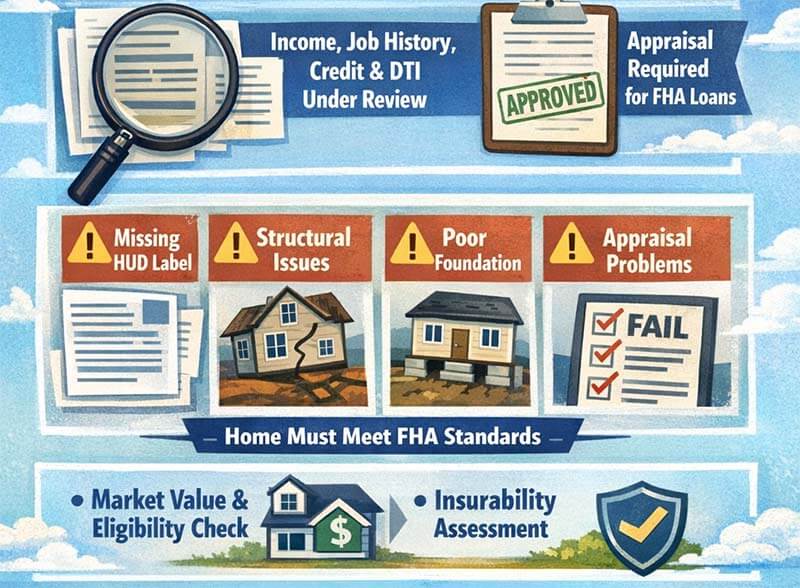
- FHA borrowers should gear up for underwriting, where your income, job history, credit, and debt-to-income ratio all come under the microscope.
- Lenders might tack on extra requirements, too.
- Even if you qualify on paper, your loan can still fall through if the home fails program or appraisal checks, is missing labels, has structural issues, or lacks a proper foundation.
- A manufactured home appraisal is more than an estimation of its current market value.
- An FHA-approved manufactured home appraisal is essential to the loan process.
- It determines if the property meets eligibility criteria, establishes market value, and assesses insurability.
- Appraisals can be challenging when comparable manufactured homes are scarce, as their availability fluctuates more than that of site-built homes.
VA Manufactured Home Financing Requirements
- A manufactured home and/or lot must still comply with VA eligibility, occupancy, credit, income, and lender guidelines.
- The VA’s official eligibility page states that eligible loan purposes include purchasing a manufactured home and/or a lot.
- One of the benefits of VA financing is that lender underwriting and property acceptability evaluations may still result in a transaction with no down payment.
- Also, the VA charges a funding fee in many cases unless the borrower is exempt.
- VA funding fee pages note current purchase funding fee rates and, in a separate note, highlight a 1% funding fee for manufactured home loans that are not permanently affixed.
- That shows how structure and financing interrelate concerning permanent attachment.
- While many buyers are eager for VA loans on manufactured homes, finding a lender who actually offers them can be a challenge.
- You may need to reach out to several lenders before finding one that follows VA guidelines for manufactured housing.
What Are The Requirements For Financing Manufactured Homes With The USDA?
If a borrower qualifies and is purchasing in a USDA-eligible rural area, USDA financing can be a smart choice. The USDA allows guaranteed loan funds for new or existing homes meant as your permanent residence—including manufactured homes. Manufactured housing materials state that the home must be constructed in accordance with federal manufactured housing standards and must be permanently affixed to the ground.
USDA eligibility goes beyond just the home itself. The property must be in a USDA-approved area, your household income must fit the guidelines, and the home must be your primary residence.
This home must also comply with dwelling and site requirements. Additionally, for certain new-unit executions, there are restrictions on the manufacturing and purchase dates. USDA training materials state that the unit must have a minimum floor area of 400 square feet and be located on a permanent foundation. USDA rules are often more detailed than you might expect, so check both property and location eligibility early.
Fannie Mae And Freddie Mac Manufactured Home Financing Requirements
Requirements also vary for special programs like MH Advantage or CHOICEHome. Fannie Mae and Freddie Mac each have their own rules for manufactured housing, including differences for single-width, multi-width, leaseholds, and cash-out refinances. Fannie Mae states that a manufactured home is eligible for the standard program.
Fannie Mae requires a manufactured home to be at least 400 square feet, 12 feet wide, built to HUD Code, permanently affixed to a foundation, and titled as real estate.
Underwriting is completed through Desktop Underwriter (DU).a multi-wide manufactured home is permitted, whereas a cash-out refinance on a single-wide manufactured home is ineligible for sale to Freddie Mac. Additionally, Freddie states that mortgages secured by manufactured homes on leasehold estates require prior written consent and that single-wide homes are not eligible for such a leasehold.
CHOICEHome and MH Advantage
These programs are for manufactured homes that meet higher standards and are designed to resemble site-built homes. Fannie Mae will align CHOICEHome and MH Advantage requirements in 2026. CHOICEHome is described by First American as manufactured housing constructed to HUD Code standards and as possessing some site-built-type features and financing options comparable to those of site-built homes when it meets specific program criteria. These programs open the door to better conventional loan options for qualifying homes. However, your home must meet strict design, documentation, and certification standards to be eligible.
Foundation, Title, and Land Requirements for Manufactured Homes
When financing a manufactured home, keep your eyes on the foundation, title, and land requirements—they are key to loan approval. If the home lacks a permanent foundation, the title is not properly converted, or you do not own the land when required, your financing options shrink fast. Most Fannie Mae, Freddie Mac, and FHA loans require real property status and a permanent foundation.
Is it Possible To Finance The Home And The Land Together?
In many situations, it is possible to finance the manufactured home and the land together, which is often the simplest arrangement for conventional mortgage financing. The VA clearly lists the purchase of a manufactured home and/or lot as an eligible purpose. Also, under the program guidelines, the USDA provides guaranteed financing for a site that contains a new or existing dwelling that meets the program criteria. If you are looking to buy just the home without the land, be prepared for far fewer financing choices.
Lenders will scrutinize your credit, debt-to-income ratio, job stability, income consistency, and available funds for your down payment and closing costs.
Property reviews for manufactured homes are often tougher than for site-built homes because of the added collateral risk. Freddie Mac points out that manufactured housing poses additional risk, so lenders look even more closely at both the property and your finances.
Credit Score, Down Payment, and Income Requirements for Manufactured Home Loans
Down payment requirements change depending on your loan. FHA loans usually ask for less up front, while VA and USDA loans can offer zero down for qualified buyers in eligible areas. Conventional loan down payments depend on the loan, the property, and your financial profile—there is no one-size-fits-all minimum.
Why Manufactured Home Loans Are Often Declined
Most manufactured home loan denials come down to either the borrower’s qualifications or the property’s eligibility. Common borrower hurdles include excessive debt, low credit, unstable income, or insufficient savings. On the property side, issues such as age, title problems, missing permanent attachment, absent HUD tags, unapproved renovations, a lack of comparable sales, or noncompliance with lender rules can all stand in the way. Given these challenges, buying a manufactured home calls for a different strategy than purchasing a traditional single-family house. Make sure to confirm early on that the home qualifies for your chosen loan program. Improving both your creditworthiness and the property’s eligibility increases your chances of loan approval. Before making an offer, verify the home meets HUD criteria, has proper labels, is titled as real property, has an acceptable foundation, and is on owned or leased land. Maintain a strong credit profile, avoid new debt, provide complete income documentation, and work with lenders experienced in manufactured home loans. Many delays occur when files are treated as standard site-built loans until title, appraisal, or foundation issues arise late in the process.
Conclusion on the Requirements to Finance a Manufactured Home
Navigating the requirements to finance a manufactured home can feel overwhelming, but knowing what lenders want makes the process smoother. Focus on whether the home is built to the HUD Code, has the right certifications, is permanently attached to a foundation, is legally real estate, and meets your loan program’s specific rules. Always check that the property is eligible before moving forward with your purchase. Just because a home is affordable does not mean it will qualify for a loan. Confirming eligibility early can help your mortgage process go much more smoothly.
Manufactured Home Financing Requirements on Down Payment
You will likely need to make a down payment when financing a manufactured home. The required down payment amount can vary, but it is typically higher than what is required for traditional homes. It can range from 5% to 20% or more of the home’s purchase price.
Lenders may have restrictions on the age and condition of the manufactured home they are willing to finance. Older homes or homes in poor condition may have more limited financing options or require higher down payments.
Lenders will assess your income and employment history to determine your ability to repay the loan. Stable employment and sufficient income are important factors in loan approval.
Facts Homebuyers Need To Know About Manufactured Home Financing Requirements
Gustan Cho Associates Mortgage Group does not impose any specific lending restrictions on manufactured homes. We are capable of providing financing to buyers with a credit score as low as 580 and requiring only a 3.5% down payment for FHA loans. In contrast, numerous other lenders specializing in manufactured home financing typically demand credit scores of 640 or above.
Borrowers can have collections and charged-off accounts and qualify for manufactured home FHA and VA loans. The financing criteria for manufactured homes may differ based on the lender and the type of loan you are applying for.
Nonetheless, there are certain standard requirements associated with financing a manufactured home. It is essential to bear in mind that these criteria may change, hence staying informed with the latest information from potential lenders is crucial. One prerequisite is having a valid title for the manufactured home, and in some cases, the lender might stipulate the necessity of obtaining homeowners insurance.
Manufactured Home Financing Requirements After Bankruptcy and Foreclosure
2-year waiting period requirements after Chapter 7 bankruptcy to qualify for VA and FHA manufactured home loans 3-year waiting period after a housing event (foreclosure, deed in lieu, short sale) to qualify for FHA loans. There is a 2-year waiting period after the housing event to qualify for VA loans.
Lenders will calculate your debt-to-income ratio to evaluate your ability to manage your monthly mortgage payments and other debts. A lower DTI ratio is generally more favorable.
Borrowers in a Chapter 13 bankruptcy repayment plan can qualify for VA and FHA loans one year into their Chapter 13 bankruptcy repayment. Borrowers in an active Chapter 13 bankruptcy repayment plan require trustee approval. There is no waiting period to qualify for manufacturer-home FHA or VA loans after the Chapter 13 bankruptcy discharge date.
Reverse Mortgages For Manufactured Homes
Owners of manufactured homes can also be eligible for reverse mortgages, provided they are 62 years old or older and possess equity in their manufactured home. The process for reverse mortgages on manufactured homes is identical to that for traditional homes. To qualify for specific financing options, the manufactured home might be required to be on a permanent foundation. This criterion ensures that the home is securely anchored and complies with safety and structural standards.
Ownership of Land on Manufactured Home Financing Requirements
Owning the land where the manufactured home is situated can provide you with a broader range of financing alternatives. If you are leasing the land, obtaining financing may necessitate a long-term lease agreement. The guidelines for financing a manufactured home stipulate that the homeowner must be the owner of the land. Additionally, the manufactured home should be permanently constructed on a concrete foundation and have a floor area of at least 400 square feet.
There are overlays about credit for manufactured home financing borrowers. The minimum credit score for manufactured home financing is 620 for most lenders.
The necessity for elevated credit scores varies among manufactured home mortgage lenders. These lenders stipulate higher credit scores due to their categorization of manufactured homes as higher-risk investments. Your eligibility will be assessed by lenders based on the loan-to-value (LTV) ratio, which compares the loan amount to the appraised value of the manufactured home. Borrowers typically benefit from a more favorable position when the LTV ratio is lower.
Type of Property Guidelines To Meet Manufactured Home Financing Requirements
Manufactured homes need to have been built after June 15, 1976, to be able to finance it: They need to conform to the Federal Manufactured Home Construction and Safety Standards.
Per manufactured home financing requirements, the home cannot be located in a trailer park. It cannot be built in a flood zone to qualify for financing.
The dwelling must be constructed and maintained on a permanent chassis to comply with the financing requirements for manufactured homes. It should be specifically designed as a residential dwelling securely affixed to a permanent foundation that adheres to the standards and criteria set by the FHA.
Get Pre-Approved For Manufactured Home Financing
It is crucial to explore various options and assess proposals from different lenders to discover the most suitable financing option for your circumstances. Moreover, it is advisable to collaborate with lenders who specialize in manufactured home financing, as they may possess greater flexibility and expertise in this area.
Homebuyers of manufactured homes needing manufactured home financing contact us at Gustan Cho Associates Mortgages.
Apply online by clicking APPLY NOW FOR MANUFACTURED HOME FINANCING to get qualified and pre-approved. Or call us or text us at 800-900-8569 anytime for a faster response. Or email us at gcho@gustancho.com. We are available seven days a week, including holidays and weekends, to answer your questions.
Frequently Asked Questions (FAQ) – Manufactured Home Financing Requirements
What Are The Fundamentals Of Financing A Manufactured Home?
- When financing a manufactured home, the home and the borrower must be approved. Most loans require the home to be built to HUD code standards, placed on a permanent foundation, and titled as real estate, not personal property.
Are FHA Loans Available For Manufactured Homes?
- Yes, but for FHA financing, the manufactured home must have been built after June 15, 1976, be over 400 square feet, and have the required HUD certification. The manufactured home must then be classified as real estate and have a permanent foundation.
Do Manufactured Homes Need To Be Permanently Affixed?
- Yes, for FHA, USDA, and conventional real estate mortgages, permanently affixed foundations are required and are among the most commonly known financing requirements.
Are Single-Wide Manufactured Homes Financeable?
- To a degree, yes. Some programs and financing types will not allow single-wide manufactured homes, but some do. For example, Fannie Mae’s guidelines allow single-wide manufactured homes, but Freddie Mac has restrictions on them as well.
Are VA Loans Available For Manufactured Homes?
- Yes. The purpose of VA loans does include the purchase of a manufactured home and/or the lot it sits on. The unique nature of VA-manufactured home financing compared to standard VA home loans for site-built properties stems from lender and property eligibility requirements.
Are You Able To Refinance A Manufactured Home?
- Refinancing may be possible for FHA, VA, conventional, or other loan types if you and the property qualify. The same issues still exist, including title, foundation, appraisal, occupancy, and compliance with the refinance program’s guidelines.
What is the main challenge when it comes to financing manufactured homes?
Many lenders view manufactured homes as high-risk properties, making it more difficult for homebuyers to secure financing.
Are there specific lending guidelines from government agencies for manufactured home financing?
Yes, the Department of Veteran Affairs (VA) and the U.S. Department of Housing and Urban Development (HUD) have similar mortgage guidelines for manufactured home financing.
What are mortgage lender overlays, and why do they matter for manufactured home financing?
Mortgage lender overlays are additional lending guidelines imposed by lenders on top of minimum federal mortgage lending guidelines. These overlays can include higher credit score requirements, making it harder to qualify for a loan.
What credit score is generally required for manufactured home financing?
While credit score requirements vary among lenders, a favorable credit score is typically necessary for loan approval and securing a more favorable interest rate.
Which government-backed loan programs allow manufactured home financing, and what are their requirements?
FHA loans allow manufacturing home financing, but the home must be built on a solid concrete foundation, and the minimum down payment is 3.5%. VA loans require no down payment, while Fannie Mae and Freddie Mac loans may require a 3% to 5% down payment for conventional loans on manufactured homes.
How much of a down payment is generally required for financing a manufactured home?
Down payment requirements for manufactured homes can range from 5% to 20% or more of the home’s purchase price, depending on the lender and the home’s condition.
Are there restrictions on the age and condition of the manufactured home for financing?
Yes, older homes or those in poor condition may have limited financing options or require higher down payments. Lenders also assess income and employment history to determine loan eligibility.
Can borrowers with lower credit scores qualify for manufactured home financing?
Some lenders, like Gustan Cho Associates Mortgage Group, may accept credit scores as low as 580 for FHA loans, while others may require higher scores. Borrowers with outstanding collections and charged-off accounts can still qualify for FHA and VA loans.
How does bankruptcy affect eligibility for manufactured home financing?
The waiting period after Chapter 7 bankruptcy is typically 2 years for VA and FHA loans, while there is a 3-year waiting period after a housing event (foreclosure, short sale) for FHA loans. Borrowers in Chapter 13 bankruptcy repayment plans may qualify one year into their repayment, with trustee approval.
Can owners of manufactured homes qualify for reverse mortgages?
Yes, owners who are 62 years or older and have equity in their manufactured homes can qualify for reverse mortgages, similar to traditional homes. Permanent foundation requirements may apply.
What are the ownership requirements for the land where the manufactured home is located?
Owning the land is ideal for financing, but a long-term lease agreement may be necessary if you’re leasing the land. The manufactured home should have a concrete foundation with a minimum floor area of 400 square feet.
What are the types of property guidelines for manufactured home financing?
Manufactured homes must have been built after June 15, 1976, conform to federal standards, not be located in a trailer park, and not be in a flood zone to qualify for financing.
How can borrowers improve their chances of securing manufactured home financing?
Exploring various options and working with lenders specializing in manufactured home financing can be beneficial, as they may offer more flexibility and expertise in this area. Stay informed about the latest lending requirements from potential lenders.
This guide about Manufactured Home Financing Requirements was updated on March 27, 2026.