


In this article, we will cover and discuss home inspection on purchase transactions compared to home appraisals. Many homebuyers often asked the difference home inspection and a home appraisal for homebuyers. Home inspection on purchase transactions are not mandatory by mortgage lenders. However, home appraisals are mandatory by all mortgage lenders.
The buyer chooses the inspector, while the lender orders the appraisal for the mortgage. These are two distinct services with distinct aims. Although both services are necessary in the home purchase process, they are not the same.
A home inspection evaluates the property’s condition and potential repair risks, whereas an appraisal assesses its value and the associated risk for the lender. Homebuyers often get confused why they need a home inspection when they are going to need a home inspection. In the following paragraphs, we will cover and discuss home inspection on purchase transactions. We will discuss and explain why a home inspection is highly recommended and why a home inspection is different than a home appraisal.
Home Inspection Versus Real Estate Appraisal: The Need to Know for Homebuyers
Many homebuyers complete both a home inspection and a real estate appraisal, yet these processes are frequently misunderstood. This confusion affects both first-time and experienced buyers. The primary distinction lies in their purpose: an appraisal determines the property’s value for the lender, while an inspection evaluates the home’s condition and identifies potential repairs for the buyer.
According to the Consumer Financial Protection Bureau and HUD, an FHA appraisal does not guarantee that the property is free of defects. It serves a different purpose, and understanding both is important for anyone buying a home.
Confusing an appraisal with an inspection may lead buyers to overlook significant issues that could require costly repairs. Omitting the appraisal may also leave buyers uncertain about the lender’s requirements regarding property value and condition. Understanding the distinction enables buyers to make informed decisions, negotiate effectively, and avoid complications before closing.
What is a Home Inspection?
A home inspection on purchase involves a professional inspector, selected by the buyer, examining the visible components of a property. The objective is to identify hazards, issues affecting livability, or potential future repair costs. According to the CFPB, if the inspection reveals problems, buyers may request repairs, negotiate credits, or, if permitted by the contract, withdraw from the transaction.om the deal.
A home inspection is intended to protect the buyer, which is why it provides a more comprehensive assessment of the home’s systems and visible issues than an appraisal.
Home inspectors assess for concerns such as aging roofs, foundation deficiencies, plumbing leaks, electrical faults, HVAC malfunctions, inadequate drainage, moisture intrusion, and other potential costly repairs. This process enables buyers to make informed decisions about the property before finalizing the purchase.
Structural Issues and Safety Issues
During the home-buying process, a home inspection can uncover safety risks associated with the foundation, framing, stairs, railings, windows, doors, and other structural elements. Inspectors frequently identify issues that may not be apparent during a brief viewing or open house, making the inspection an essential component of due diligence.
Buyers often seek information about the age and condition of major systems, including roofs, furnaces, air conditioners, water heaters, plumbing, and electrical components.
Home inspectors evaluate these systems to identify deficiencies, maintenance needs, or indications that repair or replacement may be necessary soon. This underscores why an appraisal should not be considered a substitute for a home inspection.
Related to Pests, Moisture, and Drainage
Inspectors may identify evidence of water damage, mold, drainage deficiencies, pest infestations, and other concerns, depending on accessibility. For buyers, these issues are as significant as the property’s price.
Home Inspection vs Appraisal—Know the Difference Before You Close
An appraisal protects the lender’s value, while an inspection protects you from hidden defects and repair surprises. Get a clear checklist so you know what to order, when to order it, and what to expectWhat Does It Mean To Get An Appraisal Of A Property?
A real estate appraisal is an objective report that provides an impartial assessment of a property’s value. The lender obtains this report as part of the mortgage process. According to the CFPB, an appraisal reflects the lender’s perspective on the property and is required for loan approval.
The primary purpose of an appraisal is to protect the lender, not the buyer. The lender seeks to ensure that the loan amount aligns with the property’s value.
If the appraised value is lower than the purchase price, the buyer may not need to provide additional funds, renegotiate the contract, or withdraw from the transaction An appraiser establishes a property’s value by evaluating its size, location, features, condition, upgrades, and recent comparable sales. Fannie Mae requires a comprehensive report, including photographs, to assess the property’s acceptability, mortgage value, and marketability.
Property Condition And Basic Livability
An appraiser examines the property and records its condition, but this does not equate to a comprehensive inspection. According to Freddie Mac, most appraisals involve a physical visit, except for desktop appraisals; however, this visit is solely for value assessment, not a detailed evaluation of the home’s systems for the buyer.
In summary, a home inspection on purchase addresses the property’s condition for the buyer, while a real estate appraisal determines its value for the lender.
Inspections identify potential repairs, whereas appraisals confirm that the collateral supports the mortgage amount. A home inspector carefully checks all accessible systems and notes any problems they find. An appraiser evaluates the property in terms of its value, market context, and the lender’s criteria. While an appraisal may document certain condition issues, it is not intended to replace a home inspection.
HUD Guidelines On Home Appraisals On FHA Loans
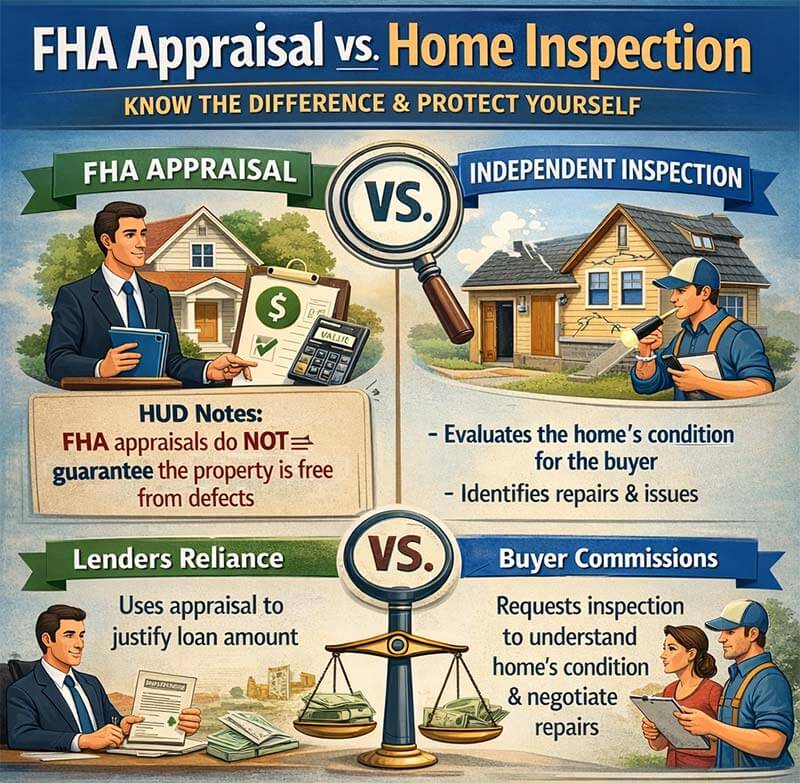 HUD specifies that FHA appraisals do not guarantee the property is free of defects and that buyers should obtain independent inspections.
The lender relies on the appraisal to justify the loan amount, whereas the buyer commissions a home inspection to understand the property’s condition, negotiate repairs, or withdraw from the contract if necessary.
This difference is even more important in fast-moving markets, where some buyers feel pressure to skip or limit contingencies. If buyers give up the inspection contingency, they risk losing the chance to renegotiate or back out if problems are found. The CFPB points out that without a proper inspection contingency, buyers may not be able to cancel the contract.
What Do Home Inspectors Look For
Home inspectors typically conduct a thorough examination of the property, beginning with the roof and attic and proceeding through each level. They assess plumbing, electrical systems, and the overall structure. The objective is to identify existing problems, deferred maintenance, and indicators of potential future issues.
Foregoing an inspection exposes the buyer to significant risk by proceeding without a comprehensive understanding of the property’s condition or potential issues.
In practice, the risk associated with waiving the inspection is often underestimated.more than most people assume. The inspection report is a critical tool that enables buyers to negotiate price adjustments, request repairs, or make other contractual demands. A home’s appearance, whether clean or recently renovated, does not guarantee the absence of underlying issues, underscoring the necessity of an inspection.
What Do Appraisers Look For
The appraiser is evaluating the home. This includes details on square footage, number of rooms, lot size, location, recent sales of similar homes, condition, construction quality, and features influencing marketability. An appraisal includes information such as square footage, number of rooms, lot size, location, recent comparable sales, property condition, construction quality, and features influencing marketability.
Both Fannie Mae and Freddie Mac require appraisals to support lending decisions. Appraisers may note visible deterioration, incomplete repairs, or safety concerns that could impact value or loan eligibility.
However, an appraisal is not a comprehensive maintenance report and does not identify all operational or concealed defects. Consequently, appraisals and inspections are complementary processes and should not be considered interchangeable. Although this can vary by contract, lender, or local custom.
Benefits of Home Inspections for Homebuyers
Prior to purchasing a home, buyers must make informed decisions. A home inspection helps identify safety concerns, necessary repairs, and the property’s overall condition. The findings enable buyers to budget appropriately, increase confidence, and, if necessary, renegotiate or withdraw from the transaction. The buyer’s real estate appraisal is less important. While the appraisal is primarily significant for the lender, as it substantiates the estimated market value and mitigates risk, it is less critical for buyers. Buyers who understand the distinct purposes of appraisals and inspections are better equipped to negotiate effectively.
What Happens if the Home Inspection Finds Problems?
If the home inspection reveals problems, buyers might be able to request that the seller make repairs, provide a credit, reduce the sale price, or allow the buyer to cancel if the contract includes the proper contingency language.
The CFPB states that inspection results can lead to negotiations and, depending on the contract, to its cancellation. Subsequent actions depend on local market conditions and the seller’s willingness to negotiate.
In competitive markets, sellers may decline repair requests, whereas in slower markets, buyers may possess greater negotiating power. Regardless, the inspection provides buyers with information unavailable through an appraisal alone. isal alone.
When Repair Negotiations Occur After an Inspection
Effective repair requests prioritize significant defects and safety concerns, such as roof or structural leaks, plumbing failures, electrical hazards, or issues with critical systems. Cosmetic concerns generally hold less importance unless they indicate underlying problems. Buyers should carefully observe contractual deadlines and thoroughly review the inspection report.
What Do You Do About a Low Appraisal?
When an appraisal is lower than the contract price, the buyer may have to provide additional cash, renegotiate the contract, dispute the appraisal with the lender, or simply walk away if an appraisal contingency is in place. Buyers should know that the appraisal will determine how much the lender will loan against the property.
A low appraisal does not necessarily indicate that the property is in poor condition; rather, it reflects a discrepancy in assessed value.
Home inspections and appraisals have different roles. An appraisal might be low even if the home is fine, and an inspection might find expensive repairs even if the appraisal value is high. That’s why it’s important not to mix up the two.
Options When an Appraisal Is Lower Than the Contract Price
Depending on the transaction, the buyer’s budget, and the market, ask the seller to drop the price, pay the difference, challenge the appraisal through the lender, or withdraw from the contract if there are still active contingency rights. Each situation is unique, and the choices are different.
Is An Appraisal and Home Inspection Necessary?
For most home loans, both a home inspection and an appraisal are necessary. Buyers typically arrange for an inspection, while lenders require an appraisal. The CFPB recommends completing both steps.
When a transaction doesn’t require an appraisal because a loan is eligible for a valuation alternative, the buyer still needs to know the home’s condition.
Some loans, according to Fannie Mae, may get value acceptance and skip the appraisal. Freddie Mac also offers appraisal waivers for some loans. Even so, these options do not replace the need for a home inspection. tion alternative. This depends on the loan file and automated underwriting and eligibility. Fannie Mae’s guidance states that some case files may receive value acceptance, and the company officially retired the term. In certain markets, buyers may choose to exclude or limit the inspection contingency.
Why FHA Appraisals Differ From Home Inspections
This misconception frequently arises with government-backed loans. Some buyers may forgo or limit the inspection contingency, but proceeding without an inspection entails substantial risk, as buyers may close without fully understanding the property’s condition or identifying potential issues. This practical lesson also applies to conventional financing. Regardless of loan type, the appraisal serves as a value assessment for the lender, not a substitute for an inspection. Recognizing this distinction enables buyers to better protect their interests.
Is A Home Inspection Necessary When An Appraisal Is Required?
Why is a home inspection on purchase transactions necessary when an appraisal is required? Is a home inspection a waste of money when a real estate appraisal needs to be done?
There are instances homebuyers want to save a few dollars and waive a home inspection on their proposed home purchase. Home inspections normally cost anywhere between $300 to $600 dollars.
Home inspections are not required by lenders. However, there are many horror stories of things going wrong after a home purchase. A home inspection would have solved that. However, the premium of a home inspection is a small price to pay versus the potential defects of the home. In this article, we will discuss and cover the importance of home inspections for home buyers.
Home Inspections Are Highly Recommended For Homebuyers

Should Real Estate Agents Attend Home Inspections?
Real estate agents should attend home inspections with their homebuyers while the home seller is present. Illinois Realtor Karry Razik is a veteran real estate agent with Re Max First Class in Orland Park Illinois. Here is what he says about home inspections:
A home inspection on purchase is normally ordered prior to the appraisal. So in the event, if there are some serious defects with the home, the buyer can cancel the purchase contract. Or the buyer and seller can negotiate the purchase contract.
Mr. Karry Razik is an expert in helping first time home buyers in Chicago and its surrounding suburbs. He works very closely with many home inspectors, lenders, contractors, title agents, insurance agents, real estate attorneys, and other realtors. He has a wide database of third-party real estate professionals and can give reputable referrals.
Worried About a Low Appraisal? Get a Game Plan
If the value comes in low, your options depend on loan type and contract terms. We’ll walk you through negotiation strategies and the cleanest path to closingHow Should You Choose A Home Inspector?
Home inspectors are not regulated by the federal government. A Home Inspector does not need to be licensed in many states. Many home inspectors are trained by private home inspection academies. Or are trained through their company’s in house training programs. If a home buyer hires a home inspector, the home inspection on home purchase should include the following inspection:
Structure Of The home:
- The main construction of the framing, walls, ceilings, flooring, roof, and foundations should be examined and any defects should be noted
The Exterior Of Home Inspection:
The general exterior should be inspected by the home inspection which includes the following:
- siding general landscape
- grades, elevations
- drainage of the surrounding property, gutters, and downspouts
- windows
- doors
- electrical
- lights
- switches
- driveways
Roof And Attic:
- Roof and attic should be checked for proper framing and ventilation, flashings, leakage, mold, and other potential defects
Plumbing:
- General plumbing should be checked and any leakage should be noted
- The home inspector should check if all plumbing is done per code and any potential defects
- All plumbing fixtures should be checked if it is in proper working condition and/or leaks
Mechanicals Which Includes:
- HVAC
- Chimneys
- Electrical panels
- Garage door openers
- Water heaters
- Water softeners
- Sprinkler systems
Appliances Which Includes:
- Refrigerators
- Dishwashers
- Washers
- Dryers
- Microwaves
- Ovens
- Garbage disposals
- Alarm Systems
- Other Systems Should All Be Checked And See If They Are Functional And Per Code
Home Inspection Report
A home inspector should write a detailed report on items he or she deems to be unsafe or short in its life span. For example, the home inspector should not short life expectancy on roofs, furnaces, air conditioning units, appliances. A home inspector is a general practitioner and might not be an expert in every field but will know a little bit of every aspect of home inspection.
Do Home Inspectors Need To Be Licensed?
Real estate appraisers need to be licensed to conduct appraisals. However, home inspectors normally do not have state licensing requirements to conduct home inspections in most states. There are standards for home inspectors to follow such as general accepted trade contract and fair trade standards and guidelines.
A home inspector may not be licensed or certified in asbestos remediation but should know that the subject property might have asbestos issues.
If a home inspector points out a potential issue, it will be up to the home buyer to hire a specialist to consult with a specialist in the field if they want to look at the matter further and see what the costs are to repair them. It is normally a home inspectors job to give you an estimate of what a repair will cost. Some home inspectors might give you a ballpark going rate on certain repairs while others will not.
What Is In The Home Inspection Report
The home inspector will complete a home inspection report after he has reviewed his home inspection. Just because the home inspector notes many defects in the subject property does not mean it is a deal killer. Some items might be extremely minor defects like replacing a ten-dollar light fixture or replacing a receptacle or two. There are home inspection reports that yield major potential problems like foundation issues or structural issues.
Why Is a Home Inspection Recommended?
A home inspection on purchase transactions is highly recommended to all home buyers. The few hundred dollars that a home inspection charges is a great insurance policy that your new home purchase will not have any major defects. Again, it is up to the home buyer whether or not they will have a home inspection on the purchase done. Home Buyers or homeowners who need to qualify for a mortgage with a mortgage company licensed in multiple states with no lender overlays can contact us at Gustan Cho Associates at 800-900-8569 or text us for a faster response. Or email us at gcho@gustancho.com. The team at Gustan Cho Associates is available 7 days a week, evenings, weekends, holidays.
Frequently Asked Questions
It Is Essential To Recognize That Both Home Inspection And Appraisal Processes Are Important, Yet They Serve Different Functions And Are Not Interchangeable?
No. A home inspection on purchase looks at the home for the buyer, while an appraisal looks at the home for the lender. Each buyer will need both because they serve vastly different purposes.
Can A Lender Require An Appraisal Rather Than A Home Inspection?
Yes. A lender will ask for a valuation step on the loan, but the home inspection is usually up to the buyer and at the buyer’s cost. However, failing to conduct the inspection will put the buyer at risk of repairs.
What If The Inspection Shows Big Problems?
Depending on the purchase contract, if an inspection contingency is in place, the buyer may have the right to negotiate repairs, request a credit or price reduction, or walk away from the contract.
What If The Appraisal Is Lower Than The Contract Price?
The buyer may need to renegotiate with the seller, possibly provide more cash, dispute factual deficiencies with the lender, or remove the appraisal contingency and walk away.
Do FHA Appraisals Replace The Need For A Home Inspection?
No. HUD states that FHA appraisals do not ensure a property is defect-free, and purchasers must complete their own home inspection.
Do Buyers Need An Appraisal To Obtain A Mortgage?
Not in many cases. Some specific loans can accept alternatives to appraisals, such as Fannie Mae’s value acceptance or Freddie Mac’s, but these replace the buyer’s need to know the home’s condition by conducting an inspection.
This Guide on Home Inspection on Purchase Was UPDATED on March 25, 2026










My dad would like to sell his home this year, and that is why he has decided to start looking for a home inspection service that will check it for any damages. Thank you for clarifying here as well the importance of detecting any cracks in it too. We’ll have its siding and windows inspected as well. Have contracts lawyers realtors and sellers all set up wife got denied for not having 40 hr on pay stubs has 39.5 hrs I am unemployed right now but collecting we need to get into this house asap please help my score is low 525 something like the there keeps dropping from being ran so now 645
My wife and I are looking to possibly getting a home. My credit score on all bureaus is about 620 as of the 15th of July and my wife’s is bue. I am a Marine veteran and would like to apply for a VA loan.