FHA loans in Louisiana can provide a more flexible path to homeownership, especially for borrowers with limited savings, lower credit scores, or past credit challenges. Qualified borrowers may purchase a primary residence with a 3.5% down payment when they have a credit score of 580 or higher. Individuals with credit scores ranging from 500 to 579 may be eligible if they put down at least 10%, depending on underwriting and lender requirements. The Federal Housing Administration does not lend money directly. Instead, it insures mortgages issued by FHA-approved lenders. Approval depends on documented income, employment history, debt-to-income ratio, credit history, available funds, and the property’s eligibility. Louisiana buyers should also consider homeownership and flood insurance costs because these expenses affect the total monthly payment and the amount they may qualify to borrow. Meeting FHA’s minimum guidelines does not guarantee loan approval.
What Is an FHA Loan and How Does it Work?
A government agency backs certain home loans so people can qualify more easily. Sometimes folks in Louisiana pick this option when saving cash up front feels tough. Credit slips from years ago might matter less here than elsewhere. Money comes not from the program itself but through local lenders trained to handle these deals. Ownership rules apply – you have got to live in the place yourself. People buying their first home might find FHA loans fit just right – same goes for those who’ve bought before or anyone watching every dollar. Getting approved? That part hinges on your credit score, how much you earn, what bills you carry, where you work, plus the house itself needing to meet certain rules.
2026 FHA Loan Requirements in Louisiana
FHA Loans in Louisiana follow federal HUD guidelines, but individual lenders may add stricter requirements known as lender overlays. Approval depends on the borrower’s credit, income, debts, available funds, intended occupancy, property eligibility, and underwriting findings.
Credit-Score Requirements
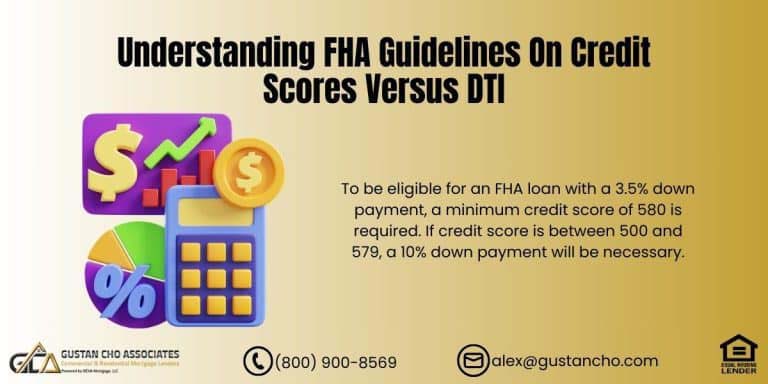
The typical requirements for credit scores and down payments are usually:
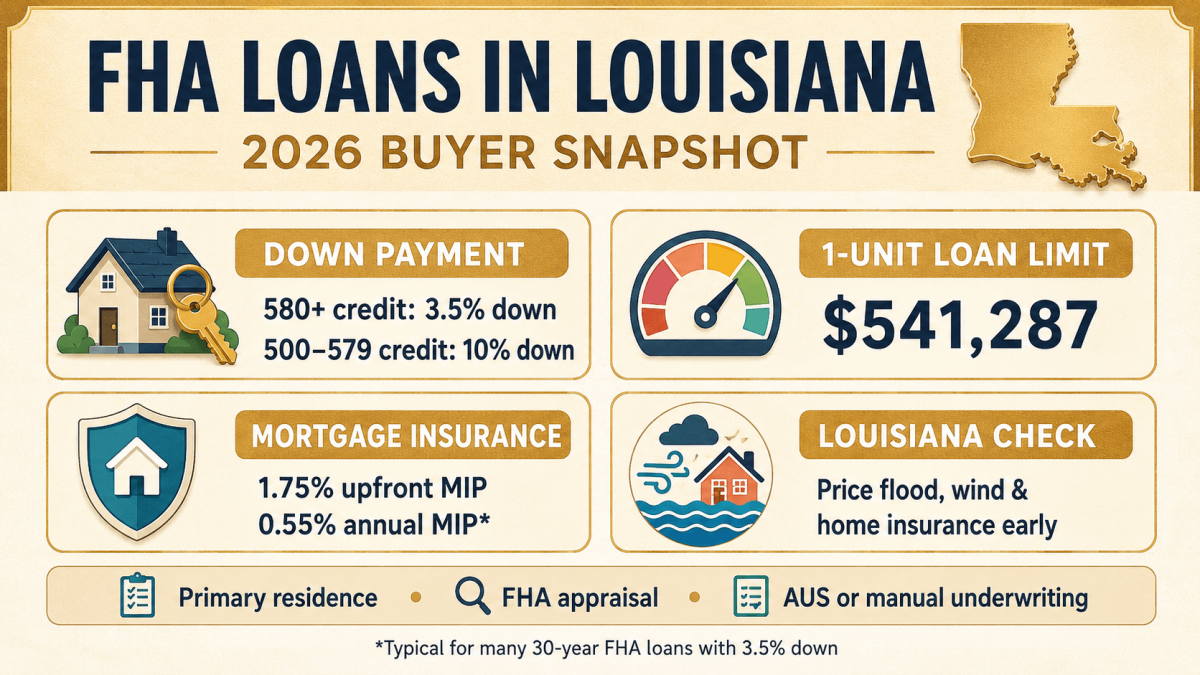
- 580 or higher: Minimum 3.5% down payment
- 500 to 579: Minimum 10% down payment
Meeting FHA’s minimum credit-score requirement does not guarantee approval. Lenders also review payment history, recent late payments, collections, judgments, bankruptcies, foreclosures, and other risk factors. Some lenders require a higher score because of their own overlays. Borrowers without a traditional credit score may qualify through manual underwriting using documented nontraditional credit, such as rent, utilities, insurance, or other recurring payments.
Down Payment and Acceptable Funds
The down payment may come from the borrower’s checking or savings account, eligible investments, an approved gift, an employer-assistance program, or a qualifying down payment assistance program. Eligible Louisiana buyers may also explore programs offered through the Louisiana Housing Corporation, which has separate income, credit, education, property, and funding requirements. Lenders must verify the source of funds used for the down payment, closing costs, and required reserves. Large or unexplained deposits may need to be documented before closing. FHA also generally allows interested parties, including the seller, to contribute up to 6% of the sales price toward eligible closing costs, prepaid expenses, and discount points. Seller contributions cannot replace the borrower’s required minimum down payment.
Income, Employment, and DTI Requirements
FHA purchase loans generally do not have maximum borrower-income limits. However, the borrower must have enough stable, reliable, and documented income to repay the mortgage and other monthly obligations. Lenders typically review the borrower’s employment and income history for the most recent two years. Borrowers do not always need to remain with the same employer for two years, but employment gaps, recent job changes, overtime, bonuses, commissions, self-employment, and variable income may require additional documentation. The debt-to-income ratio, or DTI, compares monthly debt payments with gross monthly income. FHA’s traditional manual-underwriting benchmarks are:
- 31% housing DTI
- 43% total DTI
Higher ratios may be permitted through automated underwriting or manual underwriting with sufficient compensating factors. Property taxes, homeowners’ insurance, flood insurance, FHA mortgage insurance, and homeowners’ association fees are part of the housing payment. They can influence the borrower’s qualifying debt-to-income ratio (DTI).
Occupancy and Eligible Properties
FHA financing is generally limited to a borrower’s principal residence. The borrower must move into the property within 60 days of closing and plan to live there for at least one year. FHA loans cannot ordinarily be used to purchase vacation homes or properties acquired solely for investment. Eligible properties may include:
- Detached single-family homes
- FHA-eligible condominiums
- Manufactured homes that meet FHA requirements
- Two- to four-unit residential properties
- Certain mixed-use properties that are primarily residential
Borrowers purchasing a two- to four-unit property must occupy one unit as their primary residence. Three- and four-unit properties must also satisfy FHA’s self-sufficiency requirements. The property must receive an FHA appraisal that supports its value and evaluates compliance with FHA minimum property requirements. The FHA appraisal is not a complete home inspection, so buyers should consider hiring an independent home inspector.
2026 Louisiana FHA Loan Limits
For 2026, all 64 Louisiana parishes use the FHA’s national low-cost loan limits. Borrowers considering FHA loans in Louisiana should understand that the limit applies to the mortgage amount—not necessarily the property’s purchase price. The 2026 FHA loan limits in Louisiana are:
- One-unit property: $541,287
- Two-unit property: $693,050
- Three-unit property: $837,700
- Four-unit property: $1,041,125
These limits apply throughout Louisiana, including Orleans, Jefferson, East Baton Rouge, St. Tammany, Lafayette, Caddo, Calcasieu, and every other parish. HUD establishes new limits annually based partly on national conforming loan limits and local home-price data. The 2026 figures are higher than the 2025 limits. HUD’s 2026 FHA loan-limit announcement Borrowers may use FHA financing to purchase a two- to four-unit property, provided they occupy one unit as their principal residence and meet all other FHA requirements. Three- and four-unit properties must also pass FHA’s self-sufficiency test. An FHA loan limit does not represent a guaranteed approval amount. The borrower must still qualify based on income, credit history, debt-to-income ratio, available funds, property taxes, homeowners’ insurance, flood insurance, and other housing expenses. A buyer may purchase a home priced above the applicable FHA limit by making a larger down payment, keeping the base FHA mortgage amount within the limit. Because FHA limits are updated annually, borrowers should confirm the applicable amount through HUD’s FHA Mortgage Limits lookup tool before making an offer.
FHA Loans in Louisiana With Bad Credit—See If You Qualify
Bad credit does not always stop you from buying a home in Louisiana. We’ll review your credit score, income, debts, down payment, and payment history to find the best FHA approval path.FHA Mortgage Insurance and Total Monthly Payment
Borrowers using FHA loans in Louisiana must pay mortgage insurance regardless of their credit score or down-payment amount. FHA mortgage insurance protects the lender if the borrower defaults and consists of an upfront premium and an annual premium paid monthly.
Upfront Mortgage Insurance Premium
The upfront mortgage insurance premium (UFMIP) is usually 1.75% of the total loan amount. Borrowers may pay it at closing or finance it into the mortgage. Financing the premium reduces the cash needed at closing but increases the total loan balance and interest paid. For example, a $250,000 home purchased with 3.5% down would have a base loan amount of $241,250. The 1.75% upfront premium would be approximately $4,222. If financed, the starting loan balance would increase to approximately $245,472.
Annual Mortgage Insurance Premium
The annual mortgage insurance premium is divided into 12 installments and included in the monthly mortgage payment. Most borrowers obtaining a 30-year FHA loan with 3.5% down pay an annual MIP rate of 0.55% of the applicable outstanding loan balance. Using the example above, the initial monthly MIP would be approximately $111. The actual amount gradually declines as the unpaid principal balance decreases. Rates may differ based on the mortgage term, original loan-to-value ratio, and base loan amount. HUD explains the current FHA mortgage insurance structure. For FHA case numbers assigned under current rules:
- An original loan-to-value ratio above 90% generally requires annual MIP for the mortgage term.
- An original loan-to-value ratio of 90% or less generally requires annual MIP for 11 years.
Therefore, borrowers making the minimum 3.5% down payment generally cannot cancel MIP simply by reaching 20% equity. They may need to pay off or refinance the FHA loan to eliminate it, subject to qualification and market conditions.
What Constitutes the Overall Monthly Payment?
The total monthly housing payment may include:
- Principal and interest
- FHA mortgage insurance
- Property taxes
- Homeowners insurance
- Flood or wind insurance, when required
- Homeowners association dues, when applicable
Louisiana buyers should obtain insurance estimates early because homeowners, wind, and flood insurance costs can vary significantly by property and location. These expenses affect both the total monthly payment and the borrower’s qualifying debt-to-income ratio. Even with a fixed interest rate, the total payment can change if taxes or insurance premiums increase.
Louisiana Down Payment Assistance Programs
 Borrowers using FHA loans in Louisiana may be able to combine their mortgage with an approved down payment assistance program. These programs help cover the required down payment, eligible closing costs, or both. However, assistance programs have requirements beyond FHA’s standard guidelines.
Louisiana Housing Corporation Programs
The Louisiana Housing Corporation offers several homebuyer-assistance options through participating lenders:
- MRB Assisted Program: Provides assistance equal to 4% of the final mortgage amount. The assistance is structured as a zero-interest soft-second loan that is forgiven monthly over five years while the borrower occupies the home as a principal residence. Any remaining balance may become due if the home is sold or the first mortgage is refinanced before the forgiveness period ends.
- MRB Home Program: Offers down payment and closing-cost assistance ranging from 5% to 9%, depending on the loan amount. Applicants must meet applicable household income, purchase price, credit, occupancy, and first-time homebuyer requirements.
- CDBG Assisted Program: Qualified buyers in designated Louisiana parishes affected by Hurricanes Laura, Delta, or Ida may receive a soft-second loan of up to 20% of the purchase price, capped at $55,000, plus as much as $5,000 toward closing costs. Candidates typically need to be first-time homebuyers and must have a household income that is at or below 80% of the median income for the area.
- Keys for Service: This program provides 4% assistance for eligible borrowers. Despite its name, the current LHC rate page states that all employment types are acceptable.
Program availability, interest rates, and funding can change. The borrower must use a participating lender and satisfy the rules of both the FHA loan and the selected assistance program. LHC programs commonly require at least a 640 credit score, eligible automated underwriting findings, and homebuyer education, even though FHA itself permits lower credit scores.
Assistance Is Not Always Free Money
Down payment assistance may be provided as a grant, forgivable second mortgage, deferred-payment loan, or repayable second mortgage. Buyers should confirm:
- Whether the assistance must be repaid
- How and when forgiveness occurs
- Whether selling or refinancing triggers repayment
- Whether the program carries a higher first-mortgage rate
- Which closing costs may the funds cover
- Whether homebuyer education is required
Buyers should compare the Loan Estimate for an assistance-backed mortgage with one for a standard FHA loan. Reducing the amount due at closing may be helpful, but a higher interest rate or a repayable second loan can increase the long-term cost. Local parish and city programs may also be available, subject to their own funding and eligibility rules.
Flood Zones, Homeowners Insurance, and Louisiana FHA Approval
Flood risk and insurance costs are important considerations for borrowers seeking FHA loans in Louisiana. Before final approval, the lender must confirm that the property has adequate insurance coverage and include the required premiums in the borrower’s total monthly housing payment.
Flood-Zone Requirements
A lender requests a flood-zone assessment to determine if the property is situated in a Special Flood Hazard Area designated by FEMA. These high-risk areas generally include certain A and V flood zones. When a home is in a qualifying high-risk flood zone, flood insurance is generally required for an FHA-financed property. Coverage may be obtained through the National Flood Insurance Program or an eligible private flood insurance policy that meets applicable requirements. A property outside a high-risk zone may not require flood insurance, but buyers can still purchase coverage because flooding can occur outside designated flood zones. An elevation certificate may help the insurance provider evaluate the property’s elevation and calculate the premium, particularly in higher-risk locations. Buyers should review the current FEMA flood map and obtain an actual insurance quote instead of relying solely on the seller’s previous premium.
Homeowners, Wind, and Flood Insurance
Standard homeowners insurance generally covers risks such as fire, theft, and certain storm damage, but it normally does not cover flooding. Depending on the property’s location and insurance policy, Louisiana buyers may need separate coverage for:
- Homeowners insurance
- Flood insurance
- Wind or hurricane damage
- Additional coverage required by the lender or insurer
The lender must verify that the policy provides adequate coverage before closing. Insurance availability, deductibles, and exclusions should also be reviewed carefully. A low premium may come with a high hurricane, wind, or named-storm deductible that could create a significant out-of-pocket expense after a loss.
How Insurance Affects FHA Approval
Homeowners’ flood and required wind-insurance premiums are included in the projected housing expense used to calculate the borrower’s debt-to-income ratio. A buyer may initially qualify based on an estimated premium but exceed the allowable DTI once the lender receives the final insurance quotes. For example, if the actual homeowners and flood insurance costs are $250 per month higher than originally estimated, the lender must qualify the borrower using the higher payment. This could reduce the maximum loan amount or require the borrower to pay off debt, increase the down payment, or choose a less expensive property. Louisiana buyers should obtain insurance quotes as early as possible—preferably before the inspection period ends. The FHA appraisal evaluates value and minimum property requirements, but it does not replace a flood zone determination, an insurance review, or an independent home inspection. Final approval remains subject to acceptable insurance coverage, the property’s eligibility, and the borrower’s ability to qualify with the complete monthly payment.
FHA Loans With Bad Credit or No Credit Score
Homebuyers in Louisiana who have struggled with credit might find FHA loans worth considering. Not every lender turns people away just because of poor scores. With FHA, it is possible to qualify even if your rating dips as low as 500 – though what happens next depends on more than just that number. Approval leans heavily on how steady your paycheck appears, along with existing debt loads and past bills paid. Savings matter too, especially when signs point toward better financial habits taking shape. Even without a standard credit rating, getting an FHA loan might happen. Sometimes, lenders look at different kinds of records instead – like how you’ve paid your monthly rent or kept up with electricity costs. Phone service charges or home insurance marks could count too. These show if someone pays things on time. Meeting rules about earnings matters just as much. Job status needs to check out. Savings play a role. How much debt compared to income shows up clearly in their review.
Collections, Charge-Offs and Judgments
Having collection accounts does not automatically disqualify you from getting an FHA loan in Louisiana. FHA guidelines do not require all collection accounts to be paid off before closing. However, lenders will review the type of collection, the amount owed, and your overall credit profile. In addition to collections, your income, debt-to-income ratio, employment history, and payment habits will also be considered during the approval process.
FHA Loans After Bankruptcy or Foreclosure
Just because someone had bankruptcy before does not block them from getting an FHA loan in Louisiana. After finishing Chapter 7, most people can apply again once two years have passed since discharge. For those still handling Chapter 13, eligibility might come sooner – after twelve straight monthly payments, provided both court and trustee agree. Meeting the timeline alone is not enough. Lenders will also check earnings, job status, credit history, and how debts compare to income. A foreclosure does not mean you can never buy a home again. Under standard FHA guidelines, borrowers are generally eligible for an FHA loan after a three-year waiting period following a completed foreclosure. The waiting period begins when the property ownership was transferred out of the borrower’s name. Once the waiting period has passed, borrowers must still meet FHA requirements for credit, income, employment, and debt-to-income ratio.
AUS Approval, Manual Underwriting, and Lender Overlays
Applications for FHA loans in Louisiana may be evaluated through an automated underwriting system or reviewed manually by an underwriter. The method used can affect the documentation, debt-to-income limits, reserve requirements, and approval process.
How Automated Underwriting Works
An automated underwriting system, or AUS, evaluates information such as the borrower’s credit, income, assets, debts, and proposed housing payment. A favorable AUS finding can make the process more efficient, but it is not final loan approval. The lender must still verify all information and approve the property, appraisal, title, insurance, and required documents. If Louisiana homeowners, wind, or flood insurance costs are higher than initially estimated, the lender may need to update the housing payment and rerun the AUS.
When Manual Underwriting May Be Required
Manual underwriting may be required when an application receives a referral finding, the borrower has no traditional credit score, or certain credit events require additional review. Instead of relying mainly on an automated recommendation, the underwriter evaluates the borrower’s complete financial history. The review may include:
- Housing-payment history
- Employment and income stability
- Recent late payments or credit problems
- Cash reserves after closing
- Payment shock
- Compensating factors
- Explanations for past financial hardship
FHA’s traditional manual-underwriting benchmarks generally allow housing and total DTI ratios of 31% and 43%. Ratios may increase to 37% and 47% with an acceptable compensating factor or to 40% and 50% with at least two qualifying compensating factors. The borrower must satisfy all applicable HUD requirements.
How Lender Overlays Affect Approval
Lender overlays are additional requirements imposed by a lender beyond FHA’s minimum guidelines. For example, FHA may permit a particular credit score, DTI, or manual-underwriting scenario, while an individual lender may require:
- A higher minimum credit score
- A lower maximum DTI
- Additional cash reserves
- A stronger housing-payment history
- No recent late payments
- An AUS approval rather than manual underwriting
A denial from one lender does not always mean the borrower is ineligible for FHA financing. The application may meet HUD guidelines but fail the lender’s overlays. Borrowers should ask whether a denial resulted from an FHA requirement or an individual lender policy before deciding that they cannot qualify.
AUS Approval, Manual Underwriting, and Lender Overlays
Applications for FHA loans in Louisiana may be evaluated through an automated underwriting system or reviewed manually by an underwriter. The method used can affect the documentation, debt-to-income limits, reserve requirements, and approval process.
How Automated Underwriting Works
An automated underwriting system, or AUS, evaluates information such as the borrower’s credit, income, assets, debts, and proposed housing payment. A favorable AUS finding can make the process more efficient, but it is not final loan approval. The lender must still verify all information and approve the property, appraisal, title, insurance, and required documents. If Louisiana homeowners, wind, or flood insurance costs are higher than initially estimated, the lender may need to update the housing payment and rerun the AUS.
When Manual Underwriting May Be Required
Manual underwriting may be required when an application receives a referral finding, the borrower has no traditional credit score, or certain credit events require additional review. Instead of relying mainly on an automated recommendation, the underwriter evaluates the borrower’s complete financial history. The review may include:
- Housing-payment history
- Employment and income stability
- Recent late payments or credit problems
- Cash reserves after closing
- Payment shock
- Compensating factors
- Explanations for past financial hardship
FHA’s traditional manual-underwriting benchmarks generally allow housing and total DTI ratios of 31% and 43%. Ratios may increase to 37% and 47% with an acceptable compensating factor or to 40% and 50% with at least two qualifying compensating factors. The borrower must satisfy all applicable HUD requirements.
How Lender Overlays Affect Approval
Lender overlays are additional requirements imposed by a lender beyond FHA’s minimum guidelines. For example, FHA may permit a particular credit score, DTI, or manual-underwriting scenario, while an individual lender may require:
- A higher minimum credit score
- A lower maximum DTI
- Additional cash reserves
- A stronger housing-payment history
- No recent late payments
- An AUS approval rather than manual underwriting
A denial from one lender does not always mean the borrower is ineligible for FHA financing. The application may meet HUD guidelines but fail the lender’s overlays. Borrowers should ask whether a denial resulted from an FHA requirement or an individual lender policy before deciding that they cannot qualify.
Louisiana FHA Loan Example
Consider a Louisiana borrower purchasing a $225,000 primary residence. The borrower has a 598 credit score, stable W-2 income of $5,800 per month, and $575 in monthly debt payments. Although the credit report includes an older medical collection, the borrower has maintained on-time rent and debt payments for the past 12 months. With a 3.5% down payment, the estimated FHA financing would include:
- Purchase price: $225,000
- Minimum down payment: $7,875
- Base FHA loan amount: $217,125
- Upfront mortgage insurance premium: approximately $3,800
- Total loan amount if the upfront premium is financed: approximately $220,925
The lender initially estimated the homeownership and flood insurance costs. However, the final quotes were higher than expected, increasing the total housing payment and debt-to-income ratio. The borrower reduced the qualifying debt by paying off a small monthly obligation before closing. The seller also agreed to pay part of the borrower’s eligible closing costs. After the lender verified the debt payoff, insurance coverage, income, assets, and updated housing payment, the application received an acceptable AUS finding. The borrower did not need manual underwriting. This example shows why buyers using FHA loans in Louisiana should obtain homeownership, wind, and flood insurance quotes early. A borrower may meet FHA’s credit and down-payment guidelines but still need to qualify with the complete monthly payment. Loan terms, insurance premiums, taxes, closing costs, and underwriting results will vary for each borrower and property.
Documents Needed for Preapproval
Borrowers applying for FHA loans in Louisiana should provide complete and accurate documents so the lender can review their income, assets, debts, credit history, and available funds. Requirements vary based on the borrower’s employment, income sources, credit profile, and underwriting findings. A lender may request:
- Government-issued photo identification
- Social Security number and permission to review credit
- Pay stubs for the past 30 days
- W-2 forms from the past two years
- Federal tax returns when required
- Bank and investment statements from the most recent two months
- Records that demonstrate the origin of the down payment and closing costs
- Current mortgage statements or landlord contact information
- Statements for retirement, Social Security, disability, pension, or other income
- Bankruptcy, foreclosure, divorce, child support, or judgment documents when applicable
- Written explanations for employment gaps, recent late payments, large deposits, or other financial issues
Self-employed borrowers may also need personal and business tax returns, year-to-date profit-and-loss statements, balance sheets, business bank statements, or third-party income verification. Borrowers using gift funds must document the donor, transfer of funds, and the required gift letter. Down payment assistance programs may require additional applications, income records, and homebuyer education. Buyers ought to refrain from getting new credit accounts, changing jobs, moving money without documentation, or making large purchases after preapproval. The lender may update income, employment, assets, credit, insurance, and debts before closing. A preapproval is conditional and does not guarantee final approval. The property, FHA appraisal, title, homeowners insurance, flood insurance when required, and updated borrower information must still meet lender and FHA requirements. The CFPB explains that lenders review income, assets, debts, and credit when issuing a preapproval.
Steps From Preapproval Through Closing
The process for FHA loans in Louisiana begins with preapproval and continues through property review, underwriting, and closing. A preapproval is conditional—not a guarantee of final approval—so borrowers should continue protecting their credit, income, employment, and available funds throughout the process.
1. Obtain an FHA Preapproval
The lender reviews the borrower’s credit, income, employment, assets, debts, and estimated housing expenses. If the borrower appears eligible, the lender issues a preapproval letter showing an estimated purchase price or loan amount.
2. Find an Eligible Property
The buyer works with a real estate agent to find a home within their budget. Before submitting an offer, the buyer should consider property taxes, homeowners’ insurance, flood insurance, wind coverage, and homeowners’ association dues because these costs affect the total monthly payment.
3. Sign the Purchase Agreement
After the seller accepts the offer, the signed purchase agreement is sent to the lender. The borrower then completes the formal loan application and receives a Loan Estimate showing the projected interest rate, payment, closing costs, and cash needed at closing. The buyer should schedule an independent home inspection during the contract’s inspection period. An FHA appraisal does not replace a complete home inspection.
4. Complete the FHA Appraisal and Insurance Review
The lender orders an appraisal from an FHA-approved appraiser. The appraisal must support the property’s value and evaluate whether the home meets FHA’s minimum property requirements. If the appraiser identifies required repairs, those items may need to be completed and verified before closing. The lender also obtains a flood zone determination and reviews the homeowners’ flood and wind insurance policies, when applicable.
5. Submit the Loan to Underwriting
An underwriter reviews the borrower’s documents, credit, assets, employment, debts, appraisal, title report, and insurance coverage. The underwriter may issue a conditional approval requesting additional items, such as:
- Updated pay stubs or bank statements
- Documentation for large deposits
- Proof that a debt was paid
- Letters explaining credit or employment issues
- Updated insurance quotes
- Evidence that appraisal repairs were completed
Borrowers should submit requested documents promptly and avoid opening credit accounts, financing major purchases, changing jobs, or moving money without documentation.
6. Receive Final Approval and Review Closing Documents
Once all conditions are satisfied, the lender issues final approval or “clear to close.” The borrower must get the Closing Disclosure at least three business days before closing. This document shows the final loan terms, monthly payment, closing costs, and amount due. Buyers should compare it with the original Loan Estimate and ask about unexpected changes. The CFPB explains the Closing Disclosure review period.
7. Complete the Final Walkthrough and Closing
Before closing, the buyer conducts a final walkthrough to confirm the property’s condition and verify that the agreed-upon repairs have been completed. At closing, the borrower signs the mortgage documents and provides the required funds through an approved payment method. The settlement or title company records the mortgage and deed after all closing requirements are met. Once the transaction is funded and recorded, the buyer receives possession according to the purchase agreement. Closing timelines vary based on the appraisal, insurance, title work, repairs, assistance-program requirements, and underwriting conditions. Responding quickly to the lender and obtaining Louisiana insurance quotes early can help prevent avoidable delays.
Final Thoughts About FHA Loans in Louisiana
FHA loans in Louisiana can give homebuyers another path when credit scores, past credit problems, or limited savings make conventional financing difficult. A lower credit score does not always mean you are out of options, but approval still depends on your full file, including income, debt, employment, payment history, and available funds. The best first step is to get your credit, income, and documents reviewed before shopping for a home. That way, you know what needs to be fixed, what loan amount may work, and whether FHA financing is the right fit for your situation.
Frequently Asked Questions About FHA Loans in Louisiana
Can I Apply for an FHA Loan Without My Spouse in Louisiana?
Yes. Your spouse does not have to be a borrower or co-signer. However, Louisiana is a community-property state, so the lender generally must review your non-borrowing spouse’s debts and include qualifying obligations in your debt-to-income ratio. Your spouse’s income cannot be used unless they join the application. HUD explains FHA co-borrower and non-borrowing-spouse rules.
What Happens if the FHA Appraisal is Lower Than the Purchase Price?
The maximum FHA financing is based on the lower purchase price or appraised value. Buyers may renegotiate the price, pay the difference with eligible funds, or request a reconsideration of value when supported by relevant evidence. The FHA amendatory clause may allow the buyer to cancel without losing the earnest-money deposit when the appraisal is below the stated amount, subject to the contract and applicable exceptions.
Can I Buy a Fixer-Upper with an FHA Loan in Louisiana?
An FHA 203(k) rehabilitation loan can combine the home’s purchase price and eligible renovation expenses into one mortgage. A Limited 203(k) may finance smaller, nonstructural projects, while a Standard 203(k) may be used for major or structural work. The property, improvements, contractors, and borrower must satisfy program and lender requirements.
How do Student Loans Affect FHA Qualification?
FHA requires lenders to consider outstanding student loans when calculating the borrower’s monthly debts. The lender generally uses the payment reported on the credit report or an actual documented payment when it is above zero. If the reported payment is zero, the lender generally uses 0.5% of the outstanding balance. A payment may be excluded when documentation confirms that the debt has been forgiven, canceled, discharged, or paid in full.
Can a Family Member Help Me Qualify Without Living in the Home?
FHA permits an eligible non-occupying co-borrower, such as a parent or another qualifying family member. The co-borrower’s income may help with qualification, but their debts and credit must also be reviewed. They sign the mortgage note, share legal responsibility for repayment, and generally take title to the property. At least one borrower must occupy the home as a principal residence.
Can I have Two FHA Loans at the Same Time?
FHA generally insures only one principal residence mortgage for a borrower at a time. Exceptions may apply when a borrower relocates beyond a reasonable commuting distance, leaves a jointly owned property, outgrows the current home because the family has increased in size, or is a non-occupying co-borrower on another FHA loan. Each exception has documentation and eligibility requirements. HUD explains the multiple-FHA-loan rule.
Can Closing Costs be Added to an FHA Purchase Loan?
Most ordinary purchase closing costs cannot simply be added to the base FHA loan amount. However, the 1.75% upfront mortgage insurance premium may be financed. Buyers may also reduce their cash requirement through eligible seller contributions, lender credits, documented gift funds, or approved down payment assistance. Compare each option carefully, as lender credits often come with a higher interest rate.
This article about “FHA Loans in Louisiana: Steps to Qualify with Bad Credit” was updated on July 24th, 2026.