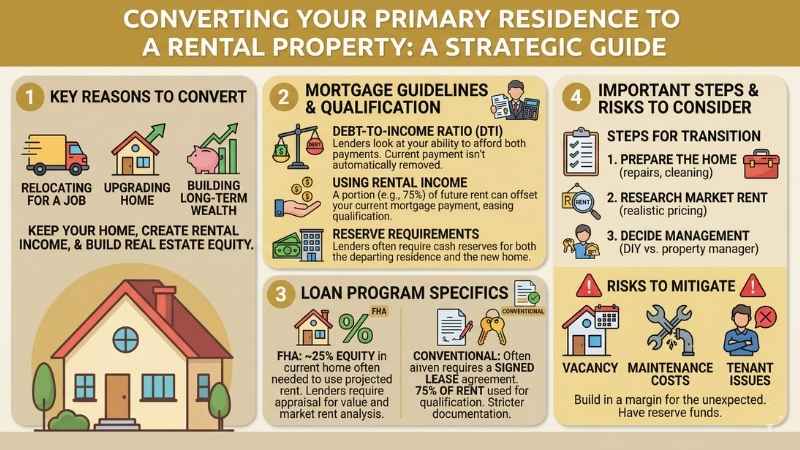
Many homeowners choose to convert a primary residence to a rental property when they want to move but do not want to sell their current home right away. This strategy can help you keep the property, create rental income, and build long-term wealth through real estate while buying another home to live in.
Turning your home into a rental isn’t just about packing up and finding someone to move in. Mortgage rules, occupancy requirements, home equity, rental income calculations, and reserve requirements can all affect whether the transition makes sense and whether you can qualify for your next home loan.
This guide will help you turn your main home into a rental property. You’ll learn when it makes sense to do this, how banks view rental income, and what to keep in mind if you’re considering buying a new place while still holding onto your current one.
Convert a Primary Residence to a Rental Property: What Homeowners Need to Know
Learn how to convert your current owner-occupied home into a rental property smoothly. We break down the mortgage steps, lender requirements, and smart tips to switch while buying your next house.
What Does It Mean to Convert Primary Residence to Rental Property?
Converting a primary residence to a rental property means turning the home you live in into a property that generates income rather than selling it. People usually do this when they’re moving for a job, upgrading to a bigger place, downsizing, or want to hang onto the property as a long-term investment.
This can be a smart move, but it is important to understand the mortgage and qualification rules before making plans. Depending on your loan type and financial profile, you can use future rental income from your current home to help qualify for your next mortgage.
How Your Current Mortgage Affects Buying Another Home
When you convert a primary residence to a rental property, your current housing payment does not automatically disappear from mortgage qualification. If you want to buy a new home while keeping your existing one, lenders usually look at whether you can afford both monthly housing payments.
This is where your debt-to-income ratio, or DTI, becomes important. Your DTI compares your monthly debts to your gross monthly income. If the payment on your current home is still counted in full, it can make qualifying for a new mortgage much harder.
In some cases, lenders may allow you to use a portion of the future rental income from your current home to offset that payment. This can make it easier to qualify when you convert a primary residence to a rental property and purchase another primary residence. The exact rules depend on the loan program, your equity position, your reserves, and whether the lender requires a lease agreement or market rent analysis.
That is why homeowners planning to convert a primary residence to a rental property should review their numbers before shopping for the next home. Understanding how your current mortgage, projected rent, and overall DTI work together can help you avoid surprises during pre-approval.
FHA Guidelines for Converting a Primary Residence to a Rental Property
FHA guidelines may let you convert a primary residence to a rental property and use future rental income from that home to help qualify for a new mortgage. In general, this becomes possible when you have enough equity in the current home.
If you need the rental income to offset the existing mortgage payment, FHA usually requires at least 25% equity in the departing residence. Lenders may also require an appraisal to confirm the home’s value and estimate market rent. In many cases, 75% of the projected rent may be used for qualification.
This matters because when you convert a primary residence to a rental property, the payment on your current home can still count against you unless rental income is documented properly. Understanding the FHA rules early can help you plan the transition more clearly.
How Rental Income From Your Current Home Can Help You Qualify
When you convert a primary residence to a rental property, the mortgage payment on your current home can still affect your ability to qualify for a new mortgage. Lenders usually count that payment as part of your monthly debts unless you can document rental income in a way the loan program allows.
This matters because your debt-to-income ratio is one of the main factors used in mortgage approval. If the full payment on your current home is counted and no rental income is used, qualifying for a new primary residence may become much harder.
Sometimes, lenders let you use part of the expected rent from your current home to help cover your mortgage payment. When you convert a primary residence to a rental property, this can lower the impact of the existing home on your debt-to-income ratio and improve your chances of approval. The amount of rent that can be used and the required documents depend on the loan program and lender guidelines.
For example, some loan programs may require enough equity in the current home. In contrast, others may require a signed lease, reserve funds, or a rental analysis from the appraisal. These details matter because they determine whether the departing residence will count mostly as a financial burden or as an income-producing asset during underwriting.
That is why homeowners who want to convert a primary residence to a rental property should review the income and documentation rules before applying for a new mortgage. Understanding how lenders treat your current housing payment can help you plan the move more confidently.
Conventional Guidelines for Converting a Primary Residence to a Rental Property
If you want to convert a primary residence to a rental property and use that home to help qualify for a new mortgage, conventional loan rules may allow it. However, conventional financing often requires more documentation than FHA.
Lease Requirements
In many cases, lenders want to see a signed lease agreement before they will count rental income from your current home. This helps confirm that the property is being turned into a real rental.
Rental Income Calculation
Even when rental income is allowed, lenders may use only part of it, often 75%, rather than the full amount. This helps account for vacancy, maintenance, and other landlord expenses.
Reserve Requirements
Conventional loans may also require cash reserves for both the departing residence and the new home. This shows that you have enough funds to cover both properties if rental income is delayed or if a property sits vacant.
Why the Difference Matters
When you convert a primary residence to a rental property, conventional loans can work well, but they usually come with stricter documentation rules. That is why it is important to review the lease, reserve, and income requirements before applying for the new mortgage.
Turning Your Owner-Occupied Home into a Rental
When it’s time to upgrade your living space or downsize, selling your current home isn’t your only option. Many homeowners keep their existing residence and turn it into a rental. Doing this creates a new stream of passive income while you build equity. However, lenders treat these situations differently, so knowing the guidelines is crucial before you make the switch. The right steps now can save you headaches later and put you on the path to long-term wealth through real estate.
What Owner-Occupied Means on a Mortgage
When you buy a home as owner-occupied, it means you are agreeing to live in the property as your primary residence rather than use it as a rental or investment property. Mortgage lenders treat owner-occupied homes differently because primary residences usually come with lower rates, lower down payment options, and more flexible loan terms than investment properties.
In most cases, lenders expect you to move into the home within a reasonable period after closing and use it as your main home. That matters because you cannot usually buy a home as owner-occupied if your real plan is to rent it out right away.
This is key if you plan to turn your main home into a rental down the line. Many homeowners do exactly that after living in the home for a while and then moving to another house. The key is that the home was first used as a true primary residence based on the terms of the mortgage.
Understanding what owner-occupied means can help you avoid mistakes when you convert a primary residence to a rental property and apply for another mortgage. It also helps explain why lenders look closely at occupancy history, rental income, and your reason for moving.
Do You Need to Refinance When You Convert a Primary Residence to a Rental Property?
If you want to convert a primary residence to a rental property, one of the first questions is whether you need to refinance the home. In many cases, the answer is no. If you originally bought the property as your primary residence, lived in it as required by the loan terms, and are now moving for a legitimate reason, you may be able to keep your current mortgage and rent out the home after you move.
Keep the Current Mortgage
Many homeowners who convert a primary residence to a rental property do not need to refinance. If you met the original owner-occupancy requirements and are moving for a legitimate reason, you may be able to keep the current loan and rent out the home after you move.
Refinance Into an Investment Property Loan
Refinancing may make sense if you want to pull cash out, change the loan term, or update the mortgage structure. But once the home is treated as an investment property, the new loan may come with a higher rate, more documentation, and stricter requirements.
Which Option Is Better?
If your current mortgage already works well, keeping it may be the easier and less expensive choice. If you need to change the loan itself, refinancing may be the better fit.
Rules to Know Before You Convert a Primary Residence to a Rental Property
If you plan to convert a primary residence into a rental property, it is important to understand that lenders do not rely on a single factor. They may review how long you lived in the home, how much equity you have, whether rental income can be used, and how much cash you have in reserve. Breaking these rules into simple parts makes the process easier to understand.
Occupancy Rules
When you bought the home as a primary residence, you agreed to live in it as your main home. That matters because a property financed as owner-occupied cannot usually be rented out right away unless there is a valid reason for the change. In many cases, homeowners later convert a primary residence to a rental property after living in the home for a period of time and then moving to another house.
Equity in the Current Home
Equity can matter when you convert a primary residence to a rental property, especially if you want to use future rental income to help qualify for a new mortgage. Some loan programs may require a certain amount of equity in the current home before the projected rent can offset the existing mortgage payment.
Using Rental Income
One of the biggest benefits when you convert a primary residence to a rental property is that a portion of the expected rental income may help you qualify for your next home loan. However, lenders usually do not count all of the rent. They might only need a chunk of it, and they could ask for stuff like a lease agreement or a rental analysis.
Reserve Requirements
Lenders may also want to see reserve funds after you convert a primary residence to a rental property. These reserves show that you can handle the mortgage payments if the rental sits vacant, repairs come up, or the rent does not start right away. Reserve requirements vary by loan program and the overall risk of the file.
Why These Rules Matter
These rules all work together. Even if you have a high income, a lender may still look at occupancy history, equity, rental income documentation, and reserves before approving a new mortgage. That is why homeowners who want to convert a primary residence to a rental property should review the full picture before starting the process.
Buying a New Home After You Convert a Primary Residence to a Rental Property
Many homeowners want to convert their primary residence into a rental property so they do not have to sell their current home before buying the next one. This often happens when a family needs more space, wants to move to a new area, or sees long-term value in keeping the current property as a rental.
The biggest issue is usually mortgage qualification. When you apply for a new home loan, lenders may count the payment on your current home along with the payment on the new one. It can be tricky to qualify unless you can use the estimated rental income from your current property to help cover some of the mortgage payments.
This is why planning matters so much. If you want to convert a primary residence to a rental property and buy another home, lenders may look at your income, debts, available cash reserves, home equity, and the expected rent on the current home. Depending on the loan program, they may also require documents such as a lease agreement or rental analysis to determine how much of the future rent can be counted.
For many borrowers, the goal is not just to keep the old home. The goal is to make sure the old home does not prevent approval for the new one. That is where the numbers become important. A homeowner may be comfortable making both payments for a short period. However, the lender still has to determine whether the file meets guideline requirements.
Before you convert a primary residence to a rental property and shop for your next home, it helps to review the full picture early. Knowing how the current mortgage will be treated, whether rental income can be used, and how much reserve funds may be needed can make the process much smoother. It can also help you set a realistic budget for the next home before you begin house hunting.
Many homeowners can do both at the same time: keep their current home as a rental while buying a new place to live. The key is preparing for the transition the way a lender would review it, not just how it looks on paper from a household budget standpoint.
Perks of Converting a Primary Residence to a Rental Property
Many homeowners choose to convert a primary residence into a rental property because it can offer both short-term flexibility and long-term financial opportunities. Instead of selling the home right away, you can keep the property, collect rent, and continue building equity over time.
One of the biggest benefits is the chance to create an additional income stream. If the rent covers most or all of the mortgage payment, the home may help support itself while you live in your new primary residence. Over time, that can improve cash flow and reduce the pressure to sell during a market that may not be ideal.
Another benefit is long-term appreciation. When you convert a primary residence to a rental property, you keep the chance to benefit if the home rises in value in the years ahead. That can be especially appealing if you bought the property with a low interest rate or in a market where home values are expected to remain strong.
Some homeowners also like the flexibility this strategy creates. Keeping the home as a rental may give you options later if your plans change. You can hold it as an investment, sell it later when market conditions improve, or use the income to support other financial goals.
For the right person, turning your main home into a rental can be more than just a decision about where to live. It can be a step toward building long-term wealth through real estate.
Risks to Consider Before You Convert a Primary Residence to a Rental Property
While there are clear advantages, homeowners should also think carefully about the risks before they convert a primary residence to a rental property. Keeping the home can sound appealing, but it also adds responsibility, uncertainty, and financial pressure if the numbers are not realistic.
One common risk is vacancy. A property that sits empty for even a short time can create a cash flow gap while the mortgage, taxes, insurance, and upkeep still need to be paid. Even if the home rents quickly, there may be periods between tenants that affect your budget.
Maintenance is another major factor. Once you convert a primary residence to a rental property, repairs do not stop just because you moved out. Landlords need to be ready for plumbing problems, appliance issues, routine wear and tear, and unexpected repair costs. These expenses can quickly reduce the profit you expected from the rental.
There is also the challenge of managing two homes at once. If you are buying a new primary residence while keeping the old one, your lender may require reserve funds and closely review your ability to handle both payments. Even if rental income is expected, the transition may feel tighter than it looks on paper.
Tenant issues are another reality. Late payments, lease violations, property damage, and turnover costs can all affect whether the rental becomes a helpful asset or a source of stress. That is why homeowners should be realistic before they convert a primary residence to a rental property and assume everything will go perfectly.
The goal is not to avoid the strategy altogether. The goal is to understand that rental property ownership comes with both upside and responsibility.
Tips Before You Convert a Primary Residence to a Rental Property
The strongest way to convert a primary residence to a rental property is to plan for the transition before you move out. A little preparation can make a major difference in how smoothly the process goes and whether the property actually helps your finances.
Start by reviewing your full mortgage qualification picture. If you are buying another home, look at your current mortgage payment, projected rent, other monthly debts, and reserve funds. This gives you a more accurate picture of whether the current home will help or hurt your approval for the next mortgage.
It also helps to research the rental market before converting a primary residence into a rental property. Look at realistic rent levels for similar homes in your area, not just the number you hope to charge. A rental that looks good on paper can feel very different once vacancy, repairs, and landlord costs are factored in.
Another smart step is to prepare the home for tenant use. That may include handling deferred maintenance, checking safety items, cleaning thoroughly, and making sure the property is in condition to attract qualified renters. A smoother turnover often leads to a better rental experience from the start.
You should also think about how involved you want to be as a landlord. Some homeowners manage the property themselves, while others hire a property manager. Before you convert a primary residence to a rental property, decide which approach fits your time, budget, and comfort level.
Finally, build in a margin for the unexpected. Reserve funds matter not just for lender approval, but for real life. The transition tends to go better when homeowners prepare for repairs, vacancies, or delays rather than assuming the property will perform perfectly from day one.
Final Thoughts About How to Convert a Primary Residence to a Rental Property
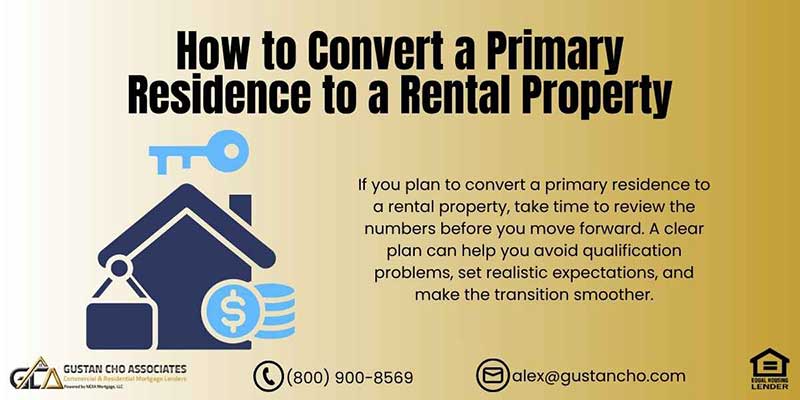
If you plan to convert a primary residence to a rental property, take time to review the numbers before you move forward. A clear plan can help you avoid qualification problems, set realistic expectations, and make the transition smoother. For many homeowners, this is not just a housing decision. It is a long-term strategy that can create greater flexibility, greater income potential, and a stronger path to building wealth through real estate.
Frequently Asked Questions About How to Convert a Primary Residence to a Rental Property:
How Long Do You Need to Live in a Home Before You Can Rent it Out?
- In many cases, homeowners are expected to live in a home as their primary residence for about 12 months before renting it out. However, the exact requirement depends on the loan program and the circumstances behind the move. Because occupancy rules can vary, borrowers should review the terms of their mortgage before making the switch.
Do You Have to Refinance to Convert a Primary Residence to a Rental Property?
- Not always. Many homeowners can keep their current mortgage after moving out and renting the property, especially if they originally occupied the home as required by the loan terms. Refinancing may still make sense in some situations, but it is not automatically required just because the home later becomes a rental.
Can Rental Income From Your Current Home Help You Qualify for a New Mortgage?
- Yes, in many cases, a lender may allow some of the projected or documented rental income from your current home to help with qualification for your next mortgage. Lenders usually do not count the full rent amount, and documentation requirements can vary depending on the loan type and underwriting guidelines.
Can You Buy a New Home and Keep Your Current Home as a Rental?
- Yes, many homeowners do exactly that. The main issue is whether you can qualify for the new mortgage while still carrying the current home, which is why lenders often review your debt-to-income ratio, reserves, and any rental income from the departing residence.
What Changes When You Turn Your Primary Residence Into a Rental Property?
- Converting a home into a rental can affect more than just your mortgage. It may also require updates to your insurance, compliance with local or HOA rules, and new planning around taxes, depreciation, and landlord expenses.
What is the Biggest Mistake Homeowners Make When Turning a Home Into a Rental?
- A common mistake is assuming the property will cash flow smoothly right away without planning for vacancy, maintenance, reserve funds, and qualification rules for the next home purchase. Stronger pages on this topic consistently emphasize that the transition works best when homeowners prepare on both the financing and landlord sides.
This article about “How to Convert a Primary Residence to a Rental Property” was updated on April 8th, 2026.
Unlock Rental Income Potential
We’ll show you how to use your owner-occupied home as an investment.