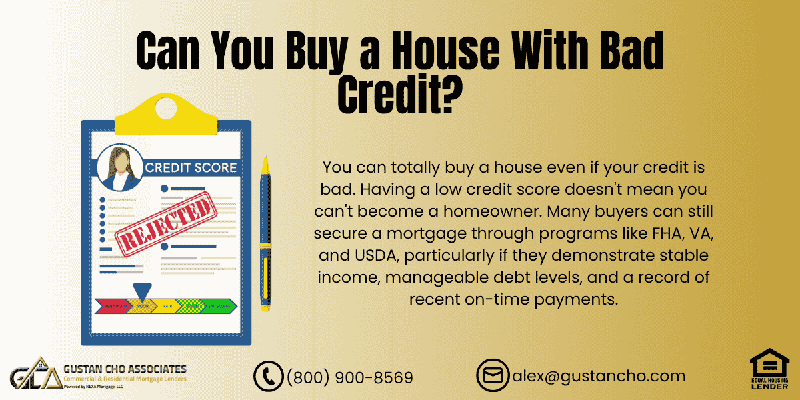
Buying a house with bad credit is still possible, but the loan process can feel confusing if you have been turned down before. A low credit score does not automatically stop you from getting approved for a mortgage. Lenders also look at your income, job history, monthly debts, down payment, and recent payment history.
Many buyers with credit problems may still qualify through FHA, VA, USDA, or non-QM loan programs. The right option depends on your credit score, recent late payments, collections, bankruptcy history, debt-to-income ratio, and whether the lender has extra rules called overlays.
The biggest mistake many borrowers make is assuming one denial means they are out of options. In reality, one lender may say no while another lender may approve the same borrower under a different program or with fewer overlays. If you are buying a house with bad credit, the key is knowing which mortgage programs fit your situation and what steps you can take to improve your chances before you apply.
Can You Really Buy a House With Bad Credit?

What is Considered Bad Credit for a Mortgage?
Bad credit for a mortgage usually means your credit score is low enough to limit your loan options or make approval harder. Many lenders consider scores below 620 to be weak credit, but that does not always mean you cannot qualify. The loan program, the lender, and the rest of your financial profile all matter.
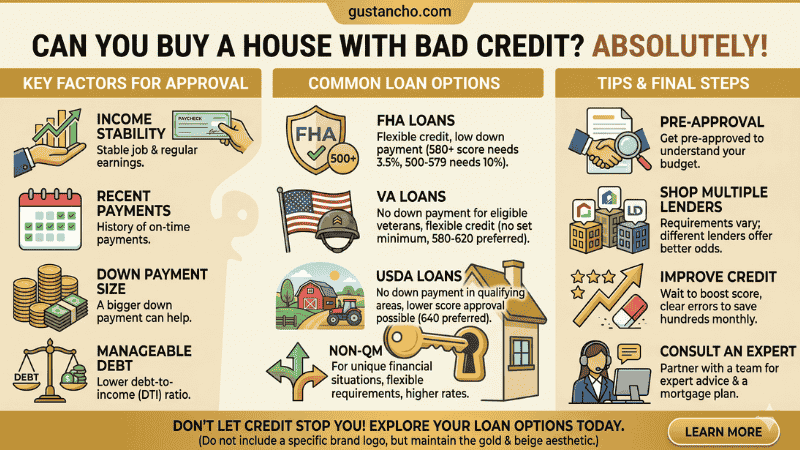
For FHA loans, some borrowers may qualify with a credit score as low as 500 if they have at least 10% down. Borrowers with a 580 score or higher may qualify with as little as 3.5% down, depending on the lender and the full application.
VA loans do not have a single universal minimum credit score set by the VA, but many lenders still set their own requirements. USDA and conventional loans usually have stricter credit standards. Bad credit is not just about the number. Lenders also look at what caused the score to drop. Recent late payments, unpaid collections, charge-offs, judgments, tax liens, high credit card balances, bankruptcy, foreclosure, and thin credit history can all affect mortgage approval. A borrower with a 580 score and clean recent payment history may be viewed differently from a borrower with the same score who has new late payments or maxed-out credit cards. Lenders look at the age and resolution of credit issues when someone with bad credit wants to buy a house. They also consider the borrower’s ability to manage the new mortgage payment.
How Bad Credit Affects Mortgage Approval
Bad credit can affect mortgage approval in several ways. It may limit which loan programs are available, increase the required down payment, raise the interest rate, or prompt the lender to request additional documentation before making a final decision. A lower score does not always mean denial, but it usually means the file will be reviewed more carefully. Lenders want to know whether the credit problem is old or recent. A borrower with older collections and 12 months of on-time payments may have a stronger file than a borrower with new late payments, maxed-out credit cards, or unpaid obligations that just appeared on the credit report. Recent credit behavior usually matters more than old mistakes. Bad credit can also affect automated underwriting. Some loans are first reviewed through an automated system that checks credit, income, assets, debts, and loan risk. If the system does not issue approval, the borrower may need a different loan program, a larger down payment, a lower debt-to-income ratio, or manual underwriting, if the program allows it. The biggest impact is often the monthly payment. Borrowers with low credit scores often face higher interest rates, making it more difficult to meet debt-to-income requirements. That is why buying a house with bad credit is not just about getting approved. It is also about making sure the mortgage payment is affordable and sustainable after closing.
FHA Loans for Buyers With Bad Credit
FHA loans are often among the first options borrowers consider when buying a house with bad credit. These loans are backed by the Federal Housing Administration. They are designed to help qualified borrowers who may not fit stricter conventional loan guidelines. One reason FHA loans are popular is the flexible credit score requirement. Borrowers with a 580 credit score or higher may qualify with as little as 3.5% down. Borrowers with credit scores from 500 to 579 may still qualify, but they generally need at least 10% down.
The final approval still depends on the lender, the automated underwriting findings, income, debt-to-income ratio, and recent credit history.
FHA loans may also be more forgiving when a borrower has a history of collections, charge-offs, late payments, bankruptcy, or foreclosure. That does not mean every credit issue can be ignored. Recent late payments, unpaid judgments, tax liens, or large unresolved debts can still create problems. Lenders want to see that the borrower has recovered from past credit issues and can handle the new mortgage payment. One important thing to know is that FHA guidelines and lender overlays are not always the same. FHA sets the basic rules, but many lenders add stricter requirements of their own. That is why one lender may require a 620 credit score, while another may consider a lower score if the rest of the file is strong. For buyers with bad credit, finding the right FHA lender can make a major difference.
VA Loans for Eligible Borrowers With Bad Credit
VA loans can be a strong option for eligible veterans, active-duty service members, and some surviving spouses who are buying a house with bad credit. One of the biggest benefits is that VA loans often allow 100% financing, which means qualified borrowers may be able to buy a home with no down payment. The VA does not set one universal minimum credit score for all borrowers. Instead, VA lenders review the full file, including income, debt-to-income ratio, residual income, employment history, and recent credit habits. Many lenders still add their own minimum score requirements, often called lender overlays, but those requirements can vary from one company to another. Bad credit does not automatically disqualify an eligible VA borrower. Some veterans may still qualify even after past late payments, collections, bankruptcy, foreclosure, short sale, or other credit problems if they meet VA guidelines and can afford the new mortgage payment. Recent payment history is especially important because lenders want to see that the borrower has recovered from past financial issues. VA loans are different from many other loan programs because residual income plays a major role. Residual income is the money left over after major monthly expenses are paid. A borrower with a lower credit score but high residual income, stable employment, and manageable debts may still have a path to approval. For eligible borrowers, a VA loan may be one of the best mortgage options when credit is less than perfect.
USDA Loans for Rural Buyers With Lower Credit Scores
USDA loans can help qualified buyers purchase a home in eligible rural and suburban areas with no down payment. These loans are USDA-backed and are often used by buyers who have steady income but limited savings for a down payment.
USDA loans can be helpful when buying a house with bad credit, but the credit requirements are usually stricter than those for FHA or VA loans. Many lenders look for a credit score around 640 because that can make automated approval easier.
However, a lower score does not always mean the borrower is automatically denied. Some files may still be reviewed if the borrower has high income, manageable debts, and a clean recent payment history. The property must be in a USDA-eligible location, and the borrower must meet household income limits. This is where many buyers get surprised. A home that looks suburban may still qualify, while another home nearby may not. Income limits also depend on household size and the county where the property is located. For buyers with lower credit scores, USDA approval often comes down to the full file. Recent late payments, unpaid collections, high debt, or unstable income can create problems. But if the credit issues are older and the borrower has rebuilt a solid payment history, a USDA loan may still be worth reviewing.
Yes—You Can Buy a House With Bad Credit
FHA, VA, and Non-QM loan programs make homeownership possible even with low scores.Non-QM Loans for Individuals Who Do Not Meet Conventional Standards
Non-QM loans are an option for borrowers who don’t qualify for FHA, VA, USDA, or conventional mortgages. QM stands for qualified mortgage. A non-QM loan is not the same as a subprime loan, but it allows more flexible review of a borrower’s income, credit history, and overall file. These loans are often used by self-employed borrowers, real estate investors, business owners, 1099 workers, retirees, and borrowers with recent credit events. Some non-QM programs allow bank statements, profit and loss statements, asset depletion, rental income, or other documentation instead of traditional W-2 income and tax returns. For buyers with bad credit, non-QM loans may offer another path when standard loan programs do not work. A borrower with a recent bankruptcy, foreclosure, short sale, charge-offs, collections, or a lower credit score may still be reviewed, depending on the program. However, non-QM loans usually come with higher rates, larger down payment requirements, and stronger reserve requirements than government-backed loans. Non-QM financing is not the right fit for every borrower. It can be useful when the buyer has the income or assets to support the loan but cannot meet standard agency guidelines. When buying a house with bad credit, non-QM loans should usually be compared against FHA, VA, USDA, and conventional options before making a final decision.
Can You Buy a House With a 500 Credit Score?
Yes, buying a house with a 500 credit score may be possible, but the loan options are limited. FHA loans are usually the primary program borrowers consider in this score range. FHA guidelines allow credit scores from 500 to 579 with at least 10% down, but not every lender will approve a file that low.
A 500 credit score means the rest of the mortgage application needs to be strong. Lenders will look closely at recent payment history, income stability, debt-to-income ratio, down payment, reserves, and the reason for the low score.
Recent late payments, unpaid obligations, or high credit card balances can make approval harder, even if the loan program technically allows it. Some borrowers with a 500 credit score may also consider non-QM loan options, but these programs usually require a larger down payment and may carry higher rates. VA-eligible borrowers may have more flexibility, depending on the lender and the full strength of the file. The best step is to determine whether the low score is due to past credit issues or current financial problems. If the problems are old and the borrower has recent on-time payments, approval may be more realistic. If the credit problems are recent, it may be better to work on the score first before applying.
What Credit Problems Can Still Affect Approval?
Buying a house with bad credit is possible, but certain credit issues can still create challenges during the mortgage process. Some problems may reduce your loan options, increase your interest rate, require additional documentation, or delay approval altogether.
Recent Late Payments
Late payments are one of the first things lenders review. A few older late payments may not be a major issue, but recent late payments on a mortgage, rent, auto loan, or credit card can raise concerns. Lenders want to see a pattern of responsible payment behavior before approving a new mortgage.
Collection Accounts and Charge-Offs
Unpaid collections and charge-offs do not always prevent mortgage approval. However, lenders may review the amount owed, how recent the account is, and whether the debt affects your debt-to-income ratio. Some loan programs are more flexible than others when it comes to outstanding collections.
High Credit Card Balances
Maxed-out credit cards can hurt both your credit score and your debt-to-income ratio. Even borrowers with decent incomes can run into problems if a large percentage of their available credit is being used.
Judgments and Tax Liens
Judgments and tax liens often require additional review. Depending on the circumstances, payment arrangements or documentation may be required before the loan can proceed.
Bankruptcy and Foreclosure
A past bankruptcy or foreclosure does not automatically prevent you from buying a home. However, most loan programs have mandatory waiting periods that must be satisfied before you can qualify. Lenders will also look at how you have managed your finances since the event occurred.
Recent Credit Inquiries and New Debt
Applying for new credit before closing can create unexpected problems. A new car loan, personal loan, or credit card can increase your monthly obligations and change your debt-to-income ratio. This is one reason mortgage professionals often advise borrowers to avoid opening new accounts while purchasing a home. Lenders rarely make decisions based on a single credit issue. They review the entire financial picture, including income, assets, employment history, debt levels, and recent payment habits. Even borrowers with past credit problems may still qualify if they can demonstrate financial stability today.
Buying a House With Bad Credit After Bankruptcy
Buying a house with bad credit after bankruptcy may still be possible, but timing matters. Most loan programs have waiting periods after a Chapter 7 or Chapter 13 bankruptcy, foreclosure, short sale, or deed-in-lieu of foreclosure. The waiting period depends on the loan type, the type of bankruptcy, and whether the bankruptcy was discharged or dismissed. FHA and VA loans are often more flexible than conventional loans after bankruptcy. Some borrowers may qualify for FHA or VA financing two years after a Chapter 7 bankruptcy discharge.
Borrowers in a Chapter 13 repayment plan may also qualify for FHA or VA financing after making at least 12 months of on-time trustee payments, with court or trustee approval when required.
Conventional loans usually have longer waiting periods after bankruptcy. A Chapter 7 bankruptcy typically requires a longer recovery period before a borrower can qualify. Chapter 13 rules can also vary depending on whether the bankruptcy was discharged or dismissed. Lenders will not look at the bankruptcy date alone. They will review what happened after the bankruptcy. Recent on-time payments, stable income, lower debt, and rebuilt credit can help strengthen the file. New late payments after bankruptcy can make approval much harder because lenders want to see that the borrower has recovered financially. The key is to know which loan program fits your timeline. Some borrowers are told they need to wait years, even though another program may allow them to qualify sooner. When buying a house with bad credit after bankruptcy, the right lender and the right loan program can make a major difference.
Why One Lender May Deny You and Another May Approve You
A mortgage denial from one lender does not always mean you cannot buy a home. This is especially true when buying a house with bad credit. Many loan programs have basic agency guidelines, but lenders can add stricter rules on top of them. These extra rules are called lender overlays. For example, FHA may allow certain borrowers to qualify with lower credit scores, but one lender may still require a 620 score. Another lender may review the same borrower with a lower score if the rest of the file is strong. The same can happen with VA loans, USDA loans, manual underwriting, debt-to-income ratios, collections, charge-offs, bankruptcy history, or recent late payments. Lenders also have different levels of risk tolerance. One company may not want to approve a borrower with a recent credit issue, while another may be comfortable if the borrower has stable income, strong reserves, low debt, or a good explanation for what happened. The loan program may be the same, but the lender’s internal rules can be very different. This is why borrowers should not assume they are out of options after one denial. Sometimes the problem is not the borrower. Sometimes the problem is that the lender does not offer the right program or has overlays that do not fit the borrower’s situation. Getting a second opinion from a lender experienced with bad credit mortgage files can make a major difference.
How To Improve Your Chances of Approval
Buying a house with bad credit is easier when the rest of your file is strong. Lenders look at more than your score. They also review income, debts, assets, job history, and recent payment habits. Start with these steps:
- Make every payment on time. Recent late payments can hurt more than older credit problems.
- Lower credit card balances. High balances can lower your credit score and increase your monthly debt payments.
- Check your credit report before applying. Look for wrong balances, duplicate collections, accounts that are not yours, or late payments reported by mistake.
- Do not open new credit. A new car loan, credit card, personal loan, or furniture account can hurt your debt-to-income ratio.
- Save more money if possible. A larger down payment, additional reserves, or money left over after closing can strengthen your file.
- Get reviewed before shopping for homes. A lender can check your credit, income, debts, and loan options before you make an offer. This gives you time to fix problems and avoid surprises during underwriting.
Final Thoughts on Buying a House With Bad Credit
Buying a house with bad credit may take more planning, but it is not impossible. A low credit score can limit your loan options, raise your interest rate, and impact your down payment and approval terms. However, lenders consider your overall financial situation, not just your credit score.
The best path depends on your situation. FHA, VA, USDA, conventional, and non-QM loans all have different rules. One borrower may need to raise their score first, while another may qualify now with the right loan program and lender.
Before you start shopping for homes, get your credit, income, debts, and recent payment history reviewed. That can help you find out what is possible, what needs to be fixed, and which mortgage option gives you the best chance of approval.
Frequently Asked Questions About Buying a House With Bad Credit
How Long Should I Wait After Improving My Credit Before Applying for a Mortgage?
There is no required waiting period after improving your credit score. However, lenders usually want to see that positive changes are reflected on your credit report. If you recently paid down credit cards, resolved collections, or corrected reporting errors, it may take several weeks for those updates to appear.
Can I Buy a House if I have no Credit Score at All?
Possibly. Some loan programs allow borrowers to qualify using non-traditional credit sources, such as rent payments, utility bills, cell phone bills, and insurance payments. The process is often more detailed than a standard credit review, but having no credit history does not always prevent homeownership.
Will Paying Off Collections Increase My Chances of Getting Approved?
It depends on the type of collection, the loan program, and the rest of your financial profile. In some cases, paying off collections may improve your credit profile. In other situations, the collection may have little impact on approval. A mortgage professional can determine whether paying off a collection is likely to benefit your application.
Can a Co-Borrower Help Me Qualify if I have Bad Credit?
Yes, adding a qualified co-borrower may strengthen a mortgage application. The lender will consider the co-borrower’s income, debts, credit profile, and financial obligations. However, both borrowers remain legally responsible for the mortgage.
Does Renting for Several Years Help When You have Bad Credit?
A strong rental history can help demonstrate financial responsibility. Many lenders view consistent on-time rent payments as a positive factor, especially when combined with stable employment and improving credit habits.
Can Medical Collections Stop Me from Buying a House?
Not always. Medical collections are often treated differently from other types of debt. Medical collections may affect mortgage approval less than unpaid consumer debt, depending on the loan program and lender requirements.
Should I Get Pre-Approved Before Looking at Homes?
Yes. Getting pre-approved early can help you understand your loan options, identify potential credit issues, and establish a realistic home-buying budget. It can also prevent surprises later in the mortgage process after you have already found a home.
This article about “Buying a House With Bad Credit? Read This First” was updated on June 18th, 2026.