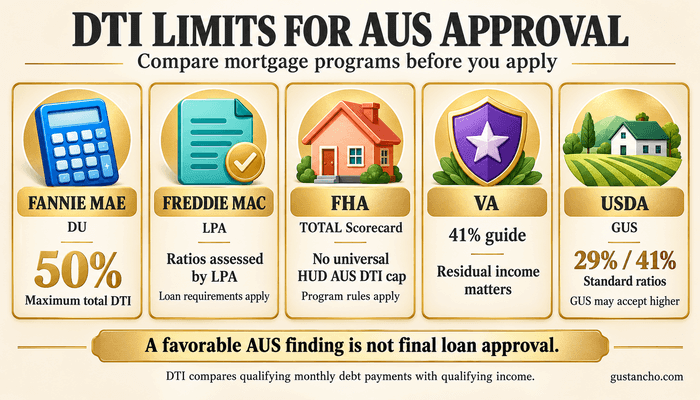
Maximum debt-to-income ratios for AUS approval vary by mortgage program. An automated underwriting system (AUS) evaluates the submitted loan information and provides an underwriting recommendation.
- Fannie Mae DU: Maximum total DTI of 50%.
- Freddie Mac LPA: Evaluates whether the submitted ratios are acceptable for the loan, subject to applicable product requirements.
- FHA: HUD does not publish a universal DTI maximum for every loan receiving a TOTAL Mortgage Scorecard Accept.
- VA: Uses 41% as a guide, with residual income central to the underwriting review.
- USDA Guaranteed: Uses standard ratios of 29% housing and 41% total debt, but GUS Accept findings can permit higher ratios.
A favorable automated finding still requires verified information and compliance with the loan program’s requirements and applicable lender policies.
FHA Debt-to-Income Ratios With Automated Underwriting
FHA does not publish one universal maximum DTI that applies to every borrower receiving an automated underwriting Accept.
The FHA TOTAL Mortgage Scorecard evaluates the borrower’s credit and loan information together and returns an Accept or Refer classification. HUD also makes clear that a lender cannot approve or deny an FHA-insured mortgage solely because of the TOTAL assessment.
This is why figures such as 46.9% front-end and 56.9% back-end should not be described as HUD’s universal maximum FHA AUS ratios. Some higher-DTI FHA files may receive an Accept, while another loan with a lower ratio may receive a Refer because of other risk factors.
A High FHA DTI Does Not Guarantee an Accept
The AUS can consider more than just the ratio. Credit history, reserves, loan-to-value ratio, housing payment increases, and other characteristics can affect the result. The borrower must also meet the underlying FHA guidelines and any applicable lender requirements, even after receiving an Accept. Manual underwriting follows a separate set of FHA debt-ratio and compensating-factor rules and should not be confused with automated underwriting.
Fannie Mae DU Maximum DTI Ratio
Fannie Mae publishes a clear maximum total DTI for loans underwritten through Desktop Underwriter. For a DU loan case file, the maximum allowable total debt-to-income ratio is 50%. That does not mean every borrower with a DTI below 50% will receive Approve/Eligible. DU evaluates the complete loan profile before making its recommendation. A borrower at 49% DTI may receive Approve/Eligible, while another borrower with a lower ratio may not.
What Happens if Fannie Mae DTI Exceeds 50%?
A DU loan with a recalculated DTI above 50% is not eligible for delivery to Fannie Mae under its standard DTI requirements. Changes during underwriting can also require the lender to recalculate the ratio or resubmit the loan through DU. This is why maximum debt-to-income ratios for AUS approval should not be viewed only at preapproval. New debts, reduced income, or changes to the proposed housing payment can affect DTI before closing.
Freddie Mac LPA Debt-to-Income Guidelines
Freddie Mac does not publish the same 50% automated-underwriting maximum that Fannie Mae uses for DU. For loans submitted through Loan Product Advisor, LPA evaluates the qualifying ratios together with the rest of the loan profile. If LPA returns an Accept recommendation, Freddie Mac has determined that the submitted ratios are acceptable for that loan, subject to verification and all other requirements. This means there is no single published LPA DTI number that should be treated as a universal maximum for every Freddie Mac loan.
Freddie Mac Manual Underwriting Is Different
Manually underwritten Freddie Mac loans follow separate qualifying-ratio and documentation requirements. A borrower whose ratios are acceptable through LPA may not qualify under the manual-underwriting standards.
VA Debt-to-Income Ratios and Residual Income
VA uses a total DTI of 41% as an underwriting guide, not as an absolute maximum. A borrower may still qualify with a DTI above 41% when the overall file supports the loan. VA places significant emphasis on residual income, which measures how much income remains after major monthly obligations are paid.
Why Residual Income Matters on VA Loans
A higher DTI receives closer review, but high residual income can help support the loan. VA guidance allows more favorable consideration when residual income exceeds the applicable requirement by at least 20%, subject to the complete underwriting analysis. This is why VA loans should not be described as having an unlimited DTI simply because the borrower receives an AUS approval. The lender still has to evaluate income, credit, debts, residual income, and the borrower’s overall ability to repay.
USDA GUS Debt-to-Income Ratios
USDA Guaranteed loans use standard repayment ratios of:
- 29% for the housing ratio
- 41% for the total debt ratio
Those numbers are important, but they are not hard maximums for every loan receiving a GUS Accept recommendation. A GUS Accept or Accept Full Documentation loan can exceed 29%/41% without requiring the same debt-ratio waiver used on certain manually underwritten or referred files.
Why 29%/41% Is Not a Hard GUS Accept Maximum
GUS evaluates more than the borrower’s ratios. Credit history, reserves, income stability, payment history, and other risk factors can affect the underwriting recommendation. For manually underwritten or certain referred USDA loans, separate ratio-waiver rules and compensating factors apply. That is why the USDA standard ratios should not be presented as the absolute maximum debt-to-income ratios for AUS approval.
FHA, VA, USDA, or Conventional—Which Program Fits Your DTI?
AUS approval can vary by loan type, credit profile, reserves, payment shock, and overall risk. Get a side-by-side review before assuming your DTI is too high.Why the Same DTI Can Lead to Different Mortgage Outcomes
Two borrowers with the same DTI can receive different findings or lending decisions. Understanding the reason means separating the four parts of the review:
- Automated risk recommendation: The system assesses the submitted loan information. Its findings should not be interpreted as proof that one particular characteristic caused the result.
- Program and product eligibility: The loan must meet the requirements of the selected program, including any applicable waiting periods after bankruptcy or foreclosure, occupancy rules, and property eligibility.
- Verification and underwriting review: The lender verifies and underwrites income, debts, assets, and other required information. It must also complete any required manual review or downgrade.
- Additional lender restrictions: A lender may impose stricter DTI, credit, reserve, or property requirements than the program requires.
Example: An Acceptable Risk Assessment With an Eligibility Problem
Fannie Mae DU may return an Approve/Ineligible result. This means the file passes DU’s credit-risk assessment but does not meet its loan-eligibility rules or fall within its acquisition criteria. This is different from a negative credit-risk recommendation. Check with your loan officer to find out which part of the review is blocking approval. Issues like program eligibility, unverified income, or a lender’s DTI limit each need a different solution.
Front-End DTI Versus Total Debt-to-Income Ratio
The front-end DTI, or housing ratio, compares your proposed monthly housing expense with your gross monthly qualifying income. The housing expense generally includes:
- Mortgage principal and interest.
- Property taxes.
- Homeowners insurance.
- Required flood insurance.
- Mortgage insurance, when applicable.
- Homeowners association dues, when applicable.
- Required payments on applicable second mortgages or other subordinate financing.
The total DTI, also called the back-end ratio, includes that housing expense plus other qualifying monthly obligations, such as auto loans, credit card minimum payments, student loans, and required support payments.
Example: Calculating Both DTI Ratios
Assume a borrower has:
- Gross monthly qualifying income: $8,000.
- Proposed monthly housing expense: $3,000, including applicable taxes, insurance, and other housing charges.
- Other qualifying monthly debt payments: $1,000.
The front-end ratio is: $3,000 ÷ $8,000 × 100 = 37.5% For total DTI, add the housing expense and other monthly debt payments: ($3,000 + $1,000) ÷ $8,000 × 100 = 50% This borrower has a 37.5% housing ratio and a 50% total DTI. These calculations illustrate the ratios; they do not establish mortgage eligibility. The income used in the denominator must be income that the lender can use for qualification under the loan program’s rules. It may differ from total earnings or bank deposits because some income requires additional documentation, an established history, or adjustments before it can be counted.
Which Automated Underwriting System Does Each Mortgage Program Use?
 There is no single automated underwriting system used for every mortgage. Different loan programs use different systems and risk-assessment methods.
Fannie Mae Desktop Underwriter
Fannie Mae uses Desktop Underwriter, commonly called DU. A common DU finding for an eligible conventional loan is “Approve/Eligible“.
Freddie Mac Loan Product Advisor
Freddie Mac uses Loan Product Advisor, commonly called LPA. LPA evaluates the loan information submitted by the lender and determines whether the qualifying ratios and overall credit risk are acceptable.
FHA TOTAL Mortgage Scorecard
FHA uses the TOTAL Mortgage Scorecard as part of automated underwriting. TOTAL itself is technically not an AUS. HUD describes TOTAL as a scorecard that works through an approved automated underwriting system. TOTAL produces an Accept or Refer classification. An Accept generally allows the loan to proceed without manual underwriting unless a manual downgrade is required. A Refer requires review by an FHA Direct Endorsement underwriter.
USDA Guaranteed Underwriting System
USDA Guaranteed loans may be evaluated through the Guaranteed Underwriting System, or GUS. GUS evaluates the borrower and the loan in accordance with USDA requirements and provides an underwriting recommendation. VA loans may also be submitted through an approved AUS, but VA underwriting requirements, including residual income, still apply.
Can Lender Overlays Lower the DTI Allowed by AUS?
Yes. A lender can apply its own debt-to-income limit even when the automated underwriting system accepts a higher ratio.
For example, an AUS may return an acceptable recommendation at a 49% total DTI, but the lender may have an internal policy limiting certain loans to 45%.
That lower limit is a lender overlay.
AUS Approval Does Not Override an Overlay
The lender is not required to approve every loan that receives a favorable AUS recommendation. Additional lender requirements can involve:
- Maximum DTI
- Minimum credit score
- Reserves
- Manual underwriting
- Recent credit events
- Property type
If a borrower meets the agency or AUS requirements but fails a lender overlay, another lender with different policies may evaluate the file differently. The borrower must still meet the actual loan program guidelines and complete the underwriting requirements.
What Happens When Your DTI Changes After AUS Approval?
An AUS approval is based on the information entered when the loan is submitted. If the borrower’s income decreases, monthly debts increase, or the proposed housing payment changes, the lender may need to recalculate DTI and resubmit the loan through the AUS. Common changes that can affect the result include:
- New auto loan or credit card account
- Higher property taxes or insurance
- Lower verified income
- Increased student loan payment
- New child support or other recurring obligation
- Changes to the loan amount or interest rate
A previous Approve/Eligible or Accept does not guarantee the same result after the file changes.
New Debt Before Closing Can Matter
Borrowers should avoid opening new credit or increasing balances before closing without first speaking with the loan officer. Even a small new monthly payment can change the total DTI enough to affect the AUS recommendation or lender eligibility.
High DTI Does Not Always Mean Mortgage Denial
Some borrowers may still receive AUS approval with higher ratios when the overall file is strong. We’ll review credit, reserves, residual income, and compensating strengths.Ways to Lower DTI Before Resubmitting to AUS
Before spending money to lower your DTI, ask your loan officer to compare the available options and confirm how each would affect qualification.
Compare Debt Payoffs
Compare the cash needed to pay off each debt with the monthly payment required to pay it off. A smaller payoff that eliminates a larger payment may help more than paying down a larger balance. Confirm that the loan program allows the payment to be excluded.
Calculate the Benefit of a Larger Down Payment
Request an updated estimate of your housing payment to see how a bigger down payment changes your principal, interest, and mortgage insurance. Then, compare the monthly savings to what you would save by paying off debt.
Check What Cash Would Remain
Figure out how much money you will have left after making your down payment, paying off debts, covering closing costs, and handling prepaid expenses. Make sure you still meet any reserve requirements before deciding what to do.
Review How Debts Are Counted
Ask your lender to review how your student loans, any duplicate debts, and debts paid by others are counted. Any changes or exclusions must follow the program’s documentation rules.
Confirm Additional Qualifying Income
Check if the income you already earn can be documented and counted. Income from overtime, commissions, rentals, or a second job may need a history of earnings and extra paperwork.
Illustration: Removing a $400 Monthly Payment
For example, if a borrower has $8,000 in qualifying monthly income and $4,000 in total monthly payments, their debt-to-income ratio (DTI) is 50%. If paying off a debt removes a $400 monthly payment, the total monthly obligations drop to $3,600. $3,600 ÷ $8,000 × 100 = 45% total DTI This example assumes your income and all other payments stay the same. The lender must verify that the payment can be omitted and provide proof of payoff.
Does a High DTI Automatically Mean Manual Underwriting?
No. A high-DTI loan may remain on the automated path if it receives a favorable AUS finding and no manual downgrade is required. A Refer or other unfavorable finding does not guarantee a manual underwriting option. The lender must confirm that the loan program permits manual underwriting, that the lender offers it, and that the borrower meets the applicable requirements.
Manual Underwriting Can Mean Tighter DTI Limits
A ratio accepted through automated underwriting may exceed the limits allowed for manual review. Manual underwriting, therefore, does not automatically solve a high-DTI problem. If FHA requires a manual downgrade, the file must satisfy FHA’s manual-underwriting rules even after an earlier TOTAL Accept finding. The previous automated recommendation cannot override those requirements. See our FHA manual underwriting mortgage guidelines for the applicable ratio categories and documentation requirements.
Final Thoughts on Maximum Debt-to-Income Ratios for AUS Approval
No single DTI limit applies to all automated mortgage approvals.
Fannie Mae sets a 50% maximum total DTI for DU. Freddie Mac’s LPA uses its own risk assessment to decide what ratios are acceptable. USDA’s 29% and 41% ratios are standard guidelines, but GUS may accept higher numbers. VA uses 41% as a guide and focuses on residual income. FHA TOTAL looks at the entire loan profile rather than relying on a single AUS maximum.
The important point is that DTI should never be reviewed by itself. Credit history, reserves, loan-to-value ratio, housing payment, income stability, and lender overlays can all affect the AUS result. A high DTI does not automatically mean denial, but a favorable AUS result must still be supported by accurate documentation and final underwriting.
FAQs About Maximum Debt-to-Income Ratios for AUS Approval
Does Paying Off a Credit Card Lower My DTI?
If a partial paydown reduces the qualifying monthly payment, then it is helpful. A full payoff, provided that the necessary documentation is available, will eliminate that payment. For Fannie Mae loans, any revolving balances paid off on or before the closing date can be excluded from the DTI without closing the account.
Can Paying Off an Auto Loan Improve AUS Results?
It can do so by lowering the DTI. The lender must verify that the payment can be excluded under the loan program’s rules and record the payoff. However, removing the payment does not ensure a favorable AUS outcome.
Can Rental Income Help Offset a High DTI?
So, provided that it satisfies the program’s requirements, the rental income may be used to offset the property’s housing expenses or included as qualifying income, depending on the type of property and the loan program. The lender won’t be able to automatically take into account the full amount of rent collected.
Does Student Loan Forbearance Remove the Payment From DTI?
Not automatically, a qualifying payment might still be necessary. Fannie Mae allows an income-driven repayment that is properly documented. If there is written evidence of a deferment extending for at least 12 months beyond the closing date, the VA may exclude the loan. These are different from the situation where no payment is currently due.
Can My Lender Decline the Loan After an AUS Approval?
Yes. The lender may decline if verified information does not support the submitted application, required conditions remain unmet, the property is ineligible, or the loan does not meet applicable lender requirements. Credit history, loan-to-value ratio, reserves, income stability, occupancy, property type, prior derogatory credit, and other factors can still affect the underwriting recommendation.
This article about “Maximum Debt-to-Income Ratios for AUS Approval by Loan Program” was updated on October 6th, 2026.