Quick Answer: Yes, overtime pay can count toward mortgage qualification, provided your lender can verify your earnings and that the income complies with your loan program’s rules. Two years of overtime is fairly typical. FHA, Fannie Mae, and Freddie Mac can look at 12 months in certain circumstances. VA will normally require two years of verified service for overtime to be considered as income. The amount the lender will use may be less than the amount you actually earned on your last pay cheque.
How Much Overtime History Do You Need?
Your lender reviews how long you’ve earned overtime, how regularly it’s paid, and whether the earnings are likely to continue. The rules depend on the loan program.
| Loan program | Overtime history and continuance |
|---|---|
| FHA | Two years is the standard. At least one year may be considered if the lender documents that the overtime was earned consistently and is reasonably likely to continue. |
| Fannie Mae conventional | Two years is recommended. A shorter history of at least 12 months may qualify when positive factors support it. The lender verifies continuance if there’s a reason to believe the overtime may stop. |
| Freddie Mac conventional | Two consecutive years is the standard. At least one year may qualify if the lender has enough documentation to support the stability of the income. The overtime must be likely to continue for at least the next three years. |
| VA | VA generally expects two verified years of consistent overtime, with a reasonable likelihood it will continue given the borrower’s hours and working conditions. |
VA also has a separate option if the overtime falls short of the standard for qualifying income. With at least 12 months of verified overtime, the lender may use it to offset debts lasting 6 to 24 months. The lender documents the reason on VA Form 26-6393. In this case, the overtime offsets eligible debt. It stays out of the qualifying-income total.
How Lenders Calculate Overtime Income
A lender reviews overtime separately from regular pay. To see whether it’s holding steady, rising, or falling, the lender compares the monthly pace of your year-to-date overtime with prior earnings. Comparing monthly amounts matters because six months of this year’s earnings cover a different period from all of last year.
For FHA forward mortgages, the lender compares two averages and uses the lower of the two. The first is the average over the previous two years, or the actual history if you have less than two eligible years. The second is the average over the previous year. This applies to both automated underwriting through FHA’s TOTAL Mortgage Scorecard and manual underwriting.
For Fannie Mae, when overtime is stable or increasing, the lender adds eligible prior-year and year-to-date earnings and divides by the number of months those earnings cover. The calculation must include at least 12 months of overtime income.
Example of How Overtime Changes Your Debt-to-Income Ratio
Suppose you earned $6,000 in overtime last year and $3,900 from January through June this year. If the earnings qualify under Fannie Mae’s rules, the lender divides $9,900 by 18 months and counts $550 per month in overtime.
With $5,000 in gross monthly base pay and $2,400 in monthly obligations, including the proposed housing payment, your debt-to-income ratio (DTI) is 48% using base pay alone. With eligible overtime, monthly qualifying income rises to $5,550, and DTI falls to 43.2%. To try your own numbers, use the mortgage debt-to-income ratio calculator.
What Happens If Your Overtime Drops?
The reason for the drop matters. A temporary plant shutdown and a permanent cut in extra shifts can look similar on a paystub, but they can lead to different underwriting decisions. For Fannie Mae, the lender must confirm that the lower level has stabilized before counting the income. If overtime continues to decline, it will be ineligible under that rule. Freddie Mac generally uses year-to-date earnings for a declining trend and requires further analysis if the drop exceeds 10%. A documented one-time event and evidence that earnings have recovered can change the calculation.
For an example of how lenders compare a lower current overtime amount with earlier earnings, see how underwriters calculate declining and irregular income.
What to Bring for Preapproval
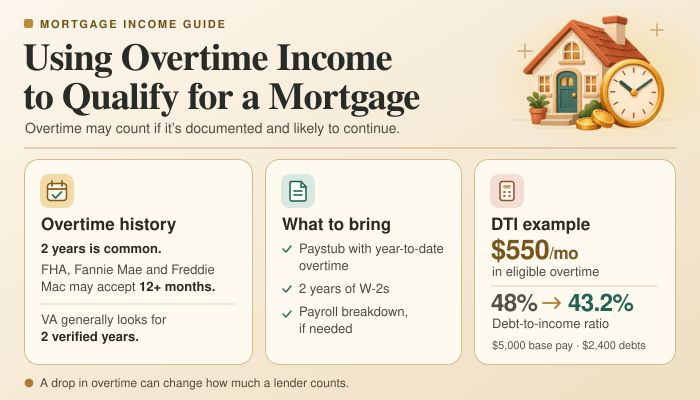
- A recent paystub with year-to-date overtime. Look for a separate overtime line so the lender can identify it apart from regular wages.
- W-2s for the two most recent years. If they show only total wages, pull your year-end paystubs or ask payroll for a breakdown showing how much of your pay came from overtime.
- Employer details and records of any changes. Flag a new employer, a change in shift availability, or a temporary interruption. Bring any payroll or employer records that explain when the change occurred and whether overtime resumed.
For example, Fannie Mae’s standard options are either a completed Form 1005 or the most recent paystub plus 2 years of W-2s. The lender also completes verbal employment verification or an allowable alternative under the guide.
Can You Count Overtime After a Job Change or a Break?
Overtime from a prior employer may help document your history. If you’re now working a similar job, bring pay records from both employers so the lender can see what you earned before the move and whether overtime is available and actually being paid at your new job. If your move also came with a permanent raise, the lender evaluates that change separately. See how mortgage underwriters view a recent increase in base pay.
If a documented one-time event outside your control temporarily prevented you from earning overtime, Fannie Mae allows the lender to exclude that period from the calculation. Payroll records showing when overtime resumed can help document the interruption and the current earning pattern.
Frequently Asked Questions About Using Overtime Income to Qualify for a Mortgage
Can Seasonal Overtime Count?
- It may count if payroll records show a recurring pattern and the income meets the loan program’s requirements. For example, if you regularly work extra shifts during the holidays, prior year-end paystubs can help the lender compare those earnings over time.
What If My Employer Cuts Overtime Before Closing?
- Tell your loan officer as soon as you know. If the lender used overtime to qualify you, the change may require a new income and DTI calculation. Ask how the revised amount affects the loan before relying on the earlier preapproval.
Does My Employer Have to Guarantee Overtime for Three Years?
- An employer guarantee is different from an underwriting determination that the income is likely to continue. Freddie Mac looks for a reasonable expectation of at least three more years. Fannie Mae generally requires a separate check on continuance only when the lender has reason to believe the overtime may stop.
Can Overtime From Two Jobs Count?
- Potentially. The lender evaluates whether income from both jobs can be used and whether the overtime from each job meets the applicable requirements. Keep the pay records separate so the lender can see how much each employer paid.
Can I Apply Using Only My Base Pay?
- Yes. If your eligible base pay is enough to qualify, the lender can calculate your DTI using that income. Ask for that calculation if you recently started earning overtime or expect your extra shifts to end.
Final Thoughts on Using Overtime Income to Qualify for a Mortgage
If overtime is the difference between qualifying and not qualifying, you should ask for an income review before making an offer. Gustan Cho Associates can review your pay records and tell you which program rules apply. You should ask what level of monthly overtime the lender will support and what your DTI would be if you used base pay only.
This article about “Using Overtime Income to Qualify for a Mortgage: FHA, VA, and Conventional Guidelines” was updated on November 6th, 2026.