

Homeowners who should refinance now: who can benefit most in 2026?
Not every homeowner should refinance right now. But for some borrowers, refinancing can still be a smart way to lower monthly payments, reduce interest costs, or move into a more stable loan. The key is knowing whether the numbers work f
or your situation.
The homeowners who should refinance now are usually those with higher mortgage rates, homeowners who need to remove a spouse after divorce, and borrowers who took out higher-cost loans when they did not qualify for traditional financing.
If your credit’s looking better, your home’s worth more now, or your finances are in a better spot than when you first got your mortgage, you could snag some better loan terms today. This guide explains which homeowners should refinance now, how to tell whether refinancing makes financial sense, and what to review before applying. Instead of chasing headlines about mortgage rates, homeowners should focus on savings, closing costs, loan structure, and long-term goals. When refinancing is done for the right reason, it can improve both your budget and your financial flexibility.
Refinance After Divorce: Removing a Spouse From the Mortgage

After a divorce, one of the most common next steps is refinancing the mortgage into one person’s name. This is usually needed when one spouse keeps the home, and the other is removed from both the mortgage and, when required, the title.
Refinancing after divorce can simplify ownership and make future payments easier to manage. It also gives the spouse keeping the home a chance to replace an older loan with a more affordable fixed-rate mortgage, depending on credit, income, home equity, and current market conditions.
Before applying, review your divorce decree carefully. Make sure it clearly explains who keeps the home, who is responsible for the mortgage, and whether one spouse must buy out the other’s share of equity. Lenders may also require supporting legal documents as part of the refinance process. The key consideration for homeowners who should refinance now is whether the remaining homeowner can qualify for the new mortgage on their own. This involves the lender evaluating factors such as current income, credit history, debts, and the property’s equity. If these criteria align, refinancing can effectively remove the ex-spouse from the loan, paving the way for a more straightforward financial future. This process can feel overwhelming during divorce, so it helps to work with a lender who understands divorce-related refinance transactions and can explain each step clearly.
Homeowners With Mortgage Rates Above 7%
Homeowners who should refinance now, especially those with mortgage rates over 7%, may find it worthwhile to explore refinancing options. Even a small decrease in the interest rate can lead to reduced monthly principal and interest payments. However, the actual advantage will vary based on factors like the loan amount, the new interest rate, closing costs, and how long the homeowner intends to remain in the property. Instead of relying on rough payment examples, it is better to look at the full picture. A refinance may make sense if it lowers your monthly payment, reduces the total interest you will pay over time, or helps you move from a less favorable loan into a more stable fixed-rate mortgage. For some homeowners, refinancing may also create an opportunity to remove mortgage insurance if they now have enough equity. The most important step is to compare the total cost of the new loan against the savings. Ask for a loan estimate, review the interest rate, lender fees, and monthly payment, and calculate how long it will take to recover the closing costs. If the savings are meaningful and the break-even point fits your plans, refinancing may be a smart move. Homeowners with rates above 7% should not focus solely on headline rates. They should focus on whether the refinance improves their overall financial position clearly and measurably.
Homeowners With Non-QM Loans May Benefit From Refinancing
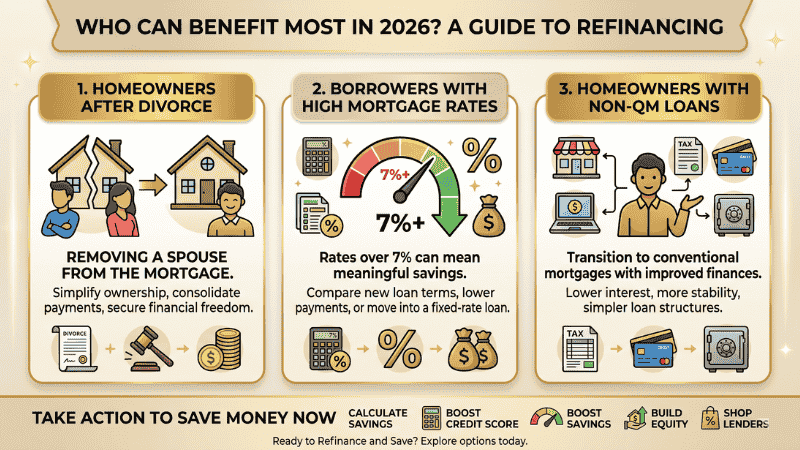
Homeowners who should refinance now, particularly those with non-QM loans, might benefit from refinancing if their financial situation has improved since obtaining their original mortgage. Non-QM loans often serve as a valuable option for self-employed borrowers who rely on alternative income documentation or who struggled to qualify for traditional financing at the time. However, if there have been advancements in income, credit, or overall loan eligibility, transitioning to a more conventional mortgage could result in significant savings.
A refinance may lower the interest rate, reduce the monthly payment, or move the homeowner into a more stable fixed-rate loan. It also helps eliminate features that are less favorable over time, such as adjustable rates, short-term structures, or prepayment penalties.
For many borrowers, the goal is not just a lower rate, but a loan that is simpler, more predictable, and better suited for long-term homeownership. This section is especially relevant for self-employed homeowners who now have stronger tax returns or more consistent documentable income, borrowers whose credit scores have improved, and homeowners who want to replace an adjustable-rate or balloon loan with a more stable mortgage. If your financial situation is stronger today than when you first took out the non-QM loan, refinancing may be worth exploring. The best way to evaluate this option is to compare your current loan terms with what you may qualify for now. If the new mortgage lowers your costs or improves the structure of your loan, refinancing could be a smart next step.
Next Steps: Homeowners Who Should Refinance Now To Save Money
- Check Your Credit First: If your score is between 620 and 680, you will likely qualify for a conventional or FHA loan.
- Gather Your Docs: Collect the paperwork lenders need—usually tax returns, bank statements, or other income documents—to prove you can carry a new loan.
- Shop for Lenders: No lender is the same, so compare your refinance options.
- Look for those with a solid track record in moving Non-QM borrowers to conventional mortgages.
These steps can now position you for lower rates, better terms, and more peace of mind.
Why Refinance Now?
- Monthly Savings: A drop from 7.5% to 6% on a $300,000 loan could reduce your monthly payment by more than $200.
- Long-Term Gain: Cutting just 1% from your rate might save you tens of thousands in interest over the life of a 30-year loan.
- Market Conditions: Changes like new tariffs and tax reforms can increase rates.
- Locking in a lower rate now can shield you from those future hikes.
Who Should Act?
- Homeowners who bought or refinanced during the high-rate years of 2022 and 2023.
- Anyone with a fixed-rate loan over 7% or an adjustable-rate mortgage (ARM) is about to reset.
- Borrowers who have boosted their credit score or gained Equity can now qualify for new, lower rates.
Action Steps
- Calculate Savings: Use a refinance calculator to see how your current payment compares to a new one.
- Boost Your Credit Score: Pay off debts and stay on time with bills to unlock better interest rates.
- Build Equity: If your home value has jumped, a higher equity stake (20% or more) can eliminate Private Mortgage Insurance (PMI).
- Shop Lenders: Get quotes from at least three different lenders to find the best rates and the lowest fees.
What to Review Before Refinancing
Before refinancing, homeowners should focus on the factors that directly affect savings. Start by comparing your current mortgage rate, monthly payment, and loan term to the new loan being offered. Then look at closing costs and lender fees, and how long it will take to recover them through monthly savings. It is also important to review your credit score, income, debt-to-income ratio, and home equity. These factors affect the rate and loan terms you may qualify for. In some cases, refinancing can also help remove mortgage insurance or move a borrower from a less favorable loan into a more stable fixed-rate mortgage. The aim is not solely to secure a lower rate; it’s to enhance your overall financial situation. For homeowners who should refinance now, if doing so results in lower payments, reduces long-term interest expenses, or better aligns with your current needs, it could be beneficial to proceed with the refinance.
Costs vs. Benefits
- Closing Costs: Plan on 2–5% of the new loan amount for fees.
- To see if the move pays off, find your break-even point.
- Example: $5,000 in fees and $200 in monthly savings means you’ll break even in 25 months.
- Loan Term: A longer term cuts your monthly payment but usually costs more in interest.
- A shorter term, like a 15-year loan, boosts your payment but saves on interest over time.
Eligibility Tips
- Credit Score: You should hit a 620 or higher for a conventional loan and 580 or higher for FHA loans.
- Debt-to-Income Ratio (DTI): Depending on the loan type, aim for a front-end DTI of under 28–31% and a total DTI of under 43–50%.
- Equity: Having at least 20% Equity in the home means avoiding private mortgage insurance (PMI) and usually getting better loan terms.
How to Get Started with Refinancing
- Assess Your Goals: Determine whether you want a lower monthly payment, a shorter loan term, or to take a co-borrower off the mortgage.
- Check Your Credit: I’d like you to get a free copy of your credit report.
- Fix any errors or clear up high balances.
- Gather Documents: You’ll need pay stubs, tax returns, bank statements, and any divorce decrees if they apply.
- Compare Lenders: Use online calculators or talk to mortgage brokers to hunt for the best rates and loan terms.
- Apply Promptly: Rates can change daily, so lock in a good rate as soon as you see it.
Ready to Refinance and Save on Your Mortgage?
Explore refinancing options and start saving money now with a better rate.
Why Homeowners Should Focus on Timing Carefully
Refinancing is not just about chasing the lowest rate on the market. It is about knowing whether the timing makes sense for your financial goals. For some homeowners, refinancing now may be a smart move if it lowers the monthly payment, reduces long-term interest costs, or replaces a less favorable loan with a more stable one. Instead of trying to predict exactly where mortgage rates will go next, homeowners should focus on the numbers in front of them today. Compare your current mortgage rate, loan term, and monthly payment with the new loan being offered. Then review the closing costs, lender fees, and the time required to recover those costs through monthly savings. Homeowners who should refinance now should consider it if the new loan clearly and measurably enhances their financial situation. The right moment to refinance isn’t solely dictated by market trends; it’s when obtaining a new loan enables you to save money or aligns better with your current requirements.
Why Waiting for the Perfect Rate Can Backfire
Many homeowners wait to refinance because they hope mortgage rates will fall even more. While that may sound sensible, waiting too long can cause borrowers to miss a savings opportunity that already makes sense today. Mortgage rates can fluctuate rapidly, and short-term changes are difficult to predict with certainty. This is why homeowners who should refinance now shouldn’t rely solely on market headlines when making their decision. Instead, it’s more effective to consider your current rate, the new rate being offered, your potential monthly savings, and your break-even point. If refinancing lowers your payment or reduces the total cost of your mortgage in a meaningful way, it is worth acting even if rates change again later. The goal is not to time the market perfectly. The goal is to improve your financial position when the numbers make sense.
Freddie Mac 30 Year Mortgage Rates
Freddie Mac 30 year fixed mortgage rates are at 6.75% for prime borrowers which is a 0.78% basis point improvement from January mortgage rates. Freddie Mac’s 15 year fixed mortgage rates are still at recent lows with a 6.75% average for prime conventional borrowers. Refinancing at today’s rates may save homeowners with higher mortgage rates save tons of interest over the term of their mortgage loan.
The Types of Homeowners Who Should Refinance Now
Homeowners who have bought their homes prior to July 2017 should examine what interest rates they have and see what today’s rates are and see if they can benefit from a refinance mortgage. Also, homeowners who have an FHA insured mortgage loan should examine if they qualify for a conventional loan. They should see if they qualify for a conventional loan. Should explore the idea of refinancing their FHA loan to a conventional loan. This is either to reduce their monthly mortgage insurance or eliminate their mortgage insurance altogether.
When a Standard Refinance Makes More Sense Than Other Refinance Options
Homeowners who want to save money should focus on refinancing options that improve their current mortgage. In most cases, that means considering a rate-and-term refinance, which is designed to lower the interest rate, reduce the monthly payment, extend the loan term, or move the borrower into a more stable loan structure. This approach is usually a better fit for homeowners whose main goal is savings. It keeps the focus on lowering borrowing costs rather than increasing the loan balance. For borrowers who qualify, a standard refinance may also help remove mortgage insurance, replace an adjustable-rate mortgage with a fixed-rate loan, or create more predictable monthly payments.
The most important question is simple: When does a standard refinance make more sense than other refinance options?
Homeowners who want to save money should focus on refinancing options that improve their current mortgage. In most cases, that means considering a rate-and-term refinance, which is designed to lower the interest rate, reduce the monthly payment, extend the loan term, or move the borrower into a more stable loan structure. This approach is usually a better fit for homeowners whose main goal is savings. It keeps the focus on lowering borrowing costs rather than increasing the loan balance. For borrowers who qualify, a standard refinance may also help remove mortgage insurance, replace an adjustable-rate mortgage with a fixed-rate loan, or create more predictable monthly payments. The most important question is simple: Does the new loan put the homeowner in a stronger financial position than they are in now? If the answer is yes, and the savings outweigh the closing costs, refinancing may be worth considering.
Final Thoughts on Why Homeowners Who Should Refinance Now
The homeowners who should refinance now are those with a clear financial reason to do so. If refinancing can lower your monthly payment, reduce long-term interest costs, remove a former spouse from the mortgage, or replace a higher-cost loan with a more stable one, it may be worth taking a closer look.
The key is to focus on real savings, not just headlines about mortgage rates. Homeowners should compare their current loan with today’s options, review closing costs carefully, and determine whether the new mortgage improves their overall financial position. A refinance only makes sense when the benefit is clear, and the numbers support the decision.
For homeowners with non-QM loans, homeowners going through divorce, and homeowners with mortgage rates above 7%, refinancing is a practical way to improve cash flow and create more long-term stability. The next step is to check in on your goals, gather your paperwork, and chat with a lender who can review your options based on where you’re at right now. When done for the right reason, refinancing is not just a loan change. It can be a smart financial move that helps homeowners save money and move forward with more confidence.
Frequently Asked Questions About Homeowners Who Should Refinance Now:
Should I Refinance My Mortgage Now or Wait?
Homeowners should refinance now when the new loan creates a clear financial benefit. This typically indicates a lower interest rate, a smaller monthly payment, a shorter loan term, or a more reliable fixed-rate mortgage. Waiting only makes sense if the current offers do not improve your position enough to justify the closing costs.
How Much Should My Interest Rate Drop Before Refinancing Makes Sense?
There is no single rule that fits everyone. A 1% drop can be meaningful, but even a smaller reduction may still be worth it depending on your loan balance, monthly savings, and closing costs. The better way to decide is to calculate your break-even point and compare that timeline with how long you expect to stay in the home.
What Are The Main Costs Of Refinancing A Mortgage?
The main refinance costs usually include lender fees, title charges, and other closing costs. Before moving forward, homeowners should review the full loan estimate and determine how many months of savings it will take to recover those upfront costs. If the savings outweigh the costs in a reasonable timeframe, refinancing may be worthwhile.
Do I Have To Refinance With My Current Mortgage Lender?
No. Homeowners aren’t stuck refinancing with their current lender. In many cases, shopping with multiple lenders is one of the smartest ways to save money because rates, fees, and loan terms can vary. Comparing offers helps you see whether refinancing truly improves your financial position.
Can I Refinance If My Credit Score Has Improved?
Yes. A better credit score is one of the most common reasons homeowners refinance. If your credit score has gone up since you got your mortgage, you might be eligible for a better interest rate or improved loan terms, making refinancing a pretty appealing option.
How Will Refinancing Really Save Me Money?
The best way to tell is to compare your current loan with the new offer side by side. Look at the interest rate, monthly payment, loan term, closing costs, and total long-term savings. Homeowners who should refinance now are the ones whose new loan provides measurable savings or solves a real financial need, not just those reacting to rate headlines.
This article about “Homeowners Who Should Refinance Now To Save Money” was updated on April 23rd, 2026.