
Quick answer: FHA property standards require a property to be safe, sound, and acceptable as mortgage collateral. An older property can qualify without any renovation, and cosmetic wear and tear doesn’t necessarily require repairs. The FHA appraiser will report their observations, and the lender will then determine whether the property meets the applicable requirements. Safety hazards, structural damage, roof problems, unsafe utilities, and inadequate access can all be reasons for repairs or further inspection. An FHA appraisal differs from a home inspection.
What Are FHA Property Standards?
FHA property standards are HUD requirements used to determine whether a home is acceptable for an FHA-insured mortgage. The basic concerns are safety, soundness, and security. Safety concerns occupant health and hazards. Soundness concerns the home’s structural condition. Security includes whether the property can serve as acceptable mortgage collateral.
An outdated kitchen or worn finish does not necessarily create a property deficiency. Exposed wiring, serious foundation movement, or an active roof leak presents a different concern because it can affect safety, the structure, or continued use of the home.
HUD’s Single-Family Housing Policy Handbook 4000.1 is the primary policy reference. The appraiser reports on property conditions within the scope of the appraisal; the lender reviews the report and determines the property’s acceptability.
Minimum Property Requirements vs. Minimum Property Standards
Minimum Property Requirements (MPR) usually apply to existing homes. Minimum Property Standards (MPS) are for new construction. HUD uses construction-status definitions to decide which rules apply, not just how a home looks. This guide mainly covers existing homes. New construction and certain property types, such as manufactured homes and condos, may have additional requirements. As of November 6, 2026, HUD’s proposal to update MPR remains a draft and is not yet in effect. Do not treat the proposed changes as current rules. However, the well-distance waiver from July 2026, explained below, is already in effect.
FHA Appraisal vs. Home Inspection
An FHA appraisal estimates the market value and reports observable conditions that affect the property’s eligibility. It does not provide a complete diagnosis of every building component or guarantee that the home is free of hidden defects. A buyer schedules a home inspection for a detailed assessment of the property’s condition. Depending on the findings, separate evaluations by a roofer, a structural engineer, an electrician, or another specialist may also be useful. HUD’s For Your Protection: Get a Home Inspection explains why an appraisal does not replace an inspection. Buyers should consider scheduling their inspection early enough to evaluate the results within their purchase contract deadlines. For a broader explanation of the mortgage appraisal process, see FHA appraisal guidelines. For differences between programs, see FHA appraisals versus conventional appraisals.
Cosmetic Issues That May Be Acceptable
Normal wear and tear, dated finishes, and minor deferred maintenance can be acceptable provided they don’t impact safety, soundness, or the security of the property as collateral. Examples include worn countertops, soiled carpeting, small holes in the window screens, and minor damage to the interior finishes in a newer property.
Condition and location are important. Worn carpeting may be purely cosmetic, but loose flooring which creates a tripping hazard is a different matter. A crack in the pavement isn’t automatically a disqualifier; it’s uneven pavement which presents a safety issue that may require a different assessment.
Cracked glass, missing handrails, and plumbing leaks shouldn’t be accepted as the norm. The appraiser will assess the actual condition and whether it poses a hazard, causes damage, or interferes with normal use. Cosmetic defects can also affect the value, even if no repairs are necessary.
Roof Requirements for FHA Home Loans
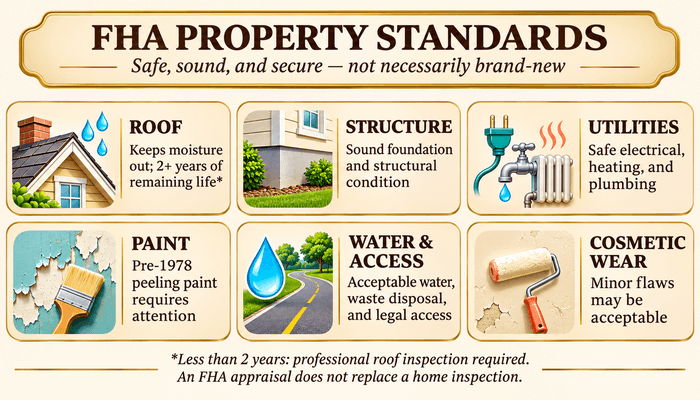 A roof does not have to be new. Under the roof-covering provisions in Handbook 4000.1, Section II.D.3.g, the roof covering must protect against moisture and have at least 2 years of remaining physical life. If the appraiser reports less than two years of remaining life, the appraisal must be subject to inspection by a professional roofer. The inspection findings help determine whether repairs or replacement are necessary. Roof age alone does not determine eligibility. A maintained older roof may be acceptable, while a newer roof with an active leak or defective installation may require attention. Meeting the roof requirement does not, by itself, establish that the rest of the property meets FHA standards.
Peeling Paint and Lead-Based Paint
Paint requirements depend partly on when the dwelling or related improvements were built.
Homes Built Before 1978
The appraiser must report defective paint surfaces subject to HUD’s lead-based paint requirements. Peeling, chipping, flaking, scaling, or loose paint may require treatment. Defective paint does not establish the presence of lead, but it must be addressed under the applicable rules. Required treatment involves proper paint stabilization and cleanup, rather than simply concealing the damage. Buyers and sellers should confirm the required work and completion documentation with the lender before arranging repairs.
Homes Built in 1978 or Later
Minor interior paint defects may be cosmetic. However, defective exterior paint that exposes the underlying surface to the elements can require repair. Surfaces designed to withstand weather without paint, such as suitable pressure-treated wood, are evaluated differently. HUD addresses these distinctions in Handbook 4000.1, Section II.D.3.i, Defective Paint.
Is the Home You Want to Buy FHA-Eligible?
FHA property standards can affect whether a home qualifies and whether repairs are needed before closing. Discuss the property and your financing options with Gustan Cho Associates.Electrical, Heating, Plumbing, and Utilities
Essential systems must support safe residential use. Their age alone does not determine whether they meet FHA property standards.
Electrical and Heating Systems
If there is exposed or frayed wiring, unsafe components, or an electrical system that does not meet normal residential needs, repairs or further evaluation may be needed. The appraisal only involves a visual check and basic operation, not a full electrical inspection. The heating system should be permanently installed, safe to use, and able to keep the home healthy and comfortable, in accordance with HUD requirements. It needs to heat living areas properly and protect parts that could freeze.
Plumbing and Water Heaters
The appraiser looks for visible plumbing problems, such as leaks, low pressure or flow, broken fixtures, and issues with hot water or waste removal. A water heater must have a proper temperature-and-pressure relief valve with piping that safely directs any escaping water or steam.
When Utilities Are Off
If utilities are unavailable, the appraiser may be unable to verify that systems operate properly. The appraisal must address that limitation, and the lender must obtain the required verification in accordance with HUD’s procedures. Ask the lender what must be activated, who can verify operation, and what evidence is required. Restoring utilities can reveal additional deficiencies that were not visible during the original visit. These subjects are addressed in Handbook 4000.1, Section II.D.3.f, Utilities—Mechanical Components.
Foundation, Basement, Attic, and Crawl-Space Requirements
Significant foundation cracking, wall bowing, settlement, deterioration, and so on can all require a professional assessment. A small crack in itself doesn’t necessarily indicate a serious structural defect, though you may well need to establish the cause and extent of the crack. Basements are inspected for dampness, water ingress, and any visible structural conditions that could affect occupants or the building. The issue is whether it’s a deficiency, rather than whether the basement is finished or even particularly attractive. The appraiser will visually inspect the attic and crawl space to the extent that they are safely accessible. They are not required to disturb any insulation or move any items that obstruct access or visibility. Inaccessible areas must be reported. A qualified third-party inspection will be required where further observation is required to determine compliance with the applicable property requirements. Standing water, excessive moisture, poor ventilation, or visible structural damage may require further inspection/repair. See Handbook 4000.1, Sections II.D.3.j-l for observation requirements.
Water, Wells, and Septic Systems
The property must have an acceptable water supply and sanitary waste-disposal system. A private well or septic system does not automatically make a home ineligible for FHA financing.
July 2026 Well-Distance Waiver for Existing Homes
On July 27, 2026, HUD issued a well-distance waiver. This allows existing homes to follow the local jurisdiction’s distance rules rather than the standard Handbook distances, provided the lender documents acceptable water-testing results. The local jurisdiction refers to the health authority, environmental agency, or municipality that has inspected, permitted, or grandfathered the private water system as it is now. The waiver does not apply to new construction and does not change water-quality requirements. Check HUD’s active housing waivers and the July 27 announcement, FHA INFO 2026-17, on the FHA INFO page. Lenders should confirm local requirements and needed documentation as early as possible.
Septic-System Concerns
The appraiser looks for visible signs of failure or malfunction. If there is sewage surfacing, drainage issues, or other clear problems, repairs or more inspection may be needed. This check does not replace a full septic-system evaluation.
Private Roads, Shared Driveways, and Property Access
FHA requires safe pedestrian access and sufficient vehicular access from a public or private street. A rural dwelling can qualify even if it’s not directly on a public road.
Private streets and shared driveways must have appropriate legal protection via a permanent recorded easement, an ownership interest, or ownership and maintenance by a Homeowners Association. HUD’s access rule does not, in itself, require a joint maintenance agreement.
That distinction in no way removes any of the other applicable legal, title, or lender requirements. Get access rights sorted early, as missing easements or unclear ownership can all but halt the financing even if the property itself is in perfect condition.
Environmental Hazards and Flood-Zone Concerns
Issues such as drainage problems, unstable soil, sinkholes, contamination, or nearby hazards can affect whether a property is acceptable. The appraiser notes any visible concerns, and the lender decides if more information, repairs, or a different decision is needed. Being close to a hazard does not always have the same effect. Some issues can be fixed, but others might make a property ineligible. Buyers should not assume that insurance or a specialist’s inspection will solve every problem with a site.
A Flood Zone Is Different From Flood Damage
Some properties in Special Flood Hazard Areas can qualify when applicable HUD eligibility and flood-insurance requirements are satisfied. Requirements can differ by construction status and property type. Actual flood damage is a separate condition issue. Unresolved water damage, structural problems, or other deficiencies still require evaluation. Flood insurance does not substitute for addressing required repairs. Consult the Handbook’s property-eligibility provisions with the lender for the specific property.
What Happens When the FHA Appraisal Requires Repairs?
An appraisal that is “subject to” repairs or inspection will identify the conditions that need to be addressed through the relevant loan process. It doesn’t necessarily put the purchase off right away, but the parties need to be aware of the nature of the work, the cost, and the impact on the closing schedule.
- Review the exact condition. Work out whether the appraisal requires a specific repair, a specialist’s inspection or both.
- Confirm the scope and payment arrangements. The buyer, the seller, and their agents need to be clear about their responsibilities under the purchase contract and any agreed changes.
- Ask the lender about completion evidence. Confirm the required qualifications (and permits where relevant), and find out whether verification will be via a completion inspection or some other acceptable form of documentation.
- Allow time for review. The lender must have the opportunity to review and confirm that the requisite conditions have been satisfied through the appropriate process before the transaction proceeds.
For a standard FHA purchase, the required property repairs must be completed before closing. Any permitted exception or repair escrow must comply with applicable HUD rules and be approved by the lender; it should never be assumed to be available. A repair/completion inspection confirms the work has been carried out to specification. An appraisal update assesses whether the existing appraisal remains valid under the relevant rules. They are different things, so you need to know which report or evidence the lender actually wants.
Illustrative Example: A Required Electrical Repair
An appraiser identifies exposed wiring and makes the appraisal subject to correction. The buyer and seller will decide who will handle the work and cover its costs. Before work begins, they confirm the lender’s repair and verification requirements. After the correction, the lender reviews the required evidence of completion.
Options When the Home Needs Substantial Repairs
The available solution depends on the property, the scope of repair, the purchase contract, and the loan program.
Complete Repairs Before Closing
The parties may arrange for required work before closing, subject to the seller’s permission and the lender’s requirements. Get the repair scope and completion process clear before spending money or scheduling contractors.
Renegotiate the Purchase
The buyer and seller can negotiate payment responsibility, price, and closing date. A lower price or seller credit does not, by itself, satisfy an FHA property repair condition. If agreement is impossible, the parties should review their contractual options with their real estate professionals.
Consider FHA 203(k) Renovation Financing
For an eligible property and borrower, an FHA 203(k) rehabilitation mortgage can combine the purchase price and eligible renovation costs into a single loan. Unlike a standard purchase requiring repairs first, the program provides a structured process for approved rehabilitation after closing. The lender must approve the project, budget, and applicable program requirements. Not every property, project, or lender qualifies. Discuss renovation financing before assuming a standard FHA purchase can accommodate unfinished repairs. Homeowners seeking improvements to a property they already own can also review refinancing into an FHA 203(k) loan.
How to Prepare Before the Appraisal
Buyers, sellers, and agents can avoid delays by taking care of practical questions early on:
- Make sure utilities are turned on so system checks can be done.
- Set up access to the home, attic, and crawl spaces so they can be reached safely.
- Point out any leaks, electrical issues, damaged paint, or structural problems you know about.
- Collect any documents you have about the well, septic system, or property access.
- Allow extra time for inspections by specialists, any needed repairs, and for your lender to review everything.
Getting ready in advance doesn’t guarantee the property will be approved, but it helps everyone spot problems before they slow down closing.
FAQs About FHA Property Standards
Does an FHA Home Have to Be Move-In Ready?
The home must meet all applicable HUD property requirements but needn’t have a remodeled kitchen, new flooring, or any modern finishes. Outdated décor is acceptable. The absence of essential services or the existence of unresolved safety and structural deficiencies are separate issues. There is a separate process for obtaining eligible renovation financing for a property that requires work.
Does the Seller Have to Pay for FHA-Required Repairs?
An appraisal repair condition does not, in itself, mean that the seller is responsible for payment. It’s the purchase contract, the negotiations, and the requirements that will determine who pays, who arranges the work, and how the work is to be completed. You need to be absolutely clear on that.
Can the Buyer Pay for Repairs Before Closing?
Possibly with the right arrangements and lender approval. The seller must authorize the work, and the scope of work and payment terms must be agreed upon and documented. A buyer who’s spent money before ownership will also have to consider what happens if the purchase doesn’t go through.
Does FHA Require a Termite Inspection on Every Existing Home?
No. Evidence of infestation, relevant damage, the appraisal findings, and any applicable state and local requirements can trigger an inspection. If treatment or structural repairs are required, then the lender must be provided with acceptable evidence that the conditions have been remedied.
Will a Lower Purchase Price Remove a Required Repair?
No. Price and property condition are separate considerations. Renegotiating the price may help the parties manage costs. However, an unresolved FHA property deficiency still requires an acceptable solution through the loan process.
Can a Lender With No Overlays Waive FHA Property Requirements?
No. Lender overlays are additional requirements imposed by lenders beyond a program’s minimum rules. Offering financing without additional overlays does not allow a lender to disregard applicable FHA property requirements or unresolved appraisal conditions.
Final Thoughts on FHA Property Standards
An older or outdated-looking home can still qualify for FHA financing if it meets the property requirements. Instead of worrying about every flaw, focus on the home’s actual condition, what the appraiser finds, and what the lender requires as proof. If a problem comes up, figure out if it needs to be fixed, checked by a specialist, documented, or if you need to consider another type of loan. Getting a home inspection and looking into any known issues early can help you make a smarter buying decision.
This article about “FHA Property Standards: HUD Minimum Property Requirements for FHA Loans” was updated on November 5th, 2026.