

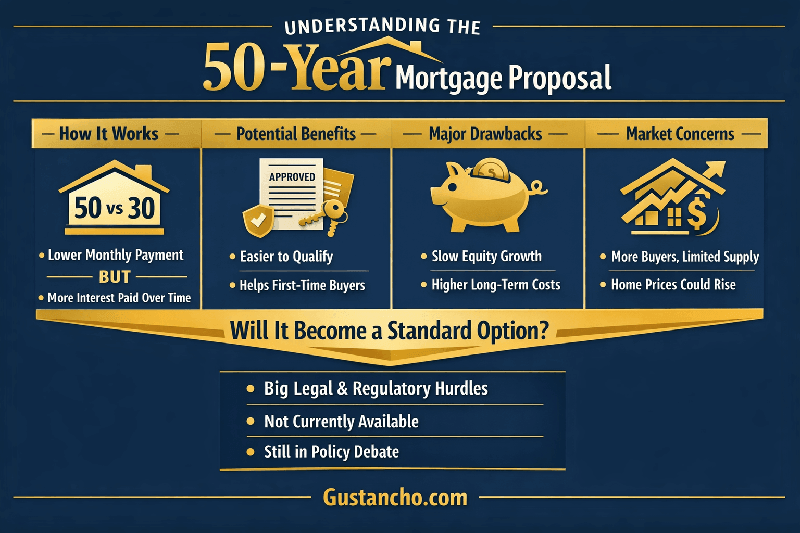
Trump’s 50-year mortgage proposal has drawn attention because it promises lower monthly payments by stretching the loan term far beyond the standard 30 years. In simple terms, a 50-year mortgage could make the required payments more affordable on paper, but it would also increase the total interest paid over time and slow the rate at which homeowners build equity.
John Strange, a senior mortgage loan originator at Gustan Cho Associates says the following about Trump’s 50-year mortgage:
At this time, a 50-year mortgage is not a standard agency-backed home loan available to most U.S. buyers. That means borrowers should view it as a policy discussion rather than an active mortgage option they can shop for today. Still, the idea matters because it raises an important question: Does a lower monthly payment really make homeownership more affordable, or does it simply stretch debt over a much longer period?
For some first-time buyers and payment-sensitive households, a longer term could improve monthly cash flow and debt-to-income ratios. But the biggest risks are clear: much higher lifetime interest costs, slower equity growth, and a greater chance of staying in debt far longer than expected.
How a 50-Year Mortgage Could Affect Homebuyers and Homeowners
A 50-year mortgage could affect both homebuyers and current homeowners by lowering the required monthly payment, but it would also change the long-term cost of borrowing. By stretching repayment over a longer period, the loan may make homeownership look more affordable at first glance. That could help some buyers qualify more easily, especially in a high-rate, high-price housing market.
At the same time, lower payments do not automatically make a home a better financial deal. A longer loan term usually means paying much more interest over time and building equity more slowly. For homeowners who want to refinance, sell, or build wealth through homeownership, that trade-off can be significant.
There is also a broader market concern. If more buyers can qualify because of lower monthly payments, demand could rise without solving the underlying shortage of affordable homes. In that case, home prices could increase further, worsening affordability problems rather than improving them.
For that reason, a 50-year mortgage is best understood as a payment-reduction idea with meaningful long-term trade-offs, not a simple solution to housing affordability.
See how a 50-year term changes your payment
Model monthly savings vs. 30-year and the trade-off in total interest
How a 50-Year Mortgage Could Change Affordability and Buyer Demand
The 50-year mortgage proposal is being discussed as a possible way to lower monthly housing payments in today’s high-rate, high-price market. The main idea is simple: if borrowers repay a loan over a longer period, the required monthly payment can be lower than it would be on a standard 30-year mortgage.
That lower payment could help some buyers qualify more easily. For first-time buyers and households with tight budgets, a longer loan term may improve debt-to-income ratios and make homeownership feel more reachable on paper.
However, lower monthly payments do not eliminate the real cost of borrowing. A 50-year term means paying far more interest over the life of the loan and building equity at a much slower pace. That can make refinancing, selling, or building long-term wealth more difficult.
There is also a market-wide concern. If more buyers qualify because of lower monthly payments, demand could rise without increasing the supply of homes. In that case, home prices could move even higher, which would reduce or even cancel out the affordability benefit.
Why the 50-Year Mortgage Proposal Started Getting Attention
The idea of a 50-year mortgage gained attention after public comments from Trump and discussions from housing officials about possible ways to address affordability. Supporters of the concept argue that extending the loan term could lower monthly payments and help more buyers qualify in a high-cost housing market.
At the same time, the proposal remains a policy discussion rather than a standard mortgage option available to most U.S. homebuyers. That is why it is important to separate public debate from actual loan availability.
How a 50-Year Mortgage Compares to a 30-Year Mortgage
A 50-year mortgage works much like a traditional 30-year fixed-rate loan, but the repayment period is stretched over a much longer time. The main benefit is a lower required monthly payment. The main trade-off is that borrowers usually pay much more total interest and build equity far more slowly.
For some buyers, the lower payment could improve affordability and make qualifying easier. But over the long term, the slower pace of principal repayment can make it harder to refinance, sell, or build wealth through homeownership. That is why a 50-year mortgage should be viewed as a lower-payment option with significant long-term costs, not simply as a cheaper mortgage.
Example: 30-Year vs 50-Year Mortgage Payment
In a very basic example, we have the following (values are ballpark estimates):
- Amount of Loan: $400,000.
- Interest: 6.5%.
- 30-Year Mortgage Loan (360 months): Monthly payment is approximately $2,530.
- The aggregate interest paid over 30 years is approximately $510,000.
- 50-Year Mortgage Loan (600 months): Monthly payment is approximately $2,250.
- The aggregate interest paid over 50 years is approximately $953,000.
- You save about $280/month, but over the life of the loan, the interest paid is over $400,000 more.
- Other analysts in the industry have shown in their reports that 50-year mortgages can nearly double interest costs, and the payments are only slightly lower.
Equity Builds Much More Slowly
A significant hidden cost of the 50-Year Mortgage is the slow momentum of building equity:
- Most of the payments made in the early years of a mortgage are interest.
- However, when stretching the duration to fifty years, the payments on the principal kick in relatively late.
- Meaning, equity is built at a slower pace, while at the same time, it is more exposed to the impact of a stagnating or declining housing market.
- Considering that the average homeowner sells or refinances within a few years, many borrowers will never reach that stage as the principal accelerates.
Possible Benefits of a 50-Year Mortgage
Proponents of the 50-Year Mortgage, including Trump, see the advantages of such a mortgage, particularly in the current high-rate, high-price environment.
Qualifying the Borrowers and Lower Expected Monthly Payments
Given that payments are stretched over longer periods of time, a 50-Year Mortgage will:
- All else being equal, reduce the expected monthly payment compared to a 30-year mortgage.
- Within the timeframe, paper calculations show that the debt-to-income ratio (DTI) will improve.
- Allow the opportunity for the Borrowers who are currently just short to qualify for the Mortgage and meet the paper calculations.
- Several lenders and analysts say it will especially benefit first-time buyers and younger families suffering from rising home prices and interest rates.
More Buying Power
Because payments would be lower, in theory, you would be able to:
- Afford a more expensive home, or
- Spend the same amount, and have more wiggle room in your budget every month.
- Advocates of the 50-Year Mortgage argue that it could attract new buyers to the marketplace, thereby increasing demand and providing more families with the opportunity to purchase a home.
More Options If You Make Extra Payments
A borrower could pay a 50-Year Mortgage if they readily agreed to make prepayments without penalty. They could:
- Assume the lower payment is a requirement and use it as a buffer.
- Make additional voluntary payments on a mortgage and pay it off in 30 years or less, if their income is sufficient.
- Go back down to the buffer payment when they don’t have much money.
- In simpler terms, the 50-Year Mortgage is, in the eyes of some people, a flexible floor, rather than a 50-year curse.
- That is only true if the borrower is willing to make additional payments.
Major Risks and Downsides of a 50-Year Mortgage
- A 50-year mortgage would address a short-term payment issue.
- On the other hand, it would create long-term equity and debt issues.
Exorbitant Lifetime Interest Over Costs
- Using the previously discussed scenario, the interest payments you’d add to the total loan in 50 years are at least 50 percent more than the 30-year loan to which you’ll only pay a couple of hundred dollars every month.
- Media comparators and word-of-mouth tend to achieve the same results, and this is evident.
- Small changes in month-to-month payments, but almost double the total interest.
Some commentators and financial professionals issue from this arrangement:
- You incur lifetime debt.
- It is mostly profitable for lenders and investors, who will earn interest from you for more than three decades.
Longer Wait for Equity and Increased Vulnerability in Economic Hard Times
The slower the principal repayment is:
- Achieving equity will be more challenging, especially in the first decade.
- The more stagnant or declining home prices become, the higher the chances of negative equity will be.
- During periods of collapsing home prices, borrowers with less equity in their homes were significantly more likely to incur defaults or foreclosures due to strategic intentions.
- A 50-year mortgage could leave some borrowers still making payments well into retirement.
A 50-Year Mortgage allows borrowers to:
- Assuming they follow the distance-to-pay schedule, they will be paying a large mortgage in their 70s or 80s.
- There is a lack of cash flow for retirement savings.
- Added stress as people age and face health challenges, especially on a fixed income.
- This is one of the major concerns expressed by naysayers, including Trump’s own supporters in Congress and in conservative media.
Could Affect Home Prices Even More
Housing economists are concerned that extending the terms of the loan to 50 years adds demand without addressing the supply problem:
- More people can afford the loan.
- That additional demand could increase the home prices in a given region, particularly in areas where the supply is low.
- Any payment relief could be offset – or eliminated – by prices increasing over time.
Could a 50-Year Mortgage Actually Become Law?
Right now, a 50-year mortgage is still a policy idea, not a standard mortgage product available to most U.S. homebuyers. Even if lawmakers and housing officials support the concept, turning it into a mainstream option would likely require major legal and regulatory changes.
One of the biggest issues is that current mortgage rules are built around shorter loan terms. A 50-year mortgage would not fit neatly into the standard framework used for most agency-backed loans. That means it could face barriers related to underwriting, investor demand, and how loans are bought and sold in the secondary mortgage market.
In practice, a 50-year mortgage would be difficult to roll out quickly as a standard, widely available home loan. Even if the idea continues to gain political attention, it would still need support from lawmakers, regulators, lenders, and investors before becoming a realistic option for everyday borrowers.
For now, homebuyers should view a 50-year mortgage as a policy debate about affordability, not as a loan product they can count on using in the current market.
How a 50-Year Mortgage Could Affect Different Types of Borrowers
First-Time Homebuyers
A 50-year mortgage could appeal to first-time buyers because the longer term may reduce the required monthly payment and make qualifying easier. That may help some buyers enter the market sooner. The downside is that equity builds much more slowly, which can matter if the borrower plans to sell, refinance, or move within the first several years.
Move-Up Buyers and Growing Families
For buyers who need more space, a 50-year mortgage may create room in the monthly budget and make a larger home feel more affordable. But the lower payment comes with a long-term cost. Borrowers who already have stable income or existing equity may find that the added lifetime interest is not worth the trade-off.
Compare 30-, 40-, and 50-year side by side
Payment, interest, equity build, and break-even—clear and simple
Real Estate Investors
Some investors may view a longer mortgage term as a way to lower monthly payments and improve cash flow. That could help certain rental properties perform better on paper. Still, investors need to compare the full cost of the loan, including total interest, exit strategy, refinance options, and how the terms compare with other products such as DSCR loans or interest-only options.
Older Borrowers Nearing Retirement
A 50-year mortgage can create serious retirement-planning concerns for older borrowers. A longer term may lower the payment today, but it could also mean carrying mortgage debt much later in life. For borrowers approaching retirement, the key question is not just whether the payment is manageable now, but whether the loan still fits long-term income, savings, and estate goals.
Alternatives to a 50-Year Mortgage
Standard Mortgage Alternatives
For many borrowers, the best alternative to a 50-year mortgage is still a traditional loan structure with a clearer long-term payoff. A standard 30-year fixed-rate mortgage remains the most common option because it offers predictable payments and a familiar repayment timeline. A 15-year or 20-year mortgage can also be worth considering for borrowers who want to build equity faster and pay less total interest, even though the monthly payment is higher.
Temporary Affordability Tools
Some borrowers do not need a dramatically longer loan term. They may need short-term payment relief while rates or budgets are tight. In those cases, options such as a rate buydown, seller concessions, or down payment assistance may improve affordability without stretching the loan across five decades. Adjustable-rate mortgages can also lower the initial payment in some situations, but they need to be evaluated carefully because the payment can change later. An ARM is not automatically a bad option, but it works best when the borrower understands the adjustment risk and has a clear plan.
Non-QM and Specialized Options
For borrowers who do not fit standard agency guidelines, non-QM or specialized mortgage products may offer more flexibility than a 50-year loan. Some lenders offer 40-year amortization in certain non-QM structures or loan modification programs. Real estate investors may also compare options such as DSCR loans or interest-only features, depending on the property and the exit strategy. These products can improve monthly cash flow, but they should be carefully reviewed because their costs, risks, and underwriting standards differ from those of traditional mortgages.
How to Evaluate a 50-Year Mortgage If It Becomes Available
If a 50-year mortgage ever becomes widely available, borrowers should evaluate it carefully before focusing solely on the lower monthly payment. The most important question is not whether the payment is smaller, but whether the long-term trade-off makes financial sense for your goals.
Start by comparing the same loan amount across a 30-year, 40-year, and 50-year term. Look at the monthly payment, total interest paid, and how quickly equity builds under each option. A lower payment may help in the short term, but the total borrowing cost can rise sharply as the term gets longer.
Next, think about how long you realistically expect to keep the home. If you may move, refinance, or sell within several years, slow equity growth could become a real disadvantage. Borrowers should also consider whether they would make extra principal payments or stay on the longer repayment schedule.
Finally, review the loan in the context of your full financial picture. A mortgage should fit your income stability, retirement timeline, savings goals, and tolerance for long-term debt. The right decision should be based on numbers and long-term strategy, not just the appeal of a lower required payment.
Contact Gustan Cho Associates to take advantage of a free mortgage evaluation before you pre-sign any payment terms.
FAQS About The 50-Year Mortgage Trump Proposal
Is There a 50-Year Mortgage Available in the United States Right Now?
- No. A 50-year mortgage is not currently a standard option for most U.S. homebuyers. Current qualified mortgage rules generally limit standard loan terms to 30 years, and mainstream agency-backed lending is built around shorter terms. That is why borrowers should treat this as a policy discussion, not an active mortgage product they can shop for today.
Would a 50-Year Mortgage Lower Monthly Payments?
- Yes, a 50-year mortgage would lower the required monthly principal and interest payment compared with a 30-year loan on the same amount financed. But the monthly savings may be smaller than many borrowers expect, especially if the longer-term loan carries a higher interest rate. Analysts cited by CBS News and Reuters noted that the payment reduction may be modest relative to the much larger increase in lifetime interest.
Why do Critics Say a 50-Year Mortgage Could Cost Borrowers More?
- The main concern is the total borrowing cost. Spreading repayment across 50 years means borrowers can pay interest for much longer, which can dramatically increase total interest paid over the life of the loan. Reporting from Reuters, AP, UBS, and Experian all point to the same trade-off: lower payments up front, but much slower equity growth and much higher long-term cost.
Could a 50-Year Mortgage Help First-Time Homebuyers Qualify?
- Potentially, yes. Because monthly payments are generally lower, some first-time buyers could show a better debt-to-income ratio and qualify more easily on paper. But qualification is only one part of the decision. A longer term can leave buyers with slower equity growth, less flexibility to refinance or sell, and a much higher total cost over time.
Would a 50-Year Mortgage Make Homes More Affordable Overall?
- Not necessarily. A 50-year mortgage could improve monthly affordability for some borrowers, but many housing economists worry that it could also increase buyer demand without fixing the shortage of available homes. If more buyers qualify while supply remains tight, prices could rise further, potentially offsetting part of the payment benefit.
Could Trump’s 50-Year Mortgage Proposal Actually Become Law or a Standard Loan Product?
- It would likely face major legal, regulatory, and market hurdles before becoming a mainstream mortgage option. Experian notes that qualified mortgage standards generally cap terms at 30 years, while broader reporting shows the idea is still being discussed as part of affordability debates rather than implemented as a widely available product. In other words, it has drawn significant attention. However, it is still far from being a standard mortgage that borrowers can rely on.
A 50-year mortgage may lower the monthly payment, but it can also increase total borrowing costs and delay equity growth. Borrowers should compare long-term trade-offs carefully before choosing a longer term.
This article about “What Trump’s 50-Year Mortgage Mean To Homeowners” was updated on March 12th, 2026.
Investors—improve DSCR with lower payments
A longer term may lift cash flow and expand buying power