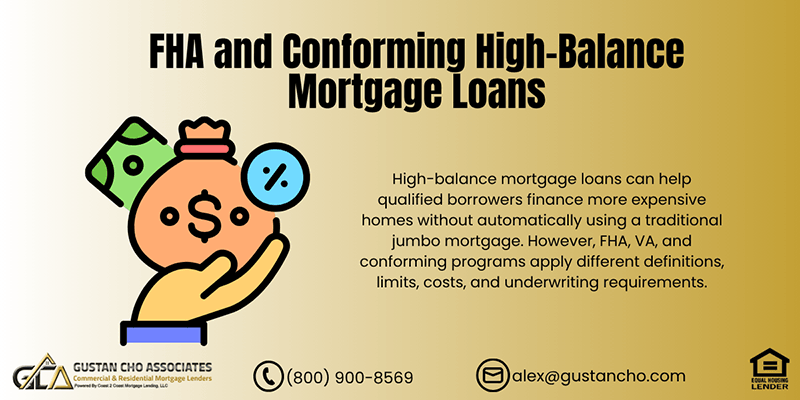
High-balance mortgage loans help qualified borrowers finance more expensive homes, but FHA, VA, and conforming programs define “high balance” differently. FHA and conforming high-balance loans depend on county loan limits. VA borrowers with full entitlement do not have a VA-imposed loan limit, although income, appraisal, entitlement, and lender approval still determine how much they can borrow. The best option depends on military eligibility, credit, down payment, mortgage insurance, occupancy, and property location.
What Are High-Balance Mortgage Loans?
High-balance mortgage loans allow qualified borrowers to finance larger loan amounts, but “high balance” does not describe one universal mortgage category. Its meaning depends on the loan program, the property’s location, and the applicable county loan limit. A conforming high-balance loan is a conventional mortgage that exceeds the national baseline conforming limit but remains within the higher FHFA limit assigned to an eligible high-cost county. The loan can still meet Fannie Mae or Freddie Mac requirements because it remains within the county’s conforming limit.
An FHA high-balance loan exceeds the national FHA floor but stays within the FHA loan limit established for the property’s county and number of units. It remains an FHA-insured mortgage and follows applicable HUD requirements for occupancy, appraisal, mortgage insurance, credit, income, and underwriting.
“VA high-balance loan” is common mortgage-industry terminology for a larger VA mortgage. It is not a separate VA loan program. Eligible borrowers with full entitlement do not have a VA-imposed loan limit. However, the lender must still determine whether the borrower qualifies based on income, debts, residual income, credit, assets, and the property’s appraised value. County limits may affect borrowers who do not have full entitlement available. A high-balance loan is not automatically a traditional jumbo loan. A conforming mortgage remains conforming when it stays within the applicable FHFA county limit, even if it exceeds the national baseline. FHA financing remains government-insured when it stays within the applicable FHA county limit. A traditional jumbo loan generally refers to a conventional mortgage that exceeds the conforming limit for the county where the property is located.
FHA, VA, and Conforming High-Balance Loans at a Glance
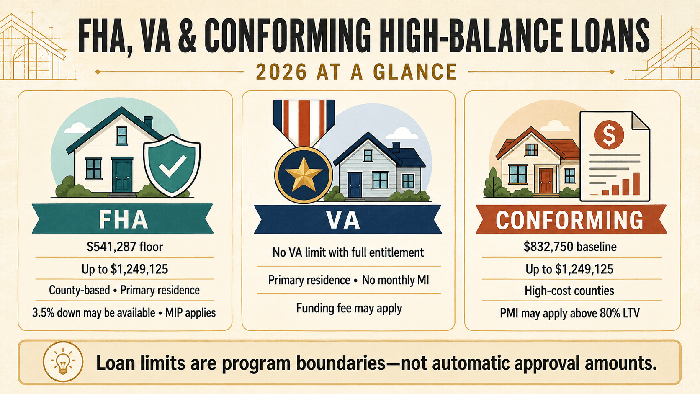
The following comparison shows how high-balance mortgage loans differ across the FHA, VA, and conventional programs. Loan limits represent program boundaries, not automatic approval amounts. Borrowers must still meet the applicable underwriting and property requirements.
| Feature | FHA High-Balance | VA High-Balance | Conforming High-Balance |
|---|---|---|---|
| Program authority | HUD/FHA | Department of Veterans Affairs | Fannie Mae or Freddie Mac |
| Geographic limit | Based on the property’s county | No VA-imposed limit with full entitlement | Based on the property’s county |
| 2026 one-unit benchmark | $541,287 floor; up to $1,249,125 ceiling | No VA-imposed limit with full entitlement | $832,750 baseline; up to $1,249,125 in high-cost areas |
| Typical occupancy | Primary residence | Primary residence | Primary residence, second home, or investment property when eligible |
| Low-down-payment feature | As little as 3.5% with qualifying credit | Potentially no down payment with sufficient entitlement | Depends on occupancy, property type, loan amount, and underwriting |
| Mortgage insurance or fee | Upfront and annual FHA mortgage insurance generally apply | No monthly mortgage insurance; VA funding fee may apply unless exempt | PMI may apply when the LTV exceeds 80% |
| May be best suited for | Borrowers who benefit from FHA underwriting flexibility | Eligible veterans, service members, and qualifying surviving spouses | Borrowers who meet conventional underwriting requirements |
For 2026, the baseline conforming limit for a one-unit property is $832,750, while the one-unit ceiling in high-cost areas is $1,249,125. FHA’s 2026 one-unit limit ranges from a $541,287 national floor to a $1,249,125 high-cost ceiling. The actual FHA or conforming limit depends on the property’s county and the number of units. VA financing works differently. An eligible borrower with full entitlement does not have a VA-imposed loan limit, but that does not guarantee approval for an unlimited loan amount. The borrower must qualify under the lender’s requirements, and the purchase price or appraised value must support the requested financing.
How FHA High-Balance Mortgage Loans Work
FHA high-balance mortgage loans are for loans secured by properties in counties with FHA loan limits that are above the national floor. HUD sets these limits annually and adjusts them for regional differences in housing costs across the country. A property in a standard cost county cannot utilize the higher limits for the more expensive housing markets.
The maximum base loan amount for properties in a given county depends on the number of units and whether the county is a high cost or a standard cost county. FHA publishes separate limits for one-unit, two-unit, three-unit, and four-unit properties.
Therefore, a borrower purchasing a two-unit property in a given county may have a higher limit than a one-unit property borrower in the same county. The borrower must use the property as their main place of residence and must comply with all applicable FHA requirements for the particular property type. In addition to the county’s high-cost status, all standard FHA loan limits apply to high-balance loans. The property must be appraised at an acceptable value, and the financing must also support the purchase at the appraised value. Like lower balance FHA loans, high balance loans will have upfront and ongoing mortgage insurance premiums. Setting a higher county limit only establishes the maximum amount of mortgage insurance that FHA will accept for that area. This does not automatically give borrowers the right to that full amount. Underwriting will still review income, credit, obligations, funds, and the LTV (loan-to-value) ratio, in addition to the lender’s decision. Additionally, the final base loan must be less than the maximum FHA-approved amount for the specific county and be acceptable within the transaction.
Denied for a High-Balance Mortgage? Get a Second Opinion
Some lenders add overlays or stricter rules on high-balance loans. We’ll review your income, credit, DTI, assets, and loan program options to see what may still work.How VA High-Balance Mortgage Loans Work
VA high-balance mortgage loans work differently from FHA and conforming high-balance financing. Eligible veterans, service members, and qualifying surviving spouses with full entitlement are not subject to a VA-imposed loan limit. This means the VA does not restrict them to the conforming limit assigned to the property’s county.
Having full entitlement does not provide unlimited borrowing power or guarantee approval for any requested amount. The lender must still determine whether the borrower can afford the mortgage. Underwriting generally considers qualifying income, monthly debts, credit history, employment, assets, residual income, and other risk factors.
The VA appraisal must also support the property’s value, and the borrower must satisfy the lender’s requirements for the requested loan amount. County loan limits can still matter when a borrower has entitlement tied up in another VA mortgage or has not restored previously used entitlement. In that situation, the lender may use the applicable one-unit conforming county limit and the borrower’s remaining entitlement to calculate the available VA guaranty. A down payment may be required if the remaining guaranty is not sufficient for the proposed loan. The terms “VA jumbo loan” and “VA high-balance loan” are commonly used to describe a larger VA mortgage, especially one above the standard conforming limit. They do not identify a separate VA benefit or loan program. The mortgage remains a VA-guaranteed loan subject to applicable VA and lender requirements. The VA confirms that borrowers with full entitlement have no VA loan limit, although qualification and property value still control the financing amount.
How Conforming High-Balance Mortgage Loans Work
Conforming high-balance mortgage loans allow qualified borrowers to finance amounts above the national conforming baseline without being automatically classified as traditional jumbo loans. For a one-unit property in 2026, the loan amount must exceed the $832,750 baseline, and the property must be located in a county that FHFA classifies as a high-cost area. Each qualifying county has its own conforming loan limit. The mortgage may be considered high-balance conforming only when the loan amount stays within the FHFA limit assigned to that county and the number of units of the property. Borrowers cannot use another county’s higher limit simply because the purchase price or requested loan amount is larger. Because the mortgage remains conforming, the borrower and property must satisfy applicable Fannie Mae or Freddie Mac underwriting requirements. Approval may also depend on automated underwriting findings and the lender’s requirements. When the requested loan exceeds the FHFA limit for the property’s county, it is generally classified as a jumbo or nonconforming mortgage. Different investor guidelines would then apply. For details about credit, debt-to-income ratios, down payments, PMI, reserves, eligible property types, and underwriting, read our complete High-Balance Conforming Loans guide.
How County Loan Limits Affect Each Program
Country-level loan limits affect the availability of high-balance mortgage loans on a program-by-program basis. Limits for the FHA program are set by HUD and apply to FHA-insured loans. Limits for the conforming program are set by the FHFA and apply to mortgage loans eligible for purchase by Fannie Mae and/or Freddie Mac. Even if the national FHA loan and conforming high-balance ceilings are the same, the two different limit systems cannot be substituted for one another. For FHA and conforming loans, the applicable limit depends on the property’s location. A given county may have different FHA and FHFA limits, so in that case, borrowers should verify the limits for each program. The national ceiling also does not guarantee that the highest FHA and conforming loan limits will apply to a given property in a high-cost state. Under the VA loan program, there are no loan limits for borrowers with full entitlement. For borrowers who have used some or all of their entitlement, the FHFA county limit for a single-unit property may affect the guaranty and the required down payment. Borrowers can verify limits on the HUD FHA Mortgage Limits search and the FHFA Conforming Loan Limit map.
FHA vs. VA vs. Conforming High-Balance Loans
When it comes to eligibility, VA loans can only be issued to Veterans, Active Duty members, and surviving Spouses who meet certain criteria. Regarding the borrower’s Entitlement, FHA and conforming loans have no eligibility requirements, while each program has its own credit and underwriting process that considers the borrower’s credit, income, debts, assets, and payment history. When comparing loans, the borrower should evaluate the down payment and the total monthly housing expense. FHA loans have both an upfront mortgage insurance premium and an annual premium. VA loans do not have monthly mortgage insurance but do include a funding fee, unless the borrower qualifies for the low- or no-cost VA funding fee exemption. Conforming loans require mortgage insurance for loan-to-value ratios greater than 80%.
The intended use of the property plays a role in the financing consideration. Generally, FHA and VA loans require the financing to be for a primary residence. Conforming loans can finance qualifying purchases of primary residences, second homes, and investment properties.
Automated underwriting decisions can affect approval and document requirements. The process can include credit, DTI, reserve, and loan amount criteria set by the lender in addition to normal automated underwriting criteria. There is no easier or cheaper program. The financing solution that best fits the borrower’s circumstances is the result of an eligibility and underwriting analysis, cash-to-close, funding fee, mortgage insurance, and the anticipated total monthly payment.
High-Balance Loans vs. Traditional Jumbo Loans
High-balance mortgage loans are not automatically traditional jumbo loans. An FHA loan that exceeds the national floor but remains within the applicable FHA county limit is still an FHA-insured mortgage subject to HUD requirements. Likewise, a conventional loan above the national conforming baseline can remain eligible for Fannie Mae or Freddie Mac when the property is in a qualifying high-cost county, and the loan does not exceed that county’s FHFA limit. A traditional jumbo loan generally exceeds the conforming limit assigned to the property’s county and number of units. Because it falls outside Fannie Mae and Freddie Mac loan limits, it is considered nonconforming. It is subject to the bank’s or investor’s proprietary guidelines. Credit, down payment, reserves, DTI, and property requirements can therefore vary by jumbo lender. A larger VA loan may also be called “VA jumbo,” but that term refers to its size rather than to a separate nonconforming loan program.
High-Balance Mortgage Comparison
A prospective borrower wishes to purchase a $1.2 million single unit, primary residence in a high-cost county. For 2026, the FHA and FHFA single unit counties are both $1,249,125. The appraisal supports the purchase price; however, the borrower must meet all the other applicable underwriting criteria. How this purchase may be assessed is as follows:
FHA: A supporting credit profile allows the borrower to make a 3.5% down payment of $42,000, resulting in a base FHA loan amount of $1,158,000. As this amount is below the FHA limit of $1,249,125, it may be eligible for an FHA high-balance mortgage loan. Lender and FHA criteria would remain a consideration.
Conforming: A down payment of $240,000 means the proposed conventional loan amount would be $960,000. While this exceeds the baseline FHFA conforming loan amount of $832,750, it would fall within the FHFA high-balance limit of $1,249,125 for the county. In this case, it may be a conforming, high-balance loan. VA: If the borrower meets VA loan criteria and has full entitlement, there is no limit on the purchase of a single-family residence. No-down-payment financing, again, would require that all other appraisal, income, debt, and credit criteria agreed to by the lender be satisfied. This hypothetical example illustrates how high-balance mortgage loans must be assessed using the specific criteria of each individual program.
Choosing the Right High-Balance Mortgage Program
Choosing among FHA, VA, and conforming high-balance mortgage loans requires more than finding the program with the highest loan limit. Use the following workflow to compare the available options:
- Identify the property county and number of units. Both factors may affect the maximum FHA or conforming loan amount.
- Check the applicable FHA and FHFA limits. Verify each limit separately because the two systems are not interchangeable.
- Confirm VA eligibility and entitlement when applicable. Review the borrower’s Certificate of Eligibility and determine whether full or remaining entitlement is available.
- Compare total monthly payments—not merely interest rates. Include principal, interest, property taxes, homeowners’ insurance, HOA dues, and applicable mortgage insurance.
- Review the complete upfront financial requirement. Compare the down payment, FHA mortgage insurance, VA funding fee, conventional PMI, closing costs, required reserves, and total cash to close.
- Obtain program-specific underwriting approval. The county limit only establishes the program’s maximum potential loan amount. Income, debts, credit, assets, appraisal results, automated underwriting findings, and lender requirements still determine approval.
The best program is the one that fits the borrower’s complete financial profile, property, eligibility, and long-term housing budget.
Final Thoughts on FHA, VA, and Conforming High-Balance Mortgage Loans
High-balance mortgage loans can help qualified borrowers finance more expensive homes without automatically using a traditional jumbo mortgage. However, FHA, VA, and conforming programs apply different definitions, limits, costs, and underwriting requirements.
FHA and conforming high-balance loans depend on separate county loan-limit systems. VA borrowers with full entitlement do not have a VA-imposed loan limit, but they must still qualify for the requested financing and obtain an appraisal that supports the property value. In every program, the maximum available loan limit is only a boundary—not an approval amount.
The right choice should be based on the complete transaction. Compare the down payment, monthly housing expense, mortgage insurance or funding fee, reserves, cash to close, property eligibility, and underwriting findings. Borrowers should also consider lender overlays that may be stricter than the underlying agency requirements. Before making an offer, obtain a program-specific preapproval using the property’s county, number of units, anticipated purchase price, and the borrower’s complete financial profile.
Frequently Asked Questions About High-Balance Mortgage Loans
Can the Purchase Price Exceed the County Loan Limit?
Yes. The county limit applies to the mortgage amount—not necessarily the property’s purchase price. A buyer may purchase a more expensive home by making a large enough down payment to keep the FHA or conforming loan within the applicable limit. FHFA confirms that conforming limits govern loan amounts rather than home prices.
Can a First-Time Homebuyer Use a High-Balance Mortgage Loan?
Yes. High-balance financing is not restricted to repeat buyers. A first-time buyer may use an FHA or conforming high-balance loan when the property and loan amount meet the applicable county limits and the borrower qualifies. An eligible veteran may also use VA financing regardless of first-time buyer status. The program’s normal occupancy, credit, income, asset, and underwriting requirements still apply.
Can I Refinance Into a High-Balance Mortgage Loan?
Potentially. A homeowner may refinance into an FHA, VA, or conforming high-balance loan when the new mortgage meets the program’s current loan limit, loan-to-value, occupancy, appraisal, and underwriting requirements. Fannie Mae specifically provides eligibility rules for high-balance refinance transactions.
Do High-Balance Mortgage Loans have Higher Interest Rates?
Not always. Pricing can vary based on the loan program, credit score, loan-to-value ratio, occupancy, loan amount, market conditions, and lender. High-balance conforming loans may be subject to pricing adjustments, but that does not guarantee their rates will always be higher than those of traditional jumbo, FHA, or VA loans. Borrowers should compare the interest rate, APR, points, mortgage insurance, fees, and total monthly payment.
Do High-Balance Loans Automatically Require Two Appraisals?
No. A mortgage does not automatically require two appraisals simply because it is a high balance. The required valuation depends on the loan program, transaction, property, automated underwriting findings, applicable law, and lender policy. Fannie Mae notes that most loans require an appraisal, while some may qualify for value acceptance. A second appraisal may be ordered when a valuation issue or lender requirement justifies it.
Can Gift Funds or Seller Credits be Used with a High-Balance Loan?
They may be permitted, but the rules depend on the program and transaction. Fannie Mae allows eligible gift funds for a primary residence or a second home, subject to documentation and minimum borrower contribution requirements. Seller or other interested-party contributions may cover eligible closing costs, but cannot replace a required down payment or reserves. FHA permits qualifying interested parties to contribute toward eligible borrower costs within HUD limits.
Do High-Balance Loan Limits Change Every Year?
They can. FHFA establishes conforming loan limits for each calendar year under the Housing and Economic Recovery Act formula, while HUD separately publishes annual FHA limits. Limits may increase or remain unchanged depending on the applicable statutory calculations and housing-price data. Borrowers should use the limits effective for their transaction rather than relying on numbers from an older preapproval or an article.
This article about “FHA and Conforming High-Balance Mortgage Loans” was updated on August 21st, 2026.