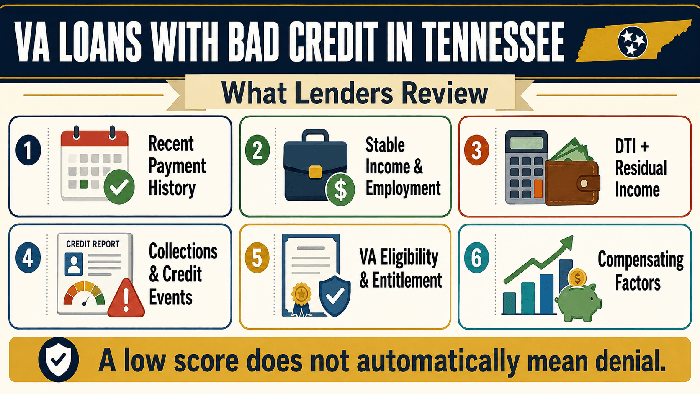
VA loans with bad credit in Tennessee may be available, even when a borrower has a low credit score. The Department of Veterans Affairs does not set one universal minimum credit score for every VA loan. However, lenders may apply their own credit standards and must evaluate the borrower’s complete financial picture. This review includes payment history, income stability, monthly debts, debt-to-income ratio, VA residual income, and the proposed housing payment.
Lenders may also consider why the credit problems occurred and whether the borrower has since established a reliable payment record. A low credit score does not guarantee approval or denial.
Can You Get a VA Loan With Bad Credit in Tennessee?
Yes, obtaining VA loans with bad credit in Tennessee may be possible. “Bad credit” can mean a low credit score, recent late payments, collections, charge-offs, bankruptcy, foreclosure, or a limited credit history. These issues are not treated the same, and a low score alone does not determine whether a borrower qualifies.
VA lenders examine the cause, severity, and recency of each credit problem. An isolated late payment caused by a documented medical emergency or temporary loss of income may be viewed differently from repeated missed payments with no clear explanation.
Recent mortgage or rent delinquencies generally raise more concern than an older collection account, especially when the borrower has since established a record of paying bills on time.
The Department of Veterans Affairs does not establish one universal minimum credit score. However, lenders may set their own score requirements and evaluate income stability, debt-to-income ratio, residual income, housing-payment history, and compensating factors. Borrowers should be prepared to explain past credit problems, document any hardship, and show that the situation has been resolved. Approval remains subject to VA eligibility, lender underwriting requirements, and the loan profile as a whole.
Tennessee VA Loan Credit Score Requirements
Borrowers seeking VA loans with bad credit in Tennessee should know that a credit score is only one part of the approval process. VA lenders also review recent payment history, income, monthly debts, residual income, employment, and the reason for past credit problems.
VA Guidelines Versus Lender Credit Requirements
The Department of Veterans Affairs does not set a universal minimum credit score for VA-backed mortgages. However, borrowers must meet the credit and income standards established by both VA and the lender. Individual lenders may set their own minimum scores and other requirements to manage risk. This is why one lender may deny a loan that another lender is willing to review.
Can a 500 Credit Score Qualify?
Gustan Cho Associates currently has access to a lender option that may consider eligible borrowers with credit scores as low as 500. This is a lender-specific option—not a minimum score established by VA or a promise of approval.
A borrower with a 500 credit score must still meet the program’s underwriting requirements. The lender will review income, employment, debt-to-income ratio, residual income, housing-payment history, collections, charge-offs, and other credit events. VA eligibility, an acceptable property, and sufficient entitlement are also required.
The cause of the low score matters. A temporary hardship followed by improved payment habits may be viewed differently from ongoing late payments or new unpaid debts.
Why Recent Payment History Matters
Recent payment history helps an underwriter determine whether the borrower is now able and willing to manage mortgage payments. The most recent 12 months often receive close attention, especially the borrower’s rent or mortgage history.
Recent housing late payments, repeated overdrafts, new collections, or several missed payments may make approval more difficult. An isolated late payment caused by a documented job loss, medical emergency, or other temporary hardship may receive different consideration when the problem has been resolved.
Borrowers can strengthen their loan profile by paying bills on time, avoiding new debt, maintaining stable account balances, and documenting the reasons for past credit problems. A good recent payment record can help, but it does not guarantee VA loan approval.
How VA Lenders Review Bad Credit
VA lenders do not review every credit problem in the same way. When evaluating VA loans with bad credit in Tennessee, the underwriter considers what happened, how recently it occurred, whether it was an isolated event or a pattern, and whether the borrower has since managed credit responsibly.
The lender may request letters of explanation and documents supporting a job loss, medical emergency, military move, divorce, or other hardship. Strong residual income, stable employment, cash reserves, and a satisfactory recent housing history may help the overall loan profile, but they do not guarantee approval.
Late Payments
VA lenders generally review at least the most recent 12 months of payment history. Late payments during that period may require an explanation and supporting documents.
Recent late payments on mortgages or rent usually receive the closest review because they may indicate how the borrower will handle a new housing payment. One late payment caused by a resolved hardship may be viewed differently from repeated late payments, new collections, or ongoing missed payments.
The underwriter will consider:
- How many late payments occurred
- How recently they occurred
- Which accounts were late
- Why were the payments missed
- Whether the hardship has ended
- Whether payments have remained current since then
A strong recent payment history can help demonstrate that the borrower’s credit has been re-established. VA generally considers satisfactory credit to be re-established after 12 months of acceptable payments following the resolution of the last derogatory credit item. VA Home Loan Buyer’s Guide
Collections and Charge-Offs
VA guidelines do not automatically require every collection or charge-off to be paid before closing. However, the underwriter must evaluate the type, age, amount, and circumstances of the account.
A few older collections caused by a temporary hardship may be viewed differently from several recently opened collections. The lender may request a written explanation and supporting documents. An established repayment plan may be treated as a positive factor, but its monthly payment may need to be included in the borrower’s debts.
Identifiable medical collections and medical charge-offs may generally be disregarded under VA guidance unless the debt has become a judgment or lien. Individual lenders may still impose additional requirements or require certain accounts to be resolved. Paying a collection immediately before applying does not automatically correct an otherwise unsatisfactory credit history.
Judgments, Tax Liens, and Federal Debt
Judgments and liens are treated more seriously than ordinary collection accounts. They generally must be paid in full or covered by an acceptable written repayment agreement. The required monthly payment must be considered when the lender calculates the borrower’s debts and ability to repay the mortgage.
VA lenders also check the Credit Alert Verification Reporting System, commonly called CAIVRS, for delinquent federal debt. A CAIVRS alert may involve a defaulted federal loan, an unpaid federal obligation, or a prior government loss. The borrower may need to prove that the debt was paid, that an approved repayment plan was entered into, or that it was reported in error before the loan can close.
Requirements may vary based on the type of judgment or lien and the government agency involved. Borrowers should provide court records, recorded releases, payoff statements, repayment agreements, and, when applicable, proof of recent payments.
Bankruptcy, Foreclosure, and Short Sale
A prior bankruptcy, foreclosure, deed in lieu of foreclosure, or short sale does not automatically disqualify a borrower. The lender must review the cause of the event, the time elapsed, and the borrower’s credit since the event.
For Chapter 7 bankruptcy and foreclosure, VA guidance generally uses a two-year waiting period. Review may be possible after one year, when the borrower has re-established acceptable credit and documents that the event resulted from circumstances beyond the borrower’s control. Lenders may apply stricter waiting periods.
A borrower currently in Chapter 13 bankruptcy may be considered after making at least 12 months of satisfactory plan payments. The borrower must also obtain permission from the bankruptcy trustee or court when required. When the Chapter 13 payment plan has been completed satisfactorily, VA guidance considers credit to be re-established, although lender requirements still apply.
VA does not establish a fixed waiting period after a short sale or a deed in lieu. However, any mortgage late payments leading up to the event must be included in the credit review. A lender may impose its own waiting period or require additional proof of re-established credit.
Limited or Nontraditional Credit
Having little or no traditional credit does not automatically make a borrower ineligible for a VA loan. VA does not require a minimum number of credit accounts, and a lack of credit should not, by itself, be treated as negative credit.
When a borrower does not have enough traditional accounts to produce a credit score, the lender may review nontraditional payment records. These may include:
- Rent payments
- Utility bills
- Mobile phone service
- Auto insurance
- Internet or cable service
- Childcare payments
- Other recurring obligations
The lender may request 12 months of canceled checks, bank statements, account records, or written payment verifications. Although VA permits nontraditional credit evaluation, not every lender offers it, and some lenders require a conventional credit score or a minimum number of accounts.
VA Debt-to-Income Ratio and Residual Income
When reviewing VA loans with bad credit in Tennessee, lenders consider both the debt-to-income ratio and residual income. These two measures help show whether the borrower can manage the proposed mortgage payment along with regular household expenses.
A borrower’s debt-to-income ratio, or DTI, compares the proposed housing payment and other monthly debts with gross monthly income. VA uses 41% as an important underwriting benchmark. However, 41% is not an absolute maximum. A borrower with a higher DTI may still qualify if the complete loan file demonstrates sufficient financial strength.
How VA Residual Income Works
Residual income is the money left each month after taxes, housing expenses, debts, and other required obligations have been paid. VA uses this calculation to determine whether the household should have enough money for food, transportation, clothing, medical needs, and other living expenses.
The minimum residual-income requirement depends on:
- The loan amount
- The number of people in the household
- The region where the property is located
- Whether the borrower receives qualifying military benefits
Tennessee is included in VA’s South region. For loan amounts of $80,000 or more, the current monthly residual-income guidelines for the South are:
- One-person household: $441
- Two-person household: $738
- Three-person household: $889
- Four-person household: $1,003
- Five-person household: $1,039
For families with more than five members, $80 is added for each additional person, up to a seven-person household. Household size generally includes a spouse, children, and other people who depend on the borrower for support—even when they are not listed on the mortgage. Certain exceptions may apply when a non-borrowing household member has verified income.
Can a VA Loan Be Approved Above 41% DTI?
A DTI above 41% does not automatically result in a denial. The underwriter may consider compensating factors such as:
- Residual income well above the required minimum
- Stable, long-term employment
- Significant cash reserves
- Minimal consumer debt
- Limited increase from the current housing payment
- Conservative use of credit
- Military benefits
- A down payment or existing home equity
When DTI exceeds 41% and residual income is at least 120% of the applicable VA guideline, VA regulations do not require the additional second-level review and written justification normally associated with a high DTI. This does not guarantee approval. The lender must still determine that the borrower has stable income, acceptable credit, and the ability to repay the loan.
Why Automated Approval Does Not End the Review
An automated underwriting system can analyze the loan information and issue findings, but it does not make the final lending decision. VA describes the automated system as a tool rather than the decision-maker.
The lender’s underwriter must still verify income, debts, assets, credit history, residual income, occupancy, VA eligibility, and the property. The underwriter must also confirm that the information entered into the system is accurate and that all conditions have been met. A lender may apply additional requirements beyond VA’s minimum standards. Therefore, an automated approval does not guarantee that the loan will close.
VA Eligibility, COE, and Entitlement
To apply for VA loans with bad credit in Tennessee, a borrower must first qualify for the VA home loan benefit. Eligibility is based on military service, duty status, length of service, and character of discharge. Credit problems do not remove a person’s military eligibility, but the borrower must still meet the lender’s credit, income, and underwriting requirements.
Who May Be Eligible for a VA Loan?
VA home loan eligibility may be available to:
- Active-duty service members must have served at least 90 consecutive days
- Veterans who completed the required service for the period in which they served
- National Guard members with qualifying active-duty service or at least six creditable years of service
- Selected Reserve members with qualifying active-duty service or at least six creditable years of service
- Certain surviving spouses of deceased veterans or service members
Service requirements can vary based on when and how the person served. National Guard members may qualify after at least 90 days of qualifying active-duty service, including certain Title 32 service with at least 30 consecutive days. Reserve members may qualify through active-duty service or six creditable years in the Selected Reserve. Discharge status and certain early-discharge exceptions can also affect eligibility. The Department of Veterans Affairs makes the final eligibility determination.
Eligibility for Surviving Spouses
A surviving spouse may qualify if the veteran passed away while in service or as a result of a service-related disability, and the spouse follows VA remarriage rules. Eligibility may also be available in certain cases when the veteran had been totally disabled before death.
A spouse of an active-duty service member who is missing in action or being held as a prisoner of war may also qualify. The surviving spouse may need to provide VA forms, marriage records, the veteran’s discharge documents, and a death certificate.
What Is a Certificate of Eligibility?
A Certificate of Eligibility, or COE, confirms that the borrower meets the military-service requirements for the VA home loan benefit. It also shows the borrower’s available entitlement and may identify information on funding-fee exemptions or special conditions.
A borrower can request a COE:
- Online through VA.gov
- Through a VA-approved mortgage lender
- By mailing VA Form 26-1880
Many lenders can obtain a COE electronically during preapproval. Some requests require added service records or a manual review by VA. Having a COE does not guarantee mortgage approval. The lender must still verify the borrower’s credit, income, debts, residual income, occupancy, and ability to repay.
How VA Entitlement Works
VA entitlement is the portion of the loan that the Department of Veterans Affairs may guarantee for the lender. It is not cash paid to the borrower, a down payment, or a limit on what the borrower can afford.
Borrowers with full entitlement do not have a VA-imposed loan limit. However, the lender must still approve the loan amount based on the borrower’s income, debts, credit profile, and the property’s appraised value.
A borrower may have remaining entitlement if another VA loan is still open or a previous VA loan resulted in a government loss. In that case, county loan limits and the amount of entitlement already used may affect how much can be borrowed without a down payment. A down payment may be required when the remaining entitlement is insufficient to meet the lender’s guaranty requirements.
Used entitlement can often be restored after the VA loan is fully paid and the property is sold. Other restoration options may apply when an eligible veteran assumes the loan and substitutes entitlement.
Down Payment, Funding Fee, and Closing Costs
Qualified borrowers can often use a VA loan to finance 100% of a home’s purchase price without a down payment. However, the property must support the sales price through the VA appraisal, and the borrower must have enough entitlement. The lender must also approve the borrower’s income, credit, debts, residual income, and overall ability to repay.
For borrowers seeking VA loans with bad credit in Tennessee, zero down does not always mean zero cash at closing. Buyers may still need money for costs such as the appraisal, title services, recording fees, prepaid property taxes, homeowners’ insurance, and discount points.
The seller or builder may agree to pay some or all allowable closing costs. VA limits certain seller concessions to 4% of the home’s reasonable value, although ordinary closing-cost credits are treated separately. Borrowers should review the Loan Estimate carefully to understand the estimated cash needed at closing.
Most VA borrowers must also pay a one-time VA funding fee. On a purchase loan with less than 5% down, the current fee is generally:
- 2.15% for first-time VA loan use
- 3.30% for subsequent use
A minimum down payment of 5% lowers the fee to 1.50%, while a minimum down payment of 10% brings it down to 1.25%. The funding fee may be paid at closing or financed into the loan. Other purchase-loan closing costs generally cannot be added to the VA loan balance. Borrowers should confirm current rates through the Department of Veterans Affairs.
A borrower may be exempt from the funding fee if the borrower:
- Receives VA compensation for a service-connected disability
- Is eligible for disability compensation but receives active-duty or retirement pay instead
- Is an eligible surviving spouse receiving Dependency and Indemnity Compensation
- Received a qualifying proposed or memorandum disability rating before closing
- Is an active-duty service member who provides proof of receiving a Purple Heart before closing
The Certificate of Eligibility may show the borrower’s exemption status. In some cases, a borrower who pays the fee and later receives a retroactive disability award effective before closing may qualify for a refund. Funding-fee status should be verified before the final closing disclosure is issued.
Tennessee Assistance Programs for VA Borrowers
Veterans exploring VA loans with bad credit in Tennessee may qualify for assistance through the Tennessee Housing Development Agency, or THDA. However, THDA has separate credit, income, purchase-price, education, and lender requirements that must be met in addition to VA loan guidelines.
Great Choice Plus Down-Payment Assistance
THDA’s Great Choice mortgage program can be paired with VA financing. Eligible borrowers may add Great Choice Plus assistance of up to 5% of the home’s sales price, capped at $15,000. The money may help cover closing costs, prepaid expenses, or any required down payment.
This assistance is not a grant. It is a 30-year second mortgage with monthly payments, and its interest rate is generally the same as that of the first mortgage. The payment must be included when calculating the borrower’s debt-to-income ratio and VA residual income.
THDA Income and Purchase-Price Limits
THDA income limits vary by county and household size. Under the limits effective August 1, 2026, the maximum acquisition cost is $500,000 throughout Tennessee, while household income limits differ by county and between one- to two-person and three- or more-person households. Buyers should check the current THDA income and acquisition-cost table before making an offer.
THDA also currently advertises a minimum credit score of 640. Therefore, a veteran who may qualify for a regular VA loan with a lower score might not qualify for THDA assistance. The borrower must satisfy both VA underwriting standards and THDA program requirements.
Homeownership for Heroes
Qualified active-duty military members and veterans may also be eligible for THDA’s Homeownership for Heroes option. The program currently offers a 0.50 percentage-point reduction off the regular Great Choice mortgage rate. Qualified military borrowers and veterans may also receive a waiver of the usual first-time-homebuyer requirement.
The reduced rate is separate from down-payment assistance. An approved lender must confirm whether the borrower can combine Homeownership for Heroes, Great Choice Plus assistance, and a VA loan in the same transaction.
Additional THDA Requirements
Borrowers must work with a lender trained and approved by THDA. Not every VA lender participates in Great Choice or Great Choice Plus. THDA-approved homebuyer education is also required for Great Choice, Great Choice Plus, and Homeownership for Heroes loans. Buyers can use THDA’s approved-lender directory to locate participating lenders.
Program availability, rates, assistance amounts, and eligibility limits can change. Borrowers should verify the current rules before relying on THDA funds for their required cash to close.
Buying a Tennessee Home Before Starting a New Job
A borrower may be able to close on a Tennessee home before starting a new job. This option can help eligible veterans applying for VA loans with bad credit in Tennessee, but future employment income must be carefully documented and approved by the lender.
The VA Lenders Handbook allows an underwriter to consider a valid, verifiable employment offer that begins on or after the expected closing date. A pay stub may not yet be available. However, an offer letter alone does not guarantee that the income will qualify.
The lender may require a signed employment offer or contract showing:
- The employer’s name and contact information
- The borrower’s position and employment status
- The salary or guaranteed hourly rate and scheduled hours
- A specific start date
- Signatures from the employer and borrower
- Confirmation that all background checks, licensing requirements, or other employment conditions have been completed
Guaranteed base pay is generally easier to use than commissions, bonuses, overtime, or other variable earnings when no established history exists.
VA’s general future-employment provision does not establish one universal maximum number of days between closing and the job’s start date. Individual lenders and investors commonly require employment to begin within a defined period, such as 30 or 60 days after closing. Some lenders may require borrowers to begin working and provide a pay stub before closing.
The lender may also require verified reserves remaining after closing. These funds may need to cover the mortgage payment and other monthly obligations between closing and the borrower’s first paycheck. The required amount depends on the employment start date, current income, cash needed for closing, debts, and lender policy. A three-month reserve requirement, for example, may be a lender rule rather than a universal VA requirement.
Before closing, the lender may contact the new employer to confirm that the offer remains valid, its terms have not changed, and all conditions have been satisfied. Some lenders may also require a post-closing employment verification or the borrower’s first pay stub before delivering the loan to an investor.
The borrower should immediately report any delayed start date, withdrawn offer, reduced salary, or change in employment terms. If the change happens before closing, the lender must determine whether the loan still qualifies. If the job falls through after closing, the mortgage payments remain due. The borrower should contact the loan servicer promptly if the loss of income may make the payment difficult.
Automated Versus Manual VA Underwriting
Lenders reviewing VA loans with bad credit in Tennessee may use an automated underwriting system or complete a manual review. The underwriting method depends on the borrower’s credit, income, debts, residual income, and the accuracy of the information submitted.
Automated Underwriting Approval
The lender may submit the application through an automated underwriting system, such as Desktop Underwriter or Loan Product Advisor. The system analyzes the loan data and may issue an approval recommendation when the file appears to meet its requirements.
An automated approval does not guarantee final loan approval. The underwriter must still verify the borrower’s income, employment, debts, credit history, assets, VA eligibility, residual income, occupancy, and property information. The lender must also satisfy every condition listed in the automated findings.
The file may need to be resubmitted or downgraded to manual underwriting if:
- The borrower’s income, debts, or credit changes
- Documents do not support the information entered
- New late payments or debts appear
- Required conditions cannot be satisfied
- The loan no longer receives acceptable automated findings
Referral and Manual Underwriting
An automated system may return a “Refer” or similar finding instead of an approval recommendation. A referral is not always a final denial. It may mean that a VA-qualified underwriter must manually review the complete file.
Manual underwriting may also be needed when the borrower has limited traditional credit, recent late payments, a prior bankruptcy or foreclosure, or other credit issues requiring individual review. The lender will closely examine the reason for the credit problems, the borrower’s recent payment history, and whether the hardship has been resolved.
Not every lender offers manual VA underwriting. Some lenders also impose stricter credit score, debt-to-income ratio, or payment history requirements than the VA guidelines do.
Compensating Factors for Manual Review
Compensating factors are financial strengths that may help offset the higher risk of a portion of the loan. Depending on the complete file, an underwriter may consider:
- Residual income above the applicable VA requirement
- Stable income and long-term employment
- A satisfactory rent or mortgage payment history
- Cash reserves remaining after closing
- Little or no increase in the new housing payment
- Low consumer debt
- Conservative use of credit
- A down payment or existing home equity
- Military benefits that provide additional financial stability
- A documented hardship that has ended
Compensating factors must be supported by documents. They cannot erase serious credit problems or guarantee approval. The lender must determine that the borrower is an acceptable credit risk and has enough stable income to repay the loan.
Documents Needed for a Tennessee VA Preapproval
Borrowers applying for VA loans with bad credit in Tennessee should provide complete and accurate documents at the start of the preapproval process. A well-documented file helps the lender verify VA eligibility, income, debts, assets, housing history, and the circumstances surrounding past credit problems.
VA Eligibility and Identification
The lender may request:
- Certificate of Eligibility (COE)
- Government-issued photo identification
- Social Security number
- DD Form 214 for discharged veterans
- Statement of Service for active-duty borrowers
- National Guard or Reserve service records, when applicable
- Documents required for an eligible surviving spouse
Many lenders can obtain the COE electronically. The COE confirms VA eligibility and entitlement, but it does not guarantee loan approval. Borrowers can also request one through VA.gov.
Income and Employment Records
Required income documents depend on how the borrower is paid. The lender may ask for:
- Pay stubs covering the most recent 30 days
- W-2 forms from the previous two years
- Federal income tax returns when required
- Written or verbal verification of employment
- Military Leave and Earnings Statements
- VA disability, retirement, pension, or Social Security award letters
- Documentation of child support or alimony used as qualifying income
- Employment offer letter when the new job has not started
- Business and personal tax returns for self-employed borrowers
- Year-to-date profit-and-loss statement and business balance sheet
The lender must determine that qualifying income is stable, reliable, and reasonably likely to continue.
Asset Statements
Even when no down payment is required, the lender may need to verify money for closing costs, prepaid expenses, earnest money, or reserves. Borrowers should provide recent statements for:
- Checking and savings accounts
- Retirement accounts
- Investment or brokerage accounts
- Gift funds
- Proceeds from selling another property
- Other accounts used for closing
Large or unusual deposits may require proof of their source. Borrowers should avoid moving money between accounts or depositing cash without documentation during the loan process.
Housing Payment History
The lender may review the borrower’s recent rent or mortgage history, especially when the loan requires manual underwriting. Requested records may include:
- Canceled rent checks
- Bank statements showing rent payments
- A verification of rent from a property-management company
- Mortgage statements
- Payment records from the current mortgage servicer
- Contact information for the landlord or property manager
A lender may request up to 12 months of housing payment records, depending on the loan profile and underwriting requirements.
Bankruptcy and Foreclosure Documents
Borrowers with a prior bankruptcy, foreclosure, short sale, or deed-in-lieu may need to provide:
- Bankruptcy petition and schedules
- Discharge or dismissal order
- Chapter 13 payment history
- Trustee or court approval when required
- Foreclosure or short-sale closing documents
- Recorded deed or proof that ownership transferred
- Evidence that the hardship has ended
- A signed letter explaining the circumstances
The lender may also verify whether a prior VA foreclosure affected the borrower’s available entitlement.
Letters of Explanation
A written letter may be required for late payments, employment gaps, credit inquiries, disputed accounts, address differences, overdrafts, large deposits, or other issues. A useful letter should briefly explain:
- What happened
- When it happened
- Whether the event was beyond the borrower’s control
- How the problem was resolved
- Why it is unlikely to happen again
Supporting documents are more persuasive than an explanation alone. These may include medical records, termination notices, divorce documents, insurance claims, military orders, or proof of restored income.
Collections and Payment Arrangements
Borrowers should disclose collections, charge-offs, judgments, tax liens, and repayment plans. The lender may request:
- Current collection-account statements
- Payoff letters
- Written repayment agreements
- Proof of recent scheduled payments
- Judgment releases
- Tax-lien documents
- Evidence that disputed or inaccurate accounts were corrected
Borrowers should not pay or dispute an account solely to improve their application without first speaking with the loan officer. Doing so could reduce available funds, change the credit report, or require the loan to be underwritten again.
Document requirements vary based on employment, credit history, automated findings, manual underwriting, and lender rules. Providing every requested item promptly does not guarantee approval, but it can reduce avoidable preapproval and underwriting delays.
Tennessee VA Approval Example
The following example is hypothetical and does not guarantee approval for borrowers seeking VA loans with bad credit in Tennessee.
A Tennessee veteran applies for a VA loan with a 556 credit score. The low score resulted from medical bills and two late credit-card payments after a temporary job interruption. Since returning to work, the borrower has made every rent and debt payment on time for the past 12 months.
The borrower has worked for the same employer for four years and earns $72,000 annually. The proposed loan has a debt-to-income ratio of 46%. Although this exceeds VA’s 41% benchmark, the borrower’s calculated residual income is $1,350 per month—above the applicable VA requirement for the household size and Tennessee’s South region.
The credit report shows a $1,200 medical collection and an older $650 charge-off, but no unpaid judgments or federal debt. Compensating factors include stable employment, verified on-time rent, three months of reserves, residual income above the required amount, and only a small increase in the new housing payment.
After manual review, the lender issues an approval subject to final conditions. These include an updated verification of employment, recent bank statements, a documented letter explaining the past credit problems, verification of rent, proof that the collection accounts are not judgments, an acceptable VA appraisal, and confirmation of VA eligibility and entitlement.
The loan can close only after all conditions are satisfied and the lender completes its final review.
What to Do After a Tennessee VA Loan Denial
A denial does not always mean a borrower is ineligible for VA loans with bad credit in Tennessee. The decision may be based on that lender’s stricter requirements, known as overlays, rather than a VA-wide rule. Ask the loan officer for the specific reasons in writing and request a copy of the automated underwriting findings when available.
Borrowers should ask:
- Was the denial based on VA guidelines or a lender overlay?
- Was the file run through an automated underwriting system?
- Is manual underwriting available?
- Did the file meet VA residual-income requirements?
- Which credit event or account caused the denial?
- Could another VA lender review the file differently?
- What documented improvement would make the borrower eligible?
Do not immediately pay collections, close accounts, or apply for new credit without guidance. A different lender may offer manual underwriting or have fewer overlays, but approval still depends on the complete loan profile.
How to Compare Tennessee VA Lenders and Loan Estimates
When comparing VA loans with bad credit in Tennessee, do not choose a lender based only on the advertised interest rate. Request Loan Estimates for the same loan amount, down payment, and rate-lock period to make a fair comparison.
Review each offer for:
- Interest rate and annual percentage rate (APR)
- Discount points paid to reduce the rate
- Lender credits and their effect on the rate
- Origination charges and other lender fees
- Estimated monthly payment and cash to close
- Whether the rate is locked and when the lock expires
- Credit score and recent payment requirements
- Availability of manual underwriting
- Experience with VA residual-income guidelines
- Whether loan servicing may be transferred after closing
A lower rate may require costly discount points, while lender credits may reduce upfront costs in exchange for a higher rate. The best offer depends on how long you expect to keep the loan, how much cash you have available, and whether the lender can approve your complete credit profile.
The Consumer Financial Protection Bureau recommends comparing multiple Loan Estimates and considering both loan costs and the lender’s ability to meet the closing deadline. VA also advises borrowers to shop around because lenders may offer different rates, fees, and underwriting requirements.
If one lender denies the application, ask whether the decision resulted from VA guidelines or that lender’s overlays. Another VA lender may review the file differently, but no lender can guarantee approval before completing underwriting.
Final Thoughts on VA Loans With Bad Credit in Tennessee
Qualifying for VA loans with bad credit in Tennessee depends on more than a credit score. Lenders review recent payment history, stable income, debt-to-income ratio, residual income, housing history, VA eligibility, and the circumstances behind past credit problems.
A low score does not guarantee approval or denial. One lender may apply stricter overlays, while another may offer manual underwriting or evaluate compensating factors differently. If you have been denied, ask for the exact reason before paying collections, opening new accounts, or making other credit changes.
Consider requesting a second review from a VA-experienced lender that can evaluate your complete financial profile and explain which documented steps may improve your chances. All loans remain subject to VA requirements and lender underwriting approval.
Frequently Asked Questions About VA Loans With Bad Credit in Tennessee
Does Bad Credit Increase the Interest rate on a VA Loan?
It can. VA does not set mortgage rates, and lenders price loans based partly on credit history and risk. A lower credit score could lead to an increased rate or added costs. Compare Loan Estimates from several lenders before choosing an offer.
Will a VA Loan Preapproval Hurt My Credit Score?
A mortgage credit check may cause a small, temporary decrease in your credit score. However, credit-scoring models generally treat multiple mortgage inquiries made within a 14- to 45-day shopping period as a single inquiry. Ask whether the lender uses a soft or hard credit pull for preapproval.
How do Student Loans Affect VA Loan Qualification?
Student-loan payments may count toward the borrower’s debt-to-income ratio. VA may allow the debt to be excluded if payments are deferred for at least 12 months after closing and the borrower provides supporting evidence. Income-based payments may be used when properly documented and expected to continue.
Can a Family Member Cosign a VA Loan if I have Bad Credit?
Not every family member can be added like a conventional cosigner. A spouse or another eligible veteran may co-borrow. A joint loan with a non-veteran who is not the veteran’s spouse may require VA prior approval, and only the veteran’s portion receives the VA guaranty. A down payment may be required, and not every lender offers these loans.
Can I Buy a Duplex or Four-Unit Property with a VA Loan in Tennessee?
Yes. An eligible borrower may use a VA purchase loan for a property containing up to four units. The veteran must generally occupy one unit as a primary residence. The borrower and property must satisfy the lender’s income, credit, appraisal, and underwriting requirements.
Can You Use a VA Loan to Buy a Manufactured Home in Tennessee?
VA permits eligible borrowers to purchase a manufactured home, a lot, or both. However, the home must meet VA and lender property standards. Manufactured-home financing is not offered by every VA lender, and borrowers seeking VA loans with bad credit in Tennessee may have fewer lenders to choose from.
Is it Possible to Refinance a Mortgage with Poor Credit Through a VA Loan?
It may be possible. A VA Interest Rate Reduction Refinance Loan applies to an existing VA-backed mortgage, while a VA cash-out refinance may replace a VA or non-VA loan. Credit, income, equity, payment history, and lender requirements vary by refinance program.
This article about VA Loans With Bad Credit in Tennessee: 2026 Guide” was updated on August 3rd, 2026.