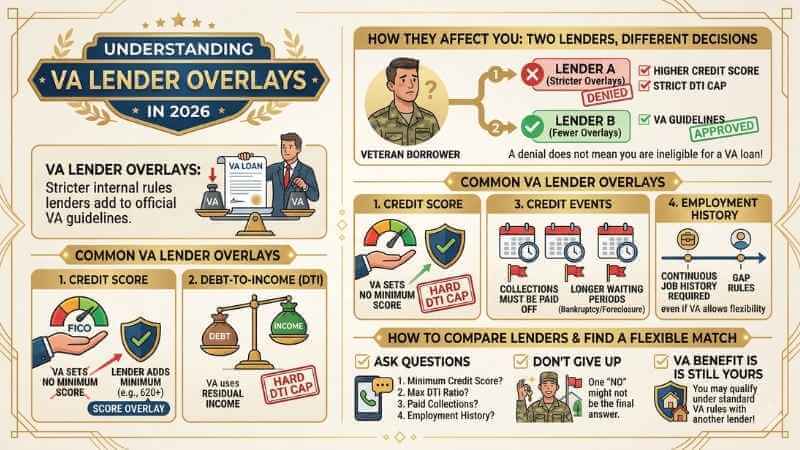
VA lender overlays are additional rules some mortgage lenders add to the official VA loan guidelines. These additional requirements can make it harder for veterans to qualify, even when they meet the basic standards set by the U.S. Department of Veterans Affairs. In many cases, overlays affect credit score expectations, debt-to-income ratios, recent credit events, collection accounts, and employment history.
That is why two lenders can look at the same veteran borrower and reach different decisions. One lender may approve the loan under VA guidelines, while another may deny it due to its stricter internal rules.
For veterans, understanding this difference is important because a denial does not always mean you are ineligible for a VA loan. It may mean that a particular lender has tighter requirements. This guide explains what VA lender overlays are, why lenders use them, how they can affect your approval, and what veterans should compare when shopping for a VA mortgage in 2026.
What Are VA Lender Overlays?
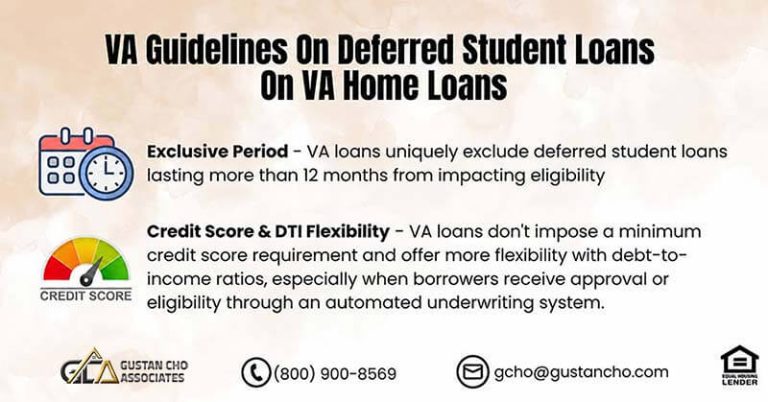
The Department of Veterans Affairs sets the core rules for the VA home loan program, but the VA does not directly lend money. Private mortgage lenders fund VA loans and can apply their own underwriting standards in addition to the agency’s baseline guidelines. These stricter lender-specific standards are called VA lender overlays. For example, the VA does not set a universal minimum credit score and does not rely on a single hard debt-to-income ratio cap, as many conventional lending programs do. However, many lenders still set their own minimum credit score requirements, DTI limits, or additional restrictions for borrowers with prior bankruptcies, foreclosures, collections, or employment gaps. Those added requirements are overlays.
Why VA Lender Overlays Matter
VA loans are created to help veterans, active-duty service members, and some surviving spouses buy homes more easily. But overlays can narrow that access. A borrower may meet VA eligibility rules and still be turned down because a lender applies stricter standards than the program itself requires. That is why veterans should not assume one denial tells the whole story. Sometimes the issue is not the VA loan program. The issue is the lender’s overlay. Understanding that distinction can help borrowers shop smarter, compare lenders more effectively, and avoid giving up on a mortgage they may still qualify for.
The VA Sets the Program, but Lenders Set Their Own Rules
The U.S. Department of Veterans Affairs backs VA home loans, but it does not lend money directly. Private mortgage lenders originate, underwrite, and fund these loans. The VA helps by backing a portion of the loan, making it easier for eligible veterans, active-duty service members, and some surviving spouses to access benefits such as no down payment, no monthly mortgage insurance, and great interest rates.
However, meeting basic VA guidelines does not always guarantee approval. Many lenders add their own stricter standards on top of VA rules. These added requirements are called VA lender overlays. They may include higher minimum credit scores, lower debt-to-income ratios, or additional rules on collections, prior credit events, and employment history.
That distinction is what veterans need to understand when shopping for a VA mortgage. A denial does not always mean you do not qualify for the VA loan program itself. It may simply mean that one lender’s overlay is more restrictive than another’s.
Why VA Loans Are Different From Conventional Loans
VA loans stand out from regular loans because they’re backed by the U.S. Department of Veterans Affairs. They’re intended for veterans, active-duty service members, and eligible surviving spouses. They can offer major benefits, including no down payment requirement, no monthly mortgage insurance, and, in some cases, more flexible underwriting standards. That said, the VA does not directly fund these loans. Private lenders do. As a result, two lenders can treat the same VA borrower differently. While the VA sets the program’s core framework, individual lenders may still add stricter rules, called overlays. That is why understanding lender overlays matters when comparing VA loan options.
How VA Lender Overlays Can Limit VA Loan Benefits
VA loans are designed to give eligible borrowers meaningful advantages, including no down payment, no monthly mortgage insurance, and more flexible qualifying standards than many other loan programs. But those benefits can be harder to access when a lender adds overlays on top of standard VA guidelines.
For example, a veteran may qualify for the VA program in principle. However, a lender may still require a higher credit score, impose a stricter debt-to-income limit, or apply tougher rules for collections, recent late payments, or prior bankruptcies and foreclosures. In that situation, the issue is not the VA loan benefit itself. The issue is the lender’s added requirement.
That is why overlays can be so frustrating for borrowers. They can block access to a loan program designed to be more flexible for veterans. When comparing lenders, veterans should look beyond the basic promise of a VA loan and ask what extra rules the lender applies before assuming they do or do not qualify.
When Overlays Affect Approval Most
VA lender overlays usually matter most when a borrower falls outside a lender’s preferred risk profile. This often happens with lower credit scores, higher debt-to-income ratios, recent late payments, unpaid collections, prior bankruptcies or foreclosures, gaps in employment, or income that is harder to document. In these cases, a veteran may still meet the basic intent of VA guidelines but run into a lender’s stricter internal rules. That is why veterans with more complex files are often the most affected by overlays. One lender may decline the loan based on its own added standards. At the same time, another may review the same borrower more flexibly within VA guidelines. For borrowers who have been told no, it is important to understand that the denial may reflect the lender’s overlay rather than a problem with VA eligibility itself. This is also why comparing lenders matters. Veterans with credit challenges, higher DTI, recent financial setbacks, or nontraditional income should carefully review each lender’s minimum credit score, DTI tolerance, treatment of collections, and waiting period policies after major credit events.
Why Lenders Add VA Overlays
Lenders add overlays to lower their own risk. Even though the VA guarantees part of the loan, the lender is still responsible for underwriting the file and wants to reduce the chance of default. Because of that, many lenders set stricter standards than the VA itself requires.
These added rules can also reflect internal company policy, investor preferences, or past loan performance.
For example, the VA does not set a universal minimum credit score. However, a lender may still require a 620 or 640 score because it believes that lower-score loans are riskier. In the same way, a lender may cap debt-to-income at 41% or 50%, even though VA lending focuses on residual income rather than a single fixed DTI rule. In plain English, an overlay is a lender saying, “The VA may allow this file, but our company wants a bigger safety margin.” That is why one lender may approve a veteran while another lender declines the same borrower.
Common VA Lender Overlays in 2026
The most common VA lender overlays in 2026 involve credit score, debt-to-income ratio, collections, employment history, and waiting periods after major credit events. These are the areas where lenders often go beyond standard VA flexibility. A common example is a credit score. The VA doesn’t have a one-size-fits-all minimum score for borrowers, but a lot of lenders still ask for a minimum score of 620 or higher. Another example is DTI. A veteran may have high residual income and still be denied if a lender applies its own hard DTI cap. Some lenders also require unpaid collections to be resolved before closing, even though VA guidelines are not always that strict on collection accounts alone. Overlays can also appear after a bankruptcy, foreclosure, or job gap. One lender may be comfortable once the borrower meets basic VA timing and documentation expectations, while another may require a longer waiting period or a more stable recent work history. That is why veterans should not assume every VA lender follows the same standards, even when they advertise the same loan program.
Know the Difference Between VA Rules and Lender Rules
We explain overlays and how veterans can still qualify even if told “no.”How to Avoid VA Lender Overlays
Veterans cannot always avoid overlays completely, but they can reduce the risk of encountering unnecessary lender restrictions by carefully comparing lenders. The key is to look beyond whether a lender offers VA loans and ask how it applies its internal rules. Two lenders may both advertise VA financing, but one may be much more flexible than the other. A smart way to approach this is to use a simple checklist. Ask each lender what minimum credit score they require, how they evaluate debt-to-income ratio, whether unpaid collections must be paid off, how they treat prior bankruptcies or foreclosures, and what employment history they want to see.
These questions can reveal whether the lender closely follows standard VA guidelines or applies stricter overlays that may affect approval.
Veterans should also remember that a denial from one lender does not always mean they are ineligible for a VA loan. In many cases, it means that the lender’s internal rules were more restrictive than those of another lender. The goal is not just to find a lender that says it offers VA loans. The goal is to find one whose requirements are a good fit for your credit, income, and overall file.
Ask the Right Questions
If you’re applying, make sure to check:
- What’s your minimum credit score to qualify?
- Will you allow a maximum DTI ratio?
- Must I pay off all collections before closing?
- Is two years of continuous employment history a must?
Why Choosing the Right VA Lender Matters
Not all VA lenders evaluate borrowers the same way. Even though they offer the same loan program, their internal standards can vary, affecting approval, pricing, and overall flexibility. That is why choosing the right lender matters, especially for veterans whose credit, income, or recent financial history may not fit a narrow underwriting box.
When comparing VA lenders, veterans should look beyond interest rates and marketing claims. It is important to compare minimum credit score requirements, debt-to-income flexibility, treatment of collections, waiting periods after bankruptcy or foreclosure, and how income and employment history are reviewed.
These details can make the difference between a smooth approval and an avoidable denial. The right lender is not simply the one with the loudest advertising or the broadest promises. It is the one whose guidelines, communication, and underwriting approach match the borrower’s actual financial profile.
FAQs About VA Lender Overlays
Can a Lender Deny a VA Loan Even if I Meet VA Guidelines?
Yes. A lender can deny a VA loan even when you appear to meet the basic VA framework because private lenders are allowed to add their own stricter rules, called overlays. These may include minimum credit scores, tighter debt-to-income limits, longer waiting periods after bankruptcy or foreclosure, or stricter treatment of collections and charge-offs.
Does the VA Require a Minimum Credit Score?
The VA itself does not set a single universal minimum credit score for all borrowers. In practice, though, many lenders apply their own score requirements, often around 620 to 640, while some lenders may consider lower scores depending on the full file, payment history, and residual income.
What is the Maximum DTI for a VA Loan?
VA lending does not work with a single hard cap in every case, as many borrowers expect. Lenders often use 41% as an important benchmark, but many also apply their own overlay limits, sometimes allowing more or less depending on residual income, compensating factors, and internal policy. That is why one lender may be more flexible than another on the same borrower.
Do I Have to Pay Off Collections to Qualify for a VA Loan?
Not always. Collection accounts do not automatically make a borrower ineligible under the VA program. Still, some lenders add overlays requiring certain collections or charge-offs to be paid before closing. This is one of the clearest examples of why lender rules can matter just as much as the base VA guidelines.
How Long After Bankruptcy or Foreclosure Can I Get a VA Loan?
Some lenders may approve borrowers once they meet standard VA timing requirements, but others may add extra seasoning requirements through overlays. In plain terms, that means two lenders may treat the same past credit event differently, with one willing to review the file sooner and another willing to wait longer.
How Can I Avoid VA Lender Overlays?
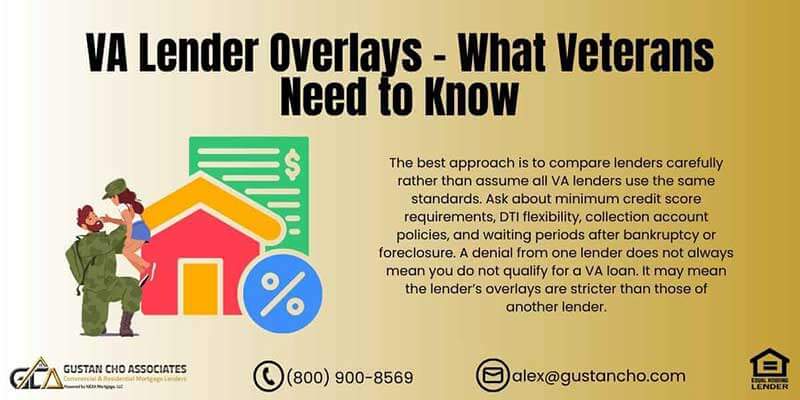
The best approach is to compare lenders carefully rather than assume all VA lenders use the same standards. Ask about minimum credit score requirements, DTI flexibility, collection account policies, and waiting periods after bankruptcy or foreclosure. A denial from one lender does not always mean you do not qualify for a VA loan. It may mean the lender’s overlays are stricter than those of another lender.
This article about “VA Lender Overlays – What Veterans Need to Know” was updated on April 3rd, 2026.