Mortgage Guidelines on Late Payments: How to Qualify for a Home Loan Despite Credit Challenges
Life happens. Unexpected events like job loss, medical emergencies, or financial setbacks can lead to late payments on bills, including mortgages. If you’ve had late payments in the past 12 months, you may think qualifying for a mortgage or refinancing your home is impossible. The truth? While late payments can complicate things, they don’t have to be a dealbreaker.
Learn mortgage guidelines on late payments today, including rules for FHA, VA, USDA, and conventional loans, what underwriters look for, and tips to increase chances of being approved.
This blog will walk you through updated mortgage guidelines on late payments for 2026 and show you how to navigate the mortgage process, even if your credit history isn’t perfect. Whether you’re a potential homebuyer or exploring refinancing options, we’ll provide actionable insights to help you achieve your dream of homeownership.
The Truth about Mortgage Guidelines and Late Payments
Having late payments on your account can complicate mortgage approval, but it’s still possible to get approved. The most important indicators to look at on your credit report are the number of late payments, the time between late payments, and the proximity of the most recent late payment. Additionally, late payments on housing.
A mortgage would be more serious than a late credit card payment. Fannie Mae states that lenders consider the timing and number of mortgage delinquencies.
They are more lenient with recent mortgage delinquencies for Fannie Mae-conforming loans. Fannie Mae, when evaluating late payments, wants lenders to assess whether the recent late payments were situational or a recurring pattern. Different mortgage lenders have their own guidelines regarding late payments and mortgage approvals.
Mortgage Guidelines on Late Payments Explained
FHA, VA, USDA, and other conventional loans differ in how late payments are assessed. In the right situation, FHA and VA guidelines can be more lenient than USDA guidelines, but USDA is more lenient on late payments that reflect a lack of willingness to repay loans. Having a late payment on your credit report is a negative, but it doesn’t mean the borrower’s only option is to pay it.
The pathway toward financing a conventional loan is even more difficult for a borrower with recent housing lates, frequent delinquencies, or a 60-day mortgage late payment.
That is why late payment qualifiers have such an emphasis on timing, documentation, and loan selection. Loans with prior mortgage delinquencies are not eligible for delivery, according to Fannie Mae. Prior mortgage delinquencies are defined as 1 or more 60, 90, 120, or 150-day mortgage delinquencies in the 12 months preceding the credit report date.
Can You Get a Mortgage with Late Payments?
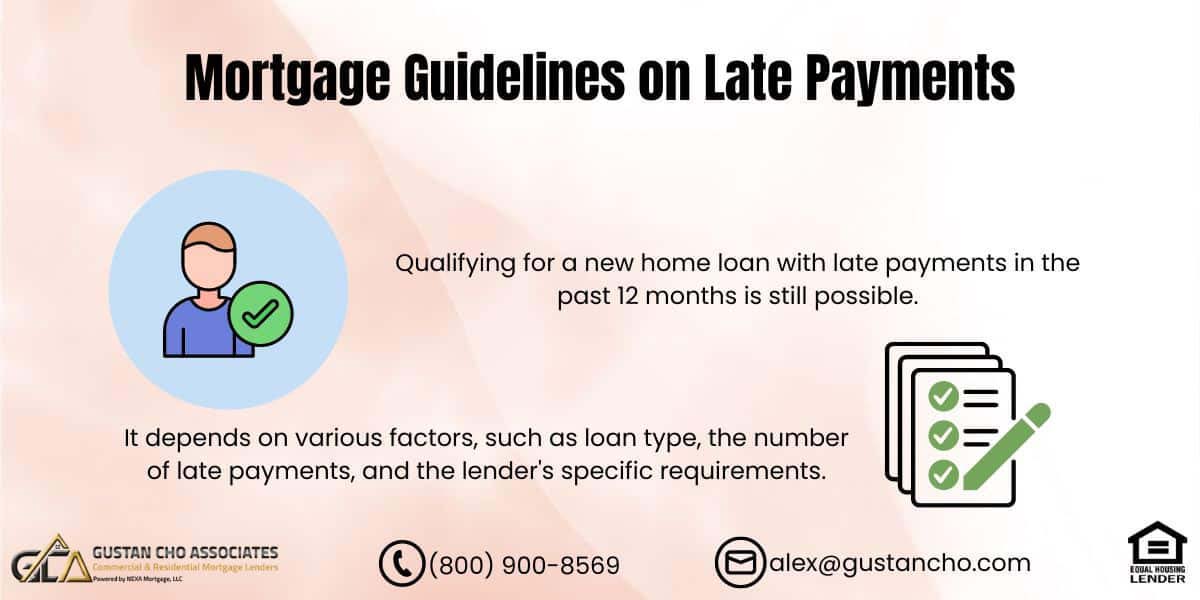
Absolutely, you can still get a loan! Just because you’ve missed some payments doesn’t mean it’s the end of the line. Many loan programs, like FHA, VA, and Non-QM loans, are available for people with less-than-perfect payment histories. That said, most lenders want to see that you’ve made your payments on time for the last year to approve your loan. Understanding the mortgage guidelines on late payments is important so you know what to expect and what steps to take next.
- One or two late payments: Most lenders are forgiving if you’ve had one or two isolated late payments.
- Multiple late payments: A pattern of late payments can raise red flags, but options like manual underwriting or non-QM loans may still allow you to qualify.
- Rolling 30-day late payments: These are treated as separate late payments and can significantly impact your eligibility.
Why the Mortgage Guidelines on Late Payments Matter
Because of the nature of mortgage underwriting, lates are important. The mortgage lender has not just looked at the credit score, nor considered only the recent late payments. The underwriter is trying to determine, based on the recent lates, whether the borrower has the willingness and ability to manage monthly obligations. Fannie Mae states that recent late payments pose a higher credit risk than those more than 24 months old.
The worst lates to have are the housing lates. If a borrower is late on their housing payment, whether that is a rent or mortgage payment, underwriting is more concerned than if a borrower has had a late payment on a credit card.
Housing history is considered the most reliable predictor of how a borrower will manage a new mortgage payment. As evidenced by Freddie Mac’s need for confirmation of the last 12 months of current and prior housing payments, housing payment behavior is essential to underwriting.
What Do Underwriters Examine When There Are Late Payments?
When underwriting a mortgage, late payments are usually assessed on four factors: recency, severity, frequency, and explanation. Recency refers to how long the late payment has been outstanding. Severity refers to how late the payment was: 30, 60 days? Fannie Mae guidance suggests that lenders should separate isolated cases from repeat offenders and consider the time frames of the late payments.
Frequency refers to whether the late payment was a one-time occurrence or a repeat. Explanation refers to whether there was some documented reason, e.g., a temporary period of hardship, and whether there was subsequent credit improvement.
Underwriters consider the entire picture. A borrower with solid reserves and stable employment, a good payment history, and one older late payment is treated more favorably than a borrower with no reserves, high debt, and several late payments. VA training documents state that there are no minimum credit score requirements for VAs and that derogatory credit does require some explanation, but they stress the need to examine the entire borrower’s credit history.
Worried About Late Payments on Your Credit? You Can Still Qualify for a Mortgage!
Contact us today to explore your mortgage options and see how we can help you qualify despite late payments.How Late Payments Affect Mortgage Qualification
Late payments can impact your ability to qualify for a mortgage in several ways:
- Credit Score Impact: Missing a payment can lower your credit score. Your credit score is important because lenders use it to decide whether to give you a loan and what interest rate you’ll pay. It’s crucial to understand the rules about late payments for mortgages, as they can impact your ability to get a mortgage. If your credit score decreases, you might have to pay a higher interest rate or may even be denied the loan you need.
- Automated Underwriting System (AUS) Findings: When you seek a mortgage, lenders frequently utilize an Automated Underwriting System (AUS) to assist in determining whether your loan will be approved. If you have had missed payments previously, the AUS may assign your application a “refer” or “caution” status. This indicates that someone will need to examine your application in greater detail instead of providing a quick response. It is crucial to recognize how late payments can impact your approval, as they significantly influence the decision-making process.
- Manual Underwriting Requirements: Manual underwriting gives borrowers with late payments more options. However, it usually needs a larger down payment, some extra savings, and clear explanations for the late payments.
Updated 2026 Mortgage Guidelines on Late Payments
Let’s dive into the latest rules for late payments across different loan programs.
What Are The Recent Late Payments of Fannie Mae
Fannie Mae has a distinct approach to treating recent late payments; at present, conventional financing is typically the most challenging option. Conventional loans have strict rules about late payments. You can have one late payment of 30 days within the past year and still get approved through the Automated Underwriting System (AUS).
If you have more than one late payment, the loan will be marked as “refer with caution” and you won’t qualify. Also, you cannot do a cash-out refinance if you had any late payments in the past year.
Fannie Mae considers excessive prior mortgage delinquency to be any mortgage tradeline with one or more 60-, 90-, 120-, or 150-day delinquency for any mortgage tradeline within the 12 months prior to the credit report date, and therefore, such tradelines are not Fannie Mae Selling Guide states that lenders are to assess if the 30, 60, or 90 days late payment was a one-off or if it was a part of a pervasive pattern. The guide has established that the more recent the late payment, the higher the risk. Therefore, one 30-day late payment, whether recent or aged, may be a nuisance; multiple recent late disbursements may be a disqualifier, irrespective of the score.
Why Mortgage Lates Hurt Conventional Approval More
Underwriting a recent mortgage delinquency shows that the borrower has had difficulties with the same type of obligation that he/she is requesting. This explains the extreme conservatism in conventional underwriting for prior mortgage delinquencies. Even with files that had automated underwriting approval, lenders are still obligated to consider the prior mortgage delinquencies as part of the mortgage eligibility criteria.
Guidelines of FHA Mortgages concerning Late Payments
It is true that in some circumstances, FHA may be more lenient than conventional financing, but late payments still carry some significance. The FHA has some of the most relaxed credit access policies. However, if a manuscript demonstrates recent housing payments, the FHA will consider a manuscript to show a recent housing payment, and multiple recent housing payments will lead to the manuscript being considered a recent housing payment. Multiple recent housing payments will lead to the manuscript being considered a recent housing payment.
The most accessible copy of the FHA Single Family Housing Policy Handbook is the version dated November 26, 2025. As such, the HUD’s Handbook 4000.1 is the primary source of FHA policies for HUD.
This will lead to the manuscript being sent to a reader for a manual underwriting consideration, and possibly a denial from the reader based on the overall profile and lender overlays. Your mortgage may show a pay a mortgage payment late if the payment is more than 15 days late, and late fees may be assessed 17 days after the payment is due, and therefore, just because it may appear that the payment is a few days late, the mortgage company doesn’t care about your analysis, and you will be able to show your analysis to the mortgage servicing company.
FHA Loans
FHA loans are a suitable option for borrowers with certain credit challenges. The guidelines have some helpful points. If you have one late payment that was 30 days late in the last 12 months, you can still qualify for a loan.
If you have two late payments of 30 days, you might still get approved, but you may need to provide a larger down payment or show extra savings. If you have a late payment of 60 days, your loan will be manually checked.
For that, you shouldn’t have any late payments in the past year, and you can only have a maximum of two 30-day late payments in the last two years. You also need to provide proof of any special reasons for your late payments, like losing a job or a medical emergency.
Agency Versus FHA Overlays on Late Payments
The agency guidelines versus overlays illustrate why borrowers are sometimes confused. Agency guidelines are more flexible than FHA guidelines, but FHA guidelines are more flexible than all agency guidelines, per individual agency. This means that if one lender denies a borrower, the borrower may still not be denied by the FHA. This means HUD has policies for mortgagees, but mortgagees can set their own Underwriting policies that exceed the minimum HUD requirements.
When Late Payments May Still Work with FHA
If the late payments were not chronic, and the borrower has a history of on-time payments, then FHA may still be an option. When cash reserves exist, older delinquencies can often be overlooked, especially when a borrower’s recent housing history is clean. HUD’s current guidelines continue to stress the importance of borrower engagement prior to an early default, noting that the agency distinguishes between a temporary inability to pay and an ongoing one.
VA Loans
VA loans are for veterans and active-duty service members. Late payments can affect your eligibility for these loans. It’s important to know the mortgage guidelines on late payments. Missing a payment or paying late may hurt your chances of getting a VA loan. Keeping up with your payments shows lenders that you are reliable.
Timely payments over the past 12 months are essential for AUS approval. You may need manual underwriting if you have one late payment of 30 days.
A 60-day or multiple late payments are serious issues and often make you ineligible for 12 months. However, Gustan Cho Associates provides some flexibility. They allow you to qualify with just 12 months of timely payments instead of the usual 24 months through manual underwriting.
Guidelines for VA Mortgages and Late Payments
VA loans offer great flexibility, but they also do not permit recent late payments. VA training materials state that there is no agency-set minimum credit score, that there is no negative bias for an absence of credit, and that derogatory credit typically requires explanation. Those same materials also direct lenders to Chapter 4 credit standards, which consider the borrower’s credit history as a whole rather than focusing on a single numerical threshold.
That is also the reason why VA is more likely than most to extend offers to those with imperfect credit. It is also the reason why recent housing lates can be such a significant concern.
If multiple recent delinquencies are present in a file, a borrower may be required to possess more than one compensating factor, such as high residual income, low overall debt, substantial cash reserves, or a documented resolution to a hardship. VA training materials reference compensating factors such as high residual income and low debt-to-income ratio.
VA Considers the Entire Credit History
VA underwriting often works on the premise of common-sense underwriting. Even when there are payment delinquencies, the borrower’s entire credit file must be documented and considered. This indicates that an isolated late payment followed by a significant improvement in payment behavior is more favorable than a borrower with a track record of consistently erratic payment behavior.
USDA Mortgage Guidelines on Late Payments
With the USDA, recent late payments are an indicator of a soft payment pattern, so they are not forgiving. USDA’s Single Family Housing Guaranteed Loan Program states that USDA lenders must determine the applicant’s ability and willingness to repay.
USDA guidance indicates that, in some refinance scenarios, the existing mortgage payment history cannot show a delinquency of more than 30 days in the last 6 months.
USDA guidelines state that if the borrower has late payment(s) in the last 12 months, the lender must fully include the mortgage obligation in the monthly debts when analyzing the ratios. This illustrates the USDA’s conservative view of a borrower’s recent payment record.
Why USDA Can Be Tough on Recent Lates
USDA’s focus is on providing affordable homeownership to eligible borrowers. Recent delinquencies are significant because they indicate the borrower may not be able to manage the new payment. Even if credit scores are at or above the automated threshold, the file still must show a pattern of responsible repayment.
Non-QM Loans
Non-QM loans are great for people with recent bumps in their credit, like late payments. You can even have a few late payments and still get approved, though you might need to put down a bigger chunk of money upfront—usually between 20% and 30%. Plus, if you’ve had rolling 30-day late payments, that’s okay, too. One of the best things about Non-QM loans is that you don’t have to wait around; they kick in just a day after big credit issues like a foreclosure or short sale.
How to Improve Your Chances of Getting a Mortgage
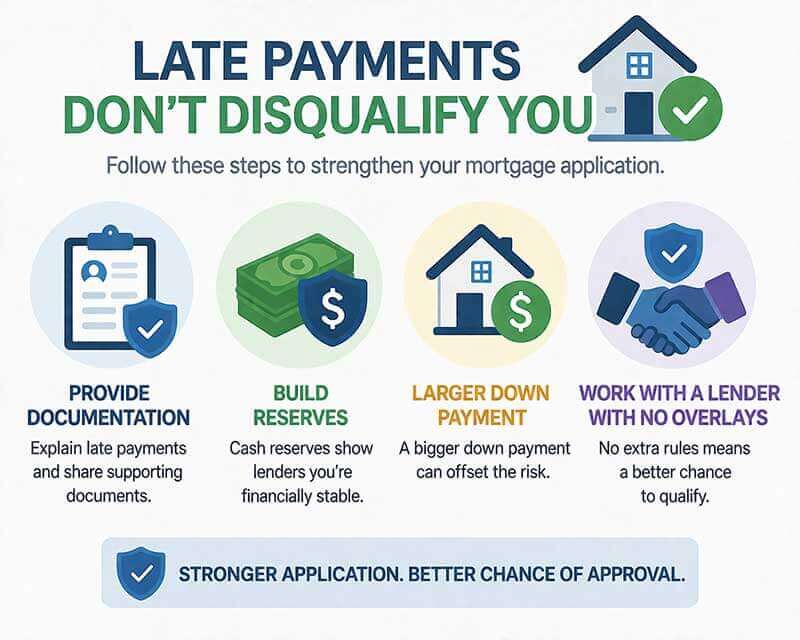 If you’ve had a few late payments in the past, don’t worry just yet. You can still make your mortgage application stronger by following some simple steps. Here are some tips to help you navigate the mortgage guidelines on late payments and improve your chances of approval:
- Provide Documentation: Explain the circumstances behind your late payments (e.g., medical bills, job loss) and provide supporting documents.
- Build Reserves: Having cash reserves can demonstrate financial stability to lenders.
- Consider a Larger Down Payment: This can offset the risk of late payments.
- Work with a Lender with No Overlays: Many lenders add their own rules (overlays) on top of agency guidelines. Gustan Cho Associates has no overlays, making it easier to qualify.
Rolling 30-Day Late Payments: What You Need to Know

Real-Life Success Stories
At Gustan Cho Associates, we’ve helped borrowers with challenging credit histories achieve their homeownership dreams. Here are a few examples:
- Case Study 1: A veteran with two 30-day late payments in the past year qualified for a VA loan after providing proof of extenuating circumstances and building 12 months of timely payments.
- Case Study 2: A self-employed borrower with rolling 30-day late payments secured a Non-QM loan with a 25% down payment.
- Case Study 3: A first-time homebuyer with a 580 credit score and a recent late payment was approved for an FHA loan with a higher down payment.
Looking for a Mortgage with Late Payments? We Can Help!
Contact us today to learn how we can work with your situation and help you secure a loan.Do All Late Payments Hurt the Same Way?
No. A 30-day late payment from two years ago will likely be treated more favorably than a 60-day late mortgage payment from three months ago. Underwriters tend to consider recent housing delinquencies to be most serious. While multiple accounts with late payments are often viewed as worse than a single account with a late payment, they are typically viewed more favorably than a single account with a late payment. Fannie Mae’s guidance most clearly illustrates the combination of delinquency severity and recency.
When to Apply for a Mortgage After Late Payments
A late payment that has never been reported to the credit bureaus is viewed more favorably than one that has been reported as a 30-day, 60-day, or 90-day delinquency. Many servicers do not report late payments to the credit bureaus until the late payment exceeds the reporting threshold; however, late fees will be assessed prior to that report. HUD’s servicing guides state that for FHA servicing, a payment is considered late after 15 days; however, this is separate from credit bureau reporting and from delinquency reporting for underwriting.
Late Mortgages Versus Late Credit Cards
Late mortgage payments will have a greater negative impact on the likelihood of mortgage approval than late payments on revolving credit accounts. This is because mortgage payments directly affect housing performance.
A single late payment on a credit card will likely impact your credit score negatively and prompt the credit agency to take further action.
When mortgage or rental payments are late, this raises the most concern for lenders: Do you have the ability to pay your rent on time? This concern stands out to the lenders, and as a result, they will place significant importance on the payment history of mortgage accounts. This is especially true for Fannie Mae and Freddie Mac.
How Long After A Late Payment Can You Apply For A Mortgage?
There is no answer to this question that will apply to every borrower, as the specifics for each loan program will differ based on the late payment type and the rest of the file. In short, the longer the time between an issue and a positive trend, the greater the chance a borrower will get approval.
Fannie Mae states that older late payments are less risky than newer ones, and a significant portion of the agency’s and lenders’ reviews focuses on the last 12 months of behavior.
In the interest of most borrowers, the best course of action is not to apply the very minute an account becomes current. Waiting long enough to develop a more positive recent history increases options, improves pricing, and diminishes the likelihood of a battle with a manual underwriter. It is basically a best guess based on the current state of agency guidelines and the recent emphasis on behavior.
After A Late Payment, What Can Be Done To Increase The Likelihood Of Loan Approval?
The most critical first step is to reverse these negative payment behaviors. It is more important to get the account current and start making payments on time than to wait for the perfect letter of explanation when the file is still a mess. The next step is to review the error on the credit report. Sometimes, an unreported late payment can significantly affect the loan’s outcome.
Fannie Mae understands that lenders use analytical tools in Desktop Underwriter to assess tradeline discrepancies that can impact the underwriting process.
Considerations affecting the rest of the file can include managing credit card balances, avoiding new debt, maintaining cash reserves, and job stability. For VA deals, high residual income and liquid assets can be seen as positive. For any type of loan, a file that is stable and shows a clear path to recovery is preferred over one that remains fragile.
Documents That Can Help Explain Late Payments
Strong explanations are simple, clear, and concise. Examples include temporary medical hardship, job loss, automatic payment error, and closed accounts with a history of payments. Underwriters prefer documented one-time hardship cases with a clear recovery. Agency guidance suggests analyzing the payment history and reasons for delinquencies; not a vague term from a borrower that they “forgot.”
Mistakes Borrowers Make After Late Payments
Some of the more common mistakes include applying too early, assuming that one lender’s decline means all other programs are off the table, and focusing solely on credit score while ignoring housing history. Underwriters tend to be more focused on credit history, so a decent score should not be relied on too heavily, especially when there are recent delinquencies in mortgage or rental payments.
Agencies have provided guidance on previous mortgage payment history and housing payment verification, indicating that payment behavior matters regardless of score.
Another wrong move is allowing a small late payment (one that is not made on time but is not within the 30-day window) to snowball into larger problems. For instance, the difference between 30 days late and 60 days late is significant for mortgage eligibility. This is particularly the case for conventional loan files, as recent 60-day mortgage delinquencies are sufficient to render a file ineligible under Fannie Mae’s prior mortgage delinquency rule.
Who May Still Qualify for a Mortgage with Late Payments
Borrowers may qualify if late payments are older, isolated, fully explained, and are followed by a recent payment history that is clean. The same applies to borrowers with stable income, controlled debts, reserves, and no recent housing delinquencies.
In contrast to the previous example, lenders face a greater adverse risk with borrowers who have multiple recent late payments, 60-day housing delinquencies, unresolved arrears that are actively in default, and financial instability.
This does not guarantee approval, but it is consistent with how the agencies approach mitigating risk. These files may benefit from waiting until it is more positive. This is particularly the case for conventional loans, due to Fannie Mae’s prior mortgage delinquency rules.
Final Thoughts on Learning Mortgage Guidelines on Late Payments Today
If you want to learn mortgage guidelines on late payments today, the biggest takeaway is that late payments do not all carry the same weight. Underwriters care most about how recent the late payment was, how severe it was, whether it involved housing, and whether your recent history shows real recovery.
Conventional financing is usually the strictest when recent mortgage delinquencies are involved. FHA and VA can offer more flexibility in some cases, while USDA still requires a strong recent repayment history.
The smartest path is usually to fix what can be fixed, document what happened, and apply only after your recent payment history tells a better story than your older credit problems do. That approach best matches how the major mortgage programs evaluate late payments today.
Apply for a Mortgage with Gustan Cho Associates
At Gustan Cho Associates, we specialize in helping borrowers with credit challenges, including late payments. We offer:
- No overlays on FHA, VA, and conventional loans.
- Flexible Non-QM loan options for borrowers with recent late payments.
- Expert guidance to help you rebuild your credit and qualify for a mortgage.
Ready to move forward? Get in touch with us today at (800) 900-8569 or shoot us an email at alex@gustancho.com. Our team is here for you every day of the week, even in the evenings and on holidays, to help you reach your dream of owning a home. If you’re worried about how mortgage guidelines on late payments might affect you, don’t hesitate to ask us! Late payments don’t have to stand in the way of your dreams. With the right guidance and loan program, you can qualify for a mortgage and turn your plans into reality. Let Gustan Cho Associates show you how!
Frequently Asked Questions About Mortgage Guidelines on Late Payments:
Can I Get A Mortgage With One Late Payment?
Yes, sometimes. One isolated late payment is usually less damaging than a pattern of late payments, especially if it was not recent and did not involve housing. Fannie Mae says lenders must determine whether late payments were isolated incidents or frequent occurrences and also weigh how recent they were.
Do Late Mortgage Payments Hurt More Than Late Credit Card Payments?
Usually yes. Mortgage and rent payment history often carries more weight because it directly reflects how you handle housing obligations. Freddie Mac requires verification of housing payment history, and Fannie Mae has a separate rule for prior mortgage delinquency.
How Many Late Payments Can You Have And Still Qualify?
There is no universal number that applies to every loan program or lender. The answer depends on the type of account, how recent the lates were, how severe they were, and whether the late payments show a pattern. For conventional loans, a recent mortgage delinquency of 60 days or more within the prior 12 months can make the loan ineligible for delivery to Fannie Mae.
Can I Get An FHA Loan With Recent Late Payments?
Possibly, but it depends on the full file and the lender’s overlays. FHA can be more flexible than conventional financing in some cases, but recent housing lates still create major underwriting concerns. HUD’s handbook provides the policy framework, while lenders may impose stricter standards.
Does VA Allow Late Payments?
VA does not set a universal minimum credit score in its agency materials, and it considers the borrower’s overall credit history rather than one simple cutoff. Even so, derogatory credit may require explanation, and recent housing lates can still hurt approval.
How Can I Improve My Chances After Late Payments?
Bring accounts current, avoid new late payments, reduce revolving balances, preserve savings, check credit reports for errors, and document any temporary hardship that caused the delinquency. This strategy aligns with how agencies and automated underwriting systems review payment history and current credit data.
What Are Mortgage Guidelines On Late Payments?
Mortgage guidelines generally require timely payments within the past 12 months. One or two late payments may be acceptable, but multiple or rolling late payments can complicate eligibility.
Is it Possible To Get a Mortgage Despite Late Payments?
Yes! FHA, VA, and Non-QM loans offer options for borrowers with late payments. However, you may need a larger down payment or reserves.
How Do Late Payments Affect My Credit Score?
Delinquent payments can lower your credit score by 60 to 110 points, based on their severity and how often they occur. This reduction can influence the conditions of your loans and the interest rates offered.
What Is The Difference Between AUS And Manual Underwriting?
AUS is an automated system that evaluates your application. Manual underwriting involves a human underwriter reviewing your file, allowing for more flexibility with late payments.
Are There Loans For Borrowers With Multiple Late Payments?
Yes! Non-QM loans are an excellent option for borrowers with multiple or recent late payments. These loans have fewer restrictions but require higher down payments.
What Loan Programs Are Best For Borrowers With Late Payments?
FHA and Non-QM loans are typically the most forgiving, offering options even with recent late payments.
How Long Can I Apply For A Mortgage After A Late Payment?
It depends on the loan type. FHA loans may allow applications sooner than conventional loans, but non-QM loans do not have a waiting period.
Do Late Payments On Credit Cards Affect Mortgage Approval?
Yes, they can. While mortgage late payments carry the most weight, late payments on other debts can still lower your credit score and raise red flags.
Can I Refinance My Mortgage If I have Late Payments?
You may still qualify for a refinance with late payments, especially with Non-QM loans or FHA streamline options.
How Do I Explain Late Payments To A Lender?
Provide a letter of explanation with documentation supporting your reason for late payments, such as medical records or proof of unemployment.
This blog about “Learn Mortgage Guidelines on Late Payments Today” Was Updated On April 7, 2026.