
Real Estate and Mortgage Market Forecast: 2026 Housing Trends You Need To Know
If you’re considering buying a home, selling, or refinancing, you’ve probably asked: What’s the real estate and mortgage market forecast for 2026? You’re not alone. Dale Elenteny, a senior mortgage loan originator at Gustan Cho Associates says the following about real estate and mortgage market forecast for 2026:
The real estate and mortgage market forecast today focuses on Home Prices, Inventory, Mortgage Rates, Buyer Demand, and what to expect in 2026.
It can feel overwhelming with mortgage rates bouncing around, home prices shifting, and inventory still tight in many areas. This guide simplifies everything, allowing you to make informed decisions and proceed confidently. At Gustan Cho Associates, we are ready to assist you in navigating the current real estate market and mortgage environment, regardless of your position in the process.
What’s Happening in the 2026 Real Estate Market?
The real estate and mortgage market forecast in 2025 shows signs of stabilizing, but conditions remain atypical. Home prices remain high, especially in the South and parts of the Midwest, though the pace of growth has slowed, and some areas are seeing steady or slightly declining prices. This trend is likely to continue into 2026, particularly in markets that experienced significant price increases in 2021 and 2022. For those asking, “Is 2026 a good time to buy a house?” the cooling market might offer better buying opportunities compared to the previous years.
2026 Mortgage Rate Forecast: Will Rates Go Down?
Understanding the potential changes in mortgage rates for 2026 requires a closer look at various factors influencing your personal situation. While predictions from Fannie Mae and Freddie Mac suggest a possible decrease in rates to the low to mid-6% range by the end of 2026, it’s essential to consider how these forecasts translate to your own borrowing options.
Today’s Mortgage Market and Refinancing
One of the first decisions you’ll face is whether to lock in your mortgage rate or float it. Locking in a rate ensures you secure a certain percentage, protecting you from potential fluctuations. Floating gives you the chance to snag better rates if they drop, but it also means you could end up dealing with higher rates, too. If you’re in a position to wait and believe rates may dip further, floating could be an option worth considering. However, if you find a rate that’s favorable based on your circumstances, locking can provide peace of mind.
What Factors Could Lead to a Decrease in Mortgage Rates
Understanding how your personal factors—such as your credit score, debt-to-income ratio (DTI), and credit score—impact your mortgage rate is extremely important.
Keeping up with the real estate and mortgage market forecast and talking to mortgage pros helps you figure out whether to lock in or float your mortgage rate in 2026. This way, you can snag the best possible terms that fit your situation.
Generally, a higher credit score means you’ll get a better rate, and having a lower DTI can help you borrow more. Additionally, buying points to lower your rate upfront can be a smart move, especially if you plan to stay in your home for a while.
Current Forecast for the Real Estate and Mortgage Market: What Buyers and Sellers Need to Know
The current forecast for the real estate and mortgage market indicates the housing market is and will continue to be challenging for buyers. Mortgage rates have dropped from their recent historic highs, but they are still elevated. As of April 9, 2026, Freddie Mac noted the 30-year fixed-rate mortgage at 6.37%, and the 15-year fixed-rate mortgage at 5.74%. While many buyers and sellers are still waiting to transact, the current environment is forcing many to make the best of their circumstances, even as affordability is still out of reach for most.
Why Today’s Housing Market Still Makes a Difference with Mortgage Rates
The current real estate market does not indicate a national housing crisis. In fact, the most recent data suggests the market is more balanced than it has been in the recent past. In February, existing-home sales increased 1.7% month-over-month to a seasonally adjusted annual rate of 4.09 million, and total housing inventory increased to 1.29 million units, or a 3.8-month supply. At the same time, for median existing-home transactions, prices increased 0.3% year-over-year to $398,000. This data indicates demand still exists, but buyers are more sensitive to pricing, and inventory is slowly improving.
Current Forecast for the Real Estate and Mortgage Market
The three primary components of today’s forecast for the real estate and mortgage market include mortgage rates, inventory levels, and buyer affordability. Fannie Mae’s March 2026 housing forecast anticipates an average of 5.8% for the 30-year fixed mortgage for the entirety of 2026 and virtually no change in total home sales, with an estimated increase from 4.758 million to 4.885 million in 2026. Fannie Mae forecasts home price index growth of 2.4% in 2026, stating that appreciation will be minimal.
What Today’s Real Estate Market Means for Buyers
Many buyers have already begun to experience the housing market, as Fannie Mae predicted that future home price appreciation would be minimal.
Despite home prices remaining high in 2026, the increased number of home sales, along with longer average listing durations compared to 2025, gave buyers more negotiating power than in the less competitive 2022 housing market.
Realtor.com’s March 2026 housing report found active listings increased 8.1% annually, new listings increased 0.7% annually, median days on market increased 4 days annually to 57 days, and median list price decreased 2.2% annually, reflecting a decline in the housing market pricing pressure, which led to increased affordability.
Importance of Mortgage Rates in Today’s Housing Market
Mortgage rates remain the most important variable for the housing market, as even minimal changes can significantly affect average monthly mortgage payments. Rates greater than 6% have decreased affordability, particularly for first-time and low- to moderate-income home buyers, leading to lower housing demand, more conservative seller expectations, and a lower propensity for homeowners to refinance their mortgages.
Current Mortgage Rate Trend
On April 9, 2026, Freddie Mac estimated the average 30-year fixed mortgage to be 6.37%. Compared to the same time last year, which was estimated to be 6.62%. This year-over-year decrease has not alleviated pressure on affordability. Based on Fannie Mae’s March forecast, while rates are expected to decrease, it is still not advisable for buyers to plan on rates falling significantly from where they are currently situated in the near term.
Affordability Constraints Continue To Be A Challenge
Affordability is not expected to improve in the short term, as home prices remain high and shelter costs continue to rise. According to the Bureau of Labor Statistics, the shelter index increased by 0.3% in March 2026, and rent costs increased by 0.2% that same month. These developments impact the overall housing costs. when it comes to household budgeting for how much they can mortgage, how much they can afford for a down payment, and how much they will need in savings.
Home Prices Are Not Crashing, But Growth Is Slower
The housing market is full of speculation, particularly around home prices. Conversely, given current market conditions for housing, the future is not overly optimistic.
Most likely, we will see rather slow price appreciation in housing, varying by location. Influencing factors will include inventory levels, job opportunities, insurance premiums, etc.
According to the FHFA, U.S. house prices increased 1.6% from January 2025 to January 2026 and gained 0.1% in January 2026. A forecast from Fannie Mae is also predicting a more modest price gain than a major pullback. In other words, the national housing market is not collapsing, but cooling.
Why Home Price Growth Has Slowed
Due to price sensitivity, market competitiveness is not what it was during the lower-rate environment. Realtor.com reported that in March 2026, prices in the national market declined by 2.2% year over year. Areas with price-per-square-foot declines of 2.5% also indicate lower median prices in many markets, even if this is not the case in every market.
Why Regional Trends in Real Estate are More Significant than the National Trends
Impacts on local markets are frequently overlooked in national headlines. Realtor.com reported that in March, the Midwestern and Western parts of the U.S. showed a clearer, more efficient response to inventory than the South and Northeast. The South and West experienced the greatest year-over-year declines in price per square foot, while the Midwest was more stable. National forecasts are not sufficient for buyers and sellers; local housing data is necessary.
Key Trends Shaping the Housing Market Forecast in 2026
Here are some of the most important trends you need to know:
Housing Inventory Is Slowly Growing
More homes are for sale now compared to last year, which is increasing the number of houses on the market. Builders are starting to build more homes, especially ones that are affordable. However, the total number of available homes is still lower than it was before the pandemic. This situation is putting some upward pressure on home prices.
More First-Time Buyers Are Entering the Market
An increasing number of first-time homebuyers are entering the real estate market due to FHA loans, VA loans, and assistance programs for down payments. This makes it easier for renters to buy homes. The real estate and mortgage market is expected to see continued interest from millennials and Gen Z as they move into homeownership.
Home Sellers Are Offering More Concessions
In many areas, bidding wars have lessened, meaning home sellers negotiate more flexibly. They are now more willing to pay for closing costs, lower interest rates, or make repairs after inspections. This change creates great chances for buyers in the housing market, making it easier for them to strike good deals.
Curious About Today’s Market Outlook? Dive In Now
Get real-time insights on mortgage rates and housing trends to guide your next move.What About Local Markets?
The real estate and mortgage market forecast varies by region. Here’s a quick look:
- Midwest and South: Homes are more affordable and are steadily increasing in value. They are great options for first-time buyers.
- West Coast: Prices are still high, but places like San Francisco and Seattle are seeing price drops.
- Florida and Texas: Still popular due to no state income tax, but insurance costs and property taxes are rising.
If you’re unsure where to look, Gustan Cho Associates can help you explore low-cost areas and loan programs that match your budget.
How Do Interest Rates Affect What You Can Afford?
When considering how interest rates affect buying power, it’s essential to look beyond just the principal and interest on a mortgage. The example of a $300,000 loan at a 6.5% interest rate, resulting in a monthly payment of about $1,896, typically only covers the principal and interest. If the interest rate rises to 7.5%, leading to a monthly fee of around $2,098, that’s a significant increase of over $200.
Why There Is A Lack of Affordability
When buying a home, potential buyers should consider additional costs that can increase their monthly payments. Taxes and insurance can differ greatly based on where you live and the type of property you buy, which adds to your monthly expenses. If you put down less than 20% on a house, you might have to shell out for Private Mortgage Insurance (PMI) or Mortgage Insurance Premium (MIP). This can really impact what you’re actually able to afford.
Will the Real Estate Market Improve Later This Year?
As you contemplate purchasing a home, understanding the effect of interest rates on your buying power is crucial. Experts predict that interest rates may decrease slightly in late 2026, so it may be wise to explore options such as a 2-1 buydown or a rate float-down. These strategies can help lower your costs while still allowing you to navigate the current mortgage landscape.
What Is a 2-1 Buydown and Is It Worth It?
A 2-1 buydown is a way to make buying a home more affordable during the first few years of a mortgage. In this plan, the seller or builder pays upfront to lower the buyer’s interest rate for the first two years. In the first year, the interest rate is cut by 2% from the standard rate. It drops by 1% in the second year, then goes back to the original fixed rate in the third year and beyond.
Why Buyers Should Have a Rate Lock Strategy
If your fixed interest rate is 7%, you would pay only 5% in the first year and 6% in the second year, before returning to 7% for the rest of the loan. This can greatly reduce monthly payments, helping homeowners adjust financially as they move into their new home. In today’s market with high rates, a 2-1 buydown can be a wise choice, and companies like Gustan Cho Associates can help negotiate this option.
What Can You Expect in a Buyer’s Market?
In 2026, many cities may shift to a buyer’s market in real estate and mortgages. This change offers several advantages for homebuyers. One key benefit is less competition, which means fewer bidding wars for homes. This setting allows buyers to negotiate better, such as asking for help with closing costs or necessary home repairs. Additionally, homes may stay on the market longer, making sellers more flexible in negotiations. If you plan to buy a house in 2026, this could be a great chance to get more value for your money.
What About Affordable Housing and the Midwest Shortage?
The Midwest has long been seen as a place with affordable housing, but that view is changing. Demand for homes is now higher than the supply in major cities like Chicago, Indianapolis, and St. Louis. Dale Elenteny, a veteran loan officer at Gustan Cho Associates, shares his thoughts on this:
These cities face serious housing shortages, which harm lower-income families the most. In some locations, rental prices have jumped by 50-60%, making it tough for residents to find affordable places to live.
New construction is not keeping up with the demand, which is pushing many first-time homebuyers out of the market. The current real estate and mortgage market forecast situation highlights the urgent need for new ideas, like affordable housing programs, zoning changes, and teamwork between the public and private sectors, to tackle this growing crisis effectively.
More Markets Have Improved Housing Inventory
The gradual increase in active inventory has been one of the largest changes in the housing market. It is not to say that supply has fully normalized, but buyers now have more opportunities than the inventory allowed in the past. NAR reported 1.29 million existing home inventory units for February, 4.9% higher than last year. Realtor.com also reported that active listings were up 8.1% year over year in March. Meanwhile, pending sales increased 3.9% year over year for March. This indicates that buyers move quickly on homes that are priced correctly and are affordable.
More Listings Equals More Options for Buyers
More listings give buyers the ability to research different neighborhoods, haggle on repairs, and take their time when making a decision, so they don’t feel pressured to take subpar homes. When buyers are more selective, it shows that inventory is higher than usual and that homes are selling more slowly.
Why Some Markets Are More Competitive
Despite a slower national real estate market, some local markets are more competitive due to rapidly changing conditions, such as supply constraints, job growth, and affordability. Well-priced homes can draw attention to affordable neighborhoods, so buyers should be very cautious if national news headlines tell of higher inventory.
Understanding the State of the Real Estate Market Today
The Real Estate and mortgage market is somewhat favorable for home buyers, but it also presents several challenges. Buyers won’t face too high a budgetary strain because mortgage interest rates, although high, are making homes more affordable. Inventory is better than before, and price growth is slow. More than anything, the main selling point is that competing listings give sellers less control over the pricing.
Mortgage Market Forecast: Key Risks That Could Change
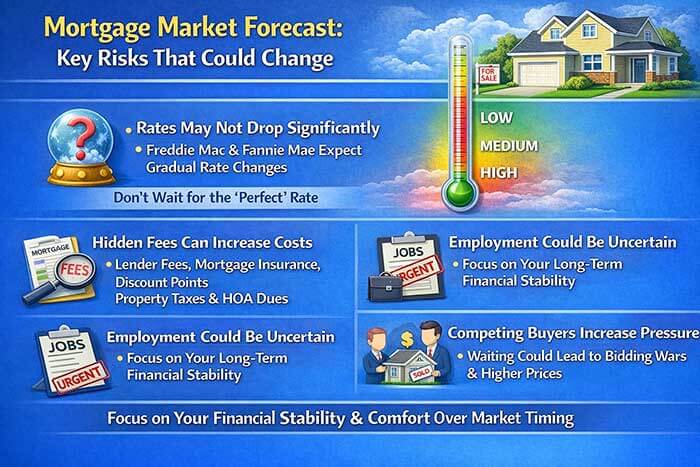
Buyers should prioritize their financial payment comfort over the market’s timing. When the market allows, and the property aligns with your long-term goals and objectives, making a purchase is a good decision. A potential threat from a competing buyer can come from waiting for lower rates.
The market remains a guessing game, but it is a more reliable decision to make a purchase based on your financial stability and employment rather than waiting for the one-month rate guess.
Freddie Mac and Fannie Mae data support gradual rate changes with no certainty that rates will drop significantly. When determining a rate, buyers should look at the total cost, not just the rate. Affordability can be impacted by lender fees, mortgage insurance, discount points, and the note rate, in addition to taxes, insurance, and HOA dues.
What Today’s Mortgage Market Means for Home Sellers
While there is still a chance for sellers in the current real estate market, approaches have changed. In a market with more listings and cells taking longer to close, it is no longer feasible to just put bold listings out to attract upward bidding.
Pricing Concerns for Sellers
In today’s market, getting the price right is critical. At the start of April 2026, Realtor.com reported that 16.2% of listings had been reduced. While still high, it is a slight decrease from a year prior. The key takeaway is that sellers who price their listings realistically from the get-go do better than those who list too high and then lower the price later. Sellers must now be willing to concede price more frequently than during the hot seller’s market just a few years ago. Homes are still selling in most markets, but not as frequently as one might expect with clean, no-contingency offers.
Today’s Mortgage Market and Its Impact on Refinancing
Today in 2026, if mortgage rates decline, we may see a slight improvement in the refinance market. However, we are nowhere near seeing refinances boom as we did in the early years of this decade. Fannie Mae, as documented in its March 2026 report, however, predicts that more homeowners will be in a position to refinance as rates decrease, even if at a slow pace.
Most homeowners will see no need to refinance if they already have a low-rate mortgage, unless they need to access cash, consolidate debt, or change their loan term.
In a refinance scenario, borrowers should weigh their overall financial situation, not just focus on a short-term benefit. Refinancing only makes sense if it benefits their entire financial situation.
Will the Real Estate Market Get Better Later This Year?
The most probable response to this inquiry is that the real estate market may become more balanced as the year progresses; however, this does not imply it will become easier across the board.
If the rates change, the market may become more affordable. New lower rates will likely pull more prospective buyers into the market, thereby supporting prices and creating greater competition.
The National Association of Realtors Chief Economist Eric D. Progno, in his 2026 Outook, said, \“For 2026, we expect home sales to increase in the nation by roughly 14% while home prices will likely grow in the range of only 2% to 3%.\” This is consistent with a market that is seeing improved activity and, in not returning to the frenzied conditions of the prior year.
What Could Push Mortgage Rates Lower
Mortgage rates are more likely to be lower with a greater background, and Federal Reserve Policy and Economic growth become more predictable. In general, however, the process of establishing a predictable flow of interest rates is unlikely to be smooth. Rates can change rapidly with new information on employment rates, inflation, Treasury yields, war and other conflicts, the real estate market, and so on.
What Keeps Rates from Going Lower
Rates will remain high if inflation remains high, especially in shelter costs, or if financial markets require higher yields for long-term borrowing. With shelter inflation increasing 0.3% for the month, there might be no clear path for significantly lower mortgage rates, according to the March CPI report.
Curious About Today’s Market Outlook? Dive In Now
Get real-time insights on mortgage rates and housing trends to guide your next move.What Could Possibly Change the Forecast for the Mortgage Market
Rapid changes in the forecast for the real estate and mortgage market are possible. The most significant risks involve persistent inflation, high and long-term mortgage rates, labor market instability, a strong and limited loan market, regional insurance or tax pressures, and constraints in local supply.
Some regions are experiencing rapid inventory availability, and supply is being added faster in some places than in others, resulting in a situation where one city has more market control by buyers, while another city remains under seller control.
It is crucial for borrowers and home sellers to understand that the national forecast is a reference, not an indicator of what to expect. The best assessment is based on local market indications, the level of monthly payments, and the decision-making horizon. For those looking to refinance, the mortgage market lacks the boom we experienced in the early 2020s, given the same mortgage rates that prevailed then.
What Should You Do Right Now?
Here’s how to move forward in 2026:
Get Pre-Approved Today
Getting pre-approved for a home loan is a key step in buying a house. It shows how much you can afford, locks in your interest rate, and tells sellers you’re a serious buyer. Gustan Cho Associates offers quick pre-approvals with no extra requirements, so we can say yes when other lenders might not.
Explore Special Loan Programs
We help homebuyers get approved for:
- FHA loans with as low as 500 credit score
- VA loans with no down payment
- Bank statement loans for self-employed borrowers
- 2-1 buydown mortgages and temporary rate relief options
Work With a Lender Who Knows the Market
We’re licensed in 48 states and have a reputation for common-sense underwriting and helping buyers succeed—even if they’ve been turned down elsewhere.
Real Estate and Mortgage Market Forecast for the Rest of 2026
Here’s what we expect for the second half of 2026:
| Forecast Category | Expectation |
| Mortgage Rates | Gradual decline to ~6.25%–6.5% |
| Home Prices | Stable or slight dip in hot areas |
| Inventory | Slow but steady growth |
| Refinancing | Likely to pick up late 2026 |
| First-Time Buyer Activity | Expected to increase |
Conclusion for the Forecast of the Mortgage Market and the Real Estate Market
Given the forecast for the real estate and mortgage market to improve, the market is slightly improving; however, the mortgage rates remain persistent at their prior peak. With housing supply increasing, prices are stabilizing, and growth is decelerating.
Buyer power is on the rise, and seller power is on the decline. This is not a nationwide housing market crash. It is a more focused market. Buyers with enough financial resources can discover new opportunities.
Sellers who grasp the new market conditions can still achieve success. Those who wait and monitor mortgage rates should remain patient. The path to the end of 2026 will likely be slow, fragmented, local, and affordability-driven, rather than the hype.
Final Thoughts: Is Now a Good Time To Buy?
Yes—if you’re prepared. Rates may drop, but waiting too long could mean missing out on the right home. With buyer-friendly trends emerging and flexible loan options available, now may be the smartest time in years to buy. The real estate and mortgage market forecast may keep shifting, but with the proper guidance, you can make your move with confidence.
Ready to Take the First Step?
If you have any questions about real estate and mortgage market forecast or you need to qualify for loans with a lender with no overlays, please contact us at 800-900-8569. Text us for a faster response. Or email us at alex@gustancho.com. The team at Gustan Cho Associates is available 7 days a week, on evenings, weekends, and holidays.
Frequently Asked Questions About the Real Estate and Mortgage Market Forecast:
Given Current Predictions For The Real Estate And Mortgage Markets, Is It A Good Time To Purchase A Home?
It can be a good time to buy a home if the monthly housing payment is manageable, your income is steady, and the purchase will satisfy your long-term housing needs. Current conditions in the housing market present opportunities: more housing is available to purchase, and competition is lower due to fewer bidding wars; however, the housing affordability challenge persists due to high mortgage rates.
Will Mortgage Rates Go Down Later This Year?
To make a guess as to whether mortgage rates will go down later this year, let’s first try to guess whether inflation will go down. There is no way to predict whether the Federal Reserve will keep rates unchanged. Most forecasts expect small changes, but not a return to the extremely cheap rates seen a couple of years ago.
Are Home Prices Going To Crash In 2026?
National data do not indicate we will see a broad home price crash. Almost all forecasts say we will see slower price growth, and a flat condition across some areas of the nation, while others may see a small price increase.
Is The Housing Market Becoming More Favorable For Buyers?
Yes, in many markets. There is more inventory across the board. There are also houses that are not selling quickly. Sellers are more realistic in the prices they set for homes, meaning buyers have more options and, in some cases, more negotiating power.
Should I Wait For Lower Mortgage Rates Before Buying?
It is quite risky to buy only for lower rates, as lower rates become available, buyers face more competition. The best time to buy is when the payment fits your budget, and the property fits your goals.
What Do The Real Estate And Mortgage Market Predictions Mean For Sellers?
Selling remains a viable option, but more careful pricing is essential. Given greater sensitivity to purchase price and payment terms, overpriced homes may languish on the market and require price adjustments. In contrast, well-presented, appropriately priced homes continue to attract significant interest.
What Are The Most Important Factors Influencing The Real Estate And Mortgage Market Forecast Today?
The most important factors are mortgage rates, housing supply, inflation, local employment conditions, and how much buyers can spend. All of these factors collectively determine housing demand, pricing, and mortgage activity.
What Is The Real Estate And Mortgage Market Forecast For 2026?
The real estate and mortgage market forecast for 2026 shows that home prices are slowing down and mortgage rates may drop slightly later this year. It’s still a good time to buy if you’re prepared and have the right loan strategy.
Are Home Prices Still Going Up?
Home prices are still high in many places, but the real estate and mortgage market forecast says prices are starting to level off or even drop a little in some cities. This gives buyers more room to negotiate.
Why Are More People Buying Homes Now?
More first-time buyers are entering the market thanks to programs like FHA and VA loans and lower home prices in some areas. The real estate and mortgage market forecast says demand from younger buyers will keep growing.
What Happens If Interest Rates Go Up Again?
If interest rates go up, your monthly payments might increase, making it harder to afford a home. Experts recommend locking in a good rate or using a buydown to save money while rates are still reasonable.
This Guide About “Real Estate and Mortgage Market Forecast Today” Was Updated on April 11, 2026.