
2026 Guide to Getting an Approved Mortgage for First-Time Home Buyers.
This article will cover getting approved for a mortgage for first-time home buyers with bad credit. Most people renting a home or an apartment need to realize they do not need a 20% down payment and thousands in closing costs to purchase a home. Homebuyers do not need perfect credit to qualify for a mortgage. Prior collections and charged-off accounts do not have to be paid. However, timely payments in the past 12 months is key in getting an approve/eligible per the automated underwriting system.
Mortgage for first-time home buyers with bad credit? Learn how to prepare, what to expect for minimum down payments, approval tips, and FHA, conventional, VA, and USDA options for 2026.
Buying your first home can feel daunting, especially if your credit isn’t stellar. Many believe you need spotless credit, a hefty down payment, and a flawless financial record to get approved. In truth, your eligibility hinges on the loan program, your income, debts, available funds, and what each lender requires. There are several federal and agency-backed programs with low down payment options, some crafted just for first-time and lower-income buyers. It’s a common myth that one credit misstep will slam the door on your dreams.
In This Guide, We Will Cover The Following Key Topics:
- Who can purchase a home?
- Can you qualify for a mortgage for first-time home buyers with bad credit?
- Benefits of being a homeowner versus a renter.
- How much does it cost to purchase a home?
- Becoming first-time home buyers loans with bad credit
In the following paragraphs, we will cover the above five bullet points in buying your first home. We will discuss the steps to qualifying and getting pre-approved for a home. The team at Gustan Cho Associates are experts in helping borrowers qualify and get approved for a mortgage for first-time home buyers with bad credit.
What Do Lenders Look At Before Approving a Mortgage to First-Time Home Buyers?
A low credit score does not slam the door on your mortgage hopes. Lenders look at your entire financial picture: your credit report, recent payment habits, job stability, income, debt-to-income ratio, savings, down payment, and the cash you have for closing. Many government- and subsidized-loan programs are more flexible for first-time buyers than most people realize. Still, some lenders add their own rules, called overlays, which can be stricter than the basic agency guidelines. For example, the VA and USDA do not set minimum credit scores, but individual lenders often do.
Who Can Qualify to Purchase a Home

A mortgage for first-time home buyers with bad credit is designed for those who haven’t recently owned a home and have a rocky credit history. This could mean low scores, limited savings, late payments, collections, high credit card balances, or a short credit track record. The best loan program is chosen based on your full financial story, not just your credit score.
Mortgage for first-time home buyers with bad credit considering purchasing a first home is possible. Home buyers can have prior bad credit to qualify for FHA loans.
Borrowers can qualify for FHA loans with outstanding collections and charged-off accounts without having to pay them off. However, the key is that they need to have re-established their credit. Borrowers need to be timely on all of their payments in the past 12 months to get an approve/eligible per Automated Underwriting System Approval. There are many questions that they may face.
Getting Approved For Mortgage For First-Time Home Buyers With Bad Credit
Mortgage for first-time home buyers with bad credit is possible. They may get many feedbacks and opinions from friends, family, and co-workers about the advantages and disadvantages of buying a home. More important than how much a lender qualifies you is how much house you can afford.
Lenders do not take into account monthly debts that do not report on your credit report or your personal budget such as entertainment, utilities, schooling, day care, medical expenses, and children extra curricular activity expenses.
There are many questions about being a homeowner for people who never purchased a home. They may also hear horror stories in the press about the skyrocketing foreclosure rates and homeowners owning underwater homes. Underwater mortgages are where their mortgage balances are higher than the market value of their homes.
Best Mortgage Options for First-Time Home Buyers With Bad Credit
First-time buyers with damaged credit often seek FHA financing because it is more flexible with credit scores and offers more options for adjustable-rate mortgages. HUD states that first-time buyers may qualify for an FHA with a down payment of at least 3.5 percent on eligible properties with one to four units.
The benchmark credit score for 3.5 percent down is about 580, while scores between 500 and 579 typically require at least 10 percent down.
FHA is not the only option. Low-down-payment mortgages for first-time, low-income buyers include Fannie Mae HomeReady and Freddie Mac Home Possible. Eligible borrowers may also benefit from zero-down-payment mortgages through USDA and VA programs.
Survey Best Mortgage Options for First-Time Home Buyers With Bad Credit
First-time buyers with bad credit often find the most luck with FHA loans, certain conventional programs like HomeReady and Home Possible, USDA loans for rural homes, and VA loans for veterans. Most buyers facing credit hurdles start with FHA loans, since other options can be tougher to qualify for. If a seller is open to a lower offer, buyers might look at conventional loans with at least 5 percent down.
USDA loans shine for rural buyers with modest incomes, while eligible borrowers can tap into VA loans that often require no down payment and set no minimum credit score.
FHA loans are popular among first-time home buyers with bad credit due to low down payments and more lenient credit score requirements. HUD states that FHA-insured loans allow down payments as low as 3.5 percent for eligible borrowers. The standard benchmark for FHA is a credit score of 580 or higher for a 3.5 percent down payment. Scores between 500 and 579 typically require a 10 percent down payment.
First-Time Homebuyer With Bad Credit? You May Still Qualify
Don’t assume you’re “not ready.” Get a quick review of your credit, income, and down payment to see which programs fit—FHA, VA, USDA, Conventional, or Non-QM options
FHA Minimum Credit Scores and Down Payment Requirements
FHA is usually the go-to for first-time buyers with shaky credit, since it was designed to open the door to homeownership. But not every lender follows the same playbook. Some add extra rules, called overlays, so one lender might say no while another says yes. It pays to check both agency guidelines and lender overlays instead of assuming all FHA lenders are alike.
Why FHA Loans Can Work For First-Time Buyers
FHA loans may not bring banks as much profit as conventional ones, but they win over buyers by making homeownership more accessible. Putting less than 20 percent down is actually the norm, not the exception. FHA is also more forgiving of imperfect credit, making it a favorite for many. Fannie Mae’s HomeReady and Freddie Mac’s Home Possible programs also offer low down payments, sometimes just 3 percent. Plus, Fannie Mae’s temporary Very Low-Income Purchase Borrower Credit can help eligible HomeReady buyers cover down payments and closing costs.
USDA and VA Loans for Eligible First-Time Buyers
Many first-time buyers with poor credit miss out on USDA and VA programs because they think these loans are too specialized. In fact, these can be some of the best mortgage options for those who qualify. The Family Housing Guaranteed Loan Program, for example, offers no-money-down loans to eligible applicants. The USDA says there are no set minimum credit score requirements, but lenders will have their own rules about your ability to repay. An additional opportunity available to eligible veterans, service members, and surviving spouses is VA-backed loans.
The VA states that there are credit, income, and occupancy requirements from both the VA and the lender, and the VA itself does not place a minimum credit score requirement.
If you qualify for a USDA or VA loan, these options can be better than FHA loans because they require little or no down payment, so you need less money upfront. Be sure to include closing costs and prepaid expenses in your budget. Many people believe first-time buyers have to put down 20 percent, but that isn’t the case.
Eligible borrowers might qualify for FHA programs with a 3.5 percent down payment or, with a 3 percent down payment, for HomeReady and Home Possible programs. No down payment options are available to eligible buyers through USDA and VA.
The down payment is only part of what you’ll need. You should also plan for closing costs, taxes, insurance, and any reserve funds, as the CFPB notes.
How Much Do First-Time Home Buyers Need for Closing Costs?
Closing costs typically add 2 to 5 percent to the home’s price. Your Loan Estimate will show these costs, your down payment, and any seller credits. Planning for both down payment and closing costs is especially important if your credit is lower, since these expenses can add up and affect your options.
When A 3 Percent Down Conventional Loan May Work
You might qualify for a conventional loan with a low down payment if your credit is solid, even if it’s not high enough for instant approval, and if you want mortgage insurance, you can eventually cancel it. This route is also open to those who fit HomeReady or Home Possible guidelines, which can be based on income or property type. For first-time buyers, these programs often require a homeownership education course. Fannie Mae’s HomeReady program, for example, asks that at least one first-time buyer complete a qualifying education course before closing.
HomeReady And Home Possible Are Different From FHA Loans
HomeReady and Home Possible are great options, but they aren’t always easier than FHA for every borrower with credit challenges. Some people with lower scores or complicated finances find FHA more flexible, while others get better deals with conventional programs or special assistance. The right fit depends on your credit history, debt-to-income ratio, savings, property type, and how your application is reviewed.
What is a Mortgage for First-Time Home Buyers with Bad Credit?
Buying your first home with bad credit is possible, though approval hinges on how serious your credit issues are and your overall financial health. If you have a lower score but steady income, manageable debts, some savings, and a recent streak of on-time payments, your chances improve.
Lenders want to see that you can handle future mortgage payments, even if your past credit isn’t perfect. Showing you’ve turned things around can make a big difference.
Each lending program views poor credit a little differently. Lower scores might shrink your loan choices, bump up your down payment and cash requirements, raise mortgage insurance costs, and make your loan pricier overall. First-time buyers should compare more than just interest rates—look at cash-to-close and total loan costs, as the CFPB suggests. Remember, closing costs usually add another 2% to 5% of the home’s price on top of your down payment.
How to Qualify for a Mortgage With Bad Credit as a First-Time Buyer
Getting a mortgage as a first-time buyer with bad credit requires planning. Begin by checking your credit score and reviewing your credit report. Add up your monthly debts, confirm your income is steady, and see how much money you have for closing costs. Your debt-to-income ratio also matters.
Sometimes, even with a low credit score, you can qualify for a loan if your income is high and your debts are low. Lenders look at all your obligations to see if you can comfortably handle a new mortgage payment.
Why You Should Get Pre-Approved Before Home Shopping
Getting pre-approved helps first-time buyers see how much they can borrow, what their payments might be, and which loans they can get. It also helps you find problems early, such as missing paperwork, credit issues, unusual deposits, or high debt. Without pre-approval, you might waste time looking at homes you can’t afford. Mistakes can affect your approval.
If your credit is weak, lender overlays can make things harder. The rules set by agencies may not align with lenders’ preferences. Some lenders ask for higher credit scores, more savings, stricter reviews, or are less flexible about recent credit issues. If one lender turns you down, don’t give up. Another lender might approve you.
How to Improve Mortgage Approval Odds
To improve your chances of approval, fix any issues before you apply. Pay down your credit cards, avoid new credit checks, and make all your payments on time. Review your bank statements in advance to avoid surprises when you apply. It’s also a good idea to talk to a HUD-approved housing counselor. Both the HUD housing counseling program and the CFPB home loan toolkit suggest using these counselors to help first-time buyers find the best programs.
Sometimes, it’s best to wait a few months and improve your finances. Even small actions, like paying down debt or saving more, can help you qualify for more mortgage options.
The Benefits of Down Payment Assistance and Housing Counseling
Many first-time buyers with credit issues miss out on extra help because they focus only on getting approved. Programs like down payment assistance, community seconds, and homebuyer education can help, but eligibility depends on your location and lender.
Fannie Mae recently offered up to $2,500 in down payment and closing cost help for very low-income buyers who qualify for HomeReady.
Another good idea is to get counseling from the U.S. Department of Housing and Urban Development (HUD) before you apply. Many buyers find budget counseling courses from HUD or the Consumer Financial Protection Bureau (CFPB) helpful.
Biggest Benefits of Being a Homeowner Versus Renter
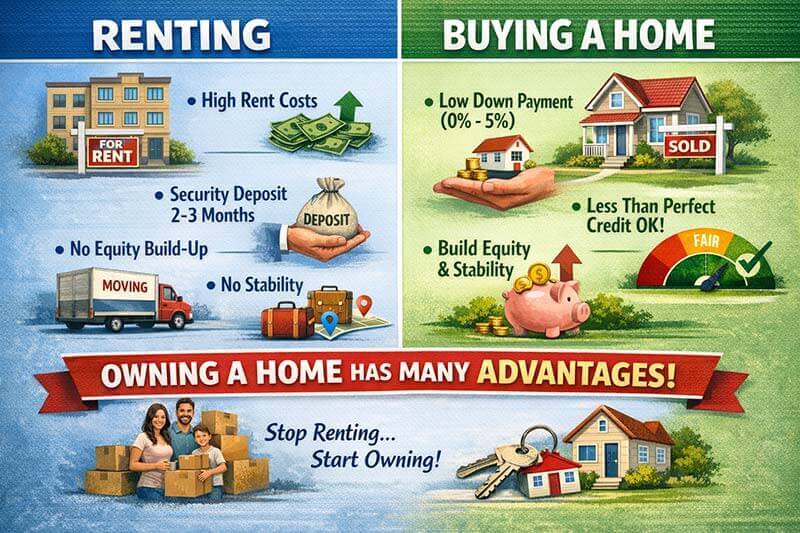
The advantages of being a homeowner out weight the disadvantages. Homeownership is not for everyone. Some people do not want to be tied down to one particular town or area for an extended period. For those folks, owning a home would not be a good idea. Alex Carlucci commented about becoming a first-time homebuyer with little to no down payment and less-than-perfect credit.
Most renters do not realize that you do not need a large down payment and great credit to qualify for a home loan. You can qualify for a mortgage with less than perfect credit and with zero to 5% down payment.
If you plan on settling down in one particular community and calling it home, then home ownership offers countless benefits versus renting. Many renters do not realize that sometimes owning a home costs less than renting. Many renters think they need stellar credit and a large down payment to become homeowners. This is not the case either. Renters with credit issues may be required to put in two or three months’ security deposit to rent. The down payment on a home purchase is often equivalent to a security deposit or less.
Down Payment Required For Mortgage For First-Time Home Buyers With Bad Credit
All home purchases require a down payment. The down payment is a percentage of the overall home purchase price. The down payment requirements are different among the different mortgage loan programs. Dale Elenteny of Gustan Cho Associates said the following about buying a home with no down payment.
VA and USDA loans are the only two mortgage loan options that do not require a down payment. FHA and conventional loans require a 3.5% and 3% down payment, respectively.
To qualify for a mortgage, first-time home buyers loans with bad credit only need a 3.5% down payment. Many times, homebuyers with bad credit only need to show the 3.5% down payment. They do not come up with the full 3.5% down payment on an FHA Home Purchase. Homebuyers in Illinois can use the seller’s property tax proration credits towards the down payment.
How Much Are Closing Costs on a Home Purchase
How about closing costs? All home purchase and refinance transactions come with closing costs. Unlike the down payment, closing costs is different depending on each borrower, the type of loan program, the type of property, the city, the county, and the state. Closing costs can vary anywhere between 2% to 7% of the home’s purchase price.
All home purchase and refinance transactions come with closing costs. Closing costs are any costs and fees associated with the home purchase and refinance transaction. This may include the lender’s costs and all other third-party costs.
Home Buyers do not have to pay for closing costs. This holds as long as they can get a seller’s concession towards a buyer’s closing costs or a lender’s credit towards closing costs.
Benefits of Going From Renter To Homeowner
The benefits outweigh the disadvantages of being a renter to a homeowner. Yes, there are disadvantages to being a homeowner. Homeowners are responsible for maintenance and repairs. Lack of mobility in moving whenever they want and needing to sell their home to make a move elsewhere. The pride of homeownership outweighs the cons. For example, homeowners can paint and decorate their homes without having to get permission from the landlord. Homeowners can have a pet or pets without asking for permission or having to put in an additional security deposit.
As a homeowner, you will be secure in their home where they do not have to fear the landlord threatening them that he will not renew the lease. Homeowners will no longer have annual rental increases.
The advantage of being a homeowner is mortgage payments will be fixed for the 30 years of the loan term. Property taxes and increases might increase. But mortgage payment will remain constant for the life of a mortgage loan with a 30-year fixed rate mortgage loan. Being a homeowner comes with tax benefits. Mortgage interest is fully tax-deductible on annual tax returns. Mortgage interest is the largest portion of monthly mortgage payments.
See Your Minimum Down Payment and Monthly Payment
Find out your expected payment and cash-to-close based on your price range, credit score band, and available programs—no surprises
Can I Get Approved For Mortgage For First-Time Home Buyers
First-time homebuyers are in a situation now where many homes are selling below replacement value due to the real estate and mortgage collapse of 2008. Homeowners can get on the ground floor of their home purchase and realize potential capital appreciation on their home purchase.
You can never predict what the future will bring. Hopefully, you will be fine but you do not want to buying too much house where you will be struggling to make the monthly housing payment.
There are risks with real estate investments. The 2008 financial crisis drop home values like never before in history. Millions of homeowners are still hanging onto their homes that are worth less than the mortgage balance they owe. Nobody can predict the future. Homeowners have excellent odds that their home purchase will appreciate.
Homebuyers Can Qualify for a Mortgage For First-Time Home Buyers With Little to No Money Down
Remember that you do not need perfect credit or high credit scores to qualify for a mortgage. Homebuyers can qualify for a mortgage with as little as a 3.0% down payment on conventional loans. Homebuyers will lower credit scores can qualify for an FHA loan with a 3.5% down payment. VA and USDA loans do not require any down payment.
Closing costs can be paid by getting a seller concession from the home seller. One of our veterans, experienced mortgage professionals at Gustan Cho Associates, can guide you on purchasing a home with little or no money down.
If you need to qualify for a mortgage for first-time home buyers with bad credit who need to get approved with a lender licensed in multiple states with no overlays on government or conventional loans can contact us at Gustan Cho Associates at 800-900-8569. Or text us for a faster response. Borrowers can also email us at gcho@gustancho.com.
Mistakes Made By First-Time Home Buyers With Bad Credit
Applying to several lenders at once can often do more harm than good. It’s better to find the best loan program for you before you apply. Keep in mind, a low down payment does not always mean you’ll need less cash at closing. Consider your entire financial situation, as strengths in one area can help offset credit problems. Be careful about late payments, changing jobs without notifying your lender, or withdrawing funds from savings before closing. Even small mistakes can cause problems if your application is borderline.
Frequently Asked Questions
Can Poor Credit Prevent You From Obtaining A Mortgage?
- Yes, even first-time buyers with poor credit can qualify for a mortgage.
- FHA loans are often the fallback option, allowing eligible borrowers to qualify with 3.5 percent down and a score of 580 or higher.
- Or with 10 percent down for lower scores down to 500 FICO.
- Other options include HomeReady, Home Possible, USDA, and VA, depending on eligibility and lender criteria.
Which Mortgage Option Is Best For First-Time Buyers With Bad Credit?
- The best mortgage depends on the borrower’s complete profile.
- If eligible, HomeReady or Home Possible may be the best options.
- Otherwise, USDA or VA loans with no down payment may be available.
How Much Down Payment Can First-Time Buyers With Bad Credit Expect To Pay?
- The required down payment depends on the loan program.
- FHA allows as little as 3.5 percent down, HomeReady and Home Possible require as little as 3 percent, and USDA and VA offer no-down-payment options for eligible buyers.
How Much Are Closing Costs?
- Closing costs are separate and typically total 2 to 5 percent of the purchase price.
How Realistic Is It To Get Approved For A Loan With Bad Credit?
- By 2026, first-time home buyers with bad credit will still be able to get a mortgage.
- HUD offers flexible options for people with lower credit, and HomeReady and Home Possible are available if you qualify.
Can I Buy a House With No Down Payment?
- If you’re eligible, USDA and VA programs can help you buy a home with no down payment required.
What Are The Eligibility Requirements To Get Approved For a Mortgage With Bad Credit?
- First-time buyers should remember that approval depends on more than just credit.
- Income, debts, assets, payment history, program eligibility, and lender rules all matter.
- Those who prepare, look at their options, and use trusted housing education resources are most likely to succeed.
Do Home Buyers With Bad Credit Have To Do Housing Counseling?
- Housing counseling is not required but can be beneficial.
- First-time buyers who are HUD-approved are eligible for the Center for Housing and Financial Policy’s mortgage counseling program, which is budget-based and helps identify buyer assistance programs.
- Homeownership education courses are required for some flexible first-time homebuyer programs under affordable lending.
Is It Better For First-Time Home Buyers With Bad Credit To Go With An FHA Loan Or A Conventional Loan?
- This is generally true, but not always. Some lenders are more FHA-friendly for lower credit, while others offer conventional loans like HomeReady and Home Possible with less flexible credit requirements.
- The most important factors are credit score, debt-to-income ratio, cash-to-close, and lender guidelines.
Determine How Much House You Can Afford versus How Much Do I Qualify.
- First, check your credit, evaluate monthly obligations, prepare income documentation, budget for down payment and closing costs, and secure pre-approval before home shopping.
- Cash-to-close can be estimated using CFPB mortgage resources and Loan Estimate guidance.
This blog on mortgages for first-time home buyers was updated on March 20th, 2026.
Ready to Buy Your First Home? Start Here
Complete a quick application or send your scenario. We’ll confirm the best program and guide you step-by-step from pre-approval to closing