Many home buyers know mortgage programs have maximum loan limits, but fewer realize some lenders also have minimum loan amounts. A borrower may qualify for a home loan but still have trouble finding a lender willing to approve a smaller mortgage, such as $50,000, $75,000, or under $100,000. This does not always mean the borrower has bad credit, weak income, or too much debt. In many cases, the challenge comes down to lender costs, pricing limits, compliance requirements, and company policy. Smaller mortgage loans can take almost the same amount of work as larger loans, but the lender may earn much less on the transaction. The good news is that small mortgage loans are still possible. Borrowers may need to compare lenders, ask about minimum loan amounts upfront, and review the total closing costs before choosing the best option.
Some Lenders Skip Small Mortgage Loans
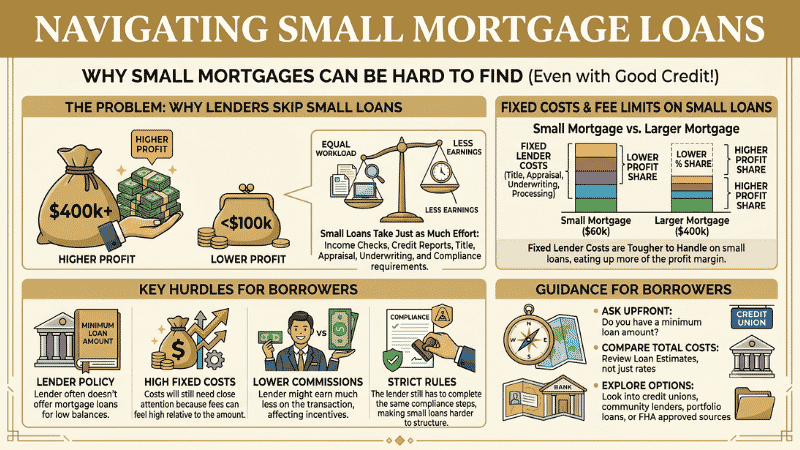
Some lenders avoid smaller mortgage loans because the work is almost the same as a larger loan. The lender still has to review income, credit, assets, title, appraisal, disclosures, underwriting, closing documents, and compliance requirements. A $60,000 mortgage can require nearly the same process as a $400,000 mortgage. The difference is that the lender may earn much less on the smaller loan, even though the time, paperwork, and compliance steps are similar. This is why a borrower may qualify based on credit, income, and debt-to-income ratio but still have trouble finding a lender that offers small mortgage loans. In many cases, the issue is not the borrower. It is the lender’s minimum loan amount policy.
Small Loans Take Just As Much Effort As Big Ones
Processing a small loan can take just as long as managing a larger one—the same paperwork and checks are involved regardless of the amount. Even if the amount is smaller, the qualifying criteria remain strict. Completing forms thoroughly is essential, no matter the size of the application. Lenders often set a minimum loan amount, and not every small request gets rejected due to concerns about the borrower’s reliability. Frequently, it’s more about the fit within their processes; tiny loans may not align with their operational model. In fact, the loan amount itself can be the primary obstacle.
Lender Fees Might Not Pay For Loan Setup Costs
Lenders incur fixed fees for each home loan they process. These include costs for checking files, verifying income, ensuring compliance with regulations, completing paperwork, double-checking details, operating software systems, and maintaining records—all of which have upfront expenses. Larger mortgages can absorb these additional fees more easily. However, for smaller loans, these same charges take a larger share of the total, making pricing for minimum loan amounts quite tight. As a result, some lenders find it challenging to generate a profit in this segment.
Loan Officers May Skip Small Loans Due to Lower Pay
Lenders sometimes get paid more when loans are bigger. A worker might take home smaller pay for helping with a fifty-thousand-dollar home loan compared to one four times larger, despite doing about the same work. The size of the deal can shape what they earn. Just because someone borrows less doesn’t shut every door. Working with a lender open to smaller home loans might be necessary. Costs will still need close attention when weighing choices. Before going further, find out if the lender sets a floor on how little they’ll lend.
Small Mortgage Loans May Face Tougher Approval
 I
I
t’s tougher to get a small home loan approved – sometimes it’s not about the person applying. Lenders might struggle to set terms, process paperwork, or make money on smaller deals. Profit margins shrink when the numbers are low, so even solid applicants face delays or denials. Lenders who offer home loans have to stick to both national and local regulations covering fees, disclosures, risk checks, plus how they approve borrowers. Rules exist mainly to guard people, yet small mortgages often bring extra hurdles since expenses for processing stay high even when the borrowed sum drops.
Small Loans Face Pricing And Fee Limits
Small mortgage loans can also run into pricing and points-and-fees limits. Fixed charges, such as underwriting, processing, compliance, title, appraisal, credit report, and closing costs, may take up a larger share of a smaller loan amount.
For example, closing costs on a smaller mortgage may feel high compared to the amount being borrowed. The lender still has to complete the same compliance steps, even for low loan amounts.
This can make it harder for some lenders to structure a small mortgage loan in accordance with applicable rules and still cover their costs. That is one reason borrowers may find fewer lender options when applying for a mortgage under $100,000 or under $50,000.
Fixed Lender Costs Are Tougher To Handle
Lenders often take just as long on smaller loans because the steps stay identical regardless of size. Though amounts differ, paperwork like income checks, credit reports, and asset proofs must all be gathered. One might assume bigger numbers mean more effort, yet disclosure forms need equal attention every single time. Title searches happen no matter the dollar figure involved. Closing prep takes consistent care even when funds are modest. Quality reviews occur without exception before any release of money. Some lenders skip small loans altogether. That choice often comes down to cost, not the person asking. Some lenders don’t offer mortgage loans for low balances Borrowing starts at fifty thousand dollars with certain lenders. Others expect seventy-five or even one hundred thousand. Not every lender posts the lowest amount they offer, so it pays to check early instead of diving into paperwork later.
Borrowers Might Want To Look At Different Lenders
Sometimes just one “no” isn’t the full story. If a bank turns down a smaller mortgage request, others might see it differently. Credit unions often look at situations another way. Community lenders pay attention to local patterns. FHA-approved sources can have looser rules for modest sums. Portfolio lenders decide on their own terms. Even certain mortgage firms build programs around tighter balances. Trying again somewhere else could shift the result. Start by asking clear questions right away:
- “Do you have a minimum mortgage loan amount?”
- “Can you finance a home loan under $100,000?”
- “What are the total closing costs compared to the loan amount?”
- “Are there better options, such as a portfolio loan, HELOC, or local bank product?”
Even tiny home loans demand legwork. Yet finding one could happen – when the match clicks between borrower and bank.
Final Thoughts on Minimum Loan Amount on Mortgage Loans
Getting a small mortgage loan can be harder, but it is not impossible. Some lenders have minimum loan amounts, while others may consider smaller balances depending on the loan program, property type, credit profile, income, and overall file strength. Borrowers should ask about minimum loan amounts early in the process. They should also compare total closing costs, not just the interest rate, because fees can feel higher on smaller loans. If one lender says no, that does not always mean the borrower cannot qualify. It may mean that the lender does not offer small mortgage loans. Looking beyond one lender can help borrowers find a better fit.
FAQs About Minimum Mortgage Loan Amounts
Can I Buy A Cheap House With A Regular Mortgage?
You might be able to get a cheaper home with a regular mortgage, but it depends on whether the lender is willing to give you that loan amount. The property must also meet the loan program’s appraisal, title, safety, and condition requirements. If the home is very low-priced or needs major repairs, the issue may not be limited to the loan amount. The property condition may also affect approval.
Do Small Mortgage Loans Have Higher Interest Rates?
Small mortgage loans may sometimes have less competitive pricing because lenders have fewer ways to cover fixed costs. The interest rate is still based on credit score, loan program, down payment, occupancy, property type, and lender pricing. Borrowers should compare the interest rate, APR, and total closing costs before choosing a lender.
Is It Better To Pay Cash Instead Of Getting A Small Mortgage?
Paying cash may make sense if the buyer has enough savings and does not need to preserve cash for repairs, emergencies, or moving costs. However, using all available cash can be risky if the home needs work after closing. A small mortgage may help the buyer keep more money available, but the borrower should compare the total cost of financing before deciding.
Can I Use An FHA Loan For A Lower-Priced Home?
An FHA loan may be an option for a lower-priced home if the lender offers smaller FHA loan amounts and the property meets FHA standards. FHA does not help if the home has serious condition issues that fail appraisal requirements. Borrowers should ask the lender early whether they have a minimum FHA loan amount.
What If The Home Price Is Low Because The Property Needs Repairs?
A low price can create extra challenges if the property needs major repairs. The lender may require the home to meet minimum property standards before approving the loan. If the property does not qualify in its current condition, buyers may need to consider renovation financing, seller repairs, a local bank product, or another financing option.
Can Closing Costs Make A Small Mortgage Not Worth It?
Yes. Closing costs can feel much higher on a small mortgage because the loan amount is lower. A few thousand dollars in fees may not seem large on a $400,000 mortgage, but it can be a big percentage of a $50,000 or $75,000 loan. Borrowers should take a close look at the Loan Estimate and check out the overall cost, not just the monthly payment.
This article about “Minimum Loan Amount: Why Small Loans Get Denied” was updated on June 2nd, 2026.
Denied for a “Loan Amount Too Small”? Get a Second Opinion
One lender’s “no” doesn’t mean you can’t buy. We’ll match you with lenders that work with smaller loan amounts and explain the best loan program for your situation.