The Effect of High Interest Rates on the Housing Market
This guide covers how skyrocketing interest rates affect housing prices going into 2026. When it comes to the current housing market, no one can, without absolute certainty, predict the values of homes. In many parts of the country such as many parts of California and Florida, home prices are skyrocketing, and homes are selling the minute they become listed. However, nobody has a crystal ball on where home prices are going. Alex Carlucci, a senior loan officer and an associate contributing editor of Great Community Authority Forums says the following about interest rates:
Things that go up can easily come down and vice versa. What does the near future hold with home prices? Are home prices going up, or are they going down?
While financial analysts and industry experts can forecast events by using past data, they cannot be certain of future outcomes. With that said, there is much speculation on what the Federal Reserve is going to do to interest rates in 2026. Interest rates are a great indicator of housing purchases. In this article, we will discuss and cover the all-time high in interest rates and how it affects the housing market.
How Interest Rates Will Be Affected with the Election of President Donald J. Trump
Many potential home buyers are concerned whether will interest rates rise in 2026: According to Freddie Mac, interest rates are likely to go up to at least 8% by the year 2026. This article explores how high interest rates affect the housing market, including affordability, buyer demand, inventory, prices, refinancing, and seller behavior. It outlines the implications for buyers, sellers, investors, and homeowners.
When interest rates rise, the real estate market slows nationwide. Higher borrowing costs shrink buyers’ budgets, fewer people qualify for loans, and homeowners hesitate to move.
These rising rates ripple through every part of the market, from monthly payments and affordability to inventory, prices, and refinancing. While some fear a dramatic crash, the truth is more nuanced. High rates usually cool the market, making buyers and sellers more cautious and careful with their decisions.
Impacts of Increased Interest Rates on Housing Affordability
As soon as interest rates rise, homeownership slips further out of reach. Buyers are hit with steeper mortgage payments for the same house, stretching their budgets to the breaking point. Many pause their search, try to save up a bigger down payment, or set their sights on more modest homes.
When mortgage rates rise, people can borrow less because more of their payment goes to interest. This means buyers with the same income can only get smaller loans. Higher rates make buyers pickier and more careful.
When rates go up, so do monthly mortgage payments. This jump can make it tough for buyers to handle not just the loan but also the extra costs of homeownership, such as taxes, insurance, utilities, and repairs.
Will Interest Rates Rise In 2026 With Job Growth
It’s no secret that the US job market is tied to the housing market. The Federal Reserve Board has indicated the fast job growth, and the hot economy will definitely not slow them down in increasing interest rates Additionally, the Federal Reserve does not historically raise interest rates right before an election, but it seems like it will do prior to the 2026 mid elections.
Impact of High Interest Rates on Housing Market Buyer Demand
As homes become less affordable, buyer demand drops. Some people hit pause, waiting for better rates, while others hunt for cheaper homes or new neighborhoods. Fewer showings and offers mean homes linger on the market, and buyers have more room to negotiate. Still, if there aren’t many homes for sale, competition can stay fierce even with fewer buyers.
Why Buyers Wait When Rates Increase
When rates rise, many buyers put their plans on hold. Even those who qualify for a mortgage may find the new payments higher than rent or what they expected. As the true cost sinks in, enthusiasm fades and fewer homes change hands.
Why Buyer Expectations Shift When Rates Increase
With higher rates, buyers become pickier about price, condition, and location. Most steer clear of fixer-uppers, choosing ready-to-move-in homes. Demand may dip, but it never vanishes—buyers are just more mindful of what they can afford each month.
Home Prices and Interest Rates
Home prices are influenced by many factors beyond interest rates. While some expect high rates to cause significant price drops, rates alone do not determine prices. Supply, local jobs, wages, migration, and housing shortages also play key roles. Higher rates can lower prices, but large declines are not guaranteed.
Are Home Prices Expected To Drop?
Depending on local conditions, price trends may stabilize, decelerate, or even reverse. Certain market segments may experience price reversals if the broader market was previously balanced. Ultimately, price changes are determined by the relationship between available inventory and demand within a specific area.
Do Higher Interest Rates Mean Home Prices Drop?
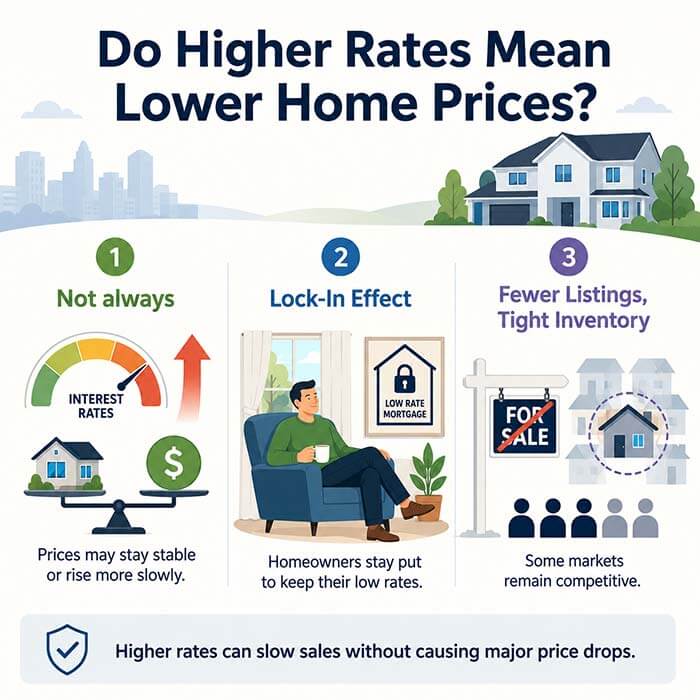
Not always. Home prices may remain stable or appreciate more slowly. Higher mortgage rates can also slow or halt new home appraisals. The following section examines how high interest rates affect the number of homes for sale.
Next, let’s look at how high interest rates affect the number of homes for sale.
High interest rates don’t just slow buyers—they also keep sellers on the sidelines. While it might seem like fewer buyers would mean more homes for sale, many homeowners are reluctant to swap their low-rate mortgage for a pricier one.
This is known as the lock-in effect. Homeowners staying in their property is called the lock-in effect. Homeowners stay put to avoid higher rates, which means fewer homes are listed, and inventory stays tight. The idea of giving up a low-rate loan keeps many from taking action. They hold back; the number of homes for sale doesn’t go up, even if fewer people are buying. Some price ranges and areas stay competitive. In general, fewer homes are sold, but those that do sell quickly keep inventory tight.
So Should You Buy a House Now or Later?
Interest rates has remained at historical lows for over half a decade and never in history has interest rates been as low as it has been for so long: The Great Recession of 2008 crushed the housing market. Dale Elenteny, a senior loan officer says the following:
Many homeowners who had equity in their homes and relied on that equity for their retirement saw their equity diminish literally overnight. Millions of homeowners saw their mortgage balances higher than the value of their homes.
Some decided to bail on their homes because they could not sell their homes. Others whose mortgages were upside down. Many homeowners never ever dreamed that they would ever see the daylight of their home value ever-increasing. They took it for granted that they were stuck in their homes for the rest of their lives. Areas of Florida, California, and many other parts of the United States have seen the value of their properties plummet more than 50% in value.
Start Your Process Towards Buying A Home
Apply Online And Get recommendations From Loan Experts
Why High Interest Rates Hit First-Time Homebuyers the Hardest
First-time homebuyers usually have less money saved and less budget wiggle room. When rates go up, it gets harder to save for a down payment, and higher monthly payments can be a shock.
Because of this, many homeowners stay put until a big life change—like a new job or retirement—forces their hand. Fewer people moving only deepens the shortage of homes for sale.
Rising rates hit first-time buyers hardest. With tight budgets, many have to wait or settle for a smaller loan—and a smaller home—than they hoped for.
Why First-Time Buyers Feel Payment Shock Faster
First-time buyers usually have tighter budgets than people who have bought homes before. They feel the biggest jump in payments when rates go up because they have not built up value from selling a previous home.
First-time buyers can look into seller concessions, such as help with closing costs or buy-down programs, as well as USDA, VA, and FHA loans. These tools can make buying more affordable, even as rates climb. Still, accepting a higher mortgage rate can make moving feel like a tough financial trade-off.
How Delaying Moves Affects a High-Rate Environment
Plenty of homeowners dream of moving for a new job, a quieter neighborhood, or a better school. But their low-rate mortgage keeps them anchored, making a move too costly. With fewer homes for sale, first-time buyers and others struggle to find something in their price range—even when demand cools.
Impact of Interest Rates on Market and Mortgage Refinance Activity
When rates are high, most homeowners do not refinance because they already have lower-rate mortgages. Refinancing typically occurs only for cash-out, to remove a borrower, or to make other changes.
As rates rise, investors become more cautious. They look for good deals, think about buying smaller properties, or just wait for a better time to buy.
This scenario is tough on both homeowners and lenders. Homeowners lose out on savings, while lenders scramble for business as fewer people seek new loans.
Why Homeowners Don’t Refinance at Increased Interest Rates
If a homeowner’s current rate is lower than available rates, refinancing results in higher payments. Most people do not refinance solely to change their rate or loan term.
When A Refinance Makes Sense
Homeowners may still choose to refinance to pay off debt, get cash, remove mortgage insurance, or switch to a fixed-rate loan. But these choices are tricky and can change your long-term money plans. Higher rates mean bigger loan payments, less profit, and sometimes deals just do not work anymore.
For higher rents, or scouting out markets with better price-to-rent ratios. In pricey areas, cash buyers have the upper hand, while others tread carefully. Rates mean lower cash flow for investors.
The more an investor borrows, the more rising rates affect the deal. Higher mortgage payments mean less profit each month, especially if rents don’t go up too.
How Interest Rates Impact Home Builders
When rates rise, builders feel the squeeze. Demand for new homes can dip, so builders roll out incentives—like covering closing costs, lowering mortgage rates, or cutting prices—to keep buyers interested and compete with existing homes.
Positive Impact of Incentives
To keep costs down and keep selling homes, builders need to maintain steady sales.
Impact of Rising Interest Rates on Supply of Homes
How confident builders feel shapes how many homes get built. When demand drops or costs soar, construction slows, deepening housing shortages and keeping prices high—even if fewer homes are selling.
The Impact of Increasing Interest Rates on Consumer Sentiment About Buying a Home
When rates rise, many buyers become more cautious. Some rush to purchase before rates increase further, while others choose to wait. Buyers make fewer purchases and wait longer before listing their homes.
The Psychology of Buying and Selling a Home
Buying or selling a home is a big financial leap. When rates rise, or the economy wobbles, many people hit pause—even if they have the means to move forward.
The Impact of Negative Media on Consumers’ Buying and Selling a Home
News about interest rates, inflation, and the economy can spook buyers and sellers—even if things are steady in their own neighborhood Increasing Interest Rates on Home Buying and Selling by Regional Markets
When rates rise, different housing markets react differently. Some areas with new jobs still see strong demand, while others with weaker economies see less buying activity.
Buyers and sellers should focus on what’s happening locally, not just on national headlines. Pay attention to how long homes sit on the market, inventory, prices, and demand in your own backyard. al Estate News. National trends give an overview, but they don’t always match what’s happening locally. Some markets stay strong when rates rise, while others slow down fast.
Areas To Monitor In The Local Real Estate Market
Check out how many homes are for sale, how long they’ve been listed, price cuts, seller perks, and local job trends. These details often tell you more than national mortgage news ever could.
Effect of High Interest Rates on Housing Market Decisions for Buyers
High interest rates do not always mean it is a bad time to buy. Some buyers prefer slower markets for less competition, more negotiation, and future refinancing opportunities. The decision depends on individual financial circumstances, including income stability, savings, creditworthiness, and the urgency of the situation. Buyers with substantial cash reserves are often better positioned, even in high-rate environments.
Buying and Interest Rates: What Should Buyers Do in a High Rate Environment?
In a high-rate market, buyers face tough choices. Some wait for rates to fall, but that can mean more competition when they do. Lower rates might make homes more affordable, but they can also bring a rush of new buyers into the market.
What Can Be Done to Make Purchasing A Home More Affordable
To make buying a home easier, buyers can boost their credit, save up for a bigger down payment, shop around for lenders, ask sellers for help, or hunt for better rates.
High Interest Rates: Housing Market Impact on Sellers
Sellers can succeed in a high-rate market with a clear strategy. Proper pricing, strong presentation, and realistic expectations are essential.
Sometimes people need to sell their home because of a new job, divorce, marriage, a new baby, downsizing, or retirement. These life events happen regardless of interest rates.
Can Sellers Receive Good Deals In A High Rate Environment?
Even in a high-rate market, sellers can land great deals—especially if inventory is low and their home is priced to move.
What Sellers Should Not Do When Rates Are High
Overpricing is the number one pitfall for sellers. Don’t expect buyers to be as eager as they were in low-rate days. Today’s buyers are focused on what they can truly afford, so price your home accordingly.
A High Interest Rate Outlook on the Housing Market
When rates rise, it triggers a domino effect. Borrowing gets pricier, homes become less affordable, and buyer demand drops. Price growth can slow, and some homeowners stay put, keeping inventory tight. The market doesn’t always follow a simple script—prices can stay high if there aren’t enough homes for sale. The real story is shaped by a mix of rates, inventory, jobs, inflation, credit, and confidence.
How Do High Interest Rates Affect The Housing Market?
Buyers, sellers, homeowners, and investors should understand how high interest rates affect the housing market. High rates increase borrowing costs and make homeowners less likely to sell, reducing supply and preventing significant price drops in some markets.
The housing market is shaped by a web of factors—interest rates, supply and demand, jobs, wages, and personal finances. High rates can be tough, but they also open doors for buyers and sellers who are ready.
Buyers might score better deals, sellers benefit from low inventory, and homeowners with low-rate mortgages hold a valuable asset. The smartest move is to focus on your payments, watch local trends, and keep your long-term goals in sight, since high rates play out differently in every market.
What High Interest Rates Mean For Housing Market Sellers
Sellers face thinner crowds in a high-rate market. With fewer buyers able to afford monthly payments, homes can sit unsold and may need price cuts to catch someone’s eye. Sellers may have to adjust their expectations more than they would in a low-rate market. They might need to offer buyer-friendly incentives, such as covering closing costs or helping the buyer qualify for a lower interest rate.
When Interest Rates Are High, Homes Must Be Priced Correctly
Even with high rates, homes that are priced right tend to sell. Overpricing based on old market highs can scare buyers away. In this environment, getting the price right is more important than ever.
Seller Concessions in a High-Interest-Rate Market
Seller concessions—such as covering closing costs or offering a temporary rate reduction—can tip the scales in buyers’ favor. These perks not only help buyers but also give sellers an edge when the market slows down.
Recovery of the Housing Market and Shortage of Housing
Fortunately, starting in 2010, the housing market slowly started to recover and by 2013, home values in many parts of the country such as Florida and California were skyrocketing by double digits every year: Many potential home buyers were on the sidelines to see if interest rates will fall further. However, while waiting, home prices were appreciating. Many who were eyeing on a certain type of home have missed the opportunity to purchase that home. Many areas of Florida such as the following:
- Miami-Dade County
- Broward County
- Palm Beach County
- Homes are selling the minute the home is listed on these particular counties of Florida on the MLS
Will Interest Rates Rise Despite Rising Home Prices?
If you are going to buy a home, now is the time. Interest rates are still reasonable. Market prices are still well below 2008 trends, prior to the bursting housing bubble. While inventory remains low, buyers are still in a great position to negotiate good terms on a home purchase.
About The Author of How High Interest Rates Affect Housing Market
Alex Carlucci is a licensed loan officer with Gustan Cho Associates. Alex is a contributing associate editor and writer with Gustan Cho Associates. Alex is armed with decades of accounting and finance knowledge.
- Alex Carlucci has an MBA and a Master’s Degree in Accountancy
- He has advanced knowledge of business taxation
- Alex’s passion is helping others and being armed with her extensive accounting experience and being an expert in real estate and finance
- Alex is a senior member with Gustan Cho Associates
- He is a full-service mortgage banker specializing in FHA Loans, VA Loans, USDA Loans, Conventional Loans, FHA 203k Loans, Reverse Mortgages, Jumbo Mortgages, Non-Conforming Loans, and Commercial Loans
- Alex’s specialty will be originating mortgage loans with no lender overlays.
- Mr. Carlucci works for a five star national full Eagle Fannie, Freddie, Ginnie Mae Direct Lender licensed in multiple states
- Gustan Cho Associates has no overlays and a policy to close loans in 21 days
FAQs: What Impact Do High Interest Rates Have on the Housing Sector
- How Do Housing Markets Respond to Changes in Interest Rates?
- Interest rates tend to affect the housing markets by:
Mortgage Payments
- With an increase in interest rates, mortgage rates are increased;
- This leads to an increase in homeowners’ monthly repayments.
Home Affordability
- Increased interest rates decrease the purchasing capacity of would-be homeowners.
Home Prices:
- Which in turn decreases the demand for these homes.
- In turn, demand for homes would decrease.
- This means home prices tend to stay the same or decrease.
What Are the Impacts of High Interest Rates for First-Time Homebuyers?
Due To the Following Reasons, First-Time Homebuyers May Be Affected by the High Repaying Interest Rates:
- Monthly repayments towards mortgage are larger, making buying a house less affordable.
- The amount that they can loan is restricted.
- Other buyers already facing inflation and high home prices are again discouraged from buying.
Do High Interest Rates Affect How Much a House is Sold For?
Yes, in case of maturity of interest rates, it does lead to houses being sold for a lower price because:
- The amount the buyers are willing to spend is lowered.
- Making competition in the housing market fierce.
- In a more gradual housing market, sellers would be forced to price their houses lower to entice buyers.
- However, such price fluctuations would depend on the inventory of available housing units and the regional demand.
What Are The Trends Regarding Mortgage Approvals and High Interest Rates?
Increased Risk:
- Some lenders will tighten their approval conditions.
- Lenders tend to adopt this policy to avoid exposure to risk in a changing market.
DTI Ratios Tend to Worsen:
- Increased situs mortgage payments can suffocate the debtor’s DTI ratios to be pegged to disqualification from the remedy.
Adjustable-Rate Mortgages (ARMs) Remain Expensive:
- ARM features initially low rates.
- However, most risks will be associated with this option in the future.
In Periods of High Interest Rates, What Occurs in the Housing Inventory?
Reduced Inventory:
- Homeowners with the old mortgage who receive low interest in the new mortgage are reluctant to sell and upgrade, resulting in a cut in the number of houses on the market.
Builder Activity:
- High rates may hinder new home construction independent of builders’ purported determination to achieve this goal.
- More stringent financing terms further reduce construction activity.
What is the Combined Effect of High Interest Rates on Real Estate Investors?
- Increased rate hike = little borrowing = more expensive investment property financing.
- Decreased demand also influences rental returns and indices of appreciation at the property.
- Increased reliance on cash deals = higher cost of borrowing.
At What Level or Rate Are Interest Rates Considered High for the Rental Market?
- High interest might imply greater demand for the rental market.
- If it is affordable to buy a home, potential buyers might wait to buy it.
- Landlords may consider increasing rent in case of rising demand.
Start Your Process Towards Buying A Home
Apply Online And Get recommendations From Loan Experts
Is There Any Positive Outcome Due to High Interest Rates in The Housing Market?
Prevention of Escalation:
- With higher rates, burning hot markets would be cooled off, and running prices would stabilize.
Favorable Deals:
- Adequate room for negotiation may be available to the buyers as reluctance grows for bidding.
Saves Encouraged:
- Higher rates encourage the range of potential buyers.
- This is because they can save to make a larger down payment.
How Do or What is The Consequence of Sellers on High Interest Rates?
Less Traffic:
- Sellers will have a greater waiting time when listing and fewer offers.
Time To Cut Prices:
- Buyers may need a down price cut to obtain sellers.
Hurdles To Move-Up Sellers:
- People intending to sell and buy a new place would think twice due to the high rates on their new mortgage.
What Types of Loans Are Most Impacted by the High Interest Rates?
Fixed Rate Mortgages
- These gain the greatest impact as the interest rise increases the cost of borrowing.
Adjustable-Rate Mortgages (ARMs):
- These kinds of loans are appealing at first.
- However, as the interest rate increases, they may become riskier.
Non-QM Loans:
- These would have further interest rate rise.
- As these are based on unconventional risk borrowers.
How Would High Interest Rates Pan Out Concerning Home Financing?
- The takeout volume of rare financing typically is low in times of high interest rates.
- Borrowers with low fixed-rate mortgages are less likely to refinance except when a cash-out refinance is observed.
Wouldn’t High Interest Rates Cause The Housing Market to Crash?
- No. Sure, streamlined refinancing can be detrimental to the market.
- Still, a crash needs a lot of extra elements, such as:
- Development of a large surplus to a high mortgage default ratio.
- Rapid decline in home values.
- Similarly, the housing market today is characterized by tighter credit and low prices, making the 2008 scenario unlikely.
How Would The Buyers Function in a Situation With High Interest Rates in The Housing Market?
ARMs or Buydowns:
- These provide sizeable payments that can help reduce the money owed during the initial stages.
Negotiate With the Sellers:
- Buyers can better maneuver by negotiating closing costs.
- Or asking the seller to accept lower prices.
Focus on Affordability:
- Shop around market rates for more realistic target budgets.
- Explore sources of down payment assistance.
Looking At High Interest Rates, What Can Sellers Do?
Have Sellers Mentally Set Their Pricing Habits:
- They should gather enough information about the market.
- Set a price for their home based on the current market.
Be Patient When Anticipating Longer Weather:
- Prepare for longer market waiting times.
Boost Buyer Confidence Through Incentives:
- Consider paying for closing costs or, going a step further, buying the buyer’s rate.
Seconds Into Minutes, It Still Fights Like a Champ:
- Regardless of the rate that fuels the fight, bigger areas will never lose hope, even if it’s slower.
Affordable Markets:
- More buyers may be willing to venture into cheaper markets and leave the higher-cost areas.
- We have more buyers coming into the market looking for affordable regions.
Rural Areas:
- If these already have a low level of competitiveness, they will be less affected.
Effects of High Interest Rates On the Housing Market FAQs
How Do High Interest Rates Affect Housing Market Affordability?
- When interest rates go up, so do monthly payments, making it harder to buy a home.
- As costs climb, many buyers find it tough to stretch their budgets enough to make a purchase.
Do High Interest Rates Always Decrease Home Values?
- Even as rates rise, home prices can keep climbing.
- If there aren’t enough homes for sale and demand stays strong, values may go up instead of down.
Why Do Homeowners Not Sell When Interest Rates Are High?
- Homeowners with low, fixed-rate mortgages are less likely to sell because their payments are so affordable.
- This keeps many from listing their homes when rates are high.
How Do High Interest Rates Affect First-tTme Homebuyers?
- First-time buyers, often with smaller savings and tighter budgets, feel the sting of rising rates the most.
- They’re less likely to qualify for a home when rates are high.
Is It Possible To Get A Mortgage With High-Interest Rates?
- Yes, you can still get a mortgage when rates are high.
- It might feel counterintuitive, but it’s possible.
- Just be sure to weigh long-term affordability, loan choices, your credit, and all monthly costs—like taxes, insurance, and fees.
How Do Interest Rates Affect The Housing Market?
- High rates affect both sides of the market.
- Buyers may wait to purchase, while sellers cling to their low-rate mortgages, shrinking the pool of homes for sale.
Is It Smart To Refinance When Interest Rates Are Nigh?
Should You Delay Buying A Home Until Interest Rates Are Lower?
- It all comes down to your finances, goals, and the market. Lower rates in the future might be offset by higher prices or less inventory.
- The key is finding a home with payments you can comfortably afford.
Will Interest Rates Start Decreasing, And How Does That Imbalance The Market?
If rates go down, it normally brings out the buyers. Still, there’s also an additional factor where competitive market conditions make buyers scarce. Prices may start to go up again. It isn’t easy to time the market. Therefore, buyers and sellers need to make decisions based on their circumstances at a given moment.
As long as one understands the impact of high interest rates, any housing activity, whether buying, selling, or investing, can be carried out in this environment. Proper planning and making smart decisions can reduce the problems posed by increased rates.
If you have any mortgage lending questions and are considering a Home Purchase and like to go over case scenarios and know more about the area, feel free to contact Gustan Cho Associates at 800-900-8569 or text us for a faster response. Or email us at gcho@gustancho.com.
This BLOG On Will Interest Rates Rise Was UPDATED on March 8, 2026.