This guide covers refinance mortgage home loan with bad credit. Homeowners considering refinancing with low credit scores on their home loans must know that credit scores determine mortgage rates. The higher the credit scores, the lower the mortgage rates. Dale Elenteny, a senior mortgage loan originator at Gustan Cho Associates says the following about refinance mortgage home loan with bad credit:
Refinance home loan with bad credit and low credit scores can be done. However homeowners thinking about refinance with bad credit and low credit scores should carefully examine their options.
They may be waiting to improve and maximize their credit scores before starting the refinancing process. The minimum credit score required to qualify for FHA loans is 580. The minimum credit score required for conventional loans is 620. Homeowners refinancing with low credit scores need to see if they can maximize their credit scores to qualify for the lowest available credit scores. In the following paragraphs, we will cover refinance mortgage home loan with bad credit.
Refinance Mortgage Home Loan with Bad Credit: Understand Your Credit Score

Refinancing with low credit scores can be challenging, but it’s not impossible. Here are some tips to help you navigate the process: Obtain a copy of your credit report before you start the refinancing process. Understand the factors affecting your credit score and address any errors or discrepancies. Take steps to improve your credit score before applying for refinancing. This may include paying off outstanding debts, making timely payments, and reducing credit card balances.
Refinance Mortgage Home Loan with Bad Credit: How to Qualify
Having a low credit score doesn’t mean you cannot refinance a mortgage. Many homeowners think they have to wait until their score is 700 or higher to start the process, but that is not the case. Depending on your loan type, equity, payment history, debt-to-income ratio, and the lender’s guidelines, you may still qualify with bad credit.
There are several reasons a homeowner may want to refinance. Some may want lower monthly payments, to eliminate mortgage insurance, or to shorten the mortgage term.
Others may want to access the home’s equity through a cash-out refinance. Whether you own a home in Chicago, elsewhere in Illinois, or anywhere else in the United States, knowing your refinancing options can help you determine whether refinancing is worth it.
What is a Bad Credit Refinance Mortgage Home Loan?
A bad credit refinance mortgage home loan replaces your current mortgage with a new one, while you still have a lower credit score.
Bad Credit? FHA, VA, and Conventional Refinance Options for 2026. Understand Non-QM options and score requirements.
Refinancing may be beneficial for you, given your situation, if you would like to do any of the following:
- Obtain a lower monthly mortgage payment.
- Obtain a fixed-rate mortgage.
- Consolidate other debt
- Get rid of mortgage insurance.
- Access the equity in your home.
- Get a shorter term
Refinance transactions are completed under current lending guidelines, not the original loan guidelines.
Is it Possible to Refinance with Bad Credit?
The short answer is yes, but eligibility depends on your loan program and lender guidelines. Although your credit may be bad, refinancing can be a good option if you have one of the following:
- A good payment history
- Sufficient home equity
- A good loan-to-value ratio (LTV)
- A good debt-to-income ratio (DTI)
- A stable line of employment
- Sufficient income
- Sufficient cash reserves
- A good automated underwriting result
- A good loan program
A person with a credit score of 600 but good equity may be less of a risk than someone with a credit score of 720 but significant debt and little equity.
Bad Credit Refinance Mortgage Home Loan Minimum Credit Score for Each Loan Program
FHA Refinance
FHA loans are among the more flexible refinancing options available, but lenders may still set their own requirements. Benefits may include:
- Less stringent credit score requirements compared with many traditional loans
- Streamlined refinancing for current FHA borrowers
- More flexible requirements for debt-to-income ratios
HUD and/or the FHA set minimum credit score requirements, but individual lenders may set their own higher requirements.
VA Refinance
The following benefit may be available to eligible veterans and active-duty members:
- VA Interest Rate Reduction Refinance Loan (IRRRL)
- VA Cash-Out Refinance
The Department of Veterans Affairs does not set a minimum credit score for VA Loans, but individual lenders can establish their own credit requirements.
Conventional Refinance
Traditional loans tend to require a stronger credit profile than FHA financing, and approval depends on the borrower’s overall profile. Some of the elements that may impact loan approval include:
- Credit score
- Loan-to-Value ratio
- Income and DTI
- Cash Reserves
- Results of automated underwriting
Generally, borrowers with a higher credit score will see better pricing.
USDA Refinance
USDA borrowers may be able to refinance if both the borrower and the property still meet USDA eligibility requirements.
Non-QM Refinance
Non-QM programs may help borrowers who do not meet the eligibility requirements for agency financing. Some examples include:
- Bank statement loans
- Asset depletion loans
- DSCR loans
- Profit and Loss only loans
- 1099 income loans
This type of financing also provides an opportunity to consider other compensating factors that the traditional credit framework may not account for.
Need a Lower Monthly Mortgage Payment?
Refinancing may help reduce your payment, restructure your loan, or create a more manageable plan depending on your equity, credit profile, and current rate.
Impact of Credit Score on Mortgage Rates
A credit score affects a borrower’s:
- Interest rates
- Closing costs
- Loan pricing adjustments
- Refine programs available
Refinancing could be more cost-effective if the score is improved first. However, the savings from refinancing may currently be greater than the savings from improving the credit score and refinancing.
Benefits of FHA Streamline Refinance for Current FHA Borrowers
The FHA Streamline Refinance could be the best refinance option. Examples of the benefits include:
- Minimal paperwork
- No income verification is needed in many cases.
- No appraisal for most cases
- Quick process
The borrower must meet the FHA seasoning requirements and must prove a net tangible benefit.
Benefits of VA IRRRL Refinance
The VA Interest Rate Reduction Refinance Loan allows refinancing of a current VA mortgage through a fast, simple process. The benefits may include:
- Lower interest rate
- Lower monthly payments
- Little to no underwriting
- No appraisal in most cases
Cash-Out Refinance With Poor Credit
A cash-out refinance is a bad credit refinance option. It increases the current mortgage loan amount and allows the borrower to receive the difference in cash. Common uses are for:
- Home improvement
- Debt consolidation
- Medical bills
- College expenses
- Purchase Investment Properties
A cash-out refinance requires substantial equity, a good credit score, and lender approval.
Refinance After Bankruptcy
It is common to refinance after a period of time and after credit score improvements. Waiting times depend on:
- Bankruptcy Chapter
- Loan Program
- Payment history
- Credit recovery
- Lender Overlays
The most beneficial thing to do is to maintain your payments on time after bankruptcy.
Can You Refinance After Foreclosure or Short Sale?
Customers who experienced Foreclosure, Deed-in-Lieu, or a Short Sale can refinance after completing the waiting period and meeting the required credit level. The refinance eligibility is determined by:
- Loan program
- Time since housing event
- Current financial profile
- Property equity
Home Equity Matters More Than Many Borrowers Realize
The equity you have in your home significantly affects your ability to refinance, along with other borrower requirements. The more home equity you have, the more options you may have:
- Lender risk decreases
- Easier approval
- More refinance options
- Decrease Mortgage Insurance
Common Reasons Refinance Applications Are Denied
This process can be frustrating, and even experienced homeowners can be denied. Some common reasons for denied applications are homeowners having:
- Insufficient income
- High debt-to-income ratio
- Recent late mortgage payments
- Low home appraisal
- Limited equity
- Unverifiable income
- New credit before closing
Knowing why you were denied will help you address it before you apply again.
Tips to Improve Your Chances of Approval
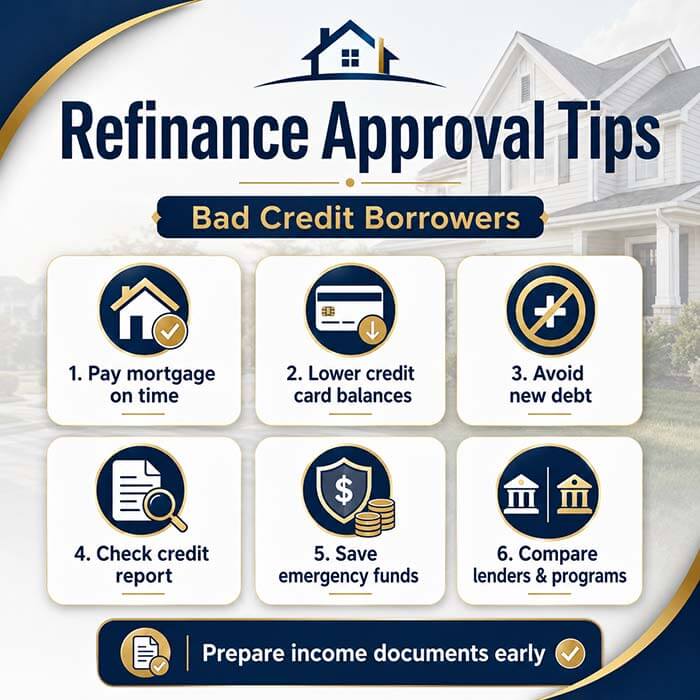
If you plan to apply for a refinance mortgage with bad credit, the following probably seems obvious, but:
- Always pay your mortgage on time.
- Reduction of revolving credit balances
- Do not establish new credit accounts.
- Do not take on new debt before closing.
- Check your report and credit history for mistakes.
- Start an emergency savings fund.
- Prepare your income documentation early.
- Look for different lenders.
- Always ask what refinance programs are available to you.
Reasons Homeowners Refinance
Monthly costs associated with home ownership can be reduced by refinancing. Refinancing can also remove private mortgage insurance, finance home improvements, consolidate debts, and cash out equity. Because of the seasonal nature of the real estate market, homeowners should partner with a responsive mortgage lender. A knowledgeable mortgage lender should be familiar with lending guidelines, and will help borrowers understand the best refinancing options available to them.
Impact of Using the Right Mortgage Lender
Refinancing options can vary by lender, and lender requirements can also vary. Some lenders will set their own credit score requirements or offer limited product lines. Conversely, some lenders will not apply strict credit score requirements. If one lender releases a loan, the second lender may place the loan with a different investor. Before giving up on finding the mortgage refinance solution that works for you, compare lenders.
Shop for Lenders if You Are Going to Refinance Mortgage Home Loan with Bad Credit and Low Credit Scores
Lenders have different criteria and may be more lenient or strict regarding credit scores. Shop around to find lenders who specialize in working with borrowers with lower credit scores. Remember that each financial situation is unique, and the success of refinancing with a low credit score can vary. It’s essential to carefully consider your options and consult financial professionals to make informed decisions.
If you’re refinancing a mortgage, consider government-backed loans like FHA (Federal Housing Administration) or VA (Veterans Affairs).
These programs may have more flexible requirements for credit scores. If possible, consider getting a co-signer with a higher credit score. A co-signer agrees to be responsible for the loan if you default, providing additional security for the lender.
Types of Lenders for Refinance with Bad Credit and Low Credit Scores
Subprime lenders specialize in working with borrowers with lower credit scores. However, be cautious with these lenders, as they may charge higher interest rates and fees.
If you’re refinancing a mortgage, offering a higher down payment may make you a more attractive candidate to lenders, potentially offsetting the impact of a lower credit score.
Some lenders may be willing to consider other aspects of your financial situation, such as income stability and employment history. Be prepared to provide additional documentation to support your application. With a lower credit score, you may be offered a higher interest rate. Be realistic about what you can afford and whether the refinancing terms are in your long-term financial interests.
Reasons why Homeowners Refinance Mortgage Home Loan with Bad Credit and Low Credit Scores
There are other reasons why homeowners need refinancing with low credit scores. They may need to take out a co-borrower. Homeowners going through a divorce often need to refinance to take the ex-spouse off the loan. This article will discuss refinancing with low and bad credit scores. The loan originator will review mortgage rates with borrowers with on their current credit scores. They will review mortgage rates and see if credit scores can be improved. Credit scores should be 740 or higher to get the best mortgage rates.
Consult with a Mortgage Consultant
Consulting with a licensed mortgage loan consultant does not cost a homeowner anything. If a mortgage lender asks for an upfront fee to run a credit report, go elsewhere.
If you’re refinancing a mortgage, having more equity in your home can be an advantage. Lenders may be more willing to work with borrowers with lower credit scores if they have substantial equity in their property.
A mortgage loan consultant should not charge anything upfront except for a home appraisal. A licensed mortgage loan originator will take a few minutes to run a credit. A professional loan originator will review the credit report and see if there is room to improve and increase credit scores.
Ways of Improving Credit Scores
There are some quick tips on maximizing credit scores easily and quickly. Just paying down your credit cards can quickly improve your credit scores. This works because if consumers have high credit card balances, the credit reporting agencies will lower their credit scores. Many of my refinance borrowers are asked to pay off their credit card balances. By paying down credit card balances to a 10% or less utilization ratio, they can get a 100-point boost in their credit scores.
How to Improve Credit Scores to Get Lower Mortgage Rates
Another way of improving credit scores is by adding more credit. For homeowners refinancing with low credit scores, they need to see the reason why they have low credit scores. Many homeowners may not have enough credit or no credit.
Some homeowners have closed out their active credit accounts, so they have no active tradelines. Having no credit, little credit, and no active tradelines will hurt consumer credit scores.
Adding new credit, such as opening several secured credit cards, can improve credit scores. Three to five secured credit cards with a $500 credit limit on each secured credit card are strongly recommended.
Errors on Credit Report
Homeowners seeking refinancing with low credit scores should carefully review their credit reports and see if there are any errors. Credit reporting agencies often report errors on consumers’ credit reports, which affect consumer credit scores. One derogatory error on one’s credit report can mean a major drop in credit score. A 30 to 40-point decrease in credit scores can mean a 0.25% difference in mortgage rates. This translates into tens of thousands of dollars worth of mortgage interest expense over the loan term.
Refinancing Costs Money
Homeowners with alternative financing can refinance with low credit scores and may save money. But with higher credit scores, it would have saved you more money. There are closing costs every time homeowners refinance a home loan. Many mortgage companies advertise that there are no closing costs.
There is no such thing. Borrowers may not have to pay any closing costs, but there are closing costs with every refinance mortgage loan.
Homeowners do not understand that the closing costs are built into the rate. When refinancing with low credit scores, weigh options and whether it makes sense to wait a few months to see if you can improve your credit and credit scores. This way, you can get the best available mortgage rates. Do not have to refinance home loans again at a later date after credit improves.
What to Consider When Refinancing a Mortgage with Bad Credit
Refinancing may still be an option if you have less-than-stellar credit. A variety of loan products are currently available for a diverse range of credit profiles, including FHA, VA, Conventional, USDA, Non-QM, and everything in between. In addition to credit, lenders are concerned with income, payment history, debt-to-income ratio, home equity, and the overall financial picture.
Before you refinance your loan, compare the loan programs, quantify the overall cost of the new loan, and consult a qualified mortgage professional to explain your options.
With the right lender and preparation, many homeowners achieve a successful refinance and a more advantageous financial position. Understanding your options, knowing the factors lenders consider, and choosing the right program can help you move forward with confidence.
Refinance Mortgage Home Loan with Bad Credit Frequently Asked Questions:
Can I Refinance with a 580 Credit Score?
A credit score of 580 is considered subprime; however, with sufficient equity, income, and lender guidelines, some individuals may qualify for FHA refinancing.
Does Refinancing Hurt My Credit Score?
Refinancing usually causes a temporary drop in your credit score due to a hard inquiry and the opening of a new loan account.
Should I Improve My Credit Score Before Refinancing?
Not necessarily. The benefits of refinancing to a significantly lower monthly payment may outweigh the benefits of waiting to refinance until your credit score improves.
Can I Refinance if My home is Underwater?
This is program-dependent. Many government refinancing options allow some flexibility, but most refinance loans require sufficient home equity.
How Long Does a Refinance Take?
Loan programs vary, and the appraisal and verification of documentation add to the time, but most refinance loans close in about 30 to 45 days.
Will Refinancing Eliminate Private Mortgage Insurance?
Refinancing may be an option. Conventional borrowers may be able to eliminate private mortgage insurance if they have sufficient home equity and refinance their loan.
Can Self-Employed Borrowers Refinance with Poor Credit?
Yes. Self-employed individuals may be able to refinance with traditional income documentation or, if the lender allows, Non-QM programs and bank statement loans.
Is it Beneficial to Apply with Multiple Mortgage Lenders?
Yes. There is a wide variety in mortgage programs, pricing, and lenders’ own underwriting and risk assessment standards. Applying with multiple lenders may improve your approval odds and allow for more advantageous loan terms.
Ready to Refinance With Bad Credit? Start Here
Complete a quick application or send your scenario. We’ll confirm your best refinance options and guide you step-by-step from review to closing.