How Derogatory Credit Affects Mortgage Approval
How derogatory credit affects mortgage approval can greatly affect your ability to get a home loan. While derogatory credit may make the approval process more challenging, it doesn’t necessarily disqualify you from obtaining a mortgage. Lenders carefully evaluate the nature of the credit issues, their severity, recency, and whether you’ve resumed making timely payments since those events. For instance, older collections, charge-offs, and late payments might have a smaller effect than more recent derogatory credit incidents. Additionally, major issues such as bankruptcy, foreclosure, and short sales can trigger waiting periods that vary by loan program.
For most borrowers, the biggest question is not whether bad credit appears on the report, but whether the credit problem is recent, part of a larger pattern, and whether the borrower now shows stable income, manageable debt, and a recent history of on-time payments.
In many cases, borrowers with past credit problems may still have mortgage options, especially if they meet the guidelines for FHA, VA, USDA, conventional, or certain non-QM loan programs. This guide explains what derogatory credit means, how lenders view different types of negative credit history, what waiting periods may apply after major credit events, and what steps can help strengthen your mortgage application. If you’re looking to buy a home after experiencing financial bumps like late payments, collections, charge-offs, bankruptcy, foreclosure, or a short sale, it’s good to know how lenders view these situations. This way, you can set realistic expectations and get ready more effectively.
Key Takeaway
Derogatory credit doesn’t necessarily prevent you from obtaining a mortgage. In many instances, lenders consider factors such as how recent the derogatory credit was, the severity of the issue, and whether you have demonstrated improved payment habits since then. Understanding how derogatory credit affects mortgage approval can help you address any potential concerns with lenders.
How Different Lenders May View Derogatory Credit and How It Affects Mortgage Approval
Not all lenders view derogatory credit in the same way, which significantly impacts how derogatory credit affects mortgage approval. While many loan programs adhere to basic guidelines, some lenders enforce their own stricter criteria. This variation is why one borrower might be denied by one lender while being approved by another.
Factors such as the specific loan program, the timing of the credit issues, and the overall strength of the borrower’s application play crucial roles.
For borrowers, it’s essential to recognize that adverse credit events—such as late payments, collections, charge-offs, bankruptcy, foreclosure, and short sales—are evaluated in a broader context when applying for a mortgage. Lenders evaluate the borrower’s entire profile, including income stability, debt-to-income ratio, cash reserves, down payment, and a history of timely payments. This comprehensive analysis often weighs heavily in the decision-making process, sometimes holding as much significance as the derogatory credit itself in determining mortgage approval.
How Derogatory Credit Affects Mortgage Approval: Types of Bad Credit
There are many different types of derogatory credit tradelines, each varying in severity when it comes to how derogatory credit affects mortgage approval. For instance, a 30-day late payment will have less impact on your credit score compared to a 90-day late payment. John Strange, a senior mortgage loan originator at Gustan Cho Associates, offers insights on how derogatory credit affects mortgage approval.
It sounds like common sense but it can be more difficult with more severe derogatory credit events such as a short sale compared to deed-in-lieu.
Borrowers can have derogatory credit tradelines that is older than 12 months. They do not have to pay outstanding collections or charge-off accounts that are older than 12 months old. However, it is best that borrowers do not have derogatory credit tradelines such as a late payment in the past 12 months. This guide provides general information for a typical borrower looking to qualify and secure approval with Gustan Cho Associates. It will not single out any specific client or individual. The content will cover various topics, including how derogatory credit affects mortgage approval, along with general information and case scenarios that are not tailored to any particular person or example.
How Recent Derogatory Credit Usually Matters Most
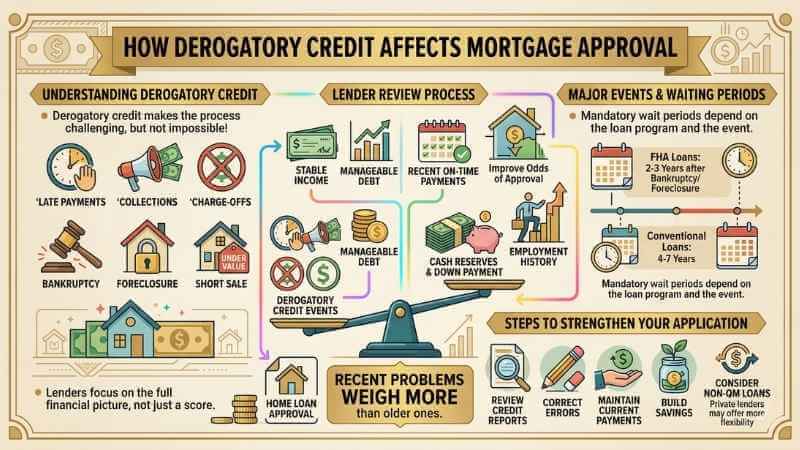
When lenders review derogatory credit, recent problems usually carry more weight than older ones. A late payment from several years ago may have less impact than a recent late payment, collection, charge-off, bankruptcy, foreclosure, or short sale. In general, the more serious and more recent the credit event, the more likely it is to affect mortgage approval, loan pricing, or waiting period requirements.
Major derogatory events can lower credit scores and may trigger mandatory waiting periods depending on the loan program. Smaller issues, such as older collections or isolated late payments, may be less damaging if the borrower has re-established timely payments and shows stable income, manageable debt, and overall financial improvement.
For most borrowers, the key question is not the exact number of points lost after a derogatory event. The more important question is whether the issue is recent, whether it shows an ongoing pattern, and whether the borrower has rebuilt strong credit habits since then.
How Bankruptcy Can Affect Mortgage Approval
A bankruptcy can significantly impact credit scores and the timing of mortgage approval. In addition to decreasing credit scores, it can also lead to a waiting period before a borrower qualifies for specific loan programs. This waiting period varies based on the type of bankruptcy, the loan program, and whether the borrower has successfully re-established credit and maintained timely payments post-filing. Understanding how derogatory credit affects mortgage approval is crucial, as it can prolong the path to homeownership for those who have experienced financial setbacks.
Each Consumer Has A Different Case Scenario
Once again, the information above is for informational purposes only and is not specific to your scenario. Your credit score may suffer more or less, but the information above will give you a nice baseline of what to expect. If you find yourself in a tough financial situation and are unable to pay your mortgage, we recommend reaching out to a real estate attorney as soon as possible. Each state handles these situations differently. It is important to have an expert on your side.
Non-QM Loans After Major Credit Events
Some borrowers who do not qualify for standard agency financing may explore non-QM loan options after a major credit event. These loans are offered by private lenders and may provide more flexibility for borrowers with recent credit challenges, depending on the lender and the overall file. While non-QM loans can provide options for those with derogatory credit, they are not just a simple shortcut around mortgage guidelines. These loans often come with higher interest rates, larger down payment requirements, reserve requirements, or other trade-offs. How derogatory credit affects mortgage approval can vary significantly from one lender to another, so borrowers should consider non-QM financing as a potential alternative path rather than viewing it as an automatic solution.
Turn Credit Challenges Into Mortgage Opportunities
Derogatory credit doesn’t always mean a denial — see how to improve your odds.
Common Types of Derogatory Marks
Here are the most frequent marks that could pop up on your credit report and hurt your mortgage chances:
- Late Payments: Missing a payment by 30 days or more is the most common strike against you and can sink your score quickly.
- Collections: If a bill hasn’t been paid and is turned over to a collection agency, it shows that you might not handle money well.
- Bankruptcies: Chapter 7 and Chapter 13 bankruptcy cases usually last 7 to 10 years, making every lender nervous.
- Foreclosures: If the bank repossesses your home, they’ll report it for seven years, and most lenders will think you’re a high-risk borrower.
- Charge-Offs: When a creditor gives up and marks the debt as a loss, it is labeled a charge-off on your report, and your credit score will take a hit.
- Short Sales: If you sell your home for less than you owe and the lender agrees, your report will show that you didn’t pay the loan in full, which can also lower your score.
Any of these negative marks can drop your credit score and make lenders think twice before giving you a mortgage.
How Bad Credit Affects Your Mortgage Application
Bad credit hits your mortgage chances in a few main ways. First, it brings down your credit score, and that score is one of the first things lenders look at. A lower score can knock you out of conventional loan options and shove you into pricier subprime loans. Second, lenders often raise the bar, asking for a bigger down payment or extra paperwork to feel safer about the risk. Finally, negative marks can shut you out of good loan programs, like VA and USDA, that have their own credit score rules. Fresh negative marks can hurt even more. If you had a bankruptcy or foreclosure in the last 2 to 3 years, you’ll likely have to sit on the sidelines a little longer before you can apply.
Lenders Keep “Waiting Periods” for Big Negative Events
- Bankruptcy: 2 to 4 years for FHA loans, 4 to 7 years for conventional loans.
- Foreclosure: 3 years for FHA loans, 7 years for conventional loans.
- Short Sale: 2 to 4 years, based on the loan type.
- These waiting times differ from lender to lender and by loan program, so it’s a good idea to check the exact rules that apply to you.
Steps to Enhance Your Credit Before Applying for a Mortgage
If you have derogatory credit on your report, there are still practical steps you can take before applying for a mortgage. It’s really important to review your credit reports carefully and watch for any mistakes or outdated information. Incorrect late payments, duplicate collection accounts, or accounts that should have been updated can unnecessarily hurt your score. Fixing reporting errors will not solve every credit issue, but it can help present a more accurate picture to lenders.
It is also important to focus on current payment habits. For most borrowers, recent on-time payments matter more than old credit problems that have already aged. Paying all bills on time, reducing credit card balances where possible, and avoiding new late payments can help stabilize your credit profile.
Even small improvements in payment history and debt levels can make a difference over time. Borrowers with collection accounts or charge-offs may also want to review whether any outstanding debts should be resolved before applying. In some cases, paying or settling certain accounts may help. In contrast, in other cases, it may not be required for mortgage qualification. Because this can vary by loan program and lender, borrowers should avoid making large payoff decisions without first understanding how those accounts will be treated during underwriting. If you have a major credit event in your history, such as bankruptcy, foreclosure, or short sale, it’s important to understand how derogatory credit affects mortgage approval. The best strategy may be to use the waiting period wisely by focusing on rebuilding your savings, maintaining steady employment, keeping your debt manageable, and demonstrating consistent on-time payments. These actions can strengthen your financial profile, not only helping raise your credit score but also showing lenders that the financial difficulties are behind you. Ultimately, this puts you in a more stable position to secure a mortgage.
How Lenders Review Derogatory Credit
Lenders do not make mortgage decisions based only on whether derogatory credit appears on a credit report. They also look at the full financial picture. That usually includes how recent the credit problem was, how serious it was, whether it happened once or occurred repeatedly, and whether the borrower has since rebuilt a history of on-time payments. Lenders also review income, employment stability, monthly debt, available savings, and the size of the down payment. One of the main numbers they consider is the debt-to-income ratio, also known as DTI. This is the share of a borrower’s monthly income that already goes toward debts such as credit cards, car loans, student loans, and housing payments.
A lower DTI usually makes it easier to qualify because it shows the borrower may have enough room in the budget for a mortgage payment.
In some cases, lenders may take a closer look at the full file instead of relying primarily on the credit score, particularly when evaluating how derogatory credit affects mortgage approval. This process, known as manual underwriting, involves the lender reviewing the borrower’s overall situation more thoroughly. They consider factors such as the reason for the credit issue, how long ago it occurred, and whether the borrower has demonstrated financial improvement since then. For example, a borrower who had a past medical collection but now has stable income, low debt, and strong recent payment history may be viewed differently from a borrower with ongoing missed payments and rising debt. That is why derogatory credit does not always lead to the same result for every borrower.
Mortgage Options May Still Be Available After Derogatory Credit
Having derogatory credit does not always mean a borrower has no mortgage options. In some cases, government-backed loans such as FHA or VA loans may still be possible if the borrower meets credit, income, and waiting period requirements. Conventional financing may also be available for some borrowers, especially when the derogatory event is older and the overall credit profile has improved. Some borrowers who do not meet standard agency guidelines may also explore non-QM loan options. These loans are usually meant for people with a tricky credit history or income, but they often come with higher interest rates, larger down payment requirements, or other trade-offs. Because of that, they should be viewed as an alternative path rather than a simple substitute for standard mortgage financing. The best loan option largely depends on how derogatory credit affects mortgage approval, including the type of derogatory credit, its recency, the borrower’s current credit profile, available cash to close, and overall financial stability. Therefore, borrowers should prioritize understanding their eligibility and timing instead of assuming that a single loan program will suit every situation.
Long-Term Effects of Derogatory Credit on Homeownership
Derogatory credit can haunt you beyond just not getting a loan. Higher interest rates won’t just hit your monthly budget; they increase the total loan cost. With a $300,000 mortgage, a simple 1% rate difference can add up to $10,000 or more over 30 years.
Also, if you start with bad credit, refinancing is not an option when rates drop later. You could be stuck with a higher-rate mortgage and no way to lower it.
The good news is that steady, on-time mortgage payments can help you crawl out of that credit hole. Credit bureaus track those payments, and slowly, your score can rise along with your financial reputation.
Final Thoughts About How Derogatory Credit Affects Mortgage Approval
Derogatory credit can make mortgage approval more challenging, but it does not always mean a borrower is out of options. What matters most is the type of credit issue, how recent it is, whether it reflects a larger pattern, and how much financial improvement has occurred since then. In many cases, borrowers with past late payments, collections, charge-offs, bankruptcy, foreclosure, or short sale may still qualify once they understand the timing, loan guidelines, and steps needed to strengthen their application. The most important takeaway is that lenders typically look beyond a credit score. They also review recent payment history, income stability, debt levels, cash reserves, and the overall strength of the file. That is why two borrowers with similar credit issues may have very different outcomes depending on the full financial picture. If you’re dealing with and want to learn how derogatory credit affects mortgage approval, it’s important to assess your situation thoroughly before submitting an application. Proper guidance can help you avoid unnecessary delays, focus on programs that align with your timeline, and take actionable steps to improve your chances of securing approval.
FAQs About How Derogatory Credit Affects Mortgage Approval
Can I Still Get a Mortgage With Derogatory Credit?
Yes, in many cases, you still may be able to qualify for a mortgage with derogatory credit. Approval usually depends on the type of derogatory item, how recent it is, whether it reflects a one-time event or a pattern, and whether you now show stable income, manageable debt, and recent on-time payments. Your credit report and score can totally make a difference in whether you get that loan or credit card you want and how much you’re going to pay for it.
What Counts as Derogatory Credit on a Mortgage Application?
Derogatory credit usually includes late payments, collection accounts, charge-offs, bankruptcies, foreclosures, deeds-in-lieu, and short sales. Fannie Mae treats major events such as bankruptcy, foreclosure, preforeclosure sale, deed-in-lieu, mortgage charge-off, and collection accounts as significant derogatory credit events in its risk assessment.
How Long Do Derogatory Marks Stay on My Credit Report?
Most negative credit information tied to payment history can generally stay on a credit report for up to seven years, while some bankruptcies may remain for up to 10 years. Even so, the impact of derogatory credit usually becomes less severe as it gets older, especially if you rebuild a strong recent payment history.
Do All Lenders Treat Derogatory Credit the Same Way?
No. Different lenders may evaluate derogatory credit differently, especially when they are reviewing the overall file. Freddie Mac’s current guide states that an explanation of adverse or derogatory credit is not required for Accept mortgages. However, lenders still assess the borrower’s full credit profile and overall risk. That is one reason one lender may say no, while another may still have a path forward.
Can I Buy a Home After Bankruptcy or Foreclosure?
Yes, but major derogatory events can trigger waiting periods. FHA states that a borrower generally must wait at least 2 years from the discharge date of a bankruptcy for standard eligibility, and Fannie Mae also applies waiting periods after significant derogatory credit events, such as bankruptcy and foreclosure. The exact timing depends on the loan program, underwriting findings, and whether any exceptions apply.
What Do Lenders Look at Besides Derogatory Credit?
Lenders do not look only at the derogatory mark itself. They also review the overall credit report, the severity and recency of delinquency, income, debt load, and whether the borrower has re-established strong payment habits. Fannie Mae specifically requires lenders to review prior mortgage delinquency for severity and recency, including whether there were serious delinquencies within the 12 months before the credit report date.
This article about “How Derogatory Credit Affects Mortgage Approval” was updated on April 2nd, 2026.